Recognition: 2 theorem links
· Lean TheoremQuantum Error Correction Exploiting Quantum Spatial Distribution and Gauge Symmetry
Pith reviewed 2026-05-13 06:10 UTC · model grok-4.3
The pith
Gauge symmetry in spin-position superpositions corrects a unified model of decoherence and dephasing noise.
A machine-rendered reading of the paper's core claim, the machinery that carries it, and where it could break.
Core claim
The gauge symmetry offers resilience against three types of noise acting on a particle: arbitrary decoherence of its spin or position state, and dephasing of both states, which partly or completely destroys its quantum spatial distribution. The authors formulate a noise model unifying these errors and prove that their error-correcting scheme, built from the 3+2 particle system on nested squares with gate operations acting exclusively on spin or position, correctly recovers the logical state. They further show that the same spatial arrangement supplies the architectural flexibility needed to implement stabilizer measurements, logical Hadamard and Toffoli gates, and a quantum adder using only,
What carries the argument
Gauge symmetry realized through the spin-state measurements of two auxiliary particles that detect errors in the Shor-encoded logical qubit formed by three particles on nested squares, with all operations acting separately on spin or position.
If this is right
- The unified noise model that includes both decoherence and dephasing is provably correctable within the stabilizer formalism.
- Error detection, logical Hadamard, logical Toffoli, and a quantum adder can be realized with interactions limited to nearest and next-nearest neighbors.
- The error-correcting blocks can be stacked both vertically and horizontally without changing the interaction graph.
- The same gauge-symmetry mechanism supplies protection against loss of the spatial superposition itself.
Where Pith is reading between the lines
- Hardware platforms that already control both spin and motional degrees of freedom, such as trapped ions or neutral atoms in optical lattices, could adopt this layout with minimal additional control lines.
- The vertical and horizontal stacking suggests a route to three-dimensional quantum error-correcting codes whose logical qubits occupy distinct spatial layers.
- Extending the construction to other stabilizer codes beyond Shor's nine-qubit code would test how generally the gauge symmetry protects the spatial superposition.
Load-bearing premise
Each particle evolves under gate operations that act exclusively on either its spin or its position, and the physical system realizes the gauge symmetry without extra uncontrolled couplings between those two degrees of freedom.
What would settle it
A simulation or experiment in which a small spin-position coupling is introduced and the logical error rate is observed to rise sharply above the threshold predicted for the unified noise model.
Figures



read the original abstract
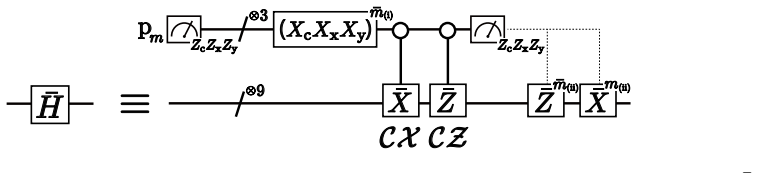
We explore what the integrated use of quantum spatial distribution (QSD), or more specifically, superposition of both spin and position states of particles, and gauge symmetry (GS) within stabilizer formalism provides for quantum error correction. The exploration employs $3+2$ particles on nested squares proposed in the companion letter (arXiv:2504.07941), where three of them encode Shor's nine-qubit code and the remaining two detect errors in this code through their spin state measurements (unlike the letter's quantum walk model, each particle evolves by gate operations acting exclusively on either its spin or position state). The first result is that the GS offers resilience against three types of noise acting on a particle: arbitrary decoherence of its spin or position state, and dephasing of both states, which partly or completely destroys its QSD. To show that, we formulate a noise model unifying the above noise and prove the correctability of this unified model under our error-correcting scheme. The second result is that QSD provides architectural flexibility allowing us to stack the error-correcting systems both vertically and horizontally. Indeed, we show implementations of the error detection (stabilizer measurement), logical Hadamard and Toffoli gates, and a quantum adder with the required interactions only between nearest-neighbor and next-nearest-neighbor particles.
Editorial analysis
A structured set of objections, weighed in public.
Referee Report
Summary. The manuscript proposes an error-correcting scheme that combines quantum spatial distribution (superpositions of spin and position states of particles) with gauge symmetry inside the stabilizer formalism. It employs a 3+2-particle layout on nested squares in which three particles realize Shor's nine-qubit code while the remaining two detect errors through spin-state measurements. The central claims are (i) that gauge symmetry renders the scheme resilient to a unified noise model encompassing arbitrary decoherence on spin or position separately plus dephasing that destroys the spatial superposition, with a proof of correctability supplied for this model, and (ii) that the spatial distribution permits vertical and horizontal stacking, enabling nearest- and next-nearest-neighbor implementations of stabilizer measurements, logical Hadamard, Toffoli, and a quantum adder.
Significance. If the correctability proof is completed and the separability assumption is rigorously justified, the work would supply a concrete route to fault-tolerant primitives that exploit an additional spatial degree of freedom, potentially lowering overhead through architectural stacking and nearest-neighbor connectivity. The explicit construction of logical gates under these constraints would be a useful addition to the stabilizer-code literature.
major comments (3)
- [Abstract and the section formulating the unified noise model] The abstract and introduction assert a proof that the unified noise model (arbitrary spin/position decoherence plus QSD-destroying dephasing) is correctable under the gauge-symmetric stabilizer code, yet the manuscript supplies neither the explicit stabilizer generators for the 3+2 layout nor the verification that the noise operators remain within the correctable set. Without these steps the central claim cannot be assessed.
- [Setup paragraph describing particle evolution and the weakest-assumption paragraph] The correctability argument rests on the assumption that each particle evolves exclusively via gates acting on spin or on position, with no uncontrolled spin-position couplings introduced by the physical realization of gauge symmetry. The manuscript states this separation but does not derive that the effective noise operators remain closed under the code when weak mixing terms are admitted; a counter-example or bound showing robustness would be required.
- [Introduction and the paragraph referencing the companion letter] The claim that the scheme is independent of the companion letter (arXiv:2504.07941) is undercut by the absence of self-contained stabilizer definitions and noise-channel closure proofs; the reader is forced to consult the companion for the basic code space, rendering the present contribution circular for the central result.
minor comments (2)
- [Setup section] Notation for the nested-square geometry and the labeling of the five particles should be introduced with a figure or explicit coordinate table before the stabilizer definitions are used.
- [Error-detection paragraph] The statement that the two auxiliary particles 'detect errors through their spin state measurements' should be expanded to show the explicit measurement operators and how they commute with the gauge symmetry.
Simulated Author's Rebuttal
We thank the referee for the careful and constructive review. We address each major comment below, indicating where revisions will strengthen the manuscript by adding explicit details and improving self-containment while preserving the core contributions on the unified noise model and architectural flexibility.
read point-by-point responses
-
Referee: [Abstract and the section formulating the unified noise model] The abstract and introduction assert a proof that the unified noise model (arbitrary spin/position decoherence plus QSD-destroying dephasing) is correctable under the gauge-symmetric stabilizer code, yet the manuscript supplies neither the explicit stabilizer generators for the 3+2 layout nor the verification that the noise operators remain within the correctable set. Without these steps the central claim cannot be assessed.
Authors: We agree that the explicit stabilizer generators and step-by-step verification of noise-operator correctability should be more prominently displayed. In the revised manuscript we will insert a dedicated subsection that lists the stabilizer generators for the 3+2-particle layout on nested squares and then verifies, operator by operator, that every element of the unified noise model either commutes with the stabilizers or is detected by the two auxiliary particles. This will render the correctability proof fully explicit and self-contained. revision: yes
-
Referee: [Setup paragraph describing particle evolution and the weakest-assumption paragraph] The correctability argument rests on the assumption that each particle evolves exclusively via gates acting on spin or on position, with no uncontrolled spin-position couplings introduced by the physical realization of gauge symmetry. The manuscript states this separation but does not derive that the effective noise operators remain closed under the code when weak mixing terms are admitted; a counter-example or bound showing robustness would be required.
Authors: The separation of spin and position evolution is stated as the operating assumption of the physical model. We acknowledge that a quantitative treatment of weak spin-position mixing is missing. The revision will add a short robustness paragraph that (i) assumes perturbative mixing and (ii) supplies a first-order bound showing that the resulting cross terms remain detectable by the existing error-detection particles, thereby keeping the noise inside the correctable set under the stated physical conditions. revision: yes
-
Referee: [Introduction and the paragraph referencing the companion letter] The claim that the scheme is independent of the companion letter (arXiv:2504.07941) is undercut by the absence of self-contained stabilizer definitions and noise-channel closure proofs; the reader is forced to consult the companion for the basic code space, rendering the present contribution circular for the central result.
Authors: We intended the present work to be independent in its treatment of the unified noise model and the gate constructions, yet we recognize that the stabilizer definitions and code-space description were only referenced. To eliminate any circularity, the revised version will include the stabilizer generators, the code-space definition, and a concise recap of the noise-channel closure argument directly in the main text (or a short appendix). Readers will then be able to evaluate the central claims without consulting the companion letter. revision: yes
Circularity Check
No significant circularity; unified noise model and correctability proof are independent
full rationale
The paper formulates a new unified noise model for three noise types (arbitrary spin/position decoherence plus QSD-destroying dephasing) and proves its correctability under the stabilizer scheme. The 3+2 nested-square layout is referenced from the companion letter, but the noise unification, model formulation, and proof are presented as original without any equation reducing the claimed resilience to a fitted parameter, self-definition, or load-bearing self-citation chain. The separability assumption (gates acting exclusively on spin or position with no uncontrolled couplings) is stated explicitly as a physical precondition rather than derived from the results themselves. The derivation chain is therefore self-contained against external benchmarks.
Axiom & Free-Parameter Ledger
axioms (2)
- standard math Stabilizer formalism for quantum error correction
- domain assumption Gate operations act exclusively on either spin or position state of each particle
Lean theorems connected to this paper
-
IndisputableMonolith/Cost/FunctionalEquation.leanwashburn_uniqueness_aczel unclear?
unclearRelation between the paper passage and the cited Recognition theorem.
We formulate a noise model unifying the above noise and prove the correctability of this unified model under our error-correcting scheme.
-
IndisputableMonolith/Foundation/AbsoluteFloorClosure.leanabsolute_floor_iff_bare_distinguishability unclear?
unclearRelation between the paper passage and the cited Recognition theorem.
the GS offers resilience against three types of noise... dephasing of both states, which partly or completely destroys its QSD
What do these tags mean?
- matches
- The paper's claim is directly supported by a theorem in the formal canon.
- supports
- The theorem supports part of the paper's argument, but the paper may add assumptions or extra steps.
- extends
- The paper goes beyond the formal theorem; the theorem is a base layer rather than the whole result.
- uses
- The paper appears to rely on the theorem as machinery.
- contradicts
- The paper's claim conflicts with a theorem or certificate in the canon.
- unclear
- Pith found a possible connection, but the passage is too broad, indirect, or ambiguous to say the theorem truly supports the claim.
Reference graph
Works this paper leans on
-
[1]
The feynman lectures on physics; vol
Richard P Feynman, Robert B Leighton, and Matthew Sands. The feynman lectures on physics; vol. iii.Addison-Wesley, Reading, Mass. 22
-
[2]
Single-and double-slit diffraction of neutrons.Reviews of modern physics, 60(4):1067, 1988
Anton Zeilinger, Roland G¨ ahler, CG Shull, Wolfgang Treimer, and Walter Mampe. Single-and double-slit diffraction of neutrons.Reviews of modern physics, 60(4):1067, 1988
work page 1988
-
[3]
Olivier Carnal and J¨ urgen Mlynek. Young’s double-slit experiment with atoms: A simple atom interferometer.Physical review letters, 66(21):2689, 1991
work page 1991
-
[4]
Demonstration of single-electron buildup of an interference pattern.Am
Akira Tonomura, Jun Endo, Toshiaki Matsuda, Takeshi Kawasaki, and Hirohiko Ezawa. Demonstration of single-electron buildup of an interference pattern.Am. J. Phys, 57(2): 117–120, 1989
work page 1989
-
[5]
Electrical control of a solid-state flying qubit.Nature Nanotechnology, 7(4):247–251, 2012
Michihisa Yamamoto, Shintaro Takada, Christopher B¨ auerle, Kenta Watanabe, An- dreas D Wieck, and Seigo Tarucha. Electrical control of a solid-state flying qubit.Nature Nanotechnology, 7(4):247–251, 2012
work page 2012
-
[6]
Tobias Bautze, Christoph S¨ ussmeier, Shintaro Takada, Christoph Groth, Tristan Me- unier, Michihisa Yamamoto, Seigo Tarucha, Xavier Waintal, and Christopher B¨ auerle. Theoretical, numerical, and experimental study of a flying qubit electronic interferome- ter.Physical Review B, 89(12):125432, 2014
work page 2014
-
[7]
Christopher B¨ auerle, D Christian Glattli, Tristan Meunier, Fabien Portier, Patrice Roche, Preden Roulleau, Shintaro Takada, and Xavier Waintal. Coherent control of single electrons: a review of current progress.Reports on Progress in Physics, 81(5): 056503, 2018
work page 2018
-
[8]
Macroscopic electron quantum coherence in a solid-state circuit.Physical Review X, 9(2):021030, 2019
H Duprez, E Sivre, A Anthore, A Aassime, A Cavanna, A Ouerghi, U Gennser, and F Pierre. Macroscopic electron quantum coherence in a solid-state circuit.Physical Review X, 9(2):021030, 2019
work page 2019
-
[9]
Shintaro Takada, Hermann Edlbauer, Hugo V Lepage, Junliang Wang, Pierre-Andr´ e Mortemousque, Giorgos Georgiou, Crispin HW Barnes, Christopher JB Ford, Mingyun Yuan, Paulo V Santos, et al. Sound-driven single-electron transfer in a circuit of coupled quantum rails.Nature communications, 10(1):4557, 2019
work page 2019
-
[10]
Hermann Edlbauer, Junliang Wang, Thierry Crozes, Pierre Perrier, Seddik Ouacel, Cl´ ement Geffroy, Giorgos Georgiou, Eleni Chatzikyriakou, Antonio Lacerda-Santos, Xavier Waintal, et al. Semiconductor-based electron flying qubits: review on recent progress accelerated by numerical modelling.EPJ Quantum Technology, 9(1):21, 2022
work page 2022
-
[11]
Junliang Wang, Hermann Edlbauer, Aymeric Richard, Shunsuke Ota, Wanki Park, Jeongmin Shim, Arne Ludwig, Andreas D Wieck, Heung-Sun Sim, Matias Urdampil- leta, et al. Coulomb-mediated antibunching of an electron pair surfing on sound.Nature Nanotechnology, 18(7):721–726, 2023
work page 2023
-
[12]
Time-resolved coulomb collision of single electrons.Nature Nanotechnology, 18(7):727–732, 2023
Jonathan D Fletcher, Wanki Park, Sungguen Ryu, Penelope See, JP Griffiths, GAC Jones, I Farrer, DA Ritchie, H-S Sim, and Misao Kataoka. Time-resolved coulomb collision of single electrons.Nature Nanotechnology, 18(7):727–732, 2023
work page 2023
-
[13]
Niels Ubbelohde, Lars Freise, Elina Pavlovska, Peter G Silvestrov, Patrik Recher, Mar- tins Kokainis, Girts Barinovs, Frank Hohls, Thomas Weimann, Klaus Pierz, et al. Two 23 electrons interacting at a mesoscopic beam splitter.Nature Nanotechnology, 18(7):733– 740, 2023
work page 2023
-
[14]
Electronic interferometry with ultrashort plasmonic pulses.Nature Communications, 16 (1):4632, 2025
Seddik Ouacel, Lucas Mazzella, Thomas Kloss, Matteo Aluffi, Thomas Vasselon, Her- mann Edlbauer, Junliang Wang, Cl´ ement Geffroy, Jashwanth Shaju, Arne Ludwig, et al. Electronic interferometry with ultrashort plasmonic pulses.Nature Communications, 16 (1):4632, 2025
work page 2025
-
[15]
Optical simulation of quantum logic.Physical Review A, 57(3):R1477, 1998
Nicolas J Cerf, Christoph Adami, and Paul G Kwiat. Optical simulation of quantum logic.Physical Review A, 57(3):R1477, 1998
work page 1998
-
[16]
Quantum random access mem- ory.Physical review letters, 100(16):160501, 2008
Vittorio Giovannetti, Seth Lloyd, and Lorenzo Maccone. Quantum random access mem- ory.Physical review letters, 100(16):160501, 2008
work page 2008
-
[17]
Architectures for a quantum random access memory.Physical Review A, 78(5):052310, 2008
Vittorio Giovannetti, Seth Lloyd, and Lorenzo Maccone. Architectures for a quantum random access memory.Physical Review A, 78(5):052310, 2008
work page 2008
-
[18]
Connor T Hann, Chang-Ling Zou, Yaxing Zhang, Yiwen Chu, Robert J Schoelkopf, Steven M Girvin, and Liang Jiang. Hardware-efficient quantum random access memory with hybrid quantum acoustic systems.Physical Review Letters, 123(25):250501, 2019
work page 2019
-
[19]
Scalable and high-fidelity quantum random access memory in spin-photon networks
Kevin C Chen, Wenhan Dai, Carlos Errando-Herranz, Seth Lloyd, and Dirk Englund. Scalable and high-fidelity quantum random access memory in spin-photon networks. PRX Quantum, 2(3):030319, 2021
work page 2021
-
[20]
Zhaoyou Wang, Hong Qiao, Andrew N Cleland, and Liang Jiang. Quantum random access memory with transmon-controlled phonon routing.Physical Review Letters, 134 (21):210601, 2025
work page 2025
-
[21]
Shivani Singh, Prateek Chawla, Anupam Sarkar, and CM Chandrashekar. Universal quantum computing using single-particle discrete-time quantum walk.Scientific Reports, 11(1):11551, 2021
work page 2021
-
[22]
Prateek Chawla, Shivani Singh, Aman Agarwal, Sarvesh Srinivasan, and CM Chan- drashekar. Multi-qubit quantum computing using discrete-time quantum walks on closed graphs.Scientific Reports, 13(1):12078, 2023
work page 2023
-
[23]
Ryo Asaka and Ryusei Minamikawa. Quantum error correction via multi-particle discrete-time quantum walk.arXiv preprint arXiv:2504.07941, 2025
-
[24]
Quantum random access memory via quantum walk.Quantum Science and Technology, 6(3):035004, 2021
Ryo Asaka, Kazumitsu Sakai, and Ryoko Yahagi. Quantum random access memory via quantum walk.Quantum Science and Technology, 6(3):035004, 2021
work page 2021
-
[26]
A resource-efficient quantum-walker Quantum RAM
Giuseppe De Riso, Giuseppe Catalano, Seth Lloyd, Vittorio Giovannetti, and Dario De Santis. A resource-efficient quantum-walker quantum ram.arXiv preprint arXiv:2508.02855, 2025. 24
work page internal anchor Pith review Pith/arXiv arXiv 2025
-
[27]
Universal computation by quantum walk.Physical review letters, 102 (18):180501, 2009
Andrew M Childs. Universal computation by quantum walk.Physical review letters, 102 (18):180501, 2009
work page 2009
-
[28]
Universal computation by multiparticle quantum walk.Science, 339(6121):791–794, 2013
Andrew M Childs, David Gosset, and Zak Webb. Universal computation by multiparticle quantum walk.Science, 339(6121):791–794, 2013
work page 2013
-
[29]
Ning Bao, Patrick Hayden, Grant Salton, and Nathaniel Thomas. Universal quantum computation by scattering in the fermi–hubbard model.New Journal of Physics, 17(9): 093028, 2015
work page 2015
-
[30]
Two-level quantum walkers on directed graphs
Ryo Asaka, Kazumitsu Sakai, and Ryoko Yahagi. Two-level quantum walkers on directed graphs. ii. application to quantum random access memory.Physical Review A, 107(2): 022416, 2023
work page 2023
-
[31]
Daniel Gottesman. Class of quantum error-correcting codes saturating the quantum hamming bound.Physical Review A, 54(3):1862, 1996
work page 1996
-
[32]
California Institute of Technology, 1997
Daniel Gottesman.Stabilizer codes and quantum error correction. California Institute of Technology, 1997
work page 1997
-
[33]
David Poulin. Stabilizer formalism for operator quantum error correction.Physical review letters, 95(23):230504, 2005
work page 2005
-
[34]
David Kribs, Raymond Laflamme, and David Poulin. Unified and generalized approach to quantum error correction.Physical review letters, 94(18):180501, 2005
work page 2005
-
[35]
Scheme for reducing decoherence in quantum computer memory.Physical review A, 52(4):R2493, 1995
Peter W Shor. Scheme for reducing decoherence in quantum computer memory.Physical review A, 52(4):R2493, 1995
work page 1995
-
[36]
Yaoyun Shi. Both toffoli and controlled-not need little help to do universal quantum computation.arXiv preprint quant-ph/0205115, 2002
-
[37]
A simple proof that toffoli and hadamard are quantum universal.arXiv preprint quant-ph/0301040, 2003
Dorit Aharonov. A simple proof that toffoli and hadamard are quantum universal.arXiv preprint quant-ph/0301040, 2003
-
[38]
Theory of quantum error cor- rection for general noise.Physical Review Letters, 84(11):2525, 2000
Emanuel Knill, Raymond Laflamme, and Lorenza Viola. Theory of quantum error cor- rection for general noise.Physical Review Letters, 84(11):2525, 2000
work page 2000
-
[39]
Stabilizing quantum information.Physical Review A, 63(1):012301, 2000
Paolo Zanardi. Stabilizing quantum information.Physical Review A, 63(1):012301, 2000
work page 2000
-
[40]
Lu-Ming Duan and Guang-Can Guo. Preserving coherence in quantum computation by pairing quantum bits.Physical Review Letters, 79(10):1953, 1997
work page 1953
-
[41]
Lu-Ming Duan and Guang-Can Guo. Reducing decoherence in quantum-computer mem- ory with all quantum bits coupling to the same environment.Physical Review A, 57(2): 737, 1998
work page 1998
-
[42]
Error avoiding quantum codes.Modern Physics Letters B, 11(25):1085–1093, 1997
Paolo Zanardi and Mario Rasetti. Error avoiding quantum codes.Modern Physics Letters B, 11(25):1085–1093, 1997. doi: 10.1142/S0217984997001304
-
[43]
Decoherence free subspaces for quantum computation.arXiv preprint quant-ph/9807004, 1998
Daniel A Lidar, Isaac L Chuang, and K Birgitta Whaley. Decoherence free subspaces for quantum computation.arXiv preprint quant-ph/9807004, 1998. 25
-
[44]
Using parity kicks for decoherence control.Physical Review A, 59(6):4178, 1999
David Vitali and Paolo Tombesi. Using parity kicks for decoherence control.Physical Review A, 59(6):4178, 1999
work page 1999
-
[45]
Lorenza Viola and Seth Lloyd. Dynamical suppression of decoherence in two-state quan- tum systems.Physical Review A, 58(4):2733, 1998
work page 1998
-
[46]
Julia Kempe, Dave Bacon, Daniel A Lidar, and K Birgitta Whaley. Theory of decoherence-free fault-tolerant universal quantum computation.Physical Review A, 63 (4):042307, 2001
work page 2001
-
[47]
Fault- tolerant control of an error-corrected qubit.Nature, 598(7880):281–286, 2021
Laird Egan, Dripto M Debroy, Crystal Noel, Andrew Risinger, Daiwei Zhu, Debopriyo Biswas, Michael Newman, Muyuan Li, Kenneth R Brown, Marko Cetina, et al. Fault- tolerant control of an error-corrected qubit.Nature, 598(7880):281–286, 2021
work page 2021
-
[48]
Dave Bacon. Operator quantum error-correcting subsystems for self-correcting quantum memories.Physical Review A—Atomic, Molecular, and Optical Physics, 73(1):012340, 2006
work page 2006
-
[49]
Subsystem fault tolerance with the bacon-shor code.Physical review letters, 98(22):220502, 2007
Panos Aliferis and Andrew W Cross. Subsystem fault tolerance with the bacon-shor code.Physical review letters, 98(22):220502, 2007
work page 2007
-
[50]
Quantum computing with realistically noisy devices.Nature, 434(7029): 39–44, 2005
Emanuel Knill. Quantum computing with realistically noisy devices.Nature, 434(7029): 39–44, 2005
work page 2005
-
[51]
Michael A Nielsen and David Poulin. Algebraic and information-theoretic conditions for operator quantum error correction.Physical Review A—Atomic, Molecular, and Optical Physics, 75(6):064304, 2007
work page 2007
-
[52]
Cambridge university press, 2010
Michael A Nielsen and Isaac L Chuang.Quantum computation and quantum information. Cambridge university press, 2010
work page 2010
-
[53]
Himanshu Thapliyal and Nagarajan Ranganathan. Design of efficient reversible logic- based binary and bcd adder circuits.ACM Journal on Emerging Technologies in Com- puting Systems (JETC), 9(3):1–31, 2013
work page 2013
-
[54]
Mapping of subtractor and adder-subtractor circuits on re- versible quantum gates
Himanshu Thapliyal. Mapping of subtractor and adder-subtractor circuits on re- versible quantum gates. InTransactions on Computational Science XXVII, pages 10–34. Springer, 2016
work page 2016
-
[55]
Quantum circuit for the fast fourier transform.Quantum Information Processing, 19:1–20, 2020
Ryo Asaka, Kazumitsu Sakai, and Ryoko Yahagi. Quantum circuit for the fast fourier transform.Quantum Information Processing, 19:1–20, 2020. 26
work page 2020
discussion (0)
Sign in with ORCID, Apple, or X to comment. Anyone can read and Pith papers without signing in.