Recognition: unknown
Sub-keV energy calibration of CONUS+ via 71Ge M-shell neutron activation
Pith reviewed 2026-05-07 13:59 UTC · model grok-4.3
The pith
Resolving the 71Ge M-shell X-ray line at 158.7 eVee validates CONUS+ energy reconstruction to the detection threshold.
A machine-rendered reading of the paper's core claim, the machinery that carries it, and where it could break.
Core claim
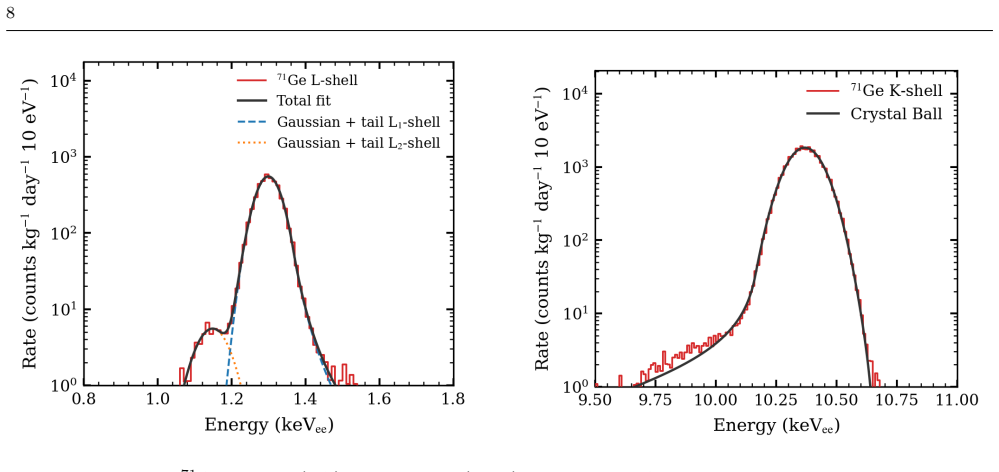
A dedicated neutron activation of one CONUS+ germanium detector with an AmBe source produces 71Ge nuclei whose M-shell X-rays appear as a distinct peak at 158.7 ± 1.4 eVee. This observation validates the complete energy reconstruction chain, including scale, resolution, trigger efficiency, and separation of physical events from noise, down to the detector threshold.
What carries the argument
The 71Ge M-shell X-ray line at approximately 160 eV, generated via neutron capture on germanium and subsequent electron capture decay, serving as an in-situ low-energy calibration standard.
If this is right
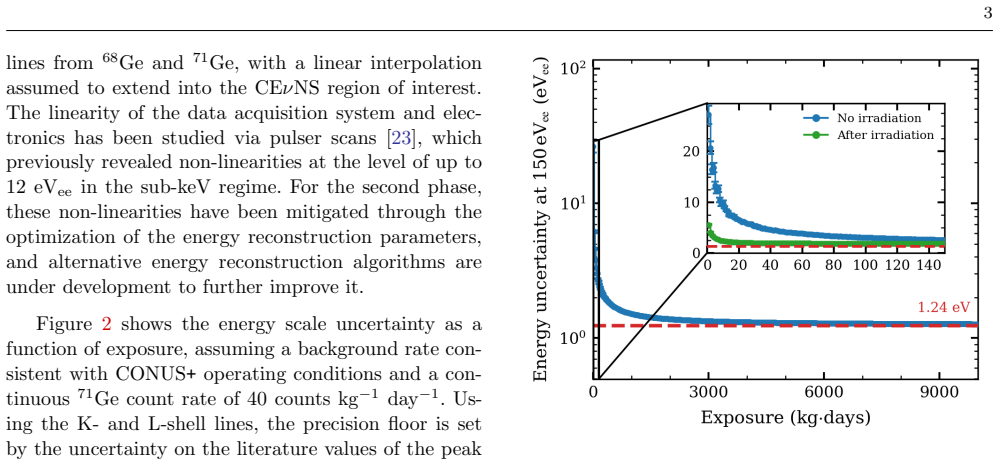
- The uncertainty from energy scale in CEvNS signal prediction drops below 4%.
- Energy calibration is now understood including trigger efficiency and noise rejection.
- Prepares for an activation campaign at the reactor site itself.
- Opens the way to higher-precision CEvNS measurements and beyond-Standard-Model searches.
Where Pith is reading between the lines
- Similar activation techniques could be applied to other low-threshold germanium detectors for sub-keV calibration.
- If the peak position matches the known atomic transition energy, it confirms no significant bias in the ionization yield model at these energies.
- Extending this method might allow real-time monitoring of detector response during data taking.
Load-bearing premise
The observed peak must arise solely from 71Ge M-shell X-rays without meaningful contamination from other sources or artifacts.
What would settle it
A measurement showing the peak position inconsistent with the expected 158-160 eVee value, or failure to resolve it distinctly from background, would indicate the calibration is not validated.
Figures





read the original abstract
The CONUS+ experiment has recently reported the first detection of coherent elastic neutrino-nucleus scattering (CEvNS) of reactor antineutrinos on germanium nuclei and is now entering a precision phase. The dominant uncertainty in the first measurement was the energy scale, which contributed 14% to the uncertainty of the prediction of the combined signal. We present a dedicated neutron activation campaign in which one of the new 2.4 kg CONUS+ germanium detectors was irradiated with a strong 241AmBe source, demonstrating that a contribution below 4% to the uncertainty of signal prediction is achievable. For the first time, the 71Ge M-shell X-ray line was clearly resolved at (158.7+-1.4) eVee, validating the CONUS+ energy reconstruction down to the detection threshold. This validation includes the understanding of the energy scale, the energy resolution, the trigger efficiency, and the correct separation of physical from noise events. These results establish the foundation for a future activation campaign at the Kernkraftwerk Leibstadt reactor site, strengthening the CONUS+ energy calibration and extending its sensitivity to precision CEvNS and beyond Standard Model physics measurements.
Editorial analysis
A structured set of objections, weighed in public.
Referee Report
Summary. The manuscript reports a neutron activation campaign in which a CONUS+ germanium detector was irradiated with a 241AmBe source. It claims the first clear resolution of the 71Ge M-shell X-ray line at (158.7 ± 1.4) eVee, which is used to validate the energy scale, energy resolution, trigger efficiency, and separation of physical from noise events down to the detection threshold. The work aims to reduce the dominant energy-scale uncertainty in the CEvNS signal prediction from 14% to below 4%, establishing the basis for a future in-situ activation campaign at the reactor site.
Significance. If the peak is shown to be free of significant contamination, the result would provide a valuable sub-keV calibration anchor for germanium detectors in neutrino experiments. The internal activation method supplies a known nuclear line directly in the region of interest, addressing a key systematic for precision CEvNS and BSM searches. The reported position and uncertainty are consistent with expectations and would strengthen the experimental foundation for the CONUS+ precision phase.
major comments (1)
- The central validation claim—that the energy reconstruction, resolution, trigger efficiency, and noise rejection are validated down to threshold—requires that the observed peak at 158.7 eVee arises solely from 71Ge M-shell X-rays. Neutron activation of natural germanium produces multiple EC-decaying isotopes (69Ge, 75Ge, 77Ge) whose L/M X-rays and Auger electrons fall in the same 100–200 eVee window. The manuscript supplies no background model, multi-component fit, or time-decay confirmation isolating the 11.4-day 71Ge component, leaving open the possibility that contamination biases the fitted centroid and efficiency extraction.
Simulated Author's Rebuttal
We thank the referee for their thorough review and for highlighting the importance of rigorously isolating the 71Ge M-shell contribution. We address the major comment below and propose revisions to strengthen the validation.
read point-by-point responses
-
Referee: The central validation claim—that the energy reconstruction, resolution, trigger efficiency, and noise rejection are validated down to threshold—requires that the observed peak at 158.7 eVee arises solely from 71Ge M-shell X-rays. Neutron activation of natural germanium produces multiple EC-decaying isotopes (69Ge, 75Ge, 77Ge) whose L/M X-rays and Auger electrons fall in the same 100–200 eVee window. The manuscript supplies no background model, multi-component fit, or time-decay confirmation isolating the 11.4-day 71Ge component, leaving open the possibility that contamination biases the fitted centroid and efficiency extraction.
Authors: We agree that explicit isolation of the 71Ge component is essential to support the central validation claims. The manuscript presents the observed peak at the literature value for the 71Ge M-shell X-ray with a fitted position and width consistent with expectations, but does not include a quantitative background model or time-dependent analysis of competing isotopes. To address this, we will revise the paper to add: (i) calculated production rates and half-lives for 69Ge, 75Ge and 77Ge under the irradiation conditions, (ii) an estimate of residual activity after the post-irradiation cooling period, and (iii) a multi-component fit (or upper-limit assessment) to the low-energy spectrum demonstrating that contamination in the 158.7 eVee region is negligible. These additions will confirm that the extracted energy scale, resolution, trigger efficiency and noise rejection are not biased. The main result and conclusions remain unchanged. revision: yes
Circularity Check
No circularity: direct experimental measurement of known nuclear line
full rationale
The paper presents an experimental neutron-activation measurement on a CONUS+ Ge detector using a 241AmBe source. The central result is the observed position of a peak at (158.7 ± 1.4) eVee, which is identified as the 71Ge M-shell X-ray line on the basis of external nuclear data and decay timing. This identification is used to validate the detector's energy scale, resolution, trigger efficiency, and noise rejection down to threshold. No derivation chain, fitted parameter, or self-citation is invoked to generate the reported centroid or efficiency; the measurement is compared against independent nuclear tables. The paper therefore contains no self-definitional, fitted-input-called-prediction, or self-citation-load-bearing steps.
Axiom & Free-Parameter Ledger
axioms (1)
- standard math The M-shell X-ray energy of 71Ge is known from prior nuclear data and can be used as an absolute calibration reference.
Reference graph
Works this paper leans on
-
[1]
M. Lindner, T. Rink and M. Sen.Light vector bosons and the weak mixing angle in the light of future germanium- based reactor CEνNS experiments. JHEP,08:171, 2024. doi:10.1007/JHEP08(2024)171. arXiv:2401.13025
-
[2]
S. Centelles Chuli´ a, M. Lindner and T. Rink.Test- ing lepton non-unitarity with the next generation of (Germanium-based) CEνNS reactor experiments. 2025. arXiv:2512.09027
-
[3]
A. A. Aguilar-Arevalo et al.Searches for CEνNS and Physics beyond the Standard Model using Skipper-CCDs at CONNIE. 2024. arXiv:2403.15976
work page internal anchor Pith review Pith/arXiv arXiv 2024
-
[4]
Mondal et al.CEνNS Search with Cryogenic Sapphire Detectors at MINER: Results from the TRIGA reactor data and Future Sensitivity at HFIR
D. Mondal et al.CEνNS Search with Cryogenic Sapphire Detectors at MINER: Results from the TRIGA reactor data and Future Sensitivity at HFIR. 2025. arXiv:2510. 15999
2025
-
[5]
J. Colaresi, J. I. Collar, T. W. Hossbach, C. M. Lewis and K. M. Yocum.Measurement of Coherent Elas- tic Neutrino-Nucleus Scattering from Reactor Antineu- trinos. Phys. Rev. Lett.,129(21):211802, 2022. doi: 10.1103/PhysRevLett.129.211802. arXiv:2202.09672
-
[6]
J. J. Choi et al.Exploring coherent elastic neutrino- nucleus scattering using reactor electron antineutrinos in the NEON experiment. Eur. Phys. J. C,83(3):226, 2023. doi:10.1140/epjc/s10052-023-11352-x. arXiv:2204.06318
-
[7]
H. Abele et al.Prospect of the NUCLEUS Experiment at Chooz for Coherent Elastic Neutrino-Nucleus Scattering and New Physics Searches. 2026. arXiv:2603.24450
-
[8]
Effects of the formation time of parton shower on jet quenching in heavy-ion collisions.Chin
V. Belov et al.New constraints on coherent elastic neu- trino–nucleus scattering by theνGeN experiment*. Chin. Phys. C,49(5):053004, 2025. doi:10.1088/1674-1137/ adb9c8. arXiv:2502.18502
-
[9]
N. Ackermann et al.Final CONUS Results on Coher- ent Elastic Neutrino-Nucleus Scattering at the Brokdorf Reactor. Phys. Rev. Lett.,133(25):251802, 2024. doi: 10.1103/PhysRevLett.133.251802. arXiv:2401.07684
- [10]
-
[11]
Bailly-Salins.Status of the RICOCHET experiment at the ILL
L. Bailly-Salins.Status of the RICOCHET experiment at the ILL. PoS,EPS-HEP2025:150, 2026. doi:10.22323/ 1.485.0150
2026
-
[12]
L. Yang, Y. Liang and Q. Yue.RECODE program for reactor neutrino CEvNS detection with PPC Germanium detector. PoS,T AUP2023:296, 2024. doi:10.22323/1. 441.0296
work page doi:10.22323/1 2024
-
[13]
Cai et al.Reactor neutrino liquid xenon coherent elas- tic scattering experiment
C. Cai et al.Reactor neutrino liquid xenon coherent elas- tic scattering experiment. Phys. Rev. D,110(7):072011,
-
[14]
doi:10.1103/PhysRevD.110.072011. arXiv:2405. 05554
-
[15]
S. Karmakar et al.New Limits on Coherent Neu- trino Nucleus Elastic Scattering Cross Section at the Kuo-Sheng Reactor Neutrino Laboratory. 2024. arXiv: 2411.18812
-
[16]
D. Z. Freedman.Coherent Neutrino Nucleus Scattering as a Probe of the Weak Neutral Current. Phys. Rev. D, 9:1389–1392, 1974. doi:10.1103/PhysRevD.9.1389
-
[17]
V. B. Kopeliovich and L. L. Frankfurt.Isotopic and chiral structure of neutral current. JETP Lett.,19:145–147, 1974
1974
-
[18]
Akimov et al.Observation of Coherent Elastic Neutrino-Nucleus Scattering
D. Akimov et al.Observation of Coherent Elastic Neutrino-Nucleus Scattering. Science,357(6356):1123– 1126, 2017. doi:10.1126/science.aao0990. arXiv:1708. 01294
-
[19]
D. Akimov et al.First Measurement of Coherent Elas- tic Neutrino-Nucleus Scattering on Argon. Phys. Rev. Lett.,126(1):012002, 2021. doi:10.1103/PhysRevLett. 126.012002. arXiv:2003.10630
-
[20]
Adhikari et al.Measurement of coherent elastic neu- trino nucleus scattering on germanium by COHERENT
M. Adhikari et al.Measurement of coherent elastic neu- trino nucleus scattering on germanium by COHERENT
-
[21]
Probing the Solar $^8$B Neutrino Fog with XENONnT
E. Aprile et al.Probing the Solar 8B Neutrino Fog with XENONnT. 2026. arXiv:2604.06002
work page internal anchor Pith review Pith/arXiv arXiv 2026
-
[22]
Z. Bo et al.First Indication of Solar B8 Neutrinos through Coherent Elastic Neutrino-Nucleus Scattering in PandaX-4T. Phys. Rev. Lett.,133(19):191001, 2024. doi: 10.1103/PhysRevLett.133.191001. arXiv:2407.10892
- [23]
-
[24]
Ackermann et al.Direct observation of coherent elastic antineutrino–nucleus scatter- ing
N. Ackermann et al.Direct observation of coherent elastic antineutrino–nucleus scatter- ing. Nature,643(8074):1229–1233, 2025. doi: 10.1038/s41586-025-09322-2. arXiv:2501.05206
-
[25]
I. R. Barabanov et al.Cosmogenic activation of ger- manium and its reduction for low background experi- ments. Nucl. Instrum. Meth. A,569(3):877–884, 2006. doi:10.1016/j.nima.2006.05.247
-
[27]
Bonet et al.Full background decomposition of the CONUS experiment
H. Bonet et al.Full background decomposition of the CONUS experiment. Eur. Phys. J. C,83(3):195, 2023. doi:10.1140/epjc/s10052-023-11240-4. arXiv:2112.09585
-
[28]
Accessed 2025
Laboratoire National Henri Becquerel.Recommended Data: Table of Radionuclides.http://www.lnhb.fr/ nuclear-data/. Accessed 2025
2025
-
[30]
Heusser.Low-radioactivity background techniques
G. Heusser.Low-radioactivity background techniques. Ann. Rev. Nucl. Part. Sci.,45:543–590, 1995. doi: 10.1146/annurev.ns.45.120195.002551
-
[32]
M. R. Anderson et al.Performance of a convolu- tional autoencoder designed to remove electronic noise from p-type point contact germanium detector signals. Eur. Phys. J. C,82(12):1084, 2022. doi:10.1140/epjc/ s10052-022-11000-w. arXiv:2204.06655
-
[33]
E. A. Lorch.Neutron energy spectra from Am-Be and Pu-Be sources. International Journal of Applied Radi- ation and Isotopes,24(10):585–589, 1973. doi:10.1016/ 0020-708X(73)90016-3
1973
-
[34]
A. D. Vijaya and A. Kumar.The neutron spectrum of Am-Be neutron sources. Nucl. Instrum. Methods, 111:435–440, 1973
1973
-
[35]
Kluge and K
H. Kluge and K. Weise.The neutron energy spectrum of a 241Am-Be(α,n) source and resulting mean fluence to dose equivalent conversion factors. Radiat. Prot. Dosim., 2(2):85–93, 1982
1982
-
[36]
doi:10.18139/ 12 nndc.ensdf/1845010
National Nuclear Data Center (NNDC).Evaluated Nu- clear Structure Data File (ENSDF), 2022. doi:10.18139/ 12 nndc.ensdf/1845010. Data extracted from the NNDC On- Line Data Service
-
[37]
Accessed 2025
National Nuclear Data Center.NuDat 3.0 Nuclear Structure and Decay Data.https://www.nndc.bnl.gov/ nudat3/. Accessed 2025
2025
-
[38]
R. Agnese et al.Production Rate Measurement of Tri- tium and Other Cosmogenic Isotopes in Germanium with CDMSlite. Astropart. Phys.,104:1–12, 2019. doi: 10.1016/j.astropartphys.2018.08.006. arXiv:1806.07043
-
[39]
Descovich et al.Effects of neutron damage on the performance of large volume segmented germanium de- tectors
M. Descovich et al.Effects of neutron damage on the performance of large volume segmented germanium de- tectors. Nuclear Instruments and Methods in Physics Research Section A,545(1):199–209, 2005. doi:10.1016/ j.nima.2005.01.308
2005
-
[40]
T. W. Raudorf and R. H. Pehl.Effect of charge carrier trapping on germanium coaxial detector line shapes. Nu- clear Instruments and Methods in Physics Research Sec- tion A,255(3):538–551, 1987. doi:10.1016/0168-9002(87) 91225-3
-
[41]
R. H. Pehl et al.Radiation damage resistance of re- verse electrode Ge coaxial detectors. IEEE Transac- tions on Nuclear Science,26(1):321–323, 1979. doi: 10.1109/TNS.1979.4329652
-
[42]
S. F. Mughabghab. Atlas of Neutron Resonances: Reso- nance Parameters and Thermal Cross Sections. Elsevier, 5 edition, 2006
2006
-
[43]
A. V. Derbin et al.New Precision Measurements of 71Ge Lifetime. Phys. At. Nucl.,88(1), 2025. doi: 10.1134/S1063778825700152
-
[44]
A. C. Thompson et al.X-Ray Data Booklet, Section 1, Table 1-1: Characteristic X-Ray Energies. Lawrence Berkeley National Laboratory,https://xdb.lbl.gov/ Section1/Table_1-1.pdf, 2009. Accessed: April 2026
2009
-
[45]
J. I. Collar and S. G. Yoon.Measurement of the 71Ge half-life. Phys. Rev. C,108:L021602, 2023. doi:10.1103/ PhysRevC.108.L021602
2023
-
[46]
E. B. Norman et al.Precision measurement of the 71Ge half-life. Phys. Rev. C,109:055501, 2024. doi:10.1103/ PhysRevC.109.055501
2024
-
[47]
J. N. Abdurashitov et al.Measurement of the solar neu- trino capture rate with gallium metal. III. Results for the 2002–2007 data-taking period. Phys. Rev. C,80:015807,
2002
-
[48]
doi:10.1103/PhysRevC.80.015807
-
[49]
F. Kaether, W. Hampel, G. Heusser, J. Kiko and T. Kirsten.Reanalysis of the GALLEX solar neutrino flux and source experiments. Phys. Lett. B,685:47, 2010. doi:10.1016/j.physletb.2010.01.030
-
[50]
V. V. Barinov et al.Results from the Baksan Experi- ment on Sterile Transitions (BEST). Phys. Rev. Lett., 128:232501, 2022. doi:10.1103/PhysRevLett.128.232501
-
[51]
Lorentz covariance of the 4d nonlinear higher-spin equations via BRST
C. Giunti, Y. F. Li, C. A. Ternes and Z. Xin.Constrain- ing light sterile neutrinos with the gallium anomaly. Phys. Lett. B,842:137983, 2023. doi:10.1016/j.physletb. 2023.137983
-
[52]
M. C. L´ epy et al.Experimental study of the response of germanium detectors to low-energy photons. Nucl. Instrum. Meth. A,439(2):239–246, 2000. doi:10.1016/ S0168-9002(00)00210-8
2000
-
[53]
Agnese et al.Search for Low-Mass Dark Matter with CDMSlite Using a Profile Likelihood Fit
R. Agnese et al.Search for Low-Mass Dark Matter with CDMSlite Using a Profile Likelihood Fit. Phys. Rev. D, 99(6):062001, 2019. doi:10.1103/PhysRevD.99.062001. arXiv:1808.09098
-
[54]
Croft and D
S. Croft and D. S. Bond.A determination of the Fano factor for germanium at 77.4 K from measurements of the energy resolution of a 113 cm 3 HPGe gamma-ray spectrometer taken over the energy range from 14 to 6129 keV. Appl. Radiat. Isot., 1996
1996
-
[55]
B. G. Lowe.Measurements of Fano factors in silicon and germanium in the low-energy X-ray region. Nucl. Instrum. Meth. A, 1997. doi:10.1016/S0168-9002(97) 00965-0
-
[56]
Papp et al.A new approach to the determination of the Fano factor for semiconductor detectors
T. Papp et al.A new approach to the determination of the Fano factor for semiconductor detectors. X-Ray Spectrometry,34:106–111, 2005
2005
-
[57]
Wiens et al.The 71Ge decay and its use for the calibration of germanium detectors
A. Wiens et al.The 71Ge decay and its use for the calibration of germanium detectors. European Physical Journal A,49:1–10, 2013
2013
-
[58]
Salath´ e
M. Salath´ e. Precision Measurement of the Fano Factor in Germanium. Thesis, Universit¨ at Heidelberg, 2015
2015
-
[59]
Agostini et al.Characterization of GERDA Phase II detectors
M. Agostini et al.Characterization of GERDA Phase II detectors. European Physical Journal C,79(11):978,
-
[60]
doi:10.1140/epjc/s10052-019-7353-8
discussion (0)
Sign in with ORCID, Apple, or X to comment. Anyone can read and Pith papers without signing in.