Recognition: unknown
Level Crossing in Random Matrices. III. Analogs of Girko's circular and Wigner's semicircle laws
Pith reviewed 2026-05-07 14:12 UTC · model grok-4.3
The pith
Under assumptions of uniform circular law plus repulsion and tail controls, the empirical measure of level crossings in random matrix pencils converges to a deterministic limit.
A machine-rendered reading of the paper's core claim, the machinery that carries it, and where it could break.
Core claim
Under assumptions combining a uniform circular law, logarithmic tail control, and small-spacing repulsion estimates, the empirical measure of level crossings for the random matrix pencil A_n + λ B_n converges weakly to an explicit deterministic limit whose density is determined by the equilibrium measure of a logarithmic energy functional built from the circular law.
What carries the argument
The normalized log-discriminant, rewritten as a sum of pairwise eigenvalue interactions, whose large-n limit is controlled by a deterministic potential derived from the circular law.
If this is right
- In the complex Gaussian case the limiting measure is unconditional once uniformity is checked.
- Any limiting measure in the real i.i.d. case does not concentrate on the real projective line.
- The same convergence statement extends to elliptic and Hermitian ensembles under the corresponding circular-law and repulsion hypotheses.
- The results are conditional in the general i.i.d. setting and rely on universality to motivate the assumptions.
Where Pith is reading between the lines
- Verification of the three assumptions in additional ensembles would immediately upgrade the conditional statements to unconditional ones.
- The representation via pairwise interactions suggests that similar energy functionals govern level crossings in other parameter-dependent random-matrix families.
- The deterministic limit supplies a concrete prediction for the typical locations of degeneracies that can be tested numerically without ensemble averaging.
Load-bearing premise
The combination of a uniform circular law for the matrices, logarithmic tail control on the eigenvalues, and small-spacing repulsion estimates.
What would settle it
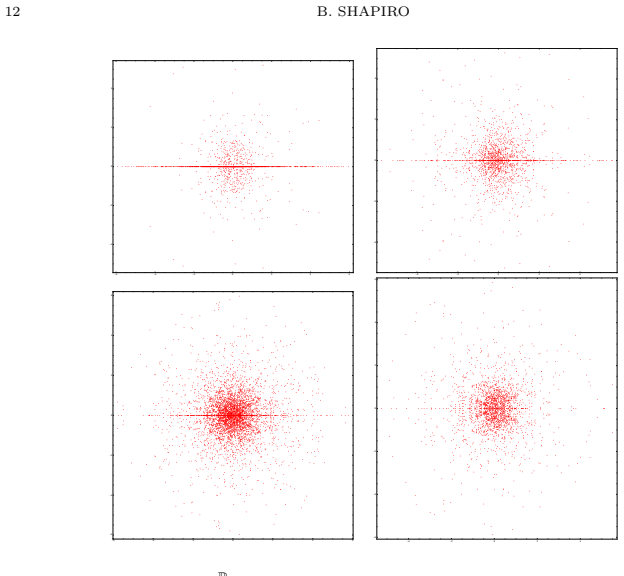
A direct Monte-Carlo computation of the empirical measure of crossings for large n in the complex Gaussian ensemble that visibly fails to approach the predicted deterministic density.
Figures


read the original abstract
We study the asymptotic distribution of level crossings for random matrix pencils A_n+\lambda B_n in several ensembles, including complex and real i.i.d. matrices and Gaussian/Hermitian settings. We derive a representation of the normalized log-discriminant in terms of pairwise eigenvalue interactions and formulate conditions under which its limit is governed by a deterministic potential. Under assumptions combining a uniform circular law, logarithmic tail control, and small-spacing (repulsion) estimates, we prove convergence of the empirical measure of level crossings to an explicit deterministic limit. In the complex Gaussian case these assumptions are verified (modulo a uniformity step), while in the general i.i.d. setting the results are conditional and motivated by universality theory. We further analyze the real case, showing that any limiting measure does not concentrate on the real projective line under suitable hypotheses, and discuss analogous phenomena for elliptic/Hermitian ensembles. Our results highlight the role of logarithmic energy and universality in governing spectral degeneracies of random matrix pencils.
Editorial analysis
A structured set of objections, weighed in public.
Referee Report
Summary. The manuscript studies the asymptotic distribution of level crossings for random matrix pencils A_n + λ B_n in i.i.d., complex/real Gaussian, and Hermitian/elliptic ensembles. It derives a representation of the normalized log-discriminant in terms of pairwise eigenvalue interactions and proves, under the combined assumptions of a uniform circular law, logarithmic tail control, and small-spacing (repulsion) estimates, that the empirical measure of level crossings converges to an explicit deterministic limit. These assumptions are verified only modulo a uniformity step in the complex Gaussian case and remain conditional (motivated by universality) in the general i.i.d. setting; additional results show that any limiting measure does not concentrate on the real projective line in the real case.
Significance. If the assumptions can be fully verified, the work supplies direct analogs of Girko's circular law and Wigner's semicircle law for the distribution of spectral degeneracies in random pencils, emphasizing the governing role of logarithmic energy and pairwise interactions. The parameter-free derivation from the log-discriminant representation and the explicit deterministic limit (when assumptions hold) are strengths that could advance the study of non-Hermitian random matrices and universality phenomena.
major comments (1)
- [Abstract and main results section] The central convergence claim (stated in the abstract and derived in the main results section) is conditional on three assumptions (uniform circular law, logarithmic tail control, small-spacing estimates) that are only partially verified: modulo an uncompleted uniformity step for complex Gaussians and left conditional for general i.i.d. ensembles. Since the explicit deterministic limit holds if and only if these inputs are satisfied, the gap in verification is load-bearing and weakens the applicability of the main theorem; the manuscript should either complete the uniformity argument or provide a precise roadmap with explicit error bounds.
Simulated Author's Rebuttal
We thank the referee for the careful reading of our manuscript and for the constructive feedback. We address the major comment point by point below.
read point-by-point responses
-
Referee: The central convergence claim (stated in the abstract and derived in the main results section) is conditional on three assumptions (uniform circular law, logarithmic tail control, small-spacing estimates) that are only partially verified: modulo an uncompleted uniformity step for complex Gaussians and left conditional for general i.i.d. ensembles. Since the explicit deterministic limit holds if and only if these inputs are satisfied, the gap in verification is load-bearing and weakens the applicability of the main theorem; the manuscript should either complete the uniformity argument or provide a precise roadmap with explicit error bounds.
Authors: We agree that the main theorem is conditional on the three assumptions, as already stated explicitly in the abstract, introduction, and results section. This conditional formulation is deliberate: it isolates the contribution of the log-discriminant representation and the resulting deterministic limit under inputs that are standard in non-Hermitian random matrix theory and widely expected to hold by universality. For complex Gaussians the uniformity step remains open, while for general i.i.d. ensembles the results are presented as conditional. We do not claim unconditional convergence. In the revised manuscript we will add a dedicated subsection that supplies a precise roadmap, including explicit error bounds and references to existing techniques for completing the uniformity argument. This addresses the referee's request without overstating the current verification status. revision: partial
- Completing the uniformity step for the complex Gaussian case requires new technical estimates on the circular law that are currently beyond the scope of this work.
Circularity Check
No circularity: limit derived from pairwise interactions under external assumptions.
full rationale
The manuscript derives a representation of the normalized log-discriminant via pairwise eigenvalue interactions and proves convergence of the empirical measure of level crossings to an explicit deterministic limit under the stated assumptions (uniform circular law, logarithmic tail control, small-spacing estimates). These assumptions are cited from prior literature or partially verified in the Gaussian case, but the derivation chain does not reduce the target limit to a fitted parameter, self-definition, or self-citation by construction. The central result therefore retains independent content from the interaction representation and is not equivalent to its inputs.
Axiom & Free-Parameter Ledger
axioms (2)
- domain assumption Uniform circular law holds for the matrix ensembles under consideration
- domain assumption Logarithmic tail control and small-spacing repulsion estimates hold
Reference graph
Works this paper leans on
-
[1]
W., Guionnet, A., Zeitouni, O., An Introduction to Random Matrices
Anderson, G. W., Guionnet, A., Zeitouni, O., An Introduction to Random Matrices. Cambridge Studies in Advanced Mathematics, 118. Cambridge University Press, Cambridge, 2010. xiv+492 pp
2010
-
[2]
Galligo, A., Poteaux, A., Computing monodromy via continuation methods on random Riemann surfaces, Theor. Comp. Sci., 412, 16 (2011), 1492--1507
2011
-
[3]
L., The V -transformation, Dokl
Girko, V. L., The V -transformation, Dokl. Akad. Nauk Ukr.SSR, Ser. Mat. 3, 5--6 (1982). (in Russian)
1982
-
[4]
L., The Circle Law, Theory of Probabilities and their Applications, 29, 4, 669--679 (1984)
Girko, V. L., The Circle Law, Theory of Probabilities and their Applications, 29, 4, 669--679 (1984)
1984
-
[5]
Reprint of the 1980 edition
Kato, T., Perturbation theory for linear operators. Reprint of the 1980 edition. Classics in Mathematics. Springer-Verlag, Berlin, 1995. xxii+619 pp
1980
-
[6]
L., Random matrices
Mehta, M. L., Random matrices. Third edition. Pure and Applied Mathematics (Amsterdam), 142. Elsevier/Academic Press, Amsterdam, 2004. xviii+688 pp
2004
-
[7]
Theory Related Fields 159 (2014), no
Bourgade, P., Yau, H.-T., Yin, J., Local circular law for random matrices, Probab. Theory Related Fields 159 (2014), no. 3--4, 545--595. doi:10.1007/s00440-013-0514-z
-
[8]
Tao, T., Vu, V., Random matrices: universality of local spectral statistics of non-Hermitian matrices, Ann. Probab. 43 (2015), no. 2, 782--874. doi:10.1214/13-AOP876
-
[9]
Edelman, A., Kostlan, E., Shub, M., How many eigenvalues of a random matrix are real?, J. Amer. Math. Soc. 7 (1994), no. 1, 247--267. doi:10.1090/S0894-0347-1994-1231689-0
-
[10]
J., Nagao, T., Eigenvalue statistics of the real Ginibre ensemble, Phys
Forrester, P. J., Nagao, T., Eigenvalue statistics of the real Ginibre ensemble, Phys. Rev. Lett. 99 (2007), 050603. doi:10.1103/PhysRevLett.99.050603
-
[11]
Sommers, H.-J., Crisanti, A., Sompolinsky, H., Stein, Y., Spectrum of large random asymmetric matrices, Phys. Rev. Lett. 60 (1988), 1895--1898
1988
-
[12]
B 504 (1997), no
Feinberg, J., Zee, A., Non-Hermitian random matrix theory: method of Hermitian reduction, Nuclear Phys. B 504 (1997), no. 3, 579--608
1997
-
[13]
J., Log-Gases and Random Matrices, London Mathematical Society Monographs Series, 34
Forrester, P. J., Log-Gases and Random Matrices, London Mathematical Society Monographs Series, 34. Princeton University Press, Princeton, NJ, 2010
2010
-
[14]
Shapiro, B., Zarembo, K., Level Crossing in Random Matrices. I. Random perturbation of a fixed matrix, Journal of Physics A: Mathematical and Theoretical, Volume 50(4)
-
[15]
Gr sfjeld, T., Shapiro, B., Zarembo, K., On level crossing in random matrix pencils. II. Random perturbation of a random matrix, J. Phys. A 52 (2019), no. 21 https://doi.org/10.1088/1751-8121/ab1733
-
[16]
R., Verbaarschot, J
Zirnbauer, M. R., Verbaarschot, J. J. M., Weidenm\"uller, H. A., Destruction of order in nuclear spectra by a residual GOE interaction, Nuclear Physics A411 (1983) 161--180
1983
discussion (0)
Sign in with ORCID, Apple, or X to comment. Anyone can read and Pith papers without signing in.