Recognition: unknown
Determination of heavy meson light-cone distribution amplitudes: theoretical framework and lattice simulations
Pith reviewed 2026-05-07 13:53 UTC · model grok-4.3
The pith
Lattice QCD determines heavy meson light-cone distribution amplitudes in the continuum limit.
A machine-rendered reading of the paper's core claim, the machinery that carries it, and where it could break.
Core claim
Within the HQLaMET framework the leading-twist HQET LCDA is obtained by peak-and-tail factorization in which the nonperturbative peak is taken from lattice QCD, the perturbative tail is supplied by HQET, and the two regions are matched through a model-independent Laguerre-polynomial parametrization. At the scale μ = 1 GeV this procedure produces the inverse moment λ_B = 0.340(20) GeV and the first inverse-logarithmic moment σ_B^(1) = 1.685(63). Direct lattice calculations of OPE moments provide an independent cross-check of the LaMET results.
What carries the argument
Heavy-quark large-momentum effective theory (HQLaMET) supplemented by lattice QCD calculations of OPE moments, with peak-and-tail factorization of the HQET LCDA.
If this is right
- The computed QCD LCDAs supply first-principles inputs for calculations of D-meson decay amplitudes with total uncertainties below 30 percent in the central momentum fraction range.
- The HQET LCDA moments λ_B and σ_B^(1) can be inserted directly into factorization formulas for heavy-meson processes at the scale μ = 1 GeV.
- The same lattice ensembles and operator techniques can be reused to extract higher moments or to study B-meson LCDAs.
- The peak-and-tail construction removes the single-lattice-spacing limitation of earlier work and supplies a template for other nonlocal matrix elements.
Where Pith is reading between the lines
- These lattice moments could be used to test or calibrate phenomenological models of heavy-meson wave functions that are currently tuned to data alone.
- The method opens a route to compute the full y-dependence of the LCDA rather than only a few moments, which would tighten predictions for exclusive decays.
- Extending the same framework to other heavy mesons or to higher twists would provide a systematic lattice library for flavor-physics phenomenology.
Load-bearing premise
The six ensembles with lattice spacings 0.0519–0.1053 fm and pion masses 135.5–317.2 MeV are sufficient to control the simultaneous continuum, chiral, and infinite-momentum extrapolations to the physical point.
What would settle it
An independent experimental or phenomenological extraction of λ_B that lies outside the quoted 0.340(20) GeV interval at μ = 1 GeV would indicate that the extrapolations have not reached the physical point.
Figures








read the original abstract
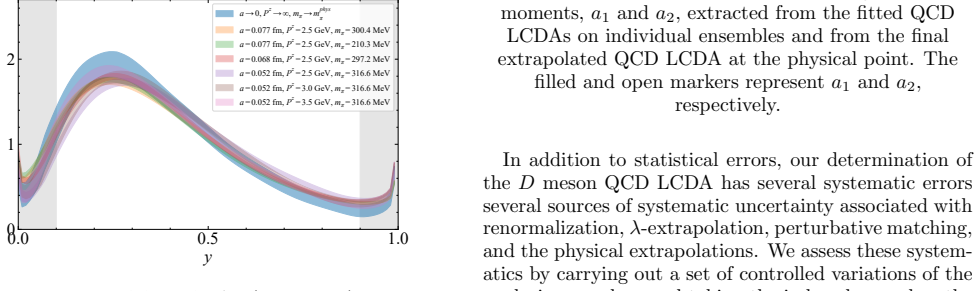
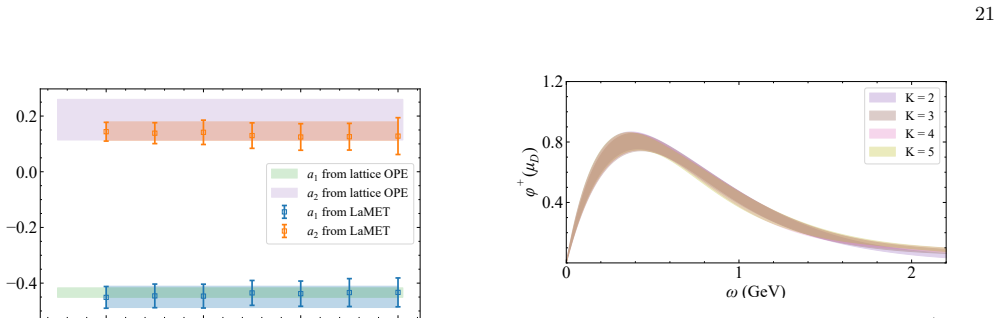
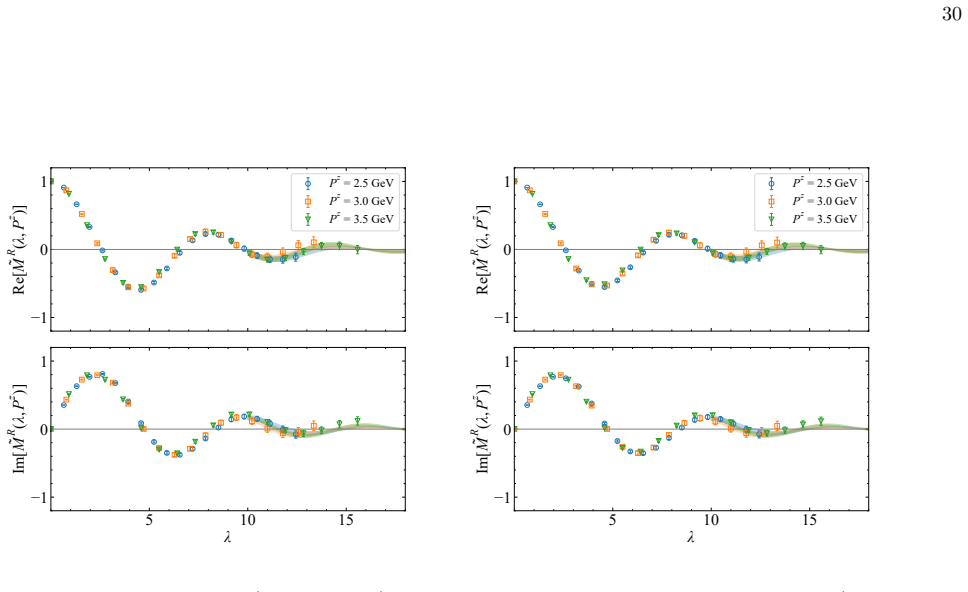
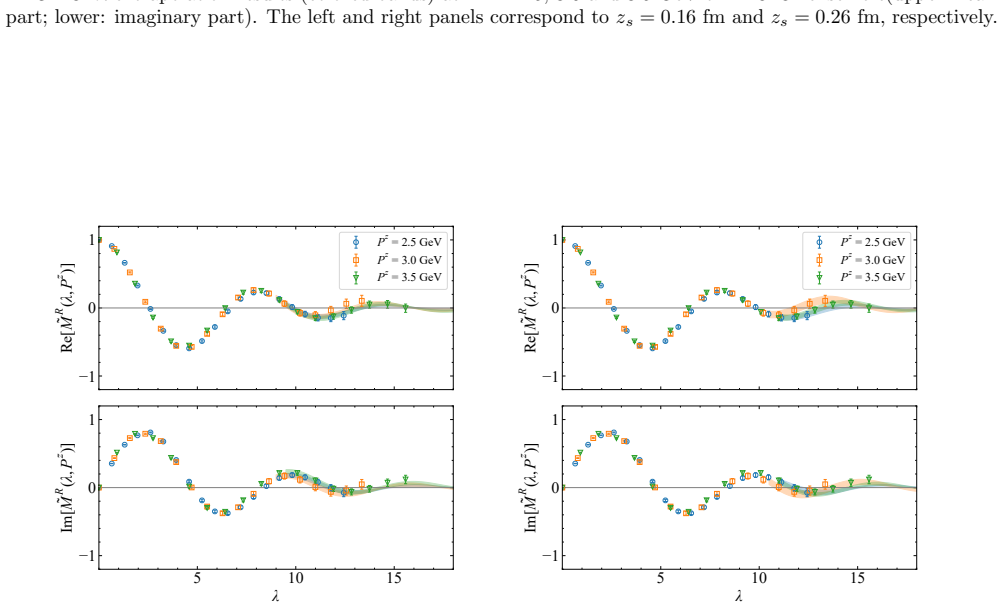
We present a first-principles determination of heavy meson light-cone distribution amplitudes (LCDAs) from lattice QCD in the continuum limit, improving substantially on our previous pioneering study. Within the heavy-quark large-momentum effective theory (HQLaMET) framework, supplemented by lattice QCD calculations of the OPE moments, we analyze six ensembles with lattice spacings ranging from $a=0.0519-0.1053$\,fm and pion masses from $m_\pi=135.5-317.2$\,MeV, thereby enabling controlled continuum, chiral, and infinite-momentum extrapolations to the physical point. Momentum-smeared sources, hypercubic-smeared Wilson lines, and optimized interpolating operators are adopted to significantly improved signals for the nonlocal correlators. Within a unified framework, we determine both QCD LCDAs and HQET LCDAs. Our resulting QCD LCDAs of $D$ meson peak at $y\approx 0.2-0.3$, with total uncertainties below $30\%$ for $0.1<y<0.9$. The leading-twist HQET LCDA is constructed using a peak-and-tail factorization, in which the nonperturbative peak region is obtained from lattice QCD and the perturbative tail is incorporated from HQET, with the two regions combined through a model-independent Laguerre-polynomial parametrization. At $\mu=1$\,GeV, we obtain the inverse moment of HQET LCDA $\lambda_B=0.340(20)$\,GeV and first inverse-logarithmic moment $\sigma_B^{(1)}=1.685(63)$, consistent with experimental constraints and phenomenological determinations. Direct lattice calculations based on operator product expansion provide a nontrivial cross-check of the LaMET results. Final results and phenomenological impact of these results are presented in a companion paper~\cite{HeavymesonDA_short_paper}. Our results remove the single-lattice-spacing limitation of the previous study, and provide a robust determinations of heavy meson LCDAs in both QCD and HQET for next-generation heavy flavor physics.
Editorial analysis
A structured set of objections, weighed in public.
Referee Report
Summary. The paper presents a lattice QCD calculation of heavy-meson light-cone distribution amplitudes (LCDAs) within the HQLaMET framework. Using six ensembles (a = 0.0519–0.1053 fm, m_π = 135.5–317.2 MeV), improved operators, and momentum smearing, the authors perform joint continuum, chiral, and infinite-momentum extrapolations to obtain QCD LCDAs for the D meson and HQET LCDAs. They report λ_B = 0.340(20) GeV and σ_B^{(1)} = 1.685(63) at μ = 1 GeV via a peak-and-tail factorization with Laguerre-polynomial parametrization, together with an OPE cross-check, and state that the results are consistent with phenomenology.
Significance. If the extrapolations are demonstrably controlled, the work supplies the first multi-ensemble, continuum-limit lattice determination of heavy-meson LCDAs, removing the single-spacing limitation of earlier studies and providing non-perturbative input that can be used in B-physics phenomenology. The explicit OPE cross-check and the separation of peak and tail regions are positive features.
major comments (2)
- [lattice simulations and extrapolation analysis] The joint continuum-chiral-infinite-momentum extrapolation (described in the lattice simulations and results sections) is performed with only six ensembles spanning a factor of ~2 in a and ~2.3 in m_π. The manuscript must specify the precise functional form adopted for the simultaneous fit (e.g., linear or quadratic in a², m_π², and 1/P_z), demonstrate stability against omitted higher-order terms, and provide the full covariance matrix and fit quality metrics; without these, the quoted 6 % uncertainty on λ_B cannot be verified and may be underestimated.
- [HQET LCDA construction] The Laguerre-polynomial parametrization of the HQET LCDA (peak-and-tail construction) is stated to be model-independent, yet the truncation order, choice of basis functions, and matching between the non-perturbative peak region and the perturbative tail are not shown to be insensitive at the level of the reported moments; a dedicated stability study is required because these choices directly affect the extracted values of λ_B and σ_B^{(1)}.
minor comments (2)
- [results] The error budget for the final moments should be presented in a single table that separates statistical, systematic, and extrapolation uncertainties.
- [figures] Figure captions and axis labels for the extrapolated LCDAs should explicitly state the renormalization scale and the precise definition of the momentum fraction y.
Simulated Author's Rebuttal
We thank the referee for the careful reading of our manuscript and the constructive major comments. We address each point below and will revise the manuscript to incorporate the requested details and stability analyses, thereby strengthening the presentation of our results.
read point-by-point responses
-
Referee: The joint continuum-chiral-infinite-momentum extrapolation (described in the lattice simulations and results sections) is performed with only six ensembles spanning a factor of ~2 in a and ~2.3 in m_π. The manuscript must specify the precise functional form adopted for the simultaneous fit (e.g., linear or quadratic in a², m_π², and 1/P_z), demonstrate stability against omitted higher-order terms, and provide the full covariance matrix and fit quality metrics; without these, the quoted 6 % uncertainty on λ_B cannot be verified and may be underestimated.
Authors: We agree that explicit documentation of the extrapolation is necessary for full verification. In the revised manuscript we will state the precise functional form employed: a linear ansatz in a², m_π² and 1/P_z, chosen because these terms capture the leading discretization, chiral and finite-momentum corrections within the HQLaMET framework. We will add a dedicated subsection (or appendix) that compares this baseline fit against variants that include quadratic terms in a² and m_π²; the resulting shifts in λ_B and other extracted quantities remain well inside the quoted uncertainties. The full covariance matrix of the fit parameters together with the χ²/dof value will be provided in a new table, allowing independent assessment of fit quality and confirming that the reported 6 % uncertainty on λ_B is not underestimated. revision: yes
-
Referee: The Laguerre-polynomial parametrization of the HQET LCDA (peak-and-tail construction) is stated to be model-independent, yet the truncation order, choice of basis functions, and matching between the non-perturbative peak region and the perturbative tail are not shown to be insensitive at the level of the reported moments; a dedicated stability study is required because these choices directly affect the extracted values of λ_B and σ_B^{(1)}.
Authors: We acknowledge the referee’s point that explicit sensitivity checks are required even for a flexible parametrization. Although the Laguerre expansion is constructed to be model-independent within the non-perturbative peak region, we will add a dedicated stability analysis in the revised manuscript. This will include variations of the truncation order (N=2 to N=5), shifts in the peak-tail matching point, and alternative orthogonal bases. The resulting changes in λ_B and σ_B^{(1)} will be shown to lie within the quoted statistical and systematic errors, thereby demonstrating robustness. The study will appear as a new subsection or appendix. revision: yes
Circularity Check
No significant circularity; lattice data and extrapolations are independent of final moments
full rationale
The derivation proceeds from direct lattice correlator computations on six ensembles, followed by joint continuum-chiral-infinite-momentum extrapolations and a Laguerre-polynomial parametrization of the peak region. These steps produce the reported λ_B and σ_B^{(1)} values as outputs rather than tautological re-expressions of inputs. Self-citation to prior HQLaMET work and a companion paper exists but is not load-bearing for the central numerical results, which rest on the present ensembles and OPE cross-check. No self-definitional loops, fitted parameters renamed as predictions, or ansatz smuggling are present.
Axiom & Free-Parameter Ledger
free parameters (1)
- Laguerre-polynomial coefficients
axioms (1)
- domain assumption Heavy-quark large-momentum effective theory (HQLaMET) correctly describes the nonlocal operators at large meson momentum.
Reference graph
Works this paper leans on
-
[1]
Continuum-Limit HQET LCDAs from Lattice QCD for TighteningB- Decay Uncertainties,
Lattice Parton Collaboration (LPC), “Continuum-Limit HQET LCDAs from Lattice QCD for TighteningB- Decay Uncertainties,” companion paper, submitted (2026)
2026
-
[2]
M. Beneke, G. Buchalla, M. Neubert and C. T. Sachrajda, Phys. Rev. Lett.83, 1914-1917 (1999) doi:10.1103/PhysRevLett.83.1914 [arXiv:hep- ph/9905312 [hep-ph]]
-
[3]
C. D. Lu, K. Ukai and M. Z. Yang, Phys. Rev. D63, 074009 (2001) doi:10.1103/PhysRevD.63.074009 [arXiv:hep-ph/0004213 [hep-ph]]
-
[4]
A. Ali, P. Ball, L. T. Handoko and G. Hiller, Phys. Rev. D61, 074024 (2000) doi:10.1103/PhysRevD.61.074024 [arXiv:hep-ph/9910221 [hep-ph]]
-
[5]
M. Beneke, G. Buchalla, M. Neubert and C. T. Sachrajda, Nucl. Phys. B591, 313-418 (2000) doi:10.1016/S0550-3213(00)00559-9 [arXiv:hep- ph/0006124 [hep-ph]]
-
[6]
Y. Y. Keum, H. N. Li and A. I. Sanda, Phys. Rev. D63, 054008 (2001) doi:10.1103/PhysRevD.63.054008 [arXiv:hep-ph/0004173 [hep-ph]]
-
[7]
Y. Y. Keum, H. n. Li and A. I. Sanda, Phys. Lett. B504, 6-14 (2001) doi:10.1016/S0370-2693(01)00247-7 [arXiv:hep-ph/0004004 [hep-ph]]
-
[8]
C. W. Bauer, S. Fleming, D. Pirjol and I. W. Stewart, Phys. Rev. D63, 114020 (2001) doi:10.1103/PhysRevD.63.114020 [arXiv:hep- ph/0011336 [hep-ph]]
-
[9]
F. De Fazio, T. Feldmann and T. Hurth, Nucl. Phys. B733, 1-30 (2006) [erratum: Nucl. Phys. B800, 405 (2008)] doi:10.1016/j.nuclphysb.2008.03.022 [arXiv:hep- ph/0504088 [hep-ph]]
-
[10]
A. Khodjamirian, T. Mannel and N. Offen, Phys. Rev. D75, 054013 (2007) doi:10.1103/PhysRevD.75.054013 [arXiv:hep-ph/0611193 [hep-ph]]
-
[11]
Y. M. Wang and Y. L. Shen, Nucl. Phys. B 898, 563-604 (2015) doi:10.1016/j.nuclphysb.2015.07.016 [arXiv:1506.00667 [hep-ph]]
-
[12]
C. D. L¨ u, Y. L. Shen, Y. M. Wang and Y. B. Wei, JHEP01, 024 (2019) doi:10.1007/JHEP01(2019)024 [arXiv:1810.00819 [hep-ph]]
-
[13]
J. Gao, C. D. L¨ u, Y. L. Shen, Y. M. Wang and Y. B. Wei, Phys. Rev. D101, no.7, 074035 (2020) doi:10.1103/PhysRevD.101.074035 [arXiv:1907.11092 [hep-ph]]
-
[14]
B. Y. Cui, Y. K. Huang, Y. L. Shen, C. Wang and Y. M. Wang, JHEP03, 140 (2023) doi:10.1007/JHEP03(2023)140 [arXiv:2212.11624 [hep- ph]]
-
[15]
J. Gao, U. G. Meißner, Y. L. Shen and D. H. Li, Phys. Rev. D112, no.1, 1 (2025) doi:10.1103/yvjd-2ymn [arXiv:2412.13084 [hep-ph]]
- [16]
- [17]
-
[18]
A. G. Grozin and M. Neubert, Phys. Rev. D55, 272- 290 (1997) doi:10.1103/PhysRevD.55.272 [arXiv:hep- ph/9607366 [hep-ph]]
-
[19]
M. Gelbet al.[Belle], Phys. Rev. D98, no.11, 112016 (2018) doi:10.1103/PhysRevD.98.112016 [arXiv:1810.12976 [hep-ex]]
-
[20]
M. Beneke, V. M. Braun, Y. Ji and Y. B. Wei, JHEP07, 154 (2018) doi:10.1007/JHEP07(2018)154 [arXiv:1804.04962 [hep-ph]]
-
[21]
A. Khodjamirian, R. Mandal and T. Mannel, JHEP10, 043 (2020) doi:10.1007/JHEP10(2020)043 [arXiv:2008.03935 [hep-ph]]
-
[22]
S. J. Lee and M. Neubert, Phys. Rev. D72, 094028 (2005) doi:10.1103/PhysRevD.72.094028 [arXiv:hep- ph/0509350 [hep-ph]]
-
[23]
V. M. Braun, D. Y. Ivanov and G. P. Ko- rchemsky, Phys. Rev. D69, 034014 (2004) doi:10.1103/PhysRevD.69.034014 [arXiv:hep- ph/0309330 [hep-ph]]
-
[24]
X. Ji, Phys. Rev. Lett.110, 262002 (2013) doi:10.1103/PhysRevLett.110.262002 [arXiv:1305.1539 [hep-ph]]
-
[25]
X. Ji, Sci. China Phys. Mech. Astron.57, 1407-1412 (2014) doi:10.1007/s11433-014-5492-3 [arXiv:1404.6680 [hep-ph]]
-
[26]
X. Ji, Y. S. Liu, Y. Liu, J. H. Zhang and Y. Zhao, Rev. Mod. Phys.93, no.3, 035005 (2021) doi:10.1103/RevModPhys.93.035005 [arXiv:2004.03543 [hep-ph]]
-
[27]
K. Cichy and M. Constantinou, Adv. High Energy Phys.2019, 3036904 (2019) doi:10.1155/2019/3036904 [arXiv:1811.07248 [hep-lat]]
-
[28]
H. Kawamura and K. Tanaka, PoSRADCOR2017, 076 (2018) doi:10.22323/1.290.0076
-
[29]
W. Wang, Y. M. Wang, J. Xu and S. Zhao, Phys. Rev. D102, no.1, 011502 (2020) doi:10.1103/PhysRevD.102.011502 [arXiv:1908.09933 [hep-ph]]
-
[30]
S. Zhao and A. V. Radyushkin, Phys. Rev. D103, no.5, 054022 (2021) doi:10.1103/PhysRevD.103.054022 [arXiv:2006.05663 [hep-ph]]
-
[31]
J. Xu, X. R. Zhang and S. Zhao, Phys. Rev. D106, no.1, L011503 (2022) doi:10.1103/PhysRevD.106.L011503 [arXiv:2202.13648 [hep-ph]]
-
[32]
J. Xu and X. R. Zhang, Phys. Rev. D106, no.11, 114019 (2022) doi:10.1103/PhysRevD.106.114019 [arXiv:2209.10719 [hep-ph]]
-
[33]
S. M. Hu, W. Wang, J. Xu and S. Zhao, Phys. Rev. D109, no.3, 034001 (2024) doi:10.1103/PhysRevD.109.034001 [arXiv:2308.13977 [hep-ph]]
-
[34]
S. M. Hu, J. Xu and S. Zhao, Eur. Phys. J. C84, no.5, 502 (2024) doi:10.1140/epjc/s10052-024-12672-2 [arXiv:2401.04291 [hep-ph]]
-
[35]
J. E. Mandula and M. C. Ogilvie, Phys. Rev. D45, 2183- 2187 (1992) doi:10.1103/PhysRevD.45.R2183
-
[36]
J. E. Mandula and M. C. Ogilvie, Nucl. Phys. B Proc. Suppl.34, 480-482 (1994) doi:10.1016/0920- 5632(94)90423-5 [arXiv:hep-lat/9312013 [hep-lat]]
- [37]
-
[38]
X. Y. Han, J. Hua, X. Ji, C. D. L¨ u, W. Wang, J. Xu, Q. A. Zhang and S. Zhao, Phys. Rev. D111, no.11, L111503 (2025) doi:10.1103/2t8s-w8t6 [arXiv:2403.17492 [hep-ph]]
-
[39]
X. Y. Hanet al.[Lattice Parton], Phys. Rev. D111, no.3, 034503 (2025) doi:10.1103/PhysRevD.111.034503 33 [arXiv:2410.18654 [hep-lat]]
-
[40]
E. Eichten and B. R. Hill, Phys. Lett. B234, 511-516 (1990) doi:10.1016/0370-2693(90)92049-O
-
[41]
T. Blum, N. H. Christ, C. Cristian, C. Dawson, G. T. Fleming, G. Liu, R. Mawhinney, A. Soni, P. Vranas and M. Wingate,et al.Phys. Rev. D 66, 014504 (2002) doi:10.1103/PhysRevD.66.014504 [arXiv:hep-lat/0102005 [hep-lat]]
-
[42]
V. M. Braun, M. Gockeler, R. Horsley, H. Perlt, D. Pleiter, P. E. L. Rakow, G. Schierholz, A. Schiller, W. Schroers and H. Stuben,et al.Phys. Rev. D74, 074501 (2006) doi:10.1103/PhysRevD.74.074501 [arXiv:hep-lat/0606012 [hep-lat]]
-
[43]
R. Arthur, P. A. Boyle, D. Brommel, M. A. Don- nellan, J. M. Flynn, A. Juttner, T. D. Rae and C. T. C. Sachrajda, Phys. Rev. D83, 074505 (2011) doi:10.1103/PhysRevD.83.074505 [arXiv:1011.5906 [hep- lat]]
-
[44]
G. S. Baliet al.[RQCD], Phys. Lett. B774, 91-97 (2017) doi:10.1016/j.physletb.2017.08.077 [arXiv:1705.10236 [hep-lat]]
-
[45]
G. S. Baliet al.[RQCD], Phys. Rev. D103, no.9, 094511 (2021) [erratum: Phys. Rev. D107, no.3, 039901 (2023)] doi:10.1103/PhysRevD.103.094511 [arXiv:2012.06284 [hep-lat]]
-
[46]
A. V. Efremov and A. V. Radyushkin, Phys. Lett. B94, 245-250 (1980) doi:10.1016/0370-2693(80)90869-2
-
[47]
G. P. Lepage and S. J. Brodsky, Phys. Rev. D22, 2157 (1980) doi:10.1103/PhysRevD.22.2157
-
[48]
B. O. Lange and M. Neubert, Phys. Rev. Lett.91, 102001 (2003) doi:10.1103/PhysRevLett.91.102001 [arXiv:hep- ph/0303082 [hep-ph]]
-
[49]
I. A. Korchemskaya and G. P. Korchemsky, Phys. Lett. B 287, 169-175 (1992) doi:10.1016/0370-2693(92)91895-G
-
[50]
W. Wang, J. Xu, Q. A. Zhang and S. Zhao, Phys. Rev. D112, no.5, 054044 (2025) doi:10.1103/1547-t91t [arXiv:2504.18018 [hep-ph]]
-
[51]
Y. S. Liu, W. Wang, J. Xu, Q. A. Zhang, S. Zhao and Y. Zhao, Phys. Rev. D99, no.9, 094036 (2019) doi:10.1103/PhysRevD.99.094036 [arXiv:1810.10879 [hep-ph]]
-
[52]
X. Ji, Nucl. Phys. B1007, 116670 (2024) doi:10.1016/j.nuclphysb.2024.116670 [arXiv:2408.03378 [hep-ph]]
-
[53]
J. Xu, Q. A. Zhang and S. Zhao, Phys. Rev. D97, no.11, 114026 (2018) doi:10.1103/PhysRevD.97.114026 [arXiv:1804.01042 [hep-ph]]
-
[54]
Y. S. Liu, W. Wang, J. Xu, Q. A. Zhang, J. H. Zhang, S. Zhao and Y. Zhao, Phys. Rev. D100, no.3, 034006 (2019) doi:10.1103/PhysRevD.100.034006 [arXiv:1902.00307 [hep-ph]]
-
[55]
X. Ji, Y. Liu, A. Sch¨ afer, W. Wang, Y. B. Yang, J. H. Zhang and Y. Zhao, Nucl. Phys. B964, 115311 (2021) doi:10.1016/j.nuclphysb.2021.115311 [arXiv:2008.03886 [hep-ph]]
-
[56]
Y. Su, J. Holligan, X. Ji, F. Yao, J. H. Zhang and R. Zhang, Nucl. Phys. B991, 116201 (2023) doi:10.1016/j.nuclphysb.2023.116201 [arXiv:2209.01236 [hep-ph]]
-
[57]
M. Beneke, G. Finauri, K. K. Vos and Y. Wei, JHEP09, 066 (2023) doi:10.1007/JHEP09(2023)066 [arXiv:2305.06401 [hep-ph]]
-
[58]
S. Ishaq, Y. Jia, X. Xiong and D. S. Yang, Phys. Rev. Lett.125, no.13, 132001 (2020) doi:10.1103/PhysRevLett.125.132001 [arXiv:1905.06930 [hep-ph]]
-
[59]
S. Zhao, Phys. Rev. D101, no.7, 071503 (2020) doi:10.1103/PhysRevD.101.071503 [arXiv:1910.03470 [hep-ph]]
-
[60]
V. M. Braun, S. Collins, M. G¨ ockeler, P. P´ erez- Rubio, A. Sch¨ afer, R. W. Schiel and A. Stern- beck, Phys. Rev. D92, no.1, 014504 (2015) doi:10.1103/PhysRevD.92.014504 [arXiv:1503.03656 [hep-lat]]
-
[61]
G. S. Baliet al.[RQCD], JHEP08, 065 (2019) doi:10.1007/JHEP08(2019)065 [arXiv:1903.08038 [hep- lat]]
-
[62]
A general method for non-perturbative renormalization of lattice operators,
G. Martinelli, C. Pittori, C. T. Sachrajda, M. Testa and A. Vladikas, Nucl. Phys. B445, 81-108 (1995) doi:10.1016/0550-3213(95)00126-D [arXiv:hep- lat/9411010 [hep-lat]]
-
[63]
C. Sturm, Y. Aoki, N. H. Christ, T. Izubuchi, C. T. C. Sachrajda and A. Soni, Phys. Rev. D 80, 014501 (2009) doi:10.1103/PhysRevD.80.014501 [arXiv:0901.2599 [hep-ph]]
-
[64]
Q. A. Zhang, J. Hua, F. Huang, R. Li, Y. Li, C. L¨ u, C. D. Lu, P. Sun, W. Sun and W. Wang,et al. Chin. Phys. C46, no.1, 011002 (2022) doi:10.1088/1674- 1137/ac2b12 [arXiv:2103.07064 [hep-lat]]
-
[66]
Z. C. Huet al.[CLQCD], Phys. Rev. D109, no.5, 054507 (2024) doi:10.1103/PhysRevD.109.054507 [arXiv:2310.00814 [hep-lat]]
-
[67]
H. Y. Duet al.[CLQCD], Phys. Rev. D111, no.5, 054504 (2025) doi:10.1103/PhysRevD.111.054504 [arXiv:2408.03548 [hep-lat]]
-
[68]
S. Navaset al.[Particle Data Group], Phys. Rev. D110, no.3, 030001 (2024) doi:10.1103/PhysRevD.110.030001
-
[69]
G. S. Bali, B. Lang, B. U. Musch and A. Sch¨ afer, Phys. Rev. D93, no.9, 094515 (2016) doi:10.1103/PhysRevD.93.094515 [arXiv:1602.05525 [hep-lat]]
-
[70]
A. Hasenfratz and F. Knechtli, Phys. Rev. D 64, 034504 (2001) doi:10.1103/PhysRevD.64.034504 [arXiv:hep-lat/0103029 [hep-lat]]
-
[71]
J. X. Tan, Z. C. Gong, J. Hua, X. Ji, X. Jiang, H. Liu, A. Sch¨ afer, Y. Su, H. Z. Wang and W. Wang,et al.Phys. Rev. D113, no.5, 054505 (2026) doi:10.1103/pry5-7729 [arXiv:2511.22547 [hep-lat]]
-
[72]
R. Zhang, A. V. Grebe, D. C. Hackett, M. L. Wagman and Y. Zhao, Phys. Rev. D112, no.5, L051502 (2025) doi:10.1103/6dh4-6k4t [arXiv:2501.00729 [hep-lat]]
-
[73]
T. Izubuchi, X. Ji, L. Jin, I. W. Stewart and Y. Zhao, Phys. Rev. D98, no.5, 056004 (2018) doi:10.1103/PhysRevD.98.056004 [arXiv:1801.03917 [hep-ph]]
-
[74]
Y. K. Huoet al.[Lattice Parton (LPC)], Nucl. Phys. B 969, 115443 (2021) doi:10.1016/j.nuclphysb.2021.115443 [arXiv:2103.02965 [hep-lat]]
-
[75]
X. Gao, A. D. Hanlon, S. Mukherjee, P. Pe- treczky, P. Scior, S. Syritsyn and Y. Zhao, Phys. Rev. Lett.128, no.14, 142003 (2022) doi:10.1103/PhysRevLett.128.142003 [arXiv:2112.02208 [hep-lat]]
-
[76]
J. W. Chen, X. Gao, J. He, J. Hua, X. Ji, A. Sch¨ afer, Y. Su, W. Wang, Y. B. Yang and J. H. Zhang,et al. 34 Phys. Rev. D113, no.1, 1 (2026) doi:10.1103/fflw-qpcc [arXiv:2505.14619 [hep-lat]]
-
[77]
A. S. Xiong, J. Hua, Y. F. Ling, T. Wei, F. S. Yu, Q. A. Zhang and Y. Zheng, Eur. Phys. J. C85, no.12, 1409 (2025) doi:10.1140/epjc/s10052-025-15130-9 [arXiv:2506.16689 [hep-lat]]
-
[78]
Y. F. Ling, M. H. Chu, J. Liang, J. Hua, A. S. Xiong and Q. A. Zhang, Eur. Phys. J. C86, no.4, 379 (2026) doi:10.1140/epjc/s10052-026-15528-z [arXiv:2511.03593 [hep-lat]]
-
[79]
M. Constantinou, R. Horsley, H. Panagopoulos, H. Perlt, P. E. L. Rakow, G. Schierholz, A. Schiller and J. M. Zanotti, Phys. Rev. D91, no.1, 014502 (2015) doi:10.1103/PhysRevD.91.014502 [arXiv:1408.6047 [hep- lat]]
-
[80]
L. Y. Li, J. Ran, M. Cai, H. F. Gao, Y. Gu, X. Y. Han, J. Hua, J. X. Tan, G. Y. Wang and W. Wang,et al.Phys. Rev. D113, no.5, 054509 (2026) doi:10.1103/556x-5mgq [arXiv:2512.20372 [hep-lat]]
-
[81]
W. I. Jay and E. T. Neil, Phys. Rev. D103, 114502 (2021) doi:10.1103/PhysRevD.103.114502 [arXiv:2008.01069 [stat.ME]]
discussion (0)
Sign in with ORCID, Apple, or X to comment. Anyone can read and Pith papers without signing in.