Recognition: unknown
Geometric Rashba Control of Polar Pairing at LaAlO₃/KTaO₃ Interfaces
Pith reviewed 2026-05-07 14:14 UTC · model grok-4.3
The pith
Geometric Rashba coupling from crystal orientation controls the angular dependence of superconductivity at LaAlO3/KTaO3 interfaces.
A machine-rendered reading of the paper's core claim, the machinery that carries it, and where it could break.
Core claim
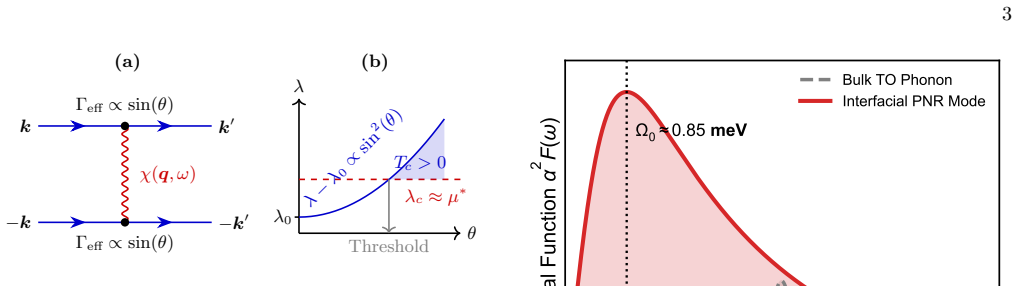
Within a reduced isotropic helicity-band description, the dynamic Rashba vertex scales as sin(θ), yielding a pairing strength λ(θ)=λ0+C sin²(θ). Exact Matsubara-Eliashberg numerical solutions show that this non-linear mapping naturally yields the same qualitative quasi-linear Tc(θ) dependence within the reduced model. Because the Rashba-activated polar channel is amplified by the large atomic spin-orbit coupling of Ta 5d orbitals, the same framework also rationalizes why KTaO3 interfaces exhibit both a much stronger orientational dependence and a substantially higher Tc scale than their SrTiO3 counterparts.
What carries the argument
The dynamic Rashba vertex in the reduced isotropic helicity-band model, which scales as sin(θ) and thereby sets the angular variation of the pairing interaction mediated by overdamped PNR fluctuations.
Load-bearing premise
Overdamped polar nanoregion fluctuations supply the dominant pairing glue and the reduced isotropic helicity-band description captures the angular dependence without needing the full microscopic interface structure.
What would settle it
Precise Tc(θ) data that deviate strongly from the quasi-linear form obtained by solving the Eliashberg equations with λ(θ)=λ0+C sin²(θ), or measurements showing no correlation between PNR activity and the superconducting state.
Figures



read the original abstract
At LaAlO$_3$/KTaO$_3$ interfaces, the superconducting $T_c$ exhibits a striking quasi-linear dependence on crystallographic orientation, coexisting with switchable polar nanoregions (PNRs). We propose an effective minimal Eliashberg framework in which overdamped PNR fluctuations provide the pairing glue, while geometric Rashba coupling controls its angular dependence. Within a reduced isotropic helicity-band description, the dynamic Rashba vertex scales as $\sin(\theta)$, yielding a pairing strength $\lambda(\theta)=\lambda_0+C\sin^2(\theta)$. Exact Matsubara-Eliashberg numerical solutions show that this non-linear mapping naturally yields the same qualitative quasi-linear $T_c(\theta)$ dependence within the reduced model. Because the Rashba-activated polar channel is amplified by the large atomic spin-orbit coupling of Ta $5d$ orbitals, the same framework also rationalizes why KTaO$_3$ interfaces exhibit both a much stronger orientational dependence and a substantially higher $T_c$ scale than their SrTiO$_3$ counterparts.
Editorial analysis
A structured set of objections, weighed in public.
Referee Report
Summary. The manuscript proposes an effective minimal Eliashberg framework for superconductivity at LaAlO3/KTaO3 interfaces. Overdamped polar nanoregion (PNR) fluctuations supply the pairing glue, while geometric Rashba coupling controls the angular dependence on crystallographic orientation θ. Within a reduced isotropic helicity-band description, the dynamic Rashba vertex scales as sin(θ), producing a pairing strength λ(θ)=λ0 + C sin²(θ). Exact Matsubara-Eliashberg numerical solutions of this nonlinear mapping are shown to recover the observed quasi-linear Tc(θ) trend. The same framework accounts for the stronger orientational dependence and higher Tc scale relative to SrTiO3 interfaces, attributing the difference to the large atomic spin-orbit coupling of Ta 5d orbitals.
Significance. If the central mapping holds, the work supplies a compact, falsifiable mechanism that ties interface geometry, Rashba physics, and polar fluctuations to the unusual superconducting phenomenology of these heterostructures. The explicit use of numerical Eliashberg solutions (rather than weak-coupling approximations) and the material-specific contrast with SrTiO3 are positive features. However, the absence of quantitative fits to measured Tc(θ) data and the reliance on an assumed angular form limit the immediate predictive or engineering utility.
major comments (2)
- [Abstract / Model Description] Abstract and model section: the claim that the dynamic Rashba vertex scales as sin(θ) (leading to λ(θ)=λ0 + C sin²(θ)) is introduced within the reduced isotropic helicity-band description but is not derived from a projection of the full Ta 5d t2g manifold. Multi-orbital effects, interface-induced orbital mixing, and atomic SOC could generate additional angular harmonics; if these corrections are O(1), the effective λ(θ) deviates from the pure sin² form and the 'natural' emergence of quasi-linear Tc(θ) no longer follows without retuning C.
- [Numerical Results] Numerical results: the manuscript states that the Matsubara-Eliashberg solutions reproduce the qualitative quasi-linear Tc(θ) dependence, yet no quantitative comparison to experimental data, χ² values, or sensitivity analysis with respect to the two free parameters λ0 and C is provided. Without such benchmarks it remains unclear whether the reproduction is robust or requires fine-tuning of the input angular form.
minor comments (2)
- The symbol λ(θ) for the pairing strength should be explicitly distinguished from the conventional Eliashberg mass-renormalization parameter to prevent notation confusion.
- A brief statement of the Matsubara frequency cutoff and convergence criteria used in the numerical Eliashberg solver would improve reproducibility.
Simulated Author's Rebuttal
We thank the referee for the positive evaluation of our work's significance and for the constructive comments on the model derivation and numerical analysis. We address each major comment below and outline the revisions we will make to strengthen the manuscript.
read point-by-point responses
-
Referee: [Abstract / Model Description] Abstract and model section: the claim that the dynamic Rashba vertex scales as sin(θ) (leading to λ(θ)=λ0 + C sin²(θ)) is introduced within the reduced isotropic helicity-band description but is not derived from a projection of the full Ta 5d t2g manifold. Multi-orbital effects, interface-induced orbital mixing, and atomic SOC could generate additional angular harmonics; if these corrections are O(1), the effective λ(θ) deviates from the pure sin² form and the 'natural' emergence of quasi-linear Tc(θ) no longer follows without retuning C.
Authors: We appreciate the referee's point on the need for a clearer connection to the underlying t2g manifold. Our reduced isotropic helicity-band description is chosen as a minimal effective model to isolate the geometric Rashba contribution to the pairing vertex from the overdamped polar fluctuations. The sin(θ) scaling emerges directly from the interface geometry and the helicity-basis projection of the Rashba term. To address the concern, we will add a concise appendix that sketches the leading-order projection from the full Ta 5d t2g states (including atomic SOC), demonstrating that higher angular harmonics remain subdominant in the relevant regime of strong atomic spin-orbit coupling. This will clarify the robustness of the sin² form without altering the main text. revision: partial
-
Referee: [Numerical Results] Numerical results: the manuscript states that the Matsubara-Eliashberg solutions reproduce the qualitative quasi-linear Tc(θ) dependence, yet no quantitative comparison to experimental data, χ² values, or sensitivity analysis with respect to the two free parameters λ0 and C is provided. Without such benchmarks it remains unclear whether the reproduction is robust or requires fine-tuning of the input angular form.
Authors: We agree that quantitative benchmarks would make the numerical results more compelling. The current manuscript emphasizes the qualitative mapping from the nonlinear λ(θ) to the observed Tc(θ) trend. In the revised version we will add a sensitivity analysis (new figure) showing how the quasi-linear Tc(θ) persists across a range of λ0 and C values consistent with the material parameters. We will also include direct comparisons to the available experimental Tc values at representative angles, together with a simple goodness-of-fit metric to illustrate that the trend is reproduced without extreme fine-tuning. revision: yes
Circularity Check
No significant circularity; derivation is self-contained
full rationale
The paper proposes an effective minimal Eliashberg framework in which the dynamic Rashba vertex scaling as sin(θ) is stated as a property within the reduced isotropic helicity-band description, directly yielding the λ(θ)=λ0+C sin²(θ) form. The subsequent exact Matsubara-Eliashberg numerical solutions then compute the resulting Tc(θ) dependence from this input. This constitutes standard model construction followed by independent numerical solution of the Eliashberg equations rather than any reduction of the output to the inputs by construction or self-definition. No load-bearing step equates a claimed prediction to a fitted parameter or self-citation chain; the qualitative reproduction of quasi-linear Tc(θ) is a calculated consequence of the non-linear mapping, not tautological.
Axiom & Free-Parameter Ledger
free parameters (2)
- λ0
- C
axioms (2)
- domain assumption Overdamped PNR fluctuations provide the pairing glue
- domain assumption Reduced isotropic helicity-band description captures the angular dependence
Reference graph
Works this paper leans on
-
[1]
C. Liu, X. Yan, D. Jin, Y. Ma, H.-W. Hsiao, Y. Lin, T. M. Bretz-Sullivan, X. Zhou, J. Pearson, B. Fisher, J. S. Jiang, W. Han, J.-M. Zuo, J. Wen, D. D. Fong, J. Sun, H. Zhou, and A. Bhattacharya, Two-dimensional superconductivity and anisotropic transport at KTaO 3 (111) interfaces, Science371, 716 (2021)
2021
-
[2]
Z. Chen, Y. Liu, H. Zhang, Z. Liu, H. Tian, Y. Sun, M. Zhang, Y. Zhou, J. Sun, and Y. Xie, Electric field control of superconductivity at the LaAlO3/KTaO3 (111) interface, Science372, 721 (2021)
2021
-
[3]
Z. Chen, Z. Liu, Y. Sun, X. Chen, Y. Liu, H. Zhang, H. Li, M. Zhang, S. Hong, T. Ren, C. Zhang, H. Tian, Y. Zhou, J. Sun, and Y. Xie, Two-dimensional supercon- ductivity at the LaAlO 3/KTaO3 (110) heterointerface, Physical Review Letters126, 026802 (2021)
2021
- [4]
-
[5]
Ohtomo and H
A. Ohtomo and H. Y. Hwang, A high-mobility electron gas at the LaAlO 3/SrTiO3 heterointerface, Nature427, 423 (2004)
2004
-
[6]
Reyren, S
N. Reyren, S. Thiel, A. D. Caviglia, L. Fitting Kourk- outis, G. Hammerl, C. Richter, C. W. Schneider, T. Kopp, A.-S. R¨ uetschi, D. Jaccard, M. Gabay, D. A. Muller, J.-M. Triscone, and J. Mannhart, Superconduct- ing interfaces between insulating oxides, Science317, 1196 (2007)
2007
-
[7]
A. D. Caviglia, S. Gariglio, N. Reyren, D. Jac- card, T. Schneider, M. Gabay, S. Thiel, G. Hammerl, J. Mannhart, and J.-M. Triscone, Electric field control of the LaAlO3/SrTiO3 interface ground state, Nature456, 624 (2008)
2008
-
[8]
Enderlein, J
C. Enderlein, J. F. de Oliveira, D. A. Tompsett, E. B. Saitovitch, S. S. Saxena, G. G. Lonzarich, and S. E. Row- ley, Superconductivity mediated by polar modes in ferro- electric metals, Nature Communications11, 4852 (2020)
2020
-
[9]
T. Ren, M. Li, X. Sun, L. Ju, Y. Liu, S. Hong, Y. Sun, Q. Tao, Y. Zhou, Z.-A. Xu, and Y. Xie, Two-dimensional superconductivity at the surfaces of KTaO 3 gated with ionic liquid, Science Advances8, eabn4273 (2022)
2022
-
[10]
Zhang, M
M. Zhang, M. Qin, Y. Sun, S. Hong, Y. Zhou, and Y. Xie, Enhanced superconductivity and coexisting ferroelectric- ity at oxide interfaces, Nature Communications17, 219 (2026)
2026
-
[11]
M. D. Dong, X. B. Cheng, M. Zhang, and J. Wu, Strongly coupled interface ferroelectricity and interface supercon- ductivity in amorphous LaAlO 3/KTaO3(111), Nature Communications17, 2805 (2026)
2026
-
[12]
Palle and J
G. Palle and J. Schmalian, Unconventional superconduc- tivity from electronic dipole fluctuations, Physical Re- view B110, 104516 (2024)
2024
-
[13]
Shirane, R
G. Shirane, R. Nathans, and V. J. Minkiewicz, Temper- ature dependence of the soft ferroelectric mode in ktao 3, Phys. Rev.157, 396 (1967)
1967
-
[14]
Cochran, Crystal stability and the theory of ferro- electricity, Advances in Physics9, 387 (1960)
W. Cochran, Crystal stability and the theory of ferro- electricity, Advances in Physics9, 387 (1960)
1960
-
[15]
Junquera and P
J. Junquera and P. Ghosez, Critical thickness for ferro- electricity in perovskite ultrathin films, Nature422, 506 (2003)
2003
-
[16]
Kozii and L
V. Kozii and L. Fu, Odd-parity superconductivity in the vicinity of inversion symmetry breaking in spin-orbit- coupled systems, Physical Review Letters115, 207002 (2015)
2015
-
[17]
X. Chen, T. Yu, Y. Liu, Y. Sun, M. Lei, N. Guo, Y. Fan, X. Sun, M. Zhang, F. Alarab, V. N. Strocov, Y. Wang, T. Zhou, X. Liu, F. Lu, W. Liu, Y. Xie, R. Peng, H. Xu, and D. Feng, Orientation-dependent electronic structure in interfacial superconductors LaAlO 3/KTaO3, Nature Communications15, 7704 (2024)
2024
-
[18]
G. M. Eliashberg, Interactions between electrons and lat- tice vibrations in a superconductor, Soviet Physics JETP 11, 696 (1960), [Zh. Eksp. Teor. Fiz.38, 966 (1960)]
1960
-
[19]
J. P. Carbotte, Properties of boson-exchange supercon- ductors, Reviews of Modern Physics62, 1027 (1990)
1990
-
[20]
Morel and P
P. Morel and P. W. Anderson, Calculation of the su- perconducting state parameters with retarded electron- phonon interaction, Phys. Rev.125, 1263 (1962)
1962
-
[21]
P. B. Allen and R. C. Dynes, Transition temperature of strong-coupled superconductors reanalyzed, Physical Review B12, 905 (1975)
1975
-
[22]
P. D. C. King, R. H. He, T. Eknapakul, P. Buaphet, S.-K. Mo, Y. Kaneko, S. Harashima, Y. Hikita, M. S. Bahramy, C. Bell, Z. Hussain, Y. Tokura, Z.-X. Shen, H. Y. Hwang, F. Baumberger, and W. Meevasana, Sub- band structure of a two-dimensional electron gas formed at the polar surface of the strong spin-orbit perovskite KTaO3, Physical Review Letters108, 11...
2012
-
[23]
Zhong, A
Z. Zhong, A. T´ oth, and K. Held, Theory of spin-orbit coupling at LaAlO 3/SrTiO3 interfaces and SrTiO 3 sur- faces, Phys. Rev. B87, 161102(R) (2013)
2013
-
[24]
M. N. Gastiasoro, J. Ruhman, and R. M. Fernandes, Su- perconductivity in dilute SrTiO 3: A review, Annals of Physics417, 168107 (2020)
2020
-
[25]
Geometric Rashba Control of Polar Pairing at LaAlO3/KTaO3 Interfaces
yizhou76 sudo, KTO-Geometry-SOC (2026). 7 Supplementary Material for “Geometric Rashba Control of Polar Pairing at LaAlO3/KTaO3 Interfaces” CONTENTS Supplementary Note 1: Basis Rotation, the Fundamental Domain, and Dipole Matrix Elements 1 Supplementary Note 2: Microscopic Derivation of the Dynamic Rashba Vertex and Helicity Basis Projection 1 Supplementa...
2026
-
[26]
Becausehis the largest index in this domain, the maximum possible polar angle occurs for the (111) facet, whereh=k=l, yieldingθ max = arccos(1/ √ 3)≈54.7 ◦
axis:θ= arccos(h/ √ h2 +k 2 +l 2). Becausehis the largest index in this domain, the maximum possible polar angle occurs for the (111) facet, whereh=k=l, yieldingθ max = arccos(1/ √ 3)≈54.7 ◦. Therefore, the physically unique geometric parameter space is strictly bounded by 0 ◦ ≤θ≤54.7 ◦. To derive the sin(θ) dependence of the dynamic electron-boson vertex...
-
[27]
The total field is strictly out-of-plane:E= (E 0 +δE z)ˆn
F undamental SOC and the Out-of-Plane Polar Fluctuation The fundamental relativistic spin-orbit interaction for an electron moving in an electric fieldEis given by: HSO ∝(E×k)·σ.(S7) The total electric field at the interface consists of the static confinement fieldE static =E 0ˆnand the dynamic out-of- plane amplitude fluctuations of the polar nanoregions...
-
[28]
To construct a scalar- dominant Eliashberg pairing strengthλ, we project this interaction onto the eigenstates of the unperturbed Fermi surface
Projection onto the Helicity Basis The dynamic interactionH int ∝(k×σ)·ˆnis matrix-valued and momentum-dependent. To construct a scalar- dominant Eliashberg pairing strengthλ, we project this interaction onto the eigenstates of the unperturbed Fermi surface. The static non-interacting Hamiltonian is given byH 0 = ℏ2k2 2m∗ +α R ˆΛk, where we define the hel...
-
[29]
Reduction to a Scalar Eliashberg Kernel Within the Eliashberg formalism, the pairing strengthλis obtained by integrating out the bosonic field. The effective four-fermion interactionV eff mediated by the boson involves the product of two vertices and the boson propagatorχ(q, ω): Veff ∝ |⟨Γeff⟩FS|2χ(q, ω).(S13) Because the helicity projection maps the domi...
-
[30]
In the limit of dominant intra-band, small-qforward scattering, it motivates the reduction of the full mixed- parity Nambu-Gorkov equations to the standard, isotropic Eliashberg equations utilized in Supplementary Note 4
-
[31]
This provides the analytical input required for the macroscopic Allen-DynesT c evaluation
Because the effective pairing strengthλis proportional to the square of this scalar vertex (λ∝ |Γ eff|2), the Eliashberg coupling inherits the geometric scaling:λ(θ) =λ 0 +Csin 2(θ). This provides the analytical input required for the macroscopic Allen-DynesT c evaluation
-
[32]
This angular dependence is physically profound, as it dictates the exact symmetry admixture ofs-wave andp-wave pairing components inherent to non-centrosymmetric superconductors
Caveat Regarding the Spinor Overlap F actor We note that the exact projection of the Rashba vertex between different momentum stateskandk ′ introduces an angular spinor overlap factor, proportional to cos[(ϕ k −ϕ k′)/2]. This angular dependence is physically profound, as it dictates the exact symmetry admixture ofs-wave andp-wave pairing components inhere...
-
[33]
Becauseµ ∗ and the attractive pairing strength enter the Allen-Dynes exponent in a correlated way, a full nonlinear refit causes the effective parameters to covary
Constrained sensitivity to the Coulomb pseudopotentialµ ∗ In the main text, we fixµ ∗ = 0.13 as a representative value for a strongly screened oxide interface. Becauseµ ∗ and the attractive pairing strength enter the Allen-Dynes exponent in a correlated way, a full nonlinear refit causes the effective parameters to covary. Our central physical conclusion,...
-
[34]
Comparison with empirical alternatives One may ask whether simpler empirical forms can describe the same dataset without invoking the reduced Eliashberg framework. To address this, we compare the present fit against two representative alternatives: (i) a purely linear fit, Tc =aθ+b, and (ii) a thresholded quadratic fit,T c =Amax[sin 2(θ)−θ 0,0], whereθ 0 ...
discussion (0)
Sign in with ORCID, Apple, or X to comment. Anyone can read and Pith papers without signing in.