Recognition: unknown
Exploring the conditions for forming planetesimals by the streaming instability and planetary systems by pebble accretion
Pith reviewed 2026-05-07 14:17 UTC · model grok-4.3
The pith
A narrow range of pebble sizes lets the streaming instability form planetesimals while pebble accretion builds cold giants, super-Earths and rocky embryos together.
A machine-rendered reading of the paper's core claim, the machinery that carries it, and where it could break.
Core claim
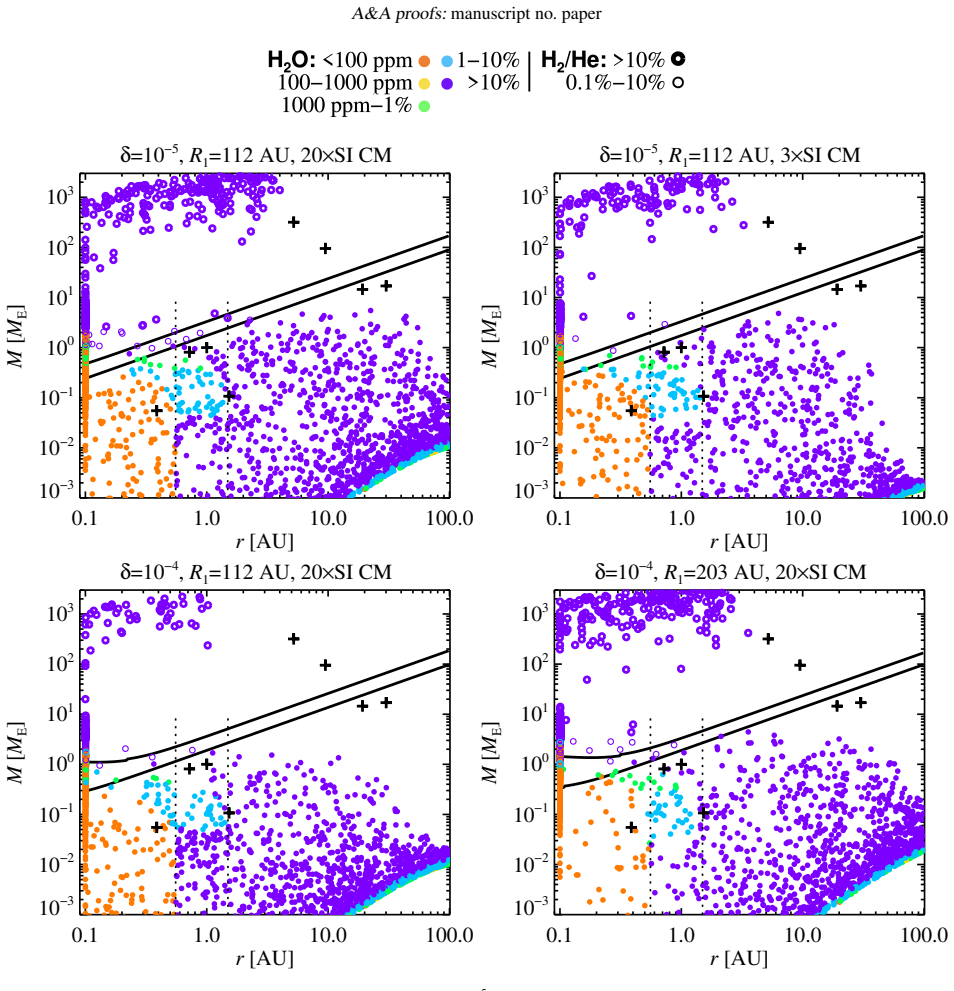
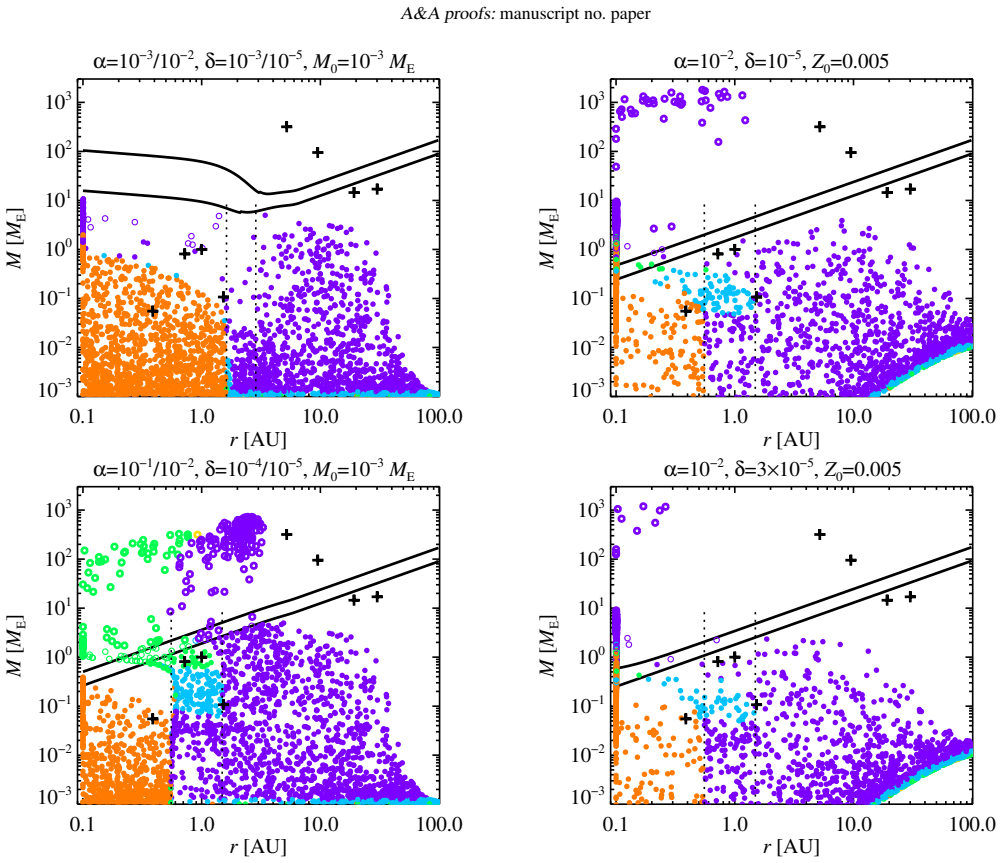
By exploring protoplanetary disc conditions in terms of turbulence strength, Stokes number and initial disc size, the paper identifies an optimum Stokes number range between St=0.01 and St=0.03 where all three planetary classes form and where the streaming instability is triggered for a slightly elevated pebble metallicity. Cold gas giants require a turbulence strength of at most δ=10^{-4} and large initial disc sizes to benefit from a prolonged pebble flux; super-Earths and rocky planet embryos tolerate higher turbulence strengths. A higher Stokes number of St=0.1 is detrimental to cold gas giants due to the short-lived pebble flux, while Stokes numbers below 0.003 demand extremely low turb
What carries the argument
The Stokes number of pebbles, which sets how tightly they couple to the gas and thereby controls both their concentration into planetesimals by streaming instability and the duration of the pebble supply available for accretion.
If this is right
- All major planet classes form together when pebbles have Stokes numbers between 0.01 and 0.03 and pebble metallicity is only slightly elevated.
- Cold gas giants appear only in large, low-turbulence disks that sustain a long pebble flux.
- Super-Earths and rocky embryos form at higher turbulence levels consistent with the vertical shear instability.
- Planetesimal masses produced by streaming instability reach the threshold where pebble accretion becomes efficient if formation occurs early.
- Gas loss to disk winds or outer pressure bumps can widen the conditions that permit cold gas giants.
Where Pith is reading between the lines
- The diversity of observed exoplanet systems can arise from modest variations in a few shared disk parameters rather than entirely separate formation channels.
- The mass match between planetesimals and the pebble-accretion threshold suggests a direct transition to rapid growth without needing a separate embryo stage.
- Turbulence measurements in disks that do or do not host cold giants could test whether low turbulence is strictly required.
- Adding thermal or dynamical torques that slow migration would further relax the conditions needed for outer planets.
Load-bearing premise
Pebble metallicity must reach locally elevated levels to trigger the streaming instability, and the disk must evolve without strong pressure bumps or rapid gas loss that would alter the timing of the pebble flux.
What would settle it
Direct measurement of pebble Stokes numbers in a young disk that contains cold gas giants but shows turbulence above 10^{-4} or pebble metallicities below the modest elevation threshold would falsify the claimed optimum range.
Figures





read the original abstract
The streaming instability and pebble accretion are two physical mechanisms with demonstrated potentials to drive, respectively, the formation of planetesimals and the growth of planetary systems containing a diverse range of planetary types. Here we explore the protoplanetary disc conditions in terms of turbulence strength, Stokes number and initial disc size that are needed to (i) form planetesimals by the streaming instability, (ii) form gas giant planets in cold orbits, (iii) form super-Earths and sub-Neptunes close to the star and (iv) form rocky planet embryos in temperate orbits. We identify an optimum Stokes number range between St= 0.01 and St= 0.03 where all three planetary classes form and where the streaming instability is triggered for a slightly elevated pebble metallicity. Cold gas giants require a turbulence strength of at most $\delta=10^{-4}$ and furthermore need large initial disc sizes to benefit from a prolonged pebble flux; super-Earths and rocky planet embryos tolerate higher turbulence strengths similar to those measured for the vertical shear instability. A higher Stokes number of St=0.1 is detrimental to the formation of cold gas giants due to the short-lived pebble flux. For Stokes numbers below St= 0.003, extremely low values of turbulence ($\delta<10^{-5}$) are required to form cold gas giants. We highlight how loss of gas to disc winds, reduction in the migration speed by thermal or dynamical torques or the presence of pressure bumps in the outer disc could increase the parameter space for the formation of cold gas giants. We derive analytically that the mass of the largest planetesimals formed by the streaming instability is of similar magnitude to the threshold mass beyond which pebble accretion becomes efficient, if planetesimals form in the earliest phases of protoplanetary disc evolution.
Editorial analysis
A structured set of objections, weighed in public.
Referee Report
Summary. The manuscript explores protoplanetary disc conditions in turbulence strength δ, Stokes number St, and initial disc size needed to form planetesimals via the streaming instability (SI) and to produce cold gas giants, super-Earths/sub-Neptunes, and rocky planet embryos via pebble accretion. It identifies an optimum St range of 0.01–0.03 where SI triggers at mildly elevated pebble metallicity and all three planet classes form. Cold gas giants require δ ≤ 10^{-4} and large initial discs for prolonged pebble flux; higher St=0.1 or St<0.003 impose stricter limits. The paper analytically derives that the largest SI planetesimal mass is comparable in magnitude to the pebble-accretion efficiency threshold when formation occurs in the earliest disc phases, and discusses how disc winds, torques, or pressure bumps could expand viable regions for cold giants.
Significance. If the results hold, the work supplies a unified parameter-space framework linking SI planetesimal formation directly to pebble-accretion outcomes across planet classes, yielding testable ranges for St and δ that could inform both simulations and exoplanet population studies. The analytical mass-equivalence result, if shown to be robust beyond the earliest-phase assumption, would provide a concrete physical connection between the two mechanisms. Explicit exploration of mitigating processes such as pressure bumps adds practical value for interpreting observed disc structures.
major comments (2)
- [analytical derivation and cold-giant parameter space] The analytical derivation (abstract and corresponding section) states that the largest SI planetesimal mass matches the pebble-accretion threshold mass only if planetesimals form in the earliest phases of disc evolution. However, the reported conditions for cold gas giants (large initial disc sizes combined with δ ≤ 10^{-4}) necessarily extend the pebble flux over later evolutionary stages where Σ_gas has declined. Because both the SI clump mass and the pebble-accretion threshold scale with local gas density and orbital radius, the magnitude equivalence may not hold under the same parameter combinations used for the numerical results; a time-dependent verification or explicit calculation at the reported late times is required to support the central claim.
- [numerical results and abstract] The numerical exploration of the St–δ–disc-size space (abstract and results sections) identifies the optimum St=0.01–0.03 window and the boundaries for each planetary class, yet provides no error bars, convergence tests, or details on how post-hoc metallicity thresholds for SI triggering were chosen. These omissions make it difficult to assess the robustness of the reported optimum range and the separation between cold-giant and other-planet regimes.
minor comments (2)
- A summary table listing the viable δ and St ranges for each planetary class (cold giants, super-Earths, rocky embryos) would improve readability and allow direct comparison with the analytical mass result.
- The manuscript would benefit from a brief statement on the assumed disc-evolution model (e.g., how Σ_gas(t) is parameterized) to clarify the timing assumptions underlying both the numerical runs and the analytical derivation.
Simulated Author's Rebuttal
We thank the referee for the constructive and detailed report. The comments highlight important points regarding the scope of our analytical derivation and the transparency of our numerical parameter-space exploration. We address each major comment below and will incorporate revisions to improve clarity and support for the claims.
read point-by-point responses
-
Referee: [analytical derivation and cold-giant parameter space] The analytical derivation (abstract and corresponding section) states that the largest SI planetesimal mass matches the pebble-accretion threshold mass only if planetesimals form in the earliest phases of disc evolution. However, the reported conditions for cold gas giants (large initial disc sizes combined with δ ≤ 10^{-4}) necessarily extend the pebble flux over later evolutionary stages where Σ_gas has declined. Because both the SI clump mass and the pebble-accretion threshold scale with local gas density and orbital radius, the magnitude equivalence may not hold under the same parameter combinations used for the numerical results; a time-dependent verification or explicit calculation at the reported late times is required to support the central claim.
Authors: We agree that the analytical equivalence is presented under the explicit condition of planetesimal formation in the earliest disc phases, as stated in the abstract and derivation section. The cold-gas-giant regime in our numerical exploration does rely on large initial disc sizes and low δ to maintain pebble flux over extended times. However, the largest SI planetesimals are expected to form early when gas densities are highest, after which they can continue to grow via pebble accretion as the disc evolves. The result is intended as an order-of-magnitude physical link rather than a precise equality at all epochs. We will add a clarifying paragraph in the discussion section that (i) reiterates the early-phase assumption, (ii) notes the scaling of both masses with declining Σ_gas, and (iii) provides a brief analytic estimate of the mass ratio at a representative later time (e.g., 1 Myr) for the fiducial cold-giant parameters. This will strengthen the connection without requiring a full time-dependent re-simulation of the entire parameter space. revision: yes
-
Referee: [numerical results and abstract] The numerical exploration of the St–δ–disc-size space (abstract and results sections) identifies the optimum St=0.01–0.03 window and the boundaries for each planetary class, yet provides no error bars, convergence tests, or details on how post-hoc metallicity thresholds for SI triggering were chosen. These omissions make it difficult to assess the robustness of the reported optimum range and the separation between cold-giant and other-planet regimes.
Authors: The metallicity thresholds for SI triggering are taken directly from the established analytic and simulation results in the literature (Youdin & Johansen 2007; Johansen et al. 2009; Li & Youdin 2021), where the critical pebble-to-gas ratio depends on St and δ. These are not chosen post-hoc but are applied consistently across the St–δ grid as the minimum metallicity needed for the instability to operate. We will insert a short methods subsection that (i) states the exact functional form and references used for the thresholds, (ii) explains that the optimum St window emerges from the overlap of SI-viable metallicities with the pebble-accretion efficiency requirements for each planet class, and (iii) discusses the sensitivity of the reported boundaries to modest variations (±20 %) in the adopted thresholds. Because the study employs semi-analytic prescriptions rather than suites of high-resolution hydrodynamical runs, conventional numerical convergence tests and statistical error bars are not directly applicable; we will nevertheless add a robustness paragraph quantifying how the St=0.01–0.03 optimum shifts under reasonable changes in disc parameters. revision: yes
Circularity Check
No circularity: analytical derivation and parameter exploration are independent of fitted outcomes
full rationale
The paper's central results consist of (i) an identified optimum Stokes number window obtained by exploring turbulence, St, and disc size parameters and (ii) an explicit analytical derivation of planetesimal mass equivalence to the pebble-accretion threshold, conditioned on formation in the earliest disc phases. Neither step reduces to a self-definition, a fitted input renamed as prediction, or a load-bearing self-citation. The conditional phrasing of the analytical result is stated openly rather than smuggled in, and the numerical boundaries are presented as outcomes of the explored models rather than forced by construction. The derivation chain therefore remains self-contained against external benchmarks.
Axiom & Free-Parameter Ledger
free parameters (3)
- turbulence strength δ
- Stokes number St
- initial disc size
axioms (2)
- domain assumption Pebble metallicity can be locally elevated enough to trigger streaming instability without additional concentration mechanisms.
- domain assumption Disc evolution follows standard viscous or wind-driven models without strong pressure bumps altering pebble drift.
Reference graph
Works this paper leans on
-
[1]
doi:10.1051/0004-6361/202245252
Appelgren, J., Lambrechts, M., & van der Marel, N.\ 2023, , 673, A139. doi:10.1051/0004-6361/202245252
-
[2]
Arakawa, S., Okuzumi, S., Tatsuuma, M., et al.\ 2023, , 951, 1, L16. doi:10.3847/2041-8213/acdb5f
-
[3]
Bai, X.-N. & Stone, J. M.\ 2010, , 722, 2, 1437. doi:10.1088/0004-637X/722/2/1437
-
[4]
Baraffe, I., Homeier, D., Allard, F., et al.\ 2015, , 577, A42. doi:10.1051/0004-6361/201425481
-
[5]
Monthly Notices of the Royal Astronomical Society475(4), 5618–5658 (2018)
Bate, M. R.\ 2018, , 475, 4, 5618. doi:10.1093/mnras/sty169
-
[6]
& Morbidelli, A.\ 2022, , 666, A19
Batygin, K. & Morbidelli, A.\ 2022, , 666, A19. doi:10.1051/0004-6361/202243196
-
[7]
& Bitsch, B.\ 2020, , 637, A11
Baumann, T. & Bitsch, B.\ 2020, , 637, A11. doi:10.1051/0004-6361/202037579
-
[8]
doi:10.1038/nature14277 , eprint =
Ben \' tez-Llambay, P., Masset, F., Koenigsberger, G., et al.\ 2015, , 520, 7545, 63. doi:10.1038/nature14277
-
[9]
arXiv , author =:1801.07913 , journal =
Ben \' tez-Llambay, P. & Pessah, M. E.\ 2018, , 855, 2, L28. doi:10.3847/2041-8213/aab2ae
-
[10]
doi:10.1051/0004-6361/201527874
B \'e thune, W., Lesur, G., & Ferreira, J.\ 2016, , 589, A87. doi:10.1051/0004-6361/201527874
-
[11]
doi:10.1051/0004-6361/201630056
B \'e thune, W., Lesur, G., & Ferreira, J.\ 2017, , 600, A75. doi:10.1051/0004-6361/201630056
-
[12]
Birnstiel, T., Ormel, C. W., & Dullemond, C. P.\ 2011, , 525, A11. doi:10.1051/0004-6361/201015228
-
[13]
arXiv , author =:1411.3255 , journal =
Bitsch, B., Johansen, A., Lambrechts, M., et al.\ 2015, , 575, A28. doi:10.1051/0004-6361/201424964
-
[14]
Bitsch, B., Morbidelli, A., Johansen, A., et al.\ 2018, , 612, A30
2018
-
[15]
doi:10.1051/0004-6361/201834489 , eid =
Bitsch, B., Izidoro, A., Johansen, A., et al.\ 2019, , 623, A88. doi:10.1051/0004-6361/201834489
-
[16]
& Wurm, G.\ 2000, , 143, 1, 138
Blum, J. & Wurm, G.\ 2000, , 143, 1, 138. doi:10.1006/icar.1999.6234
-
[17]
Bosman, A. D., Appelgren, J., Bergin, E. A., et al.\ 2023, , 944, 2, L53. doi:10.3847/2041-8213/acb651
-
[18]
Bottke, W. F., Durda, D. D., Nesvorn \'y , D., et al.\ 2005, , 175, 1, 111. doi:10.1016/j.icarus.2004.10.026
-
[19]
doi:10.1051/0004-6361:20077759 , eprint =
Brauer, F., Dullemond, C. P., & Henning, T.\ 2008, , 480, 3, 859. doi:10.1051/0004-6361:20077759
-
[20]
Buchhave, L., Latham, D., Johansen, A., et al.\ 2012, Nature, 486, 375-377, doi:10.1038/nature11121
-
[21]
Burrill, B. P., Ricci, L., Harter, S. K., et al.\ 2022, , 928, 1, 40. doi:10.3847/1538-4357/ac5592
-
[22]
Carrera, D., Johansen, A., & Davies, M. B.\ 2015, , 579, A43. doi:10.1051/0004-6361/201425120
-
[23]
Carrera, D., Gorti, U., Johansen, A., et al.\ 2017, , 839, 1, 16. doi:10.3847/1538-4357/aa6932
-
[24]
Chambers, J. E. & Wetherill, G. W.\ 1998, , 136, 2, 304. doi:10.1006/icar.1998.6007
-
[25]
arXiv , author =:1808.03293 , journal =
Chambers, J.\ 2018, , 865, 30. doi:10.3847/1538-4357/aada09
-
[26]
The Astrophysical Journal , author =
Chambers, J.\ 2019, , 879, 2, 98. doi:10.3847/1538-4357/ab2537
-
[27]
arXiv , author =:1306.0576 , journal =
Chatterjee, S. & Tan, J. C.\ 2014, , 780, 1, 53. doi:10.1088/0004-637X/780/1/53
-
[28]
2025, A&A, 701, A94, doi: 10.1051/0004-6361/202555380
Chen, D.-C., Mordasini, C., Emsenhuber, A., et al.\ 2025, , 701, A94. doi:10.1051/0004-6361/202555380
-
[29]
doi:10.1051/0004-6361/202555095
Danti, C., Lambrechts, M., & Lorek, S.\ 2025, , 700, A132. doi:10.1051/0004-6361/202555095
-
[30]
Desch, S. J. & Turner, N. J.\ 2015, , 811, 2, 156. doi:10.1088/0004-637X/811/2/156
-
[31]
Dominik, C. & Dullemond, C. P.\ 2024, , 682, A144. doi:10.1051/0004-6361/202347716
-
[32]
2017, , 608, A92, 10.1051/0004-6361/201731491
Dr a \.z kowska, J. & Alibert, Y.\ 2017, , 608, A92. doi:10.1051/0004-6361/201731491
-
[33]
Dullemond, C. P. & Dominik, C.\ 2005, , 434, 3, 971. doi:10.1051/0004-6361:20042080
-
[34]
Eriksson, L. E. J., Mol Lous, M. A. S., Shibata, S., et al.\ 2023, , 526, 4, 4860. doi:10.1093/mnras/stad3007
-
[35]
Eriksson, L. E. J., Xu, Z., Lim, J., et al.\ 2026, arXiv:2603.17195. doi:10.48550/arXiv.2603.17195
-
[36]
Fernandez, J. A. & Ip, W.-H.\ 1984, , 58, 1, 109. doi:10.1016/0019-1035(84)90101-5
-
[37]
doi:10.1051/0004-6361/201220241 , eid =
Fortier, A., Alibert, Y., Carron, F., et al.\ 2013, , 549, A44. doi:10.1051/0004-6361/201220241
-
[38]
& Teiser, J.\ 2021, , 923, 2, 134
Fritscher, M. & Teiser, J.\ 2021, , 923, 2, 134. doi:10.3847/1538-4357/ac2df4
-
[39]
Meyer Marcy, G.W., Rubenzahl, R.A., Weiss, L.M., Wright, J.T.: California Legacy Survey
Fulton, B. J., Rosenthal, L. J., Hirsch, L. A., et al.\ 2021, , 255, 1, 14. doi:10.3847/1538-4365/abfcc1
-
[40]
& Blum, J.\ 2015, , 798, 1, 34
Gundlach, B. & Blum, J.\ 2015, , 798, 1, 34. doi:10.1088/0004-637X/798/1/34
-
[41]
P., Kreuzig, C., et al.\ 2018, , 479, 1, 1273
Gundlach, B., Schmidt, K. P., Kreuzig, C., et al.\ 2018, , 479, 1, 1273. doi:10.1093/mnras/sty1550
-
[42]
doi:10.1051/0004-6361/202348020
Gurrutxaga, N., Johansen, A., Lambrechts, M., et al.\ 2024, , 682, A43. doi:10.1051/0004-6361/202348020
-
[43]
doi:10.1051/0004-6361/200912852
G \"u ttler, C., Blum, J., Zsom, A., et al.\ 2010, , 513, A56. doi:10.1051/0004-6361/200912852
-
[44]
1998, ApJ, 495, 385, doi: 10.1086/305277
Hartmann, L., Calvet, N., Gullbring, E., et al.\ 1998, , 495, 1, 385. doi:10.1086/305277
-
[45]
& Bai, X.-N.\ 2025, , 986, 1, L13
Huang, P. & Bai, X.-N.\ 2025, , 986, 1, L13. doi:10.3847/2041-8213/adcebb
-
[46]
2016, Astronomy and Astrophysics, 591, 72, doi: 10.1051/0004-6361/201628099
Ida, S., Guillot, T., & Morbidelli, A.\ 2016, , 591, A72. doi:10.1051/0004-6361/201628099
-
[47]
arXiv , author =:1610.09643 , journal =
Ida, S. & Guillot, T.\ 2016, , 596, L3. doi:10.1051/0004-6361/201629680
-
[48]
doi:10.3847/1538-4357/aad69c , eid =
Ida, S., Tanaka, H., Johansen, A., et al.\ 2018, , 864, 1, 77. doi:10.3847/1538-4357/aad69c
-
[49]
D., Hall, C., Walsh, C., et al.\ 2020, , 498, 4, 5116
Ilee, J. D., Hall, C., Walsh, C., et al.\ 2020, , 498, 4, 5116. doi:10.1093/mnras/staa2699
-
[50]
Izidoro, A., Bitsch, B., Raymond, S. N., et al.\ 2021, , 650, A152. doi:10.1051/0004-6361/201935336
-
[51]
Jiang, H. & Ormel, C. W.\ 2023, , 518, 3, 3877. doi:10.1093/mnras/stac3275
-
[52]
Jiang, H., Mac \' as, E., Guerra-Alvarado, O. M., et al.\ 2024, , 682, A32. doi:10.1051/0004-6361/202348271
-
[53]
Jiang, H., Long, F., Mac \' as, E., et al.\ 2025, , 993, 2, 166. doi:10.3847/1538-4357/ae089e
-
[54]
Johansen, A., Oishi, J. S., Mac Low, M.-M., et al.\ 2007, , 448, 7157, 1022. doi:10.1038/nature06086
-
[55]
Johansen, A. & Youdin, A.\ 2007, , 662, 1, 627. doi:10.1086/516730
-
[56]
doi:10.1088/0004-637X/697/2/1269
Johansen, A., Youdin, A., & Klahr, H.\ 2009a, , 697, 2, 1269. doi:10.1088/0004-637X/697/2/1269
-
[57]
doi:10.1088/0004-637X/704/2/L75
Johansen, A., Youdin, A., & Mac Low, M.-M.\ 2009b, , 704, 2, L75. doi:10.1088/0004-637X/704/2/L75
-
[58]
V., Melchior, A.-L., & Zolotukhin, I
Johansen, A. & Lacerda, P.\ 2010, , 404, 1, 475. doi:10.1111/j.1365-2966.2010.16309.x
-
[59]
Johansen, A., Mac Low, M.-M., Lacerda, P., et al.\ 2015, Science Advances, 1, 1500109. doi:10.1126/sciadv.1500109
-
[60]
Johansen, A. & Lambrechts, M.\ 2017, Annual Review of Earth and Planetary Sciences, 45, 1, 359. doi:10.1146/annurev-earth-063016-020226
-
[61]
& Bitsch, B.\ 2019, , 631, A70
Johansen, A. & Bitsch, B.\ 2019, , 631, A70. doi:10.1051/0004-6361/201936351
-
[62]
doi:10.1051/0004-6361/201834071
Johansen, A., Ida, S., & Brasser, R.\ 2019, , 622, A202. doi:10.1051/0004-6361/201834071
-
[63]
Science Advances 7(8), eabc0444 (2021)
Johansen, A., Ronnet, T., Bizzarro, M., et al.\ 2021, Science Advances, 7, 8, eabc0444. doi:10.1126/sciadv.abc0444
-
[64]
doi:10.1051/0004-6361/202142141
Johansen, A., Ronnet, T., Schiller, M., et al.\ 2023a, , 671, A74. doi:10.1051/0004-6361/202142141
-
[65]
doi:10.1051/0004-6361/202142142
Johansen, A., Ronnet, T., Schiller, M., et al.\ 2023b, , 671, A75. doi:10.1051/0004-6361/202142142
-
[66]
T., Dones, L., et al.\ 2025, Centaurs, 2
Johansen, A., Bannister, M. T., Dones, L., et al.\ 2025, Centaurs, 2. doi:10.1088/10.1088/2514-3433/ada267ch2
-
[67]
M., Alibert, Y., et al.\ 2025, , 696, A65
Kaufmann, N., Guilera, O. M., Alibert, Y., et al.\ 2025, , 696, A65. doi:10.1051/0004-6361/202452428
-
[68]
doi:10.1088/0004-637X/812/1/67
Kimura, H., Wada, K., Senshu, H., et al.\ 2015, , 812, 1, 67. doi:10.1088/0004-637X/812/1/67
-
[69]
& Schreiber, A.\ 2021, , 911, 1, 9
Klahr, H. & Schreiber, A.\ 2021, , 911, 1, 9. doi:10.3847/1538-4357/abca9b
-
[70]
Kokubo, E. & Ida, S.\ 2000, , 143, 1, 15. doi:10.1006/icar.1999.6237
-
[71]
& Ida, S.\ 2007, , 671, 2, 2082
Kokubo, E. & Ida, S.\ 2007, , 671, 2, 2082. doi:10.1086/522364
-
[72]
Krapp, L., Gressel, O., Ben \' tez-Llambay, P., et al.\ 2018, , 865, 2, 105. doi:10.3847/1538-4357/aadcf0
-
[73]
Lambrechts, M. & Johansen, A.\ 2012, , 544, A32. doi:10.1051/0004-6361/201219127
-
[74]
Lambrechts, M. & Johansen, A.\ 2014, , 572, A107. doi:10.1051/0004-6361/201424343
-
[75]
Lambrechts, M., Morbidelli, A., Jacobson, S. A., et al.\ 2019, , 627, A83. doi:10.1051/0004-6361/201834229
-
[76]
Lau, T. C. H., Birnstiel, T., Dr a \.z kowska, J., et al.\ 2024, , 688, A22. doi:10.1051/0004-6361/202450464
-
[77]
Levison, H. F., Thommes, E., & Duncan, M. J.\ 2010, , 139, 4, 1297. doi:10.1088/0004-6256/139/4/1297
-
[78]
Levison, H. F., Kretke, K. A., Walsh, K. J., et al.\ 2015, Proceedings of the National Academy of Science, 112, 4, 14180. doi:10.1073/pnas.1513364112
-
[79]
Li, Y., Vo c adlo, L., Sun, T., et al.\ 2020, Nature Geoscience, 13, 6, 453. doi:10.1038/s41561-020-0578-1
-
[80]
Li, R. & Youdin, A. N.\ 2021, , 919, 2, 107. doi:10.3847/1538-4357/ac0e9f
discussion (0)
Sign in with ORCID, Apple, or X to comment. Anyone can read and Pith papers without signing in.