Recognition: unknown
Embedded underwater front-end electronics for the 3-inch photomultipliers in the JUNO experiment
Pith reviewed 2026-05-07 14:02 UTC · model grok-4.3
The pith
Underwater electronics for JUNO's 3-inch photomultipliers reach 0.04 photoelectron noise with under 0.4 percent crosstalk.
A machine-rendered reading of the paper's core claim, the machinery that carries it, and where it could break.
Core claim
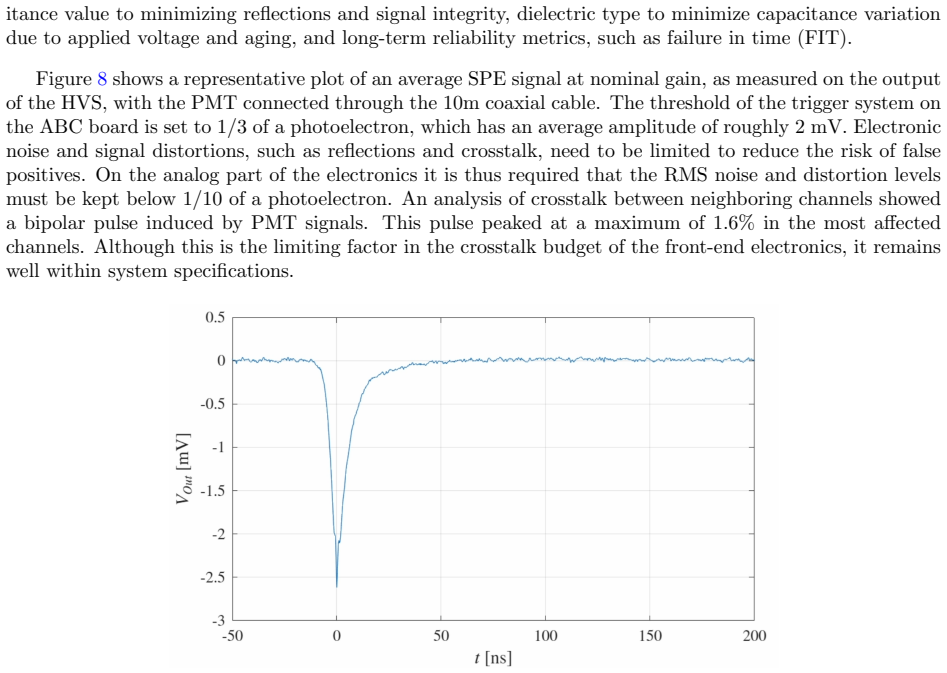
The authors report a complete underwater readout chain for the small photomultiplier system that digitizes 128 PMT channels per unit, provides synchronized time-stamping and charge measurement, manages event packaging and bandwidth at 57 MB/s, and achieves noise levels of 0.04 photoelectrons with crosstalk below 0.4 percent. Board-level and system-level tests confirm the design meets the requirements for single-photoelectron detection and high-rate operation. The full SPMT system has been integrated and installed in JUNO.
What carries the argument
The embedded front-end electronics unit that performs analog-to-digital conversion, precise time-stamping, charge integration, and data formatting for groups of 128 PMT channels while housed in a mechanically and thermally integrated package suitable for underwater deployment.
If this is right
- The system enables reliable single-photoelectron detection for the entire SPMT array under high-rate conditions.
- Data acquisition, control, and bandwidth management are handled by the firmware architecture across all units.
- The SPMT system is now fully installed and ready for commissioning and physics data taking.
- The design supports the low-radioactivity and multi-purpose goals of the 20-kton liquid-scintillator detector.
Where Pith is reading between the lines
- If the performance holds after installation, the same electronics approach could be adapted for other large underwater neutrino or dark-matter detectors that need compact low-noise readout.
- The achieved noise floor may allow the small PMTs to contribute meaningfully to JUNO's sensitivity for low-energy events such as solar neutrinos or geoneutrinos.
- Long-term monitoring data from the installed system will be needed to check for any degradation from pressure, temperature cycling, or radiation that lab tests could not fully replicate.
Load-bearing premise
Laboratory validation procedures and tests on the boards will accurately predict performance once the electronics are fully submerged, pressurized, and exposed to the actual radiation and temperature conditions inside the JUNO detector.
What would settle it
A commissioning measurement after full installation that shows noise above 0.1 photoelectrons or crosstalk above 1 percent under operating conditions in the JUNO detector would indicate the performance claims do not hold.
Figures





read the original abstract
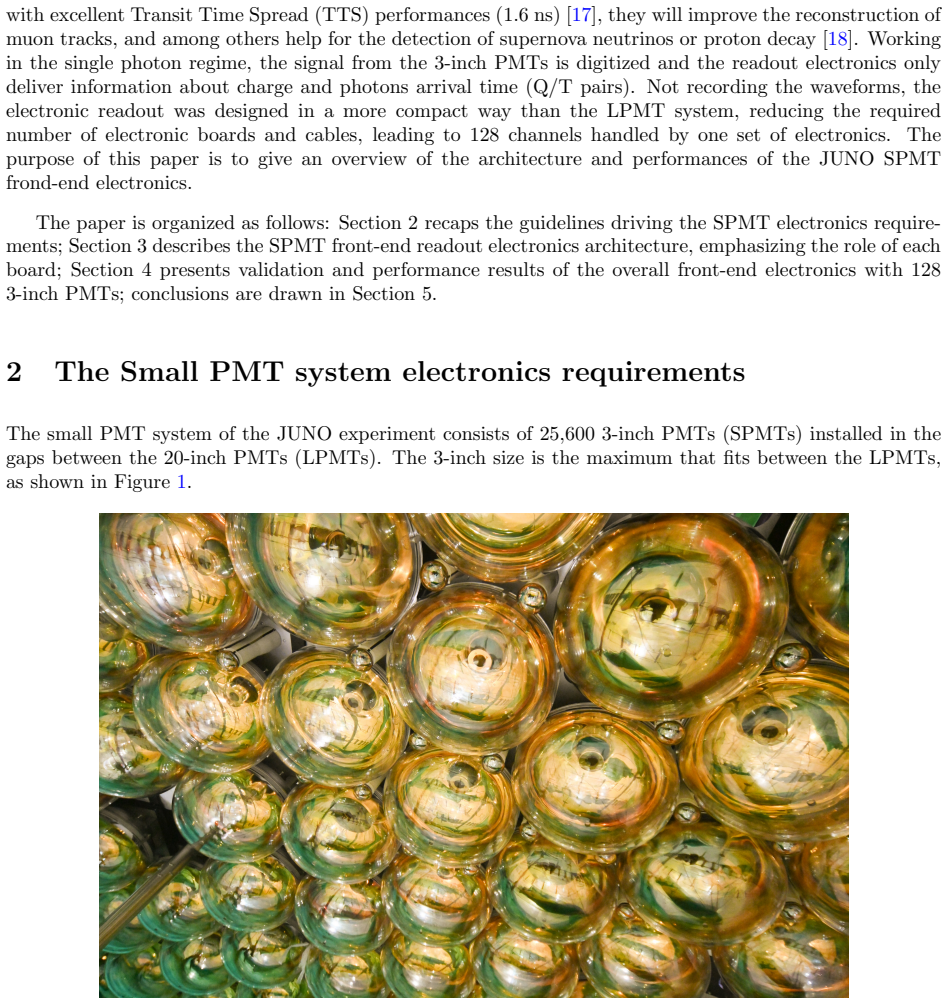
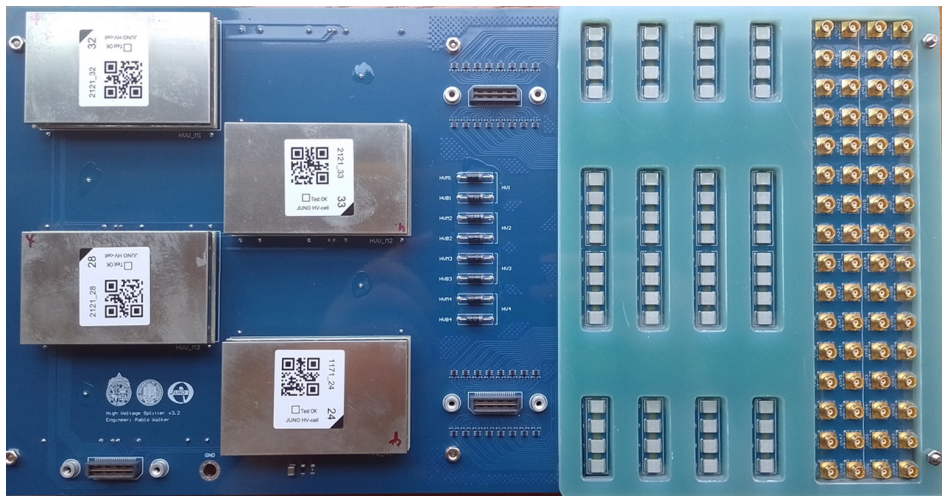
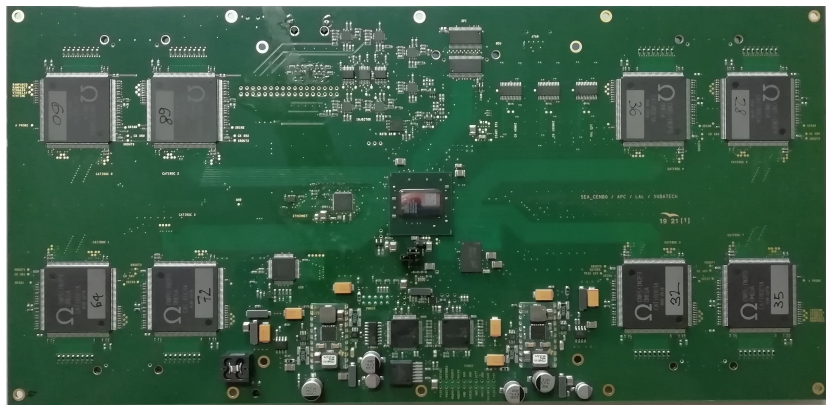
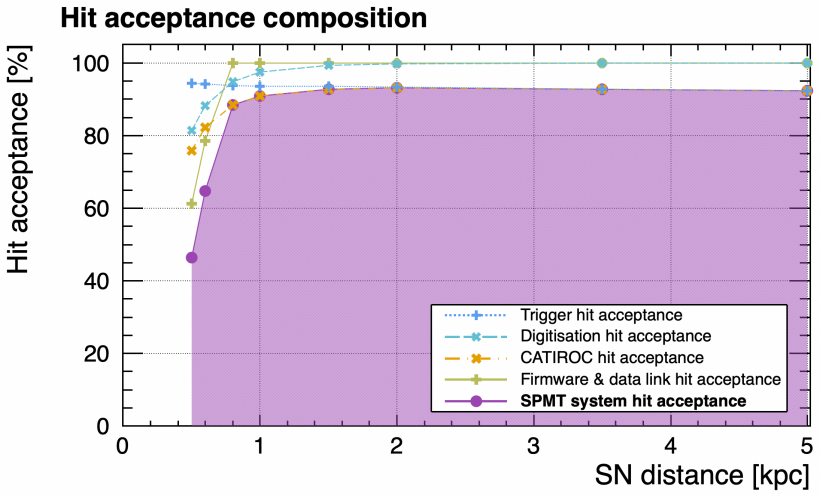
The Jiangmen Underground Neutrino Observatory (JUNO) is a 20-kton liquid scintillator-based, low-radioactivity, multi-purpose neutrino detector located 693 meters (1800 m.w.e.) underground in the Guangdong province, China. To detect scintillation light produced in the target, the detector is equipped with 17,612 20-inch photomultipliers (PMTs), forming the Large PMT system (LPMT). In addition, 25,600 3-inch photomultipliers (the Small Photomultiplier System or SPMT) are deployed in the gaps between the LPMTs. This paper presents the design and performance of the underwater front-end electronics developed for the SPMT system. It details the individual electronics boards and their key components, the inter-board interfaces, the system-level design, and the firmware architecture that supports data acquisition and control. It also outlines mechanical and thermal integration, board validation procedures, and system performance metrics. The readout chain includes digitization of 128 PMT channels per unit, synchronized time-stamping, charge measurement, event packaging, and bandwidth management. Comprehensive validation confirms the system's readiness to meet JUNO's stringent physics goals. The underwater electronics achieve noise levels as low as 0.04 photoelectrons with minimal crosstalk (below 0.4%) and a bandwidth of 57 MB/s, ensuring reliable single photo-electron detection and operation under high-rate conditions. The SPMT system has now been fully integrated and installed in JUNO. Its commissioning and physics performance will be reported in a future publication.
Editorial analysis
A structured set of objections, weighed in public.
Referee Report
Summary. The paper describes the design, components, firmware, mechanical integration, and laboratory validation of underwater front-end electronics for the 25,600 3-inch photomultipliers (SPMT system) in the JUNO detector. It reports a readout chain handling 128 channels per unit with synchronized timing, charge measurement, and data packaging, achieving noise levels as low as 0.04 photoelectrons, crosstalk below 0.4%, and a bandwidth of 57 MB/s. The system has been fully installed in JUNO, with commissioning and in-detector performance deferred to a future publication.
Significance. If the reported laboratory performance translates to operational conditions, this work provides an essential technical component for the JUNO SPMT system, which augments the large PMT array for improved energy resolution, vertex reconstruction, and background suppression in neutrino oscillation and astrophysics measurements. The explicit performance numbers, system-level architecture details, and completion of installation represent concrete engineering progress for large-scale, low-radioactivity underwater detectors.
major comments (1)
- Performance validation section: The central claim that the electronics achieve 0.04 pe noise, <0.4% crosstalk, and 57 MB/s bandwidth (ensuring reliable SPE detection and readiness for JUNO physics goals) is supported only by laboratory measurements. No error bars, full test conditions (temperature, pressure simulation, or radiation exposure matching the 693 m underground site), or quantitative table comparing results to JUNO requirements are provided, leaving the extrapolation to submerged, pressurized, low-temperature, low-radioactivity operation unverified.
minor comments (3)
- Abstract: The performance numbers (0.04 pe noise, <0.4% crosstalk, 57 MB/s) are stated without uncertainties or ranges, and the bandwidth figure lacks clarification on whether it applies per electronics unit or system-wide.
- Section on inter-board interfaces and firmware: The description of data acquisition, event packaging, and bandwidth management could include a block diagram or timing diagram to clarify synchronization across the 128 channels.
- Mechanical and thermal integration section: Quantitative details on heat dissipation and pressure tolerance under expected JUNO conditions would strengthen the integration claims.
Simulated Author's Rebuttal
We thank the referee for the careful reading and constructive feedback on our manuscript describing the underwater front-end electronics for the JUNO SPMT system. We address the major comment below and have revised the manuscript accordingly where possible.
read point-by-point responses
-
Referee: Performance validation section: The central claim that the electronics achieve 0.04 pe noise, <0.4% crosstalk, and 57 MB/s bandwidth (ensuring reliable SPE detection and readiness for JUNO physics goals) is supported only by laboratory measurements. No error bars, full test conditions (temperature, pressure simulation, or radiation exposure matching the 693 m underground site), or quantitative table comparing results to JUNO requirements are provided, leaving the extrapolation to submerged, pressurized, low-temperature, low-radioactivity operation unverified.
Authors: We agree that additional details on the laboratory validation would strengthen the manuscript. In the revised version we will: (1) add error bars to the reported noise (0.04 pe) and crosstalk (<0.4%) values, (2) explicitly state the laboratory test conditions (room temperature, ambient pressure, no artificial radiation exposure), and (3) insert a table directly comparing the measured performance metrics against the JUNO SPMT requirements. These laboratory results were obtained on fully assembled boards prior to integration and were used to qualify the design for deployment. Full pressure, temperature, and radiation testing under operational conditions was performed during the integration and installation campaign at the JUNO site; however, the detailed in-detector performance data are reserved for a future commissioning paper as stated in the manuscript. The successful installation of all 25,600 channels provides supporting evidence that the electronics met the necessary integration criteria. revision: partial
- Quantitative performance data under full submerged, pressurized, low-temperature, and low-radioactivity conditions at the 693 m underground site, which are part of the ongoing commissioning and will be presented in a dedicated future publication.
Circularity Check
No circularity: empirical hardware measurements reported directly
full rationale
This engineering paper describes the design, firmware, mechanical integration, and lab validation of underwater front-end electronics for JUNO's 3-inch PMTs. Performance metrics such as 0.04 pe noise, <0.4% crosstalk, and 57 MB/s bandwidth are stated as outcomes of board validation procedures and direct measurements on the readout chain (digitization, time-stamping, charge measurement). No equations, derivations, or parameter fits are present that could reduce to self-definitions or fitted inputs by construction. Self-citations, if any, are not load-bearing for the central claims, which rest on independent hardware testing rather than tautological loops. The paper explicitly defers in-detector commissioning data to a future publication, avoiding any circular extrapolation within this work.
Axiom & Free-Parameter Ledger
Reference graph
Works this paper leans on
-
[1]
Cabrera et al.,Multi-calorimetry in light-based neutrino detectors,Journal of High Energy Physics 2024(Dec., 2024)
A. Cabrera et al.,Multi-calorimetry in light-based neutrino detectors,Journal of High Energy Physics 2024(Dec., 2024)
2024
-
[2]
Cao et al.,Mass production and characterization of 3-inch PMTs for the JUNO experiment,Nucl
C. Cao et al.,Mass production and characterization of 3-inch PMTs for the JUNO experiment,Nucl. Instrum. Meth. A1005(2021) 165347, [2102.11538]. [18]JUNOcollaboration, A. Abusleme et al.,JUNO Sensitivity on Proton Decayp→¯νK + Searches, Chin. Phys. C47(2023) 113002, [2212.08502]
-
[3]
Li, Y.-k
N. Li, Y.-k. Heng, M. He, J.-l. Xu, X.-t. Zhang, C.-y. Cao et al.,Characterization of 3-inch photomultiplier tubes for the juno central detector,Radiation Detection Technology and Methods3(03,
-
[4]
F. Sato, J. Maeda, T. Sumiyoshi and K. Tsukagoshi,High Voltage System for the Double Chooz Experiment,Phys. Procedia37(2012) 1164–1170
2012
-
[5]
J. Xu, M. He, C. Cerna, Y. Huang et al.,Design, waterproofing, and mass production of the 3-inch PMT frontend system of JUNO,Nucl. Instrum. Meth. A1086(2026) 171301, [2510.06616]. [22]JUNOcollaboration, S. Conforti et al.,CATIROC: an integrated chip for neutrino experiments using photomultiplier tubes,JINST16(2021) P05010, [2012.01565]
-
[6]
Serafini,The juno large pmt readout electronics,Nucl
A. Serafini,The juno large pmt readout electronics,Nucl. Instrum. Meth. A1043(2022) 167499
2022
-
[7]
Walker, J
P. Walker, J. P. Ochoa-Ricoux et al.,The high voltage splitter board for the juno spmt system,Nucl. Instrum. Meth. A1082(2026) 171022
2026
-
[8]
Bellato et al.,Embedded readout electronics r&d for the large pmts in the juno experiment,Nucl
M. Bellato et al.,Embedded readout electronics r&d for the large pmts in the juno experiment,Nucl. Instrum. Meth. A985(2021) 164600
2021
-
[9]
Technical documentation
Axon’ Cable Ltd, “Technical documentation.”https://www.axon-interconnect.com, 2025
2025
-
[10]
KS Plast, “Technical documentation.”https://ks-plast.ru/download/to/to_238.pdf, 2024. 27 [28]JUNOcollaboration, A. Abusleme et al.,Radioactivity control strategy for the JUNO detector,JHEP 11(2021) 102, [2107.03669]. 28
discussion (0)
Sign in with ORCID, Apple, or X to comment. Anyone can read and Pith papers without signing in.