Recognition: unknown
Bragg-Williams order competes with superconductivity
Pith reviewed 2026-05-07 14:34 UTC · model grok-4.3
The pith
Bragg-Williams order of indium vacancies suppresses superconductivity by weakening electron-phonon coupling.
A machine-rendered reading of the paper's core claim, the machinery that carries it, and where it could break.
Core claim
In In2/3PSe3, indium vacancies are reversibly configurable between Bragg-Williams ordered and disordered states via thermal treatment. The disordered phase undergoes a pressure-induced superconducting transition with Tc of 11 K, higher than the 7 K of the ordered phase. Ginzburg-Landau and BCS-McMillan analysis establishes that Bragg-Williams order suppresses superconductivity through electron-phonon interactions, supported by ultra-low-wavenumber Raman measurements.
What carries the argument
Bragg-Williams order of indium vacancies, functioning as an independent structural order parameter that reduces electron-phonon coupling strength to compete with superconductivity.
If this is right
- Bragg-Williams order can serve as a reversible tuning parameter for Tc without altering doping.
- Electron-phonon coupling is the dominant channel through which this structural order affects superconductivity.
- Competing-order frameworks must incorporate classical structural parameters in addition to electronic and magnetic ones.
- Thermal annealing protocols offer a route to control superconducting properties in vacancy-containing compounds.
Where Pith is reading between the lines
- Similar vacancy-order tuning may appear in other layered chalcogenides or alloys where annealing can toggle site occupancy.
- Device concepts could exploit thermal cycling to switch between superconducting and normal states in related materials.
- The mechanism suggests testing whether other structural orders, such as site-disorder in different lattices, produce comparable Tc suppression.
Load-bearing premise
Thermal treatment alters only the Bragg-Williams ordering of vacancies and introduces no uncontrolled changes in carrier density or additional defects.
What would settle it
Preparing samples with identical carrier density but deliberately varied vacancy order and finding no Tc difference would falsify the claim that Bragg-Williams order alone drives the observed shift.
Figures
read the original abstract
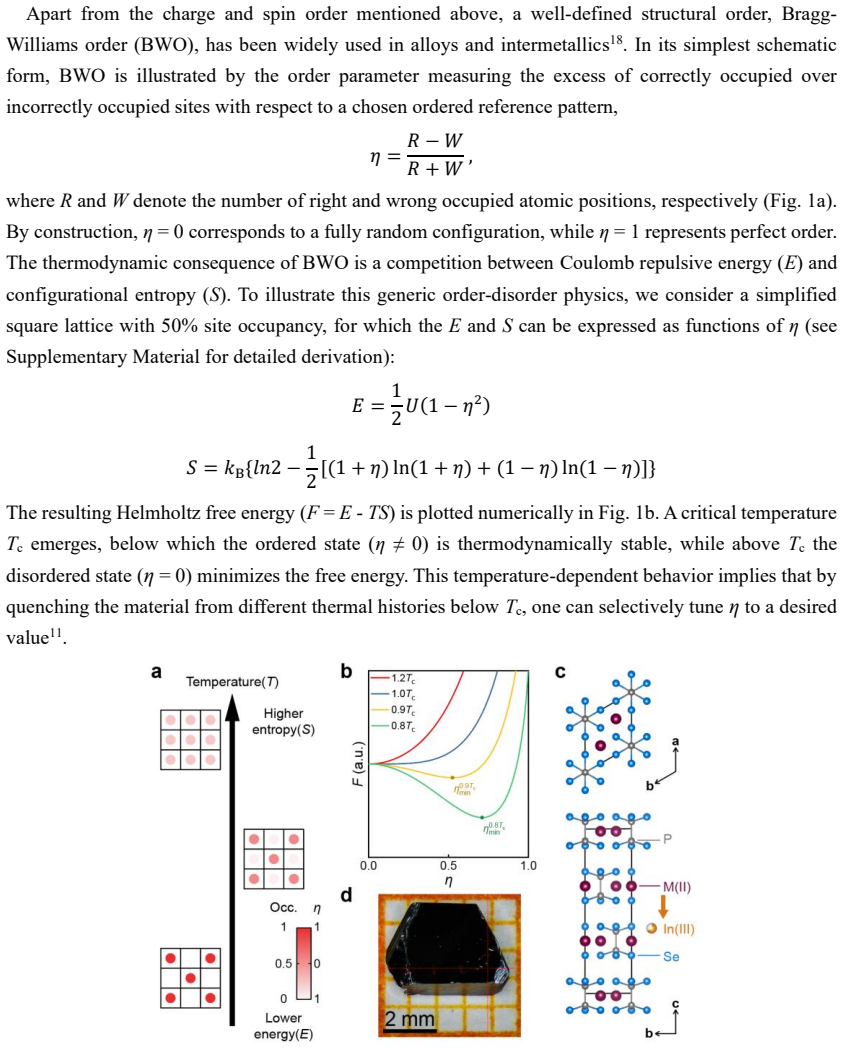
Orderings in charge and spin have been extensively studied to unravel their correlation to emergent superconductivity over the past decades. Bragg-Williams order (BWO), a classical structural order parameter describing site occupancy in alloys, has long been speculated to influence superconducting behavior. Yet, its role still remains ambiguous, largely due to the difficulty of isolating BWO from concomitant charge doping or competing electronic instabilities. Here, we establish In2/3PSe3 as a platform wherein indium vacancies are reversibly configurable between ordered and disordered states via thermal treatment. We show that the disordered phase undergoes a pressure-induced superconducting transition with a Tc of 11 K, significantly higher than the 7 K observed in its ordered counterpart. This constitutes a rare instance in which pure BWO variation drives a substantial shift in Tc. By combining a Ginzburg-Landau phenomenological analysis with a BCS-McMillan microscopic description, we demonstrate that BWO naturally suppresses superconductivity through electron-phonon interactions, a mechanism supported by ultra-low-wavenumber Raman measurements. Our findings support BWO as an independent order parameter that competes directly with superconductivity, extending the concept of competing orders beyond conventional electronic and magnetic degrees of freedom.
Editorial analysis
A structured set of objections, weighed in public.
Referee Report
Summary. The manuscript claims that In2/3PSe3 serves as a platform where indium vacancies can be reversibly switched between ordered and disordered Bragg-Williams order (BWO) states via thermal treatment. The disordered phase shows a pressure-induced superconducting Tc of 11 K, substantially higher than the 7 K in the ordered phase. Combining Ginzburg-Landau phenomenological analysis with a BCS-McMillan microscopic model, the authors argue that BWO competes with superconductivity by suppressing it through electron-phonon interactions, with supporting evidence from ultra-low-wavenumber Raman measurements. This is positioned as a rare demonstration of pure BWO variation driving a large Tc shift.
Significance. If the experimental controls confirm isolation of the BWO effect, the work offers a valuable new platform for investigating structural order as an independent competing order parameter in superconductors, extending beyond conventional charge, spin, or orbital degrees of freedom. The dual use of Ginzburg-Landau and BCS-McMillan frameworks, together with Raman data, provides a coherent theoretical and experimental link between BWO and the observed Tc difference.
major comments (2)
- [Abstract and experimental characterization sections] Abstract and experimental characterization sections: The headline claim requires that the observed ΔTc arises solely from BWO variation. No post-anneal quantitative controls (Hall coefficient for carrier density, EDX for stoichiometry, or high-resolution XRD for lattice parameters) are referenced to bound possible changes in carrier density or additional defects that would also modulate Tc via the same electron-phonon channel used in the BCS-McMillan analysis.
- [BCS-McMillan microscopic description] BCS-McMillan microscopic description: The demonstration that BWO 'naturally suppresses superconductivity through electron-phonon interactions' relies on the McMillan formula. It is unclear whether the electron-phonon coupling strength or density of states are independently determined (e.g., from specific-heat or tunneling data) or adjusted to reproduce the 4 K Tc difference; if the latter, the suppression is by construction rather than an independent prediction.
minor comments (1)
- [Raman measurements] The ultra-low-wavenumber Raman data are invoked to support the electron-phonon mechanism, but the manuscript should quantify how the observed mode shifts or intensities map onto a change in the McMillan λ parameter between the two BWO states.
Simulated Author's Rebuttal
We thank the referee for their careful reading of the manuscript and for the constructive comments, which help to clarify the isolation of the Bragg-Williams order effect. We address each major comment below and indicate the revisions that will be incorporated.
read point-by-point responses
-
Referee: [Abstract and experimental characterization sections] Abstract and experimental characterization sections: The headline claim requires that the observed ΔTc arises solely from BWO variation. No post-anneal quantitative controls (Hall coefficient for carrier density, EDX for stoichiometry, or high-resolution XRD for lattice parameters) are referenced to bound possible changes in carrier density or additional defects that would also modulate Tc via the same electron-phonon channel used in the BCS-McMillan analysis.
Authors: We agree that post-anneal quantitative controls would strengthen the isolation of the BWO effect. In the revised manuscript we will add Hall coefficient data measured after the thermal treatments to bound carrier-density variations, together with a discussion of the existing EDX and high-resolution XRD results that confirm stoichiometry and lattice parameters remain essentially unchanged between the ordered and disordered phases. The reversible switching protocol and the distinct ultra-low-wavenumber Raman signatures already indicate that the dominant difference is vacancy ordering rather than doping or additional defects; the added controls will make this explicit. revision: partial
-
Referee: [BCS-McMillan microscopic description] BCS-McMillan microscopic description: The demonstration that BWO 'naturally suppresses superconductivity through electron-phonon interactions' relies on the McMillan formula. It is unclear whether the electron-phonon coupling strength or density of states are independently determined (e.g., from specific-heat or tunneling data) or adjusted to reproduce the 4 K Tc difference; if the latter, the suppression is by construction rather than an independent prediction.
Authors: The McMillan parameters are not adjusted to fit the observed Tc values. The change in electron-phonon coupling is estimated directly from the softening and broadening of the ultra-low-wavenumber Raman modes that are sensitive to the indium-vacancy ordering, while the density of states is obtained from the structural model of the ordered versus disordered phases. These inputs, together with the Ginzburg-Landau analysis, yield the predicted Tc shift without free fitting to the experimental transition temperatures. The revised manuscript will include an expanded methods section that tabulates the Raman-derived parameters and shows the step-by-step calculation to make the independence of the prediction clear. revision: yes
Circularity Check
No significant circularity; derivation uses standard frameworks on independent data
full rationale
The paper observes a Tc difference between ordered and disordered In2/3PSe3 phases, then applies the established Ginzburg-Landau and BCS-McMillan formalisms plus Raman data to interpret the role of Bragg-Williams order. No equations or steps are presented that reduce a claimed prediction back to a fitted parameter or self-citation by construction. The frameworks are external and the supporting measurements (Raman, thermal treatment effects) are described as independent of the target Tc attribution, keeping the chain self-contained against external benchmarks.
Axiom & Free-Parameter Ledger
free parameters (1)
- electron-phonon coupling strength or related McMillan parameters
axioms (2)
- domain assumption Ginzburg-Landau theory applies to the competition between BWO and superconductivity
- domain assumption BCS-McMillan framework correctly captures the suppression mechanism through electron-phonon interactions
Reference graph
Works this paper leans on
-
[5]
vacancy density wave
High Energy Photon Source, Institute of High Energy Physics, Chinese Academy of Sciences, Beijing 101407, China * ying@iphy.ac.cn * xlchen@iphy.ac.cn ABSTRACT Orderings in charge and spin have been extensively studied to unravel their correlation to emergent superconductivity over the past decades. Bragg-Williams order (BWO), a classical structural order ...
-
[6]
P. W. Anderson, Theory of dirty superconductors, J. Phys. Chem. Solids 11, 26 (1959)
1959
-
[7]
A. Garg, M. Randeria, and N. Trivedi, Strong correlations make high-temperature superconductors robust against disorder, Nature Phys 4, 762 (2008)
2008
-
[8]
Strongin, R
M. Strongin, R. S. Thompson, O. F. Kammerer, and J. E. Crow, Destruction of superconductivity in disordered near-monolayer films. Phys. Rev. B 1, 1078 (1970)
1970
-
[9]
J. M. Graybeal and M. R. Beasley, Localization and interaction effects in ultrathin amorphous superconducting films, Phys. Rev. B 29, 4167 (1984)
1984
-
[10]
A. P. Mackenzie, R. K. W. Haselwimmer, A. W. Tyler, G. G. Lonzarich, Y. Mori, S. Nishizaki, and Y. Maeno, Extremely Strong Dependence of Superconductivity on Disorder in Sr2RuO4, Phys. Rev. Lett. 80, 161 (1998)
1998
-
[11]
Abeles, R
B. Abeles, R. W. Cohen, and G. W. Cullen, Enhancement of Superconductivity in Metal Films, Phys. Rev. Lett. 17, 632 (1966)
1966
-
[12]
A. P. Petrović, D. Ansermet, D. Chernyshov, M. Hoesch, D. Salloum, P. Gougeon, M. Potel, L. Boeri, and C. Panagopoulos, A disorder -enhanced quasi -one-dimensional superconductor, Nat Commun 7, 12262 (2016)
2016
-
[13]
Zhao et al., Disorder -induced multifractal superconductivity in monolayer niobium dichalcogenides, Nat
K. Zhao et al., Disorder -induced multifractal superconductivity in monolayer niobium dichalcogenides, Nat. Phys. 15, 904 (2019)
2019
-
[14]
Caruso, X
R. Caruso, X. He, A. T. Bollinger, and I. Božović, (Ir)Relevance of Disorder for Superconductivity in Cuprates, Phys. Rev. Lett. 136, 076003 (2026)
2026
-
[15]
M. K. Wu, J. R. Ashburn, C. J. Torng, P. H. Hor, R. L. Meng, L. Gao, Z. J. Huang, Y. Q. Wang, and C. W. Chu, Phys. Rev. Lett. 58, 908 (1987)
1987
-
[16]
J. D. Jorgensen, B. W. Veal, W. K. Kwok, G. W. Crabtree, A. Umezawa, L. J. Nowicki, and A. P. Paulikas, Structural and superconducting properties of orthorhombic and tetragonal YBa2Cu3O7-x: The effect of oxygen stoichiometry and ordering on superconductivity, Phys. Rev. B 36, 5731(R) (1987)
1987
-
[17]
J. Guo, S. Jin, G. Wang, S. Wang, K. Zhu, T. Zhou, M. He, and X. Chen, Superconductivity in the iron selenide KxFe2Se2 ( 0 ≤ x ≤ 1.0 ), Phys. Rev. B 82, 180520 (2010)
2010
-
[18]
Li et al., Phase separation and magnetic order in K-doped iron selenide superconductor, Nature Phys 8, 126 (2012)
W. Li et al., Phase separation and magnetic order in K-doped iron selenide superconductor, Nature Phys 8, 126 (2012)
2012
-
[19]
T. P. Ying, X. L. Chen, G. Wang, S. F. Jin, T. T. Zhou, X. F. Lai, H. Zhang, and W. Y. Wang, Observation of superconductivity at 30∼46K in AxFe2Se2(A = Li, Na, Ba, Sr, Ca, Yb and Eu), Sci Rep 2, 426 (2012)
2012
-
[20]
T. Ying, X. Chen, G. Wang, S. Jin, X. Lai, T. Zhou, H. Zhang, S. Shen, and W. Wang, Superconducting Phases in Potassium -Intercalated Iron Selenides, J. Am. Chem. Soc. 135, 2951 (2013)
2013
-
[21]
P. A. Lee, N. Nagaosa, and X. -G. Wen, Doping a Mott insulator: Physics of high -temperature superconductivity, Rev. Mod. Phys. 78, 17 (2006)
2006
-
[22]
Q. Si, R. Yu, and E. Abrahams, High -temperature superconductivity in iron pnictides and chalcogenides, Nat Rev Mater 1, 16017 (2016)
2016
-
[23]
Muto and Y
T. Muto and Y. Takagi, The Theory of Order-Disorder Transitions in Alloys, Solid State Physics, 1, 193 (1955)
1955
-
[24]
Wang et al., New Frontiers on van der Waals Layered Metal Phosphorous Trichalcogenides, Adv Funct Materials 28, 1802151 (2018)
F. Wang et al., New Frontiers on van der Waals Layered Metal Phosphorous Trichalcogenides, Adv Funct Materials 28, 1802151 (2018)
2018
-
[25]
Samal, G
R. Samal, G. Sanyal, B. Chakraborty, and C. S. Rout, Two -dimensional transition metal phosphorous trichalcogenides (MPX 3): a review on emerging trends, current state and future perspectives, J. Mater. Chem. A 9, 2560 (2021)
2021
-
[26]
Wang et al., Emergent superconductivity in an iron -based honeycomb lattice initiated by pressure-driven spin-crossover, Nat Commun 9, 1914 (2018)
Y. Wang et al., Emergent superconductivity in an iron -based honeycomb lattice initiated by pressure-driven spin-crossover, Nat Commun 9, 1914 (2018)
1914
-
[27]
X. Chen, J. Wang, T. Ying, D. Huang, H. Gou, Q. Zhang, Y. Li, H. Hosono, J. Guo, and X. Chen, Insulator-metal-superconductor transition in the medium-entropy van der Waals compound MPSe3 ( M = Fe , Mn , Cd , and In ) under high pressure, Phys. Rev. B 106, 184502 (2022)
2022
-
[28]
Zhang, W
H. Zhang, W. Zhong, X. Yu, B. Yue, and F. Hong, Electronic phase transitions and superconductivity in ferroelectric Sn2P2Se2 under pressure, Phys. Rev. B 109, 214517 (2024)
2024
-
[29]
J. Wang, X. Liu, L. Zhang, J. Guo, and T. Ying, Influence of dimensionality on superconductivity in pressurized 3D SnPSe3 single crystal, Phys. Rev. Materials 8, 074803 (2024)
2024
-
[30]
M. Qi, W. Chen, Y. Huang, H. Song, X. Lv, M. Wu, W. Zhao, L. Zhang, and T. Cui, Pressure - induced superconductivity in van der Waals layered semiconductor SnPSe3, J. Mater. Chem. C 12, 5108 (2024)
2024
-
[31]
Soled and A
S. Soled and A. Wold, crystal growth and characterization of In2/3PS3, Mat. Res. Bull 11, 657(1976)
1976
-
[32]
Katty, S
A. Katty, S. Soled and A. Wold, crystal growth and characterization of In2/3PSe3, Mat. Res. Bull 12, 663(1977)
1977
-
[33]
X. Zhang et al., Pressure‐Induced Structural and Semiconductor‐Metal‐Superconductor Transitions in a High‐Entropy van der Waals Compound (MnFeCuCdIn)PSe3, Adv Quantum Tech 7, 2300365 (2024)
2024
-
[34]
V. L. Ginzburg, editor , On Superconductivity and Superfluidity: A Scientific Autobiography (Springer Berlin Heidelberg, Berlin, Heidelberg, 2009)
2009
-
[35]
Farías, W
D. Farías, W. Kamiński, J. Lobo, J. Ortega, E. Hulpke , R. Pérez, F. Flores, and E. G. Michel, Phonon Softening, Chaotic Motion, and Order-Disorder Transition in Sn/Ge (111), Phys. Rev. Lett. 91, 016103 (2003)
2003
-
[36]
Delaire, K
O. Delaire, K. Marty, M. B. Stone, P. R. C. Kent, M. S. Lucas, D. L. Abernathy, D. Mandrus, and B. C. Sales, Phonon softening and metallization of a narrow -gap semiconductor by thermal disorder, Proc. Natl. Acad. Sci. U.S.A. 108, 4725 (2011)
2011
-
[37]
Bardeen, L
J. Bardeen, L. N. Cooper, and J. R. Schrieffer, Theory of Superconductivity, Phys. Rev. 108, 1175 (1957)
1957
-
[38]
W. L. Mcmillan, Transition Te mperature of Strong -Coupled Superconductors, Phys. Rev. 167, 331 (1968)
1968
-
[39]
P. B. Allen and R. C. Dynes, Transition temperature of strong-coupled superconductors reanalyzed, Phys. Rev. B 12, 905 (1975). Supplementary Material for Bragg-Williams order competes with superconductivity Xu Liu1,2,†, Xu Chen1,†, Chuizhen Chen3,†, Boqin Song1, Jing Chen1, Xijing Dai1, Qinghua Zhang 1, Feng Jin 1, Xingya Wang4, Weiwei Dong5, Dongliang Ya...
1975
-
[40]
Beijing National Laboratory for Condensed Matter Physics, Institute of Physics, Chinese Academy of Sciences, Beijing 100190, China
-
[41]
School of Physical Sciences, University of Chinese Academy of Sciences, Beijing 100049, China
-
[42]
School of Physical Science and Technology, Soochow University, Suzhou 215006, China
-
[43]
Shanghai Synchrotron Radiation Facility, Shanghai Advanced Research Institute, Chinese Academy of Sciences, Shanghai 201204, China
-
[44]
High Energy Photon Source, Institute of High Energy Physics, Chinese Academy of Sciences, Beijing 101407, China * ying@iphy.ac.cn * xlchen@iphy.ac.cn
-
[45]
Theoretical analysis of the order-disorder phase transition Qualitatively, the order-disorder phase transition originates from the competition between energy (E, favoring order) and entropy (S, favoring disorder), with temperature influencing the outcome of this competition and thus determining the degree of order in the system. Quantitatively, the relati...
-
[46]
Indium grains, Phosphorus lumps, and Selenium grains were weighed according to the stoichiometric ratio and sealed in a quartz tube together with iodine grains
Crystal synthesis and characterization under ambient conditions The order phase In 2/3PSe3 were grown by the chemical vapor transport (CVT) method using iodine as the transport agent. Indium grains, Phosphorus lumps, and Selenium grains were weighed according to the stoichiometric ratio and sealed in a quartz tube together with iodine grains. T he quartz ...
-
[47]
The generalized gradient approximation (GGA) in the form of Perdew -Burke-Ernzerhof (PBE) [3] was adopted for the exchange-correlation potentials
First-principles calculations First-principles calculations were carried out with the density functional theory (DFT) implemented in the Vienna ab initio simulation package (V ASP) [1,2]. The generalized gradient approximation (GGA) in the form of Perdew -Burke-Ernzerhof (PBE) [3] was adopted for the exchange-correlation potentials. We used the projector ...
-
[48]
Diamond culet sizes of 300 μm were employed, with rhenium gaskets serving as the pressure -confining material
Electrical and structural characterization under high pressure The high-pressure experiments were conducted using a diamond anvil cell (DAC). Diamond culet sizes of 300 μm were employed, with rhenium gaskets serving as the pressure -confining material. Pressure was calibrated using the ruby fluorescence method [6]. For electrical transport measurements, c...
-
[49]
Kresse and J
G. Kresse and J. Furthmüller, Efficient iterative schemes for ab initio total-energy calculations using a plane-wave basis set, Phys. Rev. B 54, 11169 (1996)
1996
-
[50]
Kresse and J
G. Kresse and J. Furthmüller, Efficiency of ab-initio total energy calculations for metals and semiconductors using a plane-wave basis set, Computational Materials Science 6, 15 (1996)
1996
-
[51]
J. P. Perdew, K. Burke, and M. Ernzerhof, Generalized Gradient Approximation Made Simple, Phys. Rev. Lett. 77, 3865 (1996)
1996
-
[52]
Kresse and D
G. Kresse and D. Joubert, From ultrasoft pseudopotentials to the projector augmented -wave method, Phys. Rev. B 59, 1758 (1999)
1999
-
[53]
H. J. Monkhorst and J. D. Pack, Special points for Brillonin -zone integrations, Phys. Rev. B 13, 5188. (1976)
1976
-
[54]
H. K. Mao, J. Xu, and P. M. Bell, Calibration of the ruby pressure gauge to 800 kbar under quasi‐hydrostatic conditions, J. Geophys. Res. 91, 4673 (1986)
1986
-
[55]
Birch, Finite Elastic Strain of Cubic Crystals, Phys
F. Birch, Finite Elastic Strain of Cubic Crystals, Phys. Rev. 71, 809 (1947)
1947
-
[56]
F. D. Murnaghan, The Compressibility of Media under Extreme Pressures, Proc. Natl. Acad. Sci., 30 (9) 244-247 (1944)
1944
discussion (0)
Sign in with ORCID, Apple, or X to comment. Anyone can read and Pith papers without signing in.