Recognition: unknown
MCMit: Mid-Circuit Measurement Error Mitigation
Pith reviewed 2026-05-07 16:30 UTC · model grok-4.3
The pith
MCMit reduces mid-circuit measurement errors in quantum circuits by combining faster classical feedback hardware with improved qubit discriminators.
A machine-rendered reading of the paper's core claim, the machinery that carries it, and where it could break.
Core claim
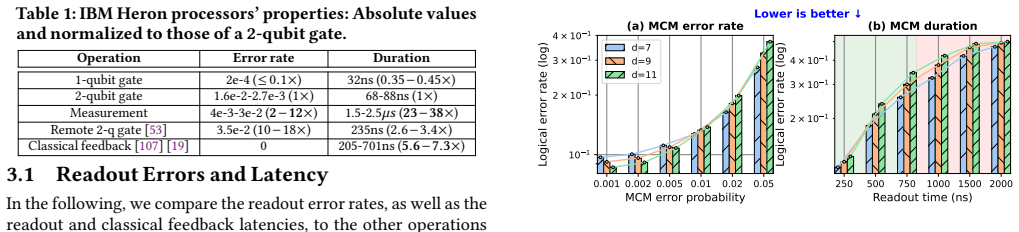
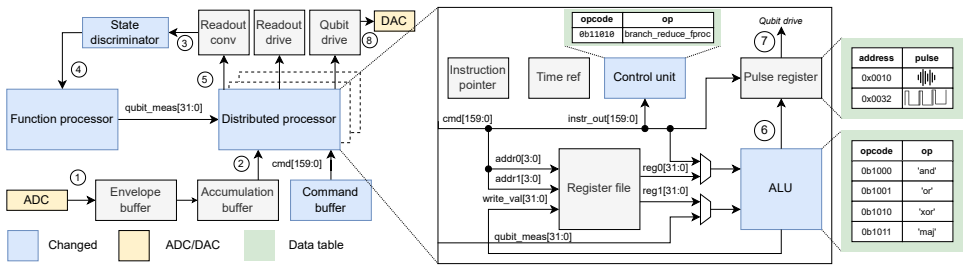
MCMit mitigates branching and latency-induced errors in mid-circuit measurements by introducing a scalable constant-latency multi-control branch instruction for faster feedback, transformer and CNN qubit-state discriminators that maintain high accuracy under short measurement durations, and software techniques of static MCM elimination and stochastic branching that handle remaining errors.
What carries the argument
The constant-latency multi-control branch instruction paired with the CNN qubit-state discriminator, which together shorten feedback time and raise discrimination accuracy at short durations.
If this is right
- Feedback latency drops by up to 70 percent, supporting circuit depths up to 7 times larger than current Qubic baselines.
- CNN discriminator accuracy rises 37-73 percent for short measurements, yielding up to 80 percent lower logical error rates in quantum error correction.
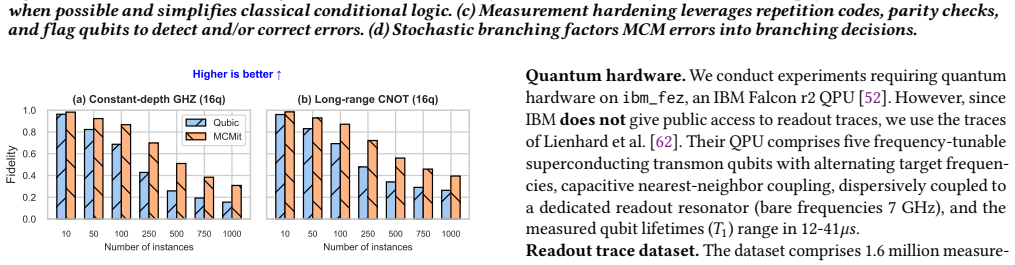
- Software mitigation adds 18-30 percent fidelity improvement over baseline methods even after hardware gains.
- The combination enables more complex dynamic circuits without proportional growth in decoherence errors.
Where Pith is reading between the lines
- The same branch instruction could support tighter real-time control loops in other quantum algorithms that rely on frequent measurements.
- Training the CNN on a broader set of circuits might extend the accuracy gains to longer or more varied measurement durations.
- Static MCM elimination could be combined with existing circuit compilation passes to further reduce overhead in error-corrected codes.
- Generalization beyond the tested Qubic setup would require verifying the discriminators on hardware with different readout noise profiles.
Load-bearing premise
The experimentally extracted QPU readout traces faithfully represent the noise and timing behavior of the target hardware under real-time operation.
What would settle it
Executing full MCMit circuits with real-time mid-circuit measurements on a different QPU and measuring whether the observed logical error rates match the reductions predicted from the trace-based simulations.
Figures








read the original abstract
Distributed Quantum Computing (DQC) and Quantum Error Correction (QEC) rely on dynamic circuits that include Mid-Circuit Measurements (MCMs) and classical feedback. These operations present a major bottleneck: MCMs suffer from high error rates that lead to real-time branching errors, while MCM and classical feedback latencies amplify decoherence errors. Current hardware controllers, qubit-state discriminators, and software error mitigation techniques fail to address these challenges holistically. We propose MCMit, a hardware-software co-design to mitigate branching and latency-induced errors. MCMit introduces a scalable, constant-latency multi-control branch instruction for faster classical feedback and two qubit-state discriminators, a transformer, and a CNN, with high accuracy even under short measurement durations. On the software side, static MCM elimination and stochastic branching complement the hardware by mitigating residual branching errors that persist despite hardware improvements. We implement MCMit on Qubic and evaluate it using experimentally extracted QPU readout traces. Our branch instruction reduces feedback latency by up to 70\%, improving circuit depths by up to $7\times$ over Qubic. Our CNN discriminator achieves 37-73\% higher accuracy for short measurement durations than the baselines, leading to up to 80\% lower logical error rates in QEC. Last, our software mitigation improves fidelity by 18--30\% over baseline methods.
Editorial analysis
A structured set of objections, weighed in public.
Referee Report
Summary. The paper proposes MCMit, a hardware-software co-design for mitigating errors in mid-circuit measurements (MCMs) and classical feedback within dynamic circuits for distributed quantum computing and quantum error correction. It introduces a constant-latency multi-control branch instruction on the Qubic controller, CNN and transformer qubit-state discriminators that maintain high accuracy at short measurement durations, and software techniques (static MCM elimination and stochastic branching) to handle residual errors. Evaluation on experimentally extracted QPU readout traces reports up to 70% feedback latency reduction (enabling up to 7× deeper circuits), 37-73% higher discriminator accuracy than baselines, up to 80% lower logical error rates in QEC, and 18-30% fidelity gains from the software mitigations.
Significance. If the central claims hold under live hardware operation, MCMit would represent a meaningful advance for practical QEC and DQC by jointly tackling MCM error rates and feedback latency, two primary bottlenecks in dynamic circuits. The hardware-software co-design and the provision of concrete latency/fidelity numbers derived from real QPU traces are strengths that offer testable benchmarks; the constant-latency branch instruction in particular addresses a hardware-level constraint that software-only approaches cannot fully resolve.
major comments (2)
- [Evaluation using experimentally extracted QPU readout traces] Evaluation using experimentally extracted QPU readout traces: The headline claims (37-73% accuracy lift for the CNN discriminator and up to 80% logical-error reduction) are obtained by feeding pre-collected traces into the proposed discriminators and modeling the multi-control branch. The manuscript does not show that these traces embed the timing jitter, crosstalk, or controller overhead that would arise when the new constant-latency branch instruction and real-time CNN inference run inside a dynamic circuit on the target hardware. Because the translation of these numbers to live QEC depends on this assumption, the evaluation constitutes an extrapolation rather than a direct measurement of the integrated system.
- [Evaluation using experimentally extracted QPU readout traces] Statistical characterization of reported gains: The accuracy (37-73%), logical-error (80%), latency (70%), and fidelity (18-30%) improvements are presented without error bars, statistical significance tests, or indication that data splits were pre-specified. This absence makes it impossible to determine whether post-hoc tuning on the same traces contributed to the quoted figures, directly affecting the reliability of the central performance claims.
minor comments (1)
- [Abstract] The abstract states that the branch instruction improves circuit depths by up to 7× over Qubic; the main text should explicitly define the baseline circuit depths and the set of circuits used for this comparison to allow readers to reproduce the scaling factor.
Simulated Author's Rebuttal
We thank the referee for the constructive feedback on our manuscript. We address each major comment below and will incorporate clarifications and additional statistical details in the revised version to strengthen the presentation of our evaluation methodology.
read point-by-point responses
-
Referee: Evaluation using experimentally extracted QPU readout traces: The headline claims (37-73% accuracy lift for the CNN discriminator and up to 80% logical-error reduction) are obtained by feeding pre-collected traces into the proposed discriminators and modeling the multi-control branch. The manuscript does not show that these traces embed the timing jitter, crosstalk, or controller overhead that would arise when the new constant-latency branch instruction and real-time CNN inference run inside a dynamic circuit on the target hardware. Because the translation of these numbers to live QEC depends on this assumption, the evaluation constitutes an extrapolation rather than a direct measurement of the integrated system.
Authors: We acknowledge that the evaluation relies on experimentally extracted QPU readout traces fed into the discriminators together with a model of the constant-latency multi-control branch, rather than a fully integrated live-hardware run of the new instruction and real-time inference inside dynamic circuits. The traces originate from real QPU measurements and therefore already incorporate the dominant readout noise characteristics that the discriminators are designed to mitigate. Our branch-instruction model is derived directly from the constant-latency specification implemented on Qubic. Nevertheless, secondary effects such as timing jitter or crosstalk that would appear only when the full stack operates in a live dynamic circuit are not captured by the trace-based methodology. In the revision we will add an explicit limitations paragraph stating that the reported gains are obtained under this trace-driven model and that live-hardware validation remains future work; we will also qualify the headline numbers as projections based on the measured trace statistics. revision: yes
-
Referee: Statistical characterization of reported gains: The accuracy (37-73%), logical-error (80%), latency (70%), and fidelity (18-30%) improvements are presented without error bars, statistical significance tests, or indication that data splits were pre-specified. This absence makes it impossible to determine whether post-hoc tuning on the same traces contributed to the quoted figures, directly affecting the reliability of the central performance claims.
Authors: The quoted figures were generated from fixed, pre-defined hyperparameter settings and a single, non-adaptive processing pipeline applied to the extracted traces; no post-hoc tuning on the reported evaluation set was performed. We nevertheless agree that the absence of error bars and formal statistical tests reduces the ability to assess variability. In the revised manuscript we will (i) report standard deviations or bootstrap confidence intervals for all accuracy, latency, logical-error, and fidelity metrics, (ii) explicitly describe the train/validation/test partitioning of the traces, and (iii) include paired statistical significance tests (e.g., Wilcoxon signed-rank or bootstrap p-values) comparing MCMit against each baseline. revision: yes
Circularity Check
No circularity: performance claims are measured on external QPU traces rather than derived by construction from fitted parameters or self-citations.
full rationale
The paper's central results (accuracy gains, latency reductions, logical error improvements) are obtained by feeding experimentally extracted readout traces into the proposed CNN/transformer discriminators and modeling the new branch instruction. No equations or sections define a quantity in terms of itself, rename a fitted parameter as a prediction, or rely on a load-bearing self-citation whose validity is internal to the authors' prior work. The evaluation uses independent hardware traces as input, making the reported numbers direct measurements against baselines rather than tautological outputs. This is the expected non-finding for an experimental systems paper whose claims rest on external data.
Axiom & Free-Parameter Ledger
axioms (1)
- domain assumption Standard assumptions about quantum readout noise and classical feedback timing in superconducting or similar qubit hardware
Reference graph
Works this paper leans on
-
[1]
Suppressing quantum errors by scaling a surface code logical qubit,
“Suppressing quantum errors by scaling a surface code logical qubit, ”Nature, vol. 614, no. 7949, pp. 676–681, 2023
2023
-
[2]
Readout error mitigated quantum state tomography tested on superconducting qubits,
A. S. Aasen, A. Di Giovanni, H. Rotzinger, A. V. Ustinov, and M. Gärttner, “Readout error mitigated quantum state tomography tested on superconducting qubits, ”Communications Physics, vol. 7, no. 1, p. 301, 2024
2024
-
[3]
Multiplexed superconducting qubit control at millikelvin temperatures with a low-power cryo-cmos multiplexer,
R. Acharya, S. Brebels, A. Grill, J. Verjauw, T. Ivanov, D. P. Lozano, D. Wan, J. Van Damme, A. Vadiraj, M. Mongilloet al., “Multiplexed superconducting qubit control at millikelvin temperatures with a low-power cryo-cmos multiplexer, ” Nature Electronics, vol. 6, no. 11, pp. 900–909, 2023
2023
-
[4]
Automated distribution of quantum circuits via hypergraph partitioning
P. Andrés-Martínez and C. Heunen, “Automated distribution of quantum circuits via hypergraph partitioning, ”Phys. Rev. A, vol. 100, p. 032308, Sep 2019. [Online]. Available: https://link.aps.org/doi/10.1103/PhysRevA.100.032308
-
[5]
Arquin: Architectures for multinode superconducting quantum computers,
J. Ang, G. Carini, Y. Chen, I. Chuang, M. Demarco, S. Economou, A. Eickbusch, A. Faraon, K.-M. Fu, S. Girvin, M. Hatridge, A. Houck, P. Hilaire, K. Krsulich, A. Li, C. Liu, Y. Liu, M. Martonosi, D. McKay, J. Misewich, M. Ritter, R. Schoelkopf, S. Stein, S. Sussman, H. Tang, W. Tang, T. Tomesh, N. Tubman, C. Wang, N. Wiebe, Y. Yao, D. Yost, and Y. Zhou, “A...
-
[6]
F. Arute, K. Arya, R. Babbush, D. Bacon, J. C. Bardin, R. Barends, R. Biswas, S. Boixo, F. G. S. L. Brandao, D. A. Buell, B. Burkett, Y. Chen, Z. Chen, B. Chiaro, R. Collins, W. Courtney, A. Dunsworth, E. Farhi, B. Foxen, A. Fowler, C. Gidney, M. Giustina, R. Graff, K. Guerin, S. Habegger, M. P. Harrigan, M. J. Hartmann, A. Ho, M. Hoffmann, T. Huang, T. S...
-
[7]
Time-sliced quantum circuit partitioning for modular architectures,
J. M. Baker, C. Duckering, A. Hoover, and F. T. Chong, “Time-sliced quantum circuit partitioning for modular architectures, ” inProceedings of the 17th ACM International Conference on Computing Frontiers, ser. CF ’20. New York, NY, USA: Association for Computing Machinery, 2020, p. 98–107. [Online]. Available: https://doi.org/10.1145/3387902.3392617
-
[8]
Review of distributed quantum computing: From single qpu to high performance quantum computing,
D. Barral, F. J. Cardama, G. Díaz-Camacho, D. Faílde, I. F. Llovo, M. Mussa-Juane, J. Vázquez-Pérez, J. Villasuso, C. Piñeiro, N. Costas, J. C. Pichel, T. F. Pena, and A. Gómez, “Review of distributed quantum computing: From single qpu to high performance quantum computing, ” Computer Science Review, vol. 57, p. 100747, 2025. [Online]. Available: https://...
2025
-
[9]
Provable bounds for noise-free expectation values computed from noisy samples,
S. V. Barron, D. J. Egger, E. Pelofske, A. Bärtschi, S. Eidenbenz, M. Lehmkuehler, and S. Woerner, “Provable bounds for noise-free expectation values computed from noisy samples, ”Nature Computational Science, vol. 4, no. 11, pp. 865–875, 2024
2024
-
[10]
Real-time decoding for fault-tolerant quantum computing: Progress, challenges and outlook,
F. Battistel, C. Chamberland, K. Johar, R. W. J. Overwater, F. Sebastiano, L. Skoric, Y. Ueno, and M. Usman, “Real-time decoding for fault-tolerant quantum computing: progress, challenges and outlook, ”Nano Futures, vol. 7, no. 3, p. 032003, Aug. 2023. [Online]. Available: http://dx.doi.org/10.1088/2399-1984/aceba6
-
[11]
Quantum Fourier Transform Using Dynamic Circuits
E. Bäumer, V. Tripathi, A. Seif, D. Lidar, and D. S. Wang, “Quantum fourier transform using dynamic circuits, ”Phys. Rev. Lett., vol. 133, p. 150602, Oct 2024. 12 [Online]. Available: https://link.aps.org/doi/10.1103/PhysRevLett.133.150602
-
[12]
Efficient long-range entanglement using dynamic circuits,
E. Bäumer, V. Tripathi, D. S. Wang, P. Rall, E. H. Chen, S. Majumder, A. Seif, and Z. K. Minev, “Efficient long-range entanglement using dynamic circuits, ”PRX Quantum, vol. 5, p. 030339, Aug 2024. [Online]. Available: https://link.aps.org/doi/10.1103/PRXQuantum.5.030339
-
[13]
Teleporting an unknown quantum state via dual classical and einstein-podolsky-rosen channels,
C. H. Bennett, G. Brassard, C. Crépeau, R. Jozsa, A. Peres, and W. K. Wootters, “Teleporting an unknown quantum state via dual classical and einstein-podolsky-rosen channels, ”Phys. Rev. Lett., vol. 70, pp. 1895–1899, Mar
-
[14]
Teleporting an unknown quantum state via dual classical and einstein-podolsky-rosen channels,
[Online]. Available: https://link.aps.org/doi/10.1103/PhysRevLett.70.1895
-
[15]
M. Beverland, V. Kliuchnikov, and E. Schoute, “Surface code compilation via edge-disjoint paths, ”PRX Quantum, vol. 3, no. 2, May 2022. [Online]. Available: http://dx.doi.org/10.1103/PRXQuantum.3.020342
-
[16]
The future of quantum computing with superconducting qubits,
S. Bravyi, O. Dial, J. M. Gambetta, D. Gil, and Z. Nazario, “The future of quantum computing with superconducting qubits, ”Journal of Applied Physics, vol. 132, no. 16, p. 160902, 10 2022. [Online]. Available: https://doi.org/10.1063/5.0082975
-
[17]
S. Bravyi, S. Sheldon, A. Kandala, D. C. Mckay, and J. M. Gam- betta, “Mitigating measurement errors in multiqubit experiments, ” Phys. Rev. A, vol. 103, p. 042605, Apr 2021. [Online]. Available: https://link.aps.org/doi/10.1103/PhysRevA.103.042605
-
[18]
Distributed quantum computing: A survey,
M. Caleffi, M. Amoretti, D. Ferrari, J. Illiano, A. Manzalini, and A. S. Cacciapuoti, “Distributed quantum computing: A survey, ” Computer Networks, vol. 254, p. 110672, 2024. [Online]. Available: https://www.sciencedirect.com/science/article/pii/S1389128624005048
2024
-
[19]
Hypergraphic partitioning of quantum circuits for distributed quantum computing,
W. Cambiucci, R. M. Silveira, and W. V. Ruggiero, “Hypergraphic partitioning of quantum circuits for distributed quantum computing, ” in2023 IEEE International Conference on Quantum Computing and Engineering (QCE), vol. 02, Sep. 2023, pp. 268–269
2023
-
[20]
Combining quantum processors with real-time classical communication,
A. Carrera Vazquez, C. Tornow, D. Ristè, S. Woerner, M. Takita, and D. J. Egger, “Combining quantum processors with real-time classical communication, ” Nature, pp. 1–5, 2024
2024
-
[21]
Reducing mid-circuit measurements via probabilistic circuits,
Y. Chen, I. Fulginiti, and C. B. Mendl, “Reducing mid-circuit measurements via probabilistic circuits, ” in2024 IEEE International Conference on Quantum Computing and Engineering (QCE), vol. 01, 2024, pp. 952–958
2024
-
[22]
Optimization framework for reducing mid-circuit measurements and resets,
——, “Optimization framework for reducing mid-circuit measurements and resets, ” inComputational Science – ICCS 2025 Workshops, M. Paszynski, A. S. Barnard, and Y. J. Zhang, Eds. Cham: Springer Nature Switzerland, 2025, pp. 150–164
2025
-
[23]
Quantum constant propagation,
Y. Chen and Y. Stade, “Quantum constant propagation, ” inStatic Analysis, M. V. Hermenegildo and J. F. Morales, Eds. Cham: Springer Nature Switzerland, 2023, pp. 164–189
2023
-
[24]
Multiplexed dispersive readout of superconducting phase qubits,
Y. Chen, D. Sank, P. O’Malley, T. White, R. Barends, B. Chiaro, J. Kelly, E. Lucero, M. Mariantoni, A. Megrant, C. Neill, A. Vainsencher, J. Wenner, Y. Yin, A. N. Cleland, and J. M. Martinis, “Multiplexed dispersive readout of superconducting phase qubits, ”Applied Physics Letters, vol. 101, no. 18, p. 182601, 11 2012. [Online]. Available: https://doi.org...
-
[25]
, Measuring and suppressing quantum state leakage in a superconducting processor
Z. Chen, J. Kelly, C. Quintana, R. Barends, B. Campbell, Y. Chen, B. Chiaro, A. Dunsworth, A. G. Fowler, E. Lucero, E. Jeffrey, A. Megrant, J. Mutus, M. Neeley, C. Neill, P. J. J. O’Malley, P. Roushan, D. Sank, A. Vainsencher, J. Wenner, T. C. White, A. N. Korotkov, and J. M. Martinis, “Measuring and suppressing quantum state leakage in a superconducting ...
-
[26]
Exploiting dynamic quantum circuits in a quantum algorithm with superconducting qubits,
A. D. Córcoles, M. Takita, K. Inoue, S. Lekuch, Z. K. Minev, J. M. Chow, and J. M. Gambetta, “Exploiting dynamic quantum circuits in a quantum algorithm with superconducting qubits, ”Phys. Rev. Lett., vol. 127, p. 100501, Aug 2021. [Online]. Available: https://link.aps.org/doi/10.1103/PhysRevLett.127.100501
-
[27]
Reordering and partitioning of distributed quantum circuits,
D. Dadkhah, M. Zomorodi, S. E. Hosseini, P. Plawiak, and X. Zhou, “Reordering and partitioning of distributed quantum circuits, ”IEEE Access, vol. 10, pp. 70 329–70 341, 2022
2022
-
[28]
Varsaw: Application-tailored measurement error mitigation for variational quantum algorithms,
S. Dangwal, G. S. Ravi, P. Das, K. N. Smith, J. M. Baker, and F. T. Chong, “Varsaw: Application-tailored measurement error mitigation for variational quantum algorithms, ” inProceedings of the 28th ACM International Conference on Architectural Support for Programming Languages and Operating Systems, Volume 4, ser. ASPLOS ’23. New York, NY, USA: Associatio...
-
[29]
Jigsaw: Boosting fidelity of nisq programs via measurement subsetting,
P. Das, S. Tannu, and M. Qureshi, “Jigsaw: Boosting fidelity of nisq programs via measurement subsetting, ” inMICRO-54: 54th Annual IEEE/ACM International Symposium on Microarchitecture, ser. MICRO ’21. New York, NY, USA: Association for Computing Machinery, 2021, p. 937–949. [Online]. Available: https://doi.org/10.1145/3466752.3480044
-
[30]
A dynamic programming approach for distributing quantum circuits by bipartite graphs,
Z. Davarzani, M. Zomorodi-Moghadam, M. Houshmand, and M. Nouri-Baygi, “A dynamic programming approach for distributing quantum circuits by bipartite graphs, ”Quantum Information Processing, vol. 19, pp. 1–18, 2020
2020
-
[31]
Superconducting-qubit readout via low-backaction electro-optic transduction,
R. Delaney, M. Urmey, S. Mittal, B. Brubaker, J. Kindem, P. Burns, C. Regal, and K. Lehnert, “Superconducting-qubit readout via low-backaction electro-optic transduction, ”Nature, vol. 606, no. 7914, pp. 489–493, 2022
2022
-
[32]
Distributed quantum computing and network control for accelerated vqe,
S. DiAdamo, M. Ghibaudi, and J. Cruise, “Distributed quantum computing and network control for accelerated vqe, ”IEEE Transactions on Quantum Engineering, vol. 2, pp. 1–21, 2021
2021
-
[33]
Y. Ding, A. Holmes, A. Javadi-Abhari, D. Franklin, M. Martonosi, and F. T. Chong, “Magic-state functional units: mapping and scheduling multi-level distillation circuits for fault-tolerant quantum architectures, ” inProceedings of the 51st Annual IEEE/ACM International Symposium on Microarchitecture, ser. MICRO-51. IEEE Press, 2018, p. 828–840. [Online]. ...
-
[34]
Fast inference of deep neural networks in FPGAs for particle physics,
J. Duarteet al., “Fast inference of deep neural networks in FPGAs for particle physics, ”JINST, vol. 13, no. 07, p. P07027, 2018
2018
-
[35]
Revisiting the Mapping of Quantum Circuits: Entering the Multi-core Era
P. Escofet, A. Ovide, M. Bandic, L. Prielinger, H. van Someren, S. Feld, E. Alarcon, S. Abadal, and C. Almudever, “Revisiting the mapping of quantum circuits: Entering the multi-core era, ”ACM Transactions on Quantum Computing, vol. 6, no. 1, Jan. 2025. [Online]. Available: https://doi.org/10.1145/3655029
-
[36]
Compiler design for distributed quantum computing,
D. Ferrari, A. S. Cacciapuoti, M. Amoretti, and M. Caleffi, “Compiler design for distributed quantum computing, ”IEEE Transactions on Quantum Engineering, vol. 2, pp. 1–20, 2021
2021
-
[37]
Qiskit Hellinger Fidelity,
“Qiskit Hellinger Fidelity, ” https://docs.quantum.ibm.com/api/qiskit/0.31/qiskit. quantum_info.hellinger_fidelity, accessed: 2025-05-05
2025
-
[38]
Fowler, Matteo Mariantoni, John M
A. G. Fowler, M. Mariantoni, J. M. Martinis, and A. N. Cleland, “Surface codes: Towards practical large-scale quantum computation, ” Phys. Rev. A, vol. 86, p. 032324, Sep 2012. [Online]. Available: https://link.aps.org/doi/10.1103/PhysRevA.86.032324
-
[39]
How to factor 2048 bit RSA integers in 8 hours using 20 million noisy qubits
C. Gidney and M. Ekerå, “How to factor 2048 bit rsa integers in 8 hours using 20 million noisy qubits, ”Quantum, vol. 5, p. 433, Apr. 2021. [Online]. Available: http://dx.doi.org/10.22331/q-2021-04-15-433
-
[40]
Qos: quantum operating system,
E. Giortamis, F. Romão, N. Tornow, and P. Bhatotia, “Qos: quantum operating system, ” inProceedings of the 19th USENIX Conference on Operating Systems Design and Implementation, ser. OSDI ’25. USA: USENIX Association, 2025
2025
-
[41]
Qonductor: A cloud orchestrator for quantum computing,
E. Giortamis, F. Romao, N. Tornow, D. Lugovoy, and P. Bhatotia, “Qonductor: A cloud orchestrator for quantum computing, ” inProceedings of the International Conference for High Performance Computing, Networking, Storage and Analysis, ser. SC ’25. New York, NY, USA: Association for Computing Machinery, 2025, p. 728–745. [Online]. Available: https://doi.org...
-
[42]
Midcircuit measurements on a single-species neutral alkali atom quantum processor,
T. M. Graham, L. Phuttitarn, R. Chinnarasu, Y. Song, C. Poole, K. Jooya, J. Scott, A. Scott, P. Eichler, and M. Saffman, “Midcircuit measurements on a single-species neutral alkali atom quantum processor, ”Phys. Rev. X, vol. 13, p. 041051, Dec
-
[43]
Available: https://link.aps.org/doi/10.1103/PhysRevX.13.041051
[Online]. Available: https://link.aps.org/doi/10.1103/PhysRevX.13.041051
-
[44]
End-to-end workflow for machine learning-based qubit readout with qick and hls4ml,
G. D. Guglielmo, B. Du, J. Campos, A. Boltasseva, A. V. Dixit, F. Fahim, Z. Kudyshev, S. Lopez, R. Ma, G. N. Perdue, N. Tran, O. Yesilyurt, and D. Bowring, “End-to-end workflow for machine learning-based qubit readout with qick and hls4ml, ” 2025. [Online]. Available: https://arxiv.org/abs/2501.14663
-
[45]
Klinq: Knowledge distillation-assisted lightweight neural network for qubit readout on fpga,
X. Guo, T. Bunarjyan, D. Liu, B. Lienhard, and M. Schulz, “Klinq: Knowledge distillation-assisted lightweight neural network for qubit readout on fpga, ” 2025. [Online]. Available: https://arxiv.org/abs/2503.03544
-
[46]
Improving readout in quantum simulations with repetition codes,
J. M. Günther, F. Tacchino, J. R. Wootton, I. Tavernelli, and P. K. Barkoutsos, “Improving readout in quantum simulations with repetition codes, ”Quantum Science and Technology, vol. 7, no. 1, p. 015009, nov 2021. [Online]. Available: https://doi.org/10.1088/2058-9565/ac3386
-
[47]
Distributed quantum computing with qmpi,
T. Häner, D. S. Steiger, T. Hoefler, and M. Troyer, “Distributed quantum computing with qmpi, ” inProceedings of the International Conference for High Performance Computing, Networking, Storage and Analysis, ser. SC ’21. New York, NY, USA: Association for Computing Machinery, 2021. [Online]. Available: https://doi.org/10.1145/3458817.3476172
-
[48]
Characterising the failure mechanisms of error-corrected quantum logic gates,
R. Harper, C. Lainé, E. Hockings, C. McLauchlan, G. M. Nixon, B. J. Brown, and S. D. Bartlett, “Characterising the failure mechanisms of error-corrected quantum logic gates, ” 2025. [Online]. Available: https://arxiv.org/abs/2504.07258
-
[49]
Rapid high-fidelity multiplexed readout of superconducting qubits,
J. Heinsoo, C. K. Andersen, A. Remm, S. Krinner, T. Walter, Y. Salathé, S. Gasparinetti, J.-C. Besse, A. Potočnik, A. Wallraff, and C. Eichler, “Rapid high-fidelity multiplexed readout of superconducting qubits, ” Phys. Rev. Appl., vol. 10, p. 034040, Sep 2018. [Online]. Available: https://link.aps.org/doi/10.1103/PhysRevApplied.10.034040
-
[50]
Lattice surgery translation for quantum computation,
D. Herr, F. Nori, and S. J. Devitt, “Lattice surgery translation for quantum computation, ”New Journal of Physics, vol. 19, no. 1, p. 013034, Jan. 2017. [Online]. Available: http://dx.doi.org/10.1088/1367-2630/aa5709
-
[51]
Sparse blossom: correcting a million errors per core second with minimum-weight matching,
O. Higgott and C. Gidney, “Sparse blossom: correcting a million errors per core second with minimum-weight matching, ”Quantum, vol. 9, p. 1600, Jan. 2025. [Online]. Available: http://dx.doi.org/10.22331/q-2025-01-20-1600
-
[52]
D. Horsman, A. G. Fowler, S. Devitt, and R. V. Meter, “Surface code quantum computing by lattice surgery, ”New Journal of Physics, vol. 14, no. 12, p. 123011, dec 2012. [Online]. Available: https://dx.doi.org/10.1088/1367-2630/14/12/123011
-
[53]
Ibm quantum cloud compute resources,
“Ibm quantum cloud compute resources, ” https://quantum.ibm.com/services/ resources, accessed: 2025-20-08
2025
-
[54]
IBM Quantum delivers on performance challenge made two years ago,
“IBM Quantum delivers on performance challenge made two years ago, ” https://www.ibm.com/quantum/blog/qdc-2024, accessed: 2025-08-20
2024
-
[55]
Big cats: Entanglement in 120 qubits and beyond.arXiv preprint arXiv:2510.09520, 2025
A. Javadi-Abhari, S. Martiel, A. Seif, M. Takita, and K. X. Wei, “Big cats: entanglement in 120 qubits and beyond, ” 2025. [Online]. Available: https://arxiv.org/abs/2510.09520 13
-
[56]
A. Javadi-Abhari, M. Treinish, K. Krsulich, C. J. Wood, J. Lishman, J. Gacon, S. Martiel, P. D. Nation, L. S. Bishop, A. W. Cross, B. R. Johnson, and J. M. Gambetta, “Quantum computing with qiskit, ” 2024. [Online]. Available: https://arxiv.org/abs/2405.08810
work page internal anchor Pith review arXiv 2024
-
[57]
Teleporting two-qubit entanglement across 19 qubits on a superconducting quantum computer,
H. Kang, J. F. Kam, G. J. Mooney, and L. C. Hollenberg, “Teleporting two-qubit entanglement across 19 qubits on a superconducting quantum computer, ”Phys. Rev. Appl., vol. 23, p. 014057, Jan 2025. [Online]. Available: https://link.aps.org/doi/10.1103/PhysRevApplied.23.014057
-
[58]
Quantum readout error mitigation via deep learning,
J. Kim, B. Oh, Y. Chong, E. Hwang, and D. K. Park, “Quantum readout error mitigation via deep learning, ”New Journal of Physics, vol. 24, no. 7, p. 073009, jul 2022. [Online]. Available: https://dx.doi.org/10.1088/1367-2630/ac7b3d
-
[59]
Theory of quantum error-correcting codes
E. Knill and R. Laflamme, “Theory of quantum error-correcting codes, ” Phys. Rev. A, vol. 55, pp. 900–911, Feb 1997. [Online]. Available: https://link.aps.org/doi/10.1103/PhysRevA.55.900
-
[60]
Towards large-scale quantum networks,
W. Kozlowski and S. Wehner, “Towards large-scale quantum networks, ” in Proceedings of the Sixth Annual ACM International Conference on Nanoscale Computing and Communication, ser. NANOCOM ’19. New York, NY, USA: Association for Computing Machinery, 2019. [Online]. Available: https://doi.org/10.1145/3345312.3345497
-
[61]
Engineering cryogenic setups for 100-qubit scale superconducting circuit systems,
S. Krinner, S. Storz, P. Kurpiers, P. Magnard, J. Heinsoo, R. Keller, J. Luetolf, C. Eichler, and A. Wallraff, “Engineering cryogenic setups for 100-qubit scale superconducting circuit systems, ”EPJ Quantum Technology, vol. 6, no. 1, p. 2, 2019
2019
-
[62]
Tiscc: A surface code compiler and resource estimator for trapped-ion processors,
T. Leblond, R. S. Bennink, J. G. Lietz, and C. M. Seck, “Tiscc: A surface code compiler and resource estimator for trapped-ion processors, ” inProceedings of the SC ’23 Workshops of the International Conference on High Performance Computing, Network, Storage, and Analysis, ser. SC-W 2023. ACM, Nov. 2023, p. 1426–1435. [Online]. Available: http://dx.doi.or...
-
[63]
Deep-neural-network discrimination of multiplexed superconducting-qubit states,
B. Lienhard, A. Vepsäläinen, L. C. Govia, C. R. Hoffer, J. Y. Qiu, D. Ristè, M. Ware, D. Kim, R. Winik, A. Melville, B. Niedzielski, J. Yoder, G. J. Ribeill, T. A. Ohki, H. K. Krovi, T. P. Orlando, S. Gustavsson, and W. D. Oliver, “Deep-neural-network discrimination of multiplexed superconducting-qubit states, ”Phys. Rev. Appl., vol. 17, p. 014024, Jan 20...
-
[64]
A substrate scheduler for compiling arbitrary fault-tolerant graph states,
S. Liu, N. Benchasattabuse, D. Q. Morgan, M. Hajdušek, S. J. Devitt, and R. Van Meter, “A substrate scheduler for compiling arbitrary fault-tolerant graph states, ” in2023 IEEE International Conference on Quantum Computing and Engineering (QCE). IEEE, Sep. 2023, p. 870–880. [Online]. Available: http://dx.doi.org/10.1109/QCE57702.2023.00101
-
[65]
Mitigation of readout noise in near-term quantum devices by classical post-processing based on detector tomography,
F. B. Maciejewski, Z. Zimborás, and M. Oszmaniec, “Mitigation of readout noise in near-term quantum devices by classical post-processing based on detector tomography, ”Quantum, vol. 4, p. 257, 2020
2020
-
[66]
A near–quantum-limited josephson traveling-wave parametric amplifier,
C. Macklin, K. O’Brien, D. Hover, M. E. Schwartz, V. Bolkhovsky, X. Zhang, W. D. Oliver, and I. Siddiqi, “A near–quantum-limited josephson traveling-wave parametric amplifier, ”Science, vol. 350, no. 6258, pp. 307–310, 2015. [Online]. Available: https://www.science.org/doi/abs/10.1126/science.aaa8525
-
[67]
Machine learning for discriminating quantum measurement trajectories and improving readout,
E. Magesan, J. M. Gambetta, A. D. Córcoles, and J. M. Chow, “Machine learning for discriminating quantum measurement trajectories and improving readout, ”Phys. Rev. Lett., vol. 114, p. 200501, May 2015. [Online]. Available: https://link.aps.org/doi/10.1103/PhysRevLett.114.200501
-
[68]
Single-shot qubit readout in circuit quantum electrodynamics,
F. Mallet, F. R. Ong, A. Palacios-Laloy, F. Nguyen, P. Bertet, D. Vion, and D. Esteve, “Single-shot qubit readout in circuit quantum electrodynamics, ”Nature Physics, vol. 5, no. 11, pp. 791–795, 2009
2009
-
[69]
Scaling qubit readout with hardware efficient machine learning architectures,
S. Maurya, C. N. Mude, W. D. Oliver, B. Lienhard, and S. Tannu, “Scaling qubit readout with hardware efficient machine learning architectures, ” inProceedings of the 50th Annual International Symposium on Computer Architecture, ser. ISCA ’23. New York, NY, USA: Association for Computing Machinery, 2023. [Online]. Available: https://doi.org/10.1145/3579371.3589042
-
[70]
MoPAC: Efficiently Mitigating Rowhammer with Probabilistic Activation Counting,
S. Maurya and S. Tannu, “Synchronization for fault-tolerant quantum computers, ” inProceedings of the 52nd Annual International Symposium on Computer Architecture, ser. SIGARCH ’25. ACM, Jun. 2025, p. 1370–1385. [Online]. Available: http://dx.doi.org/10.1145/3695053.3730991
-
[71]
A hardware-accelerated qubit control system for quantum information processing,
N. Messaoudi, C. Crocker, and M. Almendros, “A hardware-accelerated qubit control system for quantum information processing, ” in2020 XXXV Conference on Design of Circuits and Integrated Systems (DCIS), Nov 2020, pp. 1–5
2020
-
[72]
Quantum chemistry simulation of ground-and excited-state properties of the sulfonium cation on a superconducting quantum processor,
M. Motta, G. O. Jones, J. E. Rice, T. P. Gujarati, R. Sakuma, I. Liepuoniute, J. M. Garcia, and Y.-y. Ohnishi, “Quantum chemistry simulation of ground-and excited-state properties of the sulfonium cation on a superconducting quantum processor, ”Chemical Science, vol. 14, no. 11, pp. 2915–2927, 2023
2023
-
[73]
Efficient and scalable architectures for multi-level superconducting qubit readout,
C. N. Mude, S. Maurya, B. Lienhard, and S. Tannu, “Efficient and scalable architectures for multi-level superconducting qubit readout, ” 2025. [Online]. Available: https://arxiv.org/abs/2405.08982
-
[74]
https://doi.org/10.1103/PRXQuantum.2.040326
P. D. Nation, H. Kang, N. Sundaresan, and J. M. Gambetta, “Scal- able mitigation of measurement errors on quantum computers, ” PRX Quantum, vol. 2, p. 040326, Nov 2021. [Online]. Available: https://link.aps.org/doi/10.1103/PRXQuantum.2.040326
-
[75]
M. A. Nielsen and I. L. Chuang,Quantum Computation and Quantum Information: 10th Anniversary Edition. Cambridge University Press, 2010
2010
-
[76]
Fault-tolerant, high-level quantum circuits: form, compilation and description,
A. Paler, I. Polian, K. Nemoto, and S. J. Devitt, “Fault-tolerant, high-level quantum circuits: form, compilation and description, ”Quantum Science and Technology, vol. 2, no. 2, p. 025003, Apr. 2017. [Online]. Available: http://dx.doi.org/10.1088/2058-9565/aa66eb
-
[77]
PyTorch: An Imperative Style, High-Performance Deep Learning Library
A. Paszke, S. Gross, F. Massa, A. Lerer, J. Bradbury, G. Chanan, T. Killeen, Z. Lin, N. Gimelshein, L. Antiga, A. Desmaison, A. Köpf, E. Yang, Z. DeVito, M. Raison, A. Tejani, S. Chilamkurthy, B. Steiner, L. Fang, J. Bai, and S. Chintala, “Pytorch: An imperative style, high-performance deep learning library, ” 2019. [Online]. Available: https://arxiv.org/...
work page internal anchor Pith review arXiv 2019
-
[78]
Experimental evaluation of nisq quantum computers: Error measurement, characterization, and implications,
T. Patel, A. Potharaju, B. Li, R. B. Roy, and D. Tiwari, “Experimental evaluation of nisq quantum computers: Error measurement, characterization, and implications, ” inSC20: International Conference for High Performance Computing, Networking, Storage and Analysis, Nov 2020, pp. 1–15
2020
-
[79]
T. Picot, A. Lupaşcu, S. Saito, C. J. P. M. Harmans, and J. E. Mooij, “Role of relaxation in the quantum measurement of a superconducting qubit using a nonlinear oscillator, ”Phys. Rev. B, vol. 78, p. 132508, Oct 2008. [Online]. Available: https://link.aps.org/doi/10.1103/PhysRevB.78.132508
-
[80]
Advances in quantum teleportation,
S. Pirandola, J. Eisert, C. Weedbrook, A. Furusawa, and S. L. Braunstein, “Advances in quantum teleportation, ”Nature photonics, vol. 9, no. 10, pp. 641–652, 2015
2015
discussion (0)
Sign in with ORCID, Apple, or X to comment. Anyone can read and Pith papers without signing in.