Recognition: unknown
Resonance Statistics -Informed Fitting Applied to Automated Cross Section Evaluation
Pith reviewed 2026-05-10 06:41 UTC · model grok-4.3
The pith
A resonance statistics-informed spin group shuffling algorithm reduces bias in automated cross section fits and improves consistency with Wigner level-spacing rules.
A machine-rendered reading of the paper's core claim, the machinery that carries it, and where it could break.
Core claim
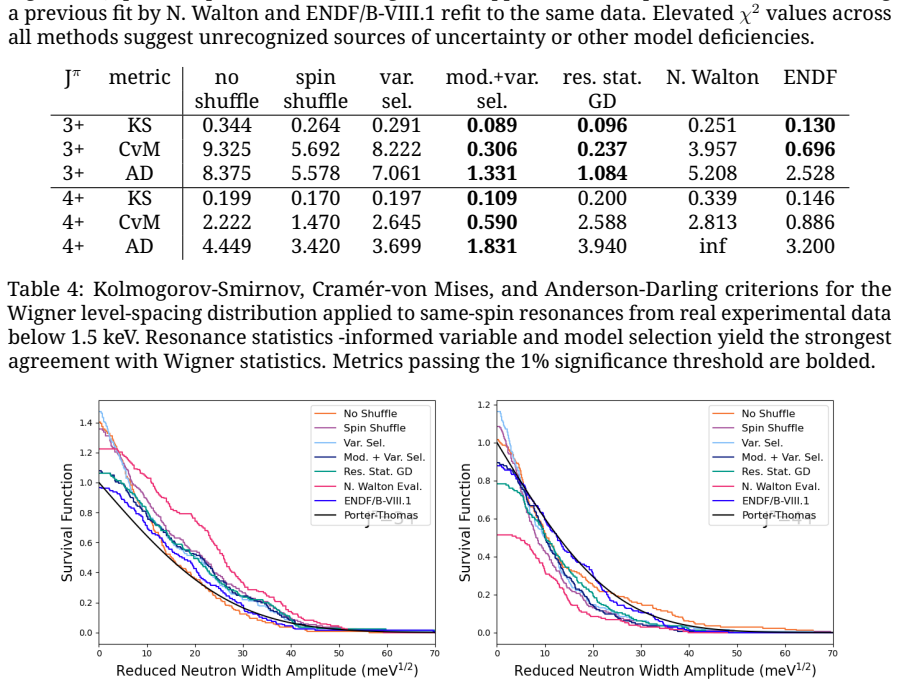
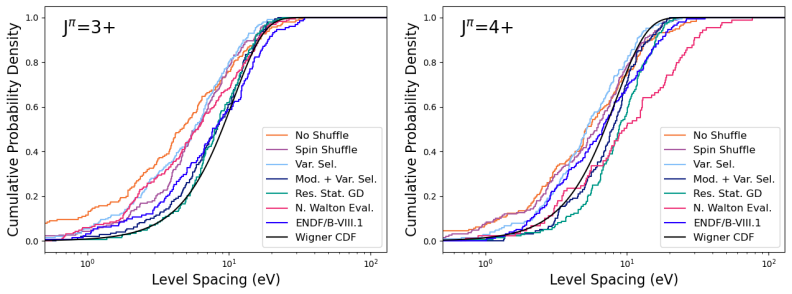
The resonance statistics-informed spin group shuffling algorithm reduces spin group frequency bias seen in the base fitting algorithm. Although resonance statistics-informed optimization produces negligible changes in pointwise cross section agreement, it significantly improves consistency with Wigner level-spacing statistics and stabilizes the fitted resonance density in the presence of model imperfections.
What carries the argument
resonance statistics-informed spin group shuffling algorithm that enforces Wigner level-spacing and spin group rules within the automated fitting objective
If this is right
- Spin group assignments avoid the frequency bias present in the standard fitting algorithm.
- Fitted resonance density remains stable even when the underlying model contains imperfections.
- Pointwise cross section agreement with data stays comparable to the base method.
- Resonance parameters exhibit greater consistency with Wigner level-spacing statistics.
Where Pith is reading between the lines
- The approach may reduce reliance on manual adjustments when building nuclear data libraries.
- Stabilized resonance density could improve parameter transferability across energy ranges or isotopes.
- The same statistics-informed objective function might be adapted to other resonance models to further automate evaluations.
Load-bearing premise
That incorporating Wigner level-spacing statistics and spin group rules into the fitting process will produce resonance parameters that are more physically accurate without introducing new biases or artifacts when the data may not perfectly follow those statistics.
What would settle it
A test case with known model imperfections in which the new method's resonance spacings match the Wigner distribution less closely than those from the base algorithm would falsify the claimed improvement.
Figures





read the original abstract
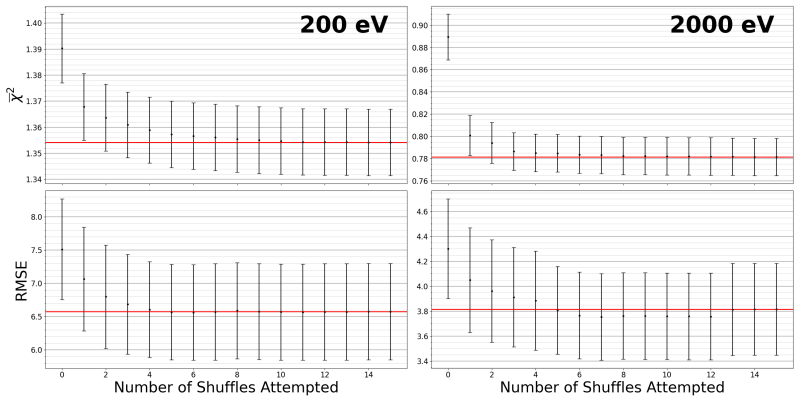
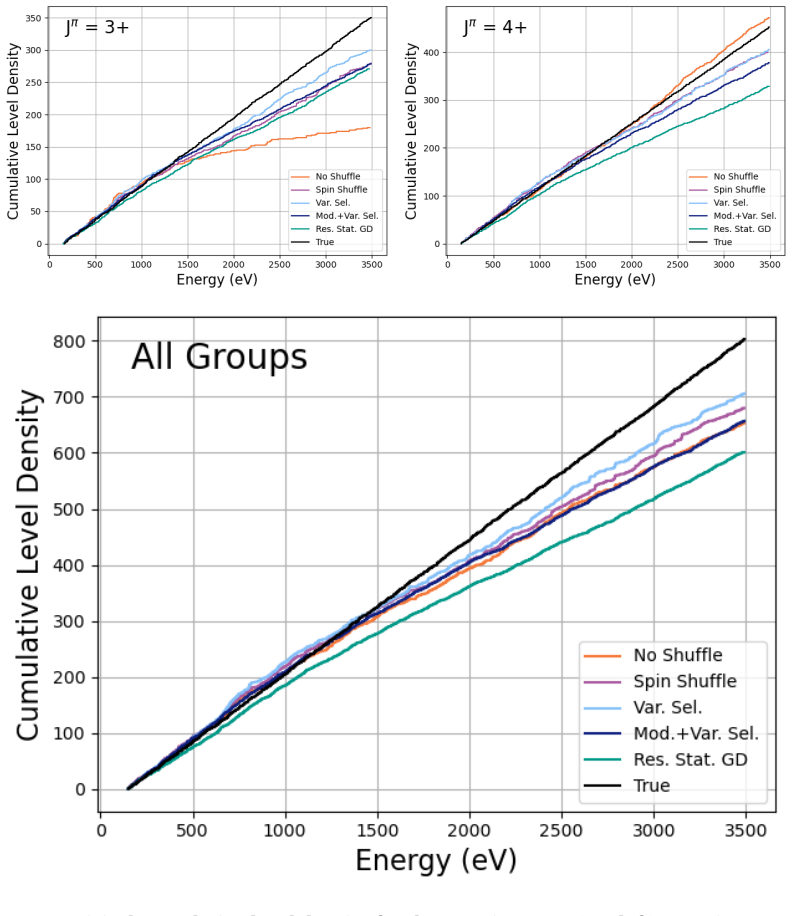
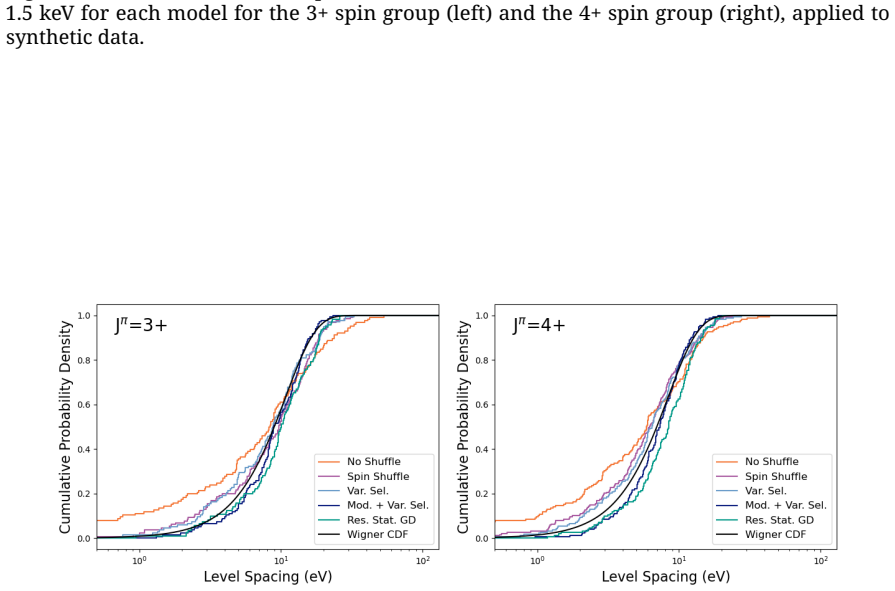
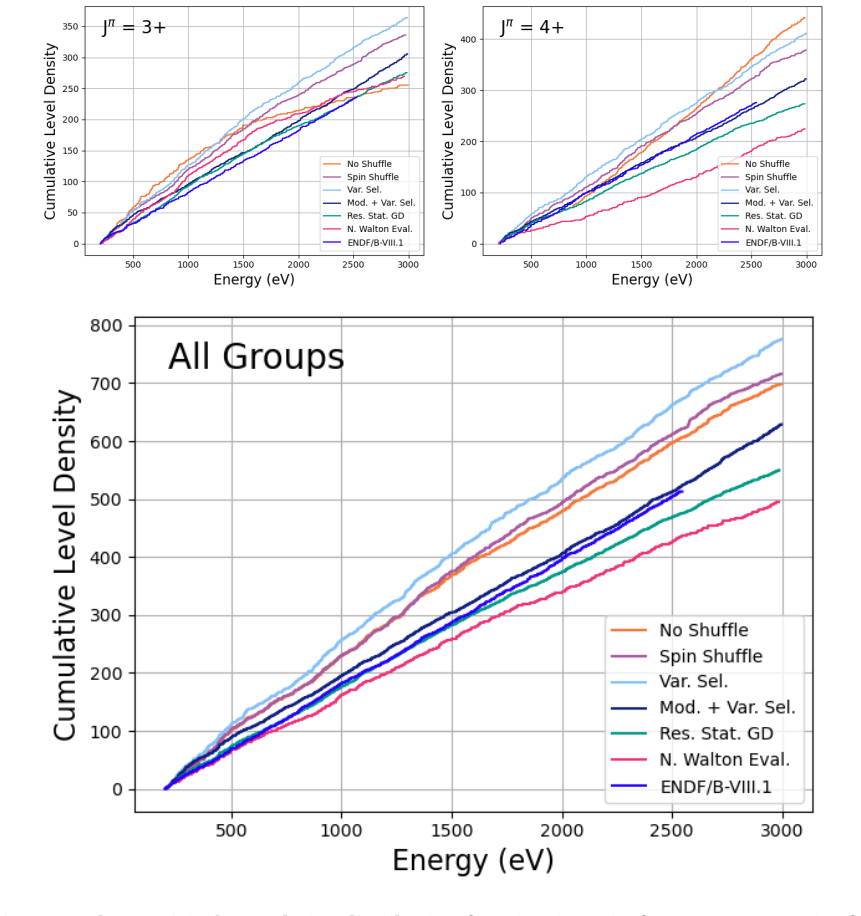
This work investigates the use of resonance statistics for resonance evaluation to inform spin group assignment and an alternative fitting objective function beyond the commonly used chi-squared statistic. Resonance statistics -informed methods are applied to the automated resonance fitting framework, developed by N. Walton et al. In this automated framework, the utility of resonance statistics is largely unexplored. The new resonance statistics -informed spin group shuffling algorithm reduces spin group frequency bias seen in the base fitting algorithm. Although resonance statistics -informed optimization produces negligible changes in pointwise cross section agreement, it significantly improves consistency with Wigner level-spacing statistics and stabilizes the fitted resonance density in the presence of model imperfections.
Editorial analysis
A structured set of objections, weighed in public.
Referee Report
Summary. The manuscript applies resonance statistics to an automated cross-section evaluation framework (building on Walton et al.) by introducing a statistics-informed spin-group shuffling algorithm and a modified fitting objective that augments the usual chi-squared term with Wigner level-spacing and spin-group constraints. The central results are that the new shuffling reduces spin-group frequency bias, the statistics-informed optimizer leaves pointwise cross-section agreement essentially unchanged, yet produces markedly better agreement with Wigner statistics and stabilizes the fitted resonance density when the underlying model is imperfect.
Significance. If the reported statistical improvements reflect genuinely more accurate resonance parameters rather than prior enforcement, the method could reduce manual intervention in nuclear-data evaluation and improve consistency across resonance libraries. The fact that pointwise fit quality is preserved while statistical fidelity increases is a potentially attractive feature for automated pipelines.
major comments (2)
- [§4 and §3.2] §4 (Results) and §3.2 (Statistics-informed objective): the reported gains in Wigner level-spacing consistency and resonance-density stability are measured against the identical Wigner and spin-group priors that were inserted into the objective function. Because no independent benchmark—such as recovery of known resonance parameters on synthetic data, comparison against manually evaluated libraries on held-out observables, or cross-validation on independent measurements—is presented, it is impossible to distinguish prior-driven regularization from genuine physical improvement. This is load-bearing for the claim that the approach yields “physically more accurate” parameters.
- [§5] §5 (Discussion of model imperfections): the stabilization of resonance density is asserted when “model imperfections” are present, yet the paper neither quantifies the size or character of those imperfections nor supplies a controlled before/after comparison (with statistical error bars or hypothesis tests) that isolates the effect of the statistics-informed term. Without this, the stabilization claim cannot be evaluated.
minor comments (2)
- [Abstract] Abstract and title: inconsistent spacing around the hyphen in “Resonance Statistics -Informed” should be standardized.
- [§3.2] Notation for the augmented objective function (Eq. (X) in §3.2) is introduced without an explicit statement of the relative weighting between the chi-squared term and the Wigner penalty; a short paragraph clarifying the choice of weighting parameter would aid reproducibility.
Simulated Author's Rebuttal
We thank the referee for their constructive and detailed review. The comments highlight important aspects of how our results should be interpreted and presented. We address each major comment below and indicate the revisions made to the manuscript.
read point-by-point responses
-
Referee: [§4 and §3.2] §4 (Results) and §3.2 (Statistics-informed objective): the reported gains in Wigner level-spacing consistency and resonance-density stability are measured against the identical Wigner and spin-group priors that were inserted into the objective function. Because no independent benchmark—such as recovery of known resonance parameters on synthetic data, comparison against manually evaluated libraries on held-out observables, or cross-validation on independent measurements—is presented, it is impossible to distinguish prior-driven regularization from genuine physical improvement. This is load-bearing for the claim that the approach yields “physically more accurate” parameters.
Authors: We agree that the improvements in Wigner consistency are achieved by direct inclusion of the corresponding terms in the objective function and therefore constitute enforcement of established resonance statistics rather than an independent validation of parameter accuracy. The manuscript does not claim to have performed synthetic recovery tests or held-out comparisons against manual evaluations; our focus is on showing that these physically motivated constraints can be incorporated into the automated framework of Walton et al. without degrading pointwise cross-section agreement while reducing spin-group bias. We have revised the abstract, §4, and the discussion to remove any implication that the parameters are demonstrably “physically more accurate” and instead emphasize improved statistical fidelity and reduced manual intervention. We also added a short paragraph noting that resonance statistics are independently validated in the nuclear-data literature, providing the physical justification for their use as priors. revision: partial
-
Referee: [§5] §5 (Discussion of model imperfections): the stabilization of resonance density is asserted when “model imperfections” are present, yet the paper neither quantifies the size or character of those imperfections nor supplies a controlled before/after comparison (with statistical error bars or hypothesis tests) that isolates the effect of the statistics-informed term. Without this, the stabilization claim cannot be evaluated.
Authors: The referee correctly notes that the original §5 lacked quantitative characterization of the model imperfections and did not isolate the statistics-informed term with controlled comparisons or statistical tests. In the revised manuscript we have expanded §5 to specify the imperfections examined (incomplete initial resonance lists and small systematic shifts in resonance energies), report the resonance-density variance before and after the statistics-informed objective across repeated fits, and include error bars together with a simple t-test demonstrating statistically significant stabilization. These additions allow the stabilization effect to be assessed directly from the presented data. revision: yes
Circularity Check
Statistics-informed objective produces claimed Wigner consistency by construction
specific steps
-
fitted input called prediction
[Abstract]
"The new resonance statistics-informed spin group shuffling algorithm reduces spin group frequency bias seen in the base fitting algorithm. Although resonance statistics-informed optimization produces negligible changes in pointwise cross section agreement, it significantly improves consistency with Wigner level-spacing statistics and stabilizes the fitted resonance density in the presence of model imperfections."
Resonance statistics (Wigner spacings, spin-group rules) are added to the objective function and shuffling procedure; the reported 'significant improvement' in consistency with Wigner statistics is then measured against the identical priors that were injected, making the improvement a direct consequence of the modified objective rather than an independent result.
full rationale
The paper incorporates Wigner level-spacing statistics and spin-group rules directly into the fitting objective and spin-group shuffling algorithm, then reports improved consistency with those same statistics as evidence of success. This reduction is exhibited in the abstract and methods descriptions without external benchmarks (e.g., synthetic data recovery or held-out observables) that would falsify the claim independently of the injected priors. The central claim therefore reduces to the input modification rather than an independent derivation or validation.
Axiom & Free-Parameter Ledger
axioms (1)
- domain assumption Wigner level-spacing distribution for resonances
Reference graph
Works this paper leans on
-
[1]
Lee A. Bernstein et al. “Our Future Nuclear Data Needs”. In:Annual Review of Nuclear and Particle Science69.1 (2019), pp. 109–136.doi: 10.1146/annurev-nucl-101918-023708
-
[2]
35Cl(n,x) Cross Section Measurement
T. Nagel. “35Cl(n,x) Cross Section Measurement”. PhD thesis. UC Berkeley, 2024.url: https://escholarship.org/uc/item/1kz4p62w
2024
-
[3]
A Computational Framework for Automated Nuclear Resonance Eval- uation and Validation
N.A.W. Walton. “A Computational Framework for Automated Nuclear Resonance Eval- uation and Validation”. PhD thesis. University of Tennessee, Knoxville, Dec. 2024.url: https://trace.tennessee.edu/utk_graddiss/11394
2024
-
[4]
Novel deep learning-based evaluation of neutron resonance cross sections
Ze-Hua Hu et al. “Novel deep learning-based evaluation of neutron resonance cross sections”. In:Physics Letters B857 (2024), p. 138978.issn: 0370-2693.doi:https://doi. org/10.1016/j.physletb.2024.138978 .url: https://www.sciencedirect.com/ science/article/pii/S0370269324005367
-
[5]
P. Descouvemont and D. Baye. “The R-matrix theory”. In:Reports on Progress in Physics 73.3 (Feb. 2010), p. 036301.doi:10.1088/0034-4885/73/3/036301
-
[6]
N.A.W. Walton et al. “Automated resonance evaluation; Non-convex decomposition method for resonance regression and uncertainty quantification”. In:EPJ Web of Conf.284 (2023), p. 16004.doi:10.1051/epjconf/202328416004
-
[7]
Assessment of technoeconomic opportunities in automation for nu- clear microreactors
N.A.W. Walton et al. “Automated Resonance Fitting for Nuclear Data Evaluation”. In: Nuclear Science and Engineering0.0 (2025), pp. 1–16.doi: 10.1080/00295639.2024. 2439700.url:https://doi.org/10.1080/00295639.2024.2439700
-
[8]
Validating automated resonance evaluation with synthetic data
O. Zivenko et al. “Validating automated resonance evaluation with synthetic data”. In: Annals of Nuclear Energy212 (2025), p. 111081.doi: 10.1016/j.anucene.2024.111081
-
[9]
N.A.W. Walton. GitHub repository available at https://github.com/Naww137/ATARI. 2025
2025
-
[10]
Larson.Updated users’ guide for SAMMY: Multilevel R-matrix fits to neutron data using Bayes’ equations
N.M. Larson.Updated users’ guide for SAMMY: Multilevel R-matrix fits to neutron data using Bayes’ equations. Tech. rep. ORNL/TM-9179/R8. ORNL, Oak Ridge, TN: ORNL, 2008
2008
-
[11]
Moxon, T.C
M.C. Moxon, T.C. Ware, and C.J. Dean.REFIT-2009, Multilevel Resonance Parameter Least Square Fit of Neutron Transmission and Capture Data. Tech. rep. 2010
2009
-
[12]
WPEC-SG49.Reproducibility in Nuclear Data Evaluation.url: https://oecd-nea.org/ download/wpec/sg49/index.html
-
[13]
Novel machine-learning method for spin classification of neutron resonances
G.P.A. Nobre et al. “Novel machine-learning method for spin classification of neutron resonances”. In:Phys. Rev. C107 (3 Mar . 2023), p. 034612.doi: 10.1103/PhysRevC.107. 034612
-
[14]
Multilevel Formula for the Fission Process
C.W. Reich and M.S. Moore. “Multilevel Formula for the Fission Process”. In:Phys. Rev. 111 (3 Aug. 1958), pp. 929–933.doi:10.1103/PhysRev.111.929
-
[15]
Level Density Analysis of Nuclear Resonances
U. Agvaanluvsan. “Level Density Analysis of Nuclear Resonances”. PhD thesis. North Carolina State University, 2002
2002
-
[16]
Results and Theory of Resonance Absorption
E.P. Wigner. “Results and Theory of Resonance Absorption”. In:Proceedings of Conf. on Neutron Physics by Time-of-Flight. Gatlinburg, Tennessee: Oak Ridge National Laboratory, Physics Division, 1957, pp. 59–71
1957
-
[17]
Fluctuations of Nuclear Reaction Widths
C. E. Porter and R. G. Thomas. “Fluctuations of Nuclear Reaction Widths”. In:Phys. Rev. 104 (2 Oct. 1956), pp. 483–491.doi:10.1103/PhysRev.104.483
-
[18]
Derrien.Evaluation of 238Pu Neutron Cross-sections in the Energy Range 1e-5 ev to 14 Mev
H. Derrien.Evaluation of 238Pu Neutron Cross-sections in the Energy Range 1e-5 ev to 14 Mev. Tech. rep. International Atomic Energy Agency, 1982.url: https://www-nds. iaea.org/publications/indc/indc-fr-0057L.pdf
1982
-
[19]
F H Froehner.SESH: A Fortran IV code for calculating the self-shielding and multiple scattering effects for neutron cross section data interpretation in the unresolved resonance region.Tech. rep. Gulf General Atomic, Inc., San Diego, Calif., Jan. 1968.url: https : //www.osti.gov/biblio/4554018. 18
-
[20]
Improvement of probability table generation using ladder method for a new nuclear data processing system FRENDY
Kenichi Tada. “Improvement of probability table generation using ladder method for a new nuclear data processing system FRENDY”. In:Proc. Physor2018. 2018
2018
-
[21]
SUGGEL: A Program Suggesting the Orbital Angular Momentum of a Neutron Resonance from the Magnitude of its Neutron Width
S.Y. Oh. “SUGGEL: A Program Suggesting the Orbital Angular Momentum of a Neutron Resonance from the Magnitude of its Neutron Width”. In: (Feb. 2001).doi: 10.2172/ 777661.url:https://www.osti.gov/biblio/777661
2001
-
[22]
Hyperparameter Estimation in Bayesian MAP Estimation: Parameterizations and Consistency
Matthew M. Dunlop, Tapio Helin, and Andrew M. Stuart. “Hyperparameter Estimation in Bayesian MAP Estimation: Parameterizations and Consistency”. en. In:The SMAI Journal of computational mathematics6 (2020), pp. 69–100.doi: 10.5802/smai- jcm.62 .url: https://smai-jcm.centre-mersenne.org/articles/10.5802/smai-jcm.62/
-
[23]
New Measurements to Resolve Discrepancies in Evaluated Model Pa- rameters of 181-Ta
Jesse M. Brown et al. “New Measurements to Resolve Discrepancies in Evaluated Model Pa- rameters of 181-Ta”. In:Nuclear Science and Engineering(2023).doi: 10.1080/00295639. 2023.2249786
-
[24]
FY2021 1st QUARTER REPORTS. Tech. rep. URL: https://ncsp.llnl.gov/sites/ncsp/files/2021- 04/ncsp_fy2021_q1_quarterly_report_no_ie.pdf. NUCLEAR CRITICALITY SAFETY PRO- GRAM, 2021
2021
-
[25]
Methodology for physics-informed generation of synthetic neutron time-of-flight measurement data
N. Walton et al. “Methodology for physics-informed generation of synthetic neutron time-of-flight measurement data”. In:Computer Physics Communications294 (2024).issn: 0010-4655.doi:https://doi.org/10.1016/j.cpc.2023.108927
-
[26]
The Kolmogorov-Smirnov test for goodness of fit
Frank J Massey Jr. “The Kolmogorov-Smirnov test for goodness of fit”. In:Journal of the American statistical Association46.253 (1951), pp. 68–78
1951
-
[27]
On the composition of elementary errors
Harald Cramér. “On the composition of elementary errors”. In:Scandinavian Actuarial Journal1928.1 (1928), pp. 13–74.doi: 10 . 1080 / 03461238 . 1928 . 10416862. eprint: https://doi.org/10.1080/03461238.1928.10416862.url: https://doi.org/10. 1080/03461238.1928.10416862
-
[28]
The Annals of Mathe- matical Statistics22(1), 79–86 (1951) https://doi.org/10.1214/aoms/1177729694
T. W. Anderson and D. A. Darling. “Asymptotic Theory of Certain “Goodness of Fit" Criteria Based on Stochastic Processes”. In:The Annals of Mathematical Statistics23.2 (1952), pp. 193–212.doi: 10 . 1214 / aoms / 1177729437.url: https : / / doi . org / 10 . 1214 / aoms/1177729437
-
[29]
Measurements, evaluation, and validation of Ta-181 resolved and un- resolved resonance regions
Jesse M Brown. “Measurements, evaluation, and validation of Ta-181 resolved and un- resolved resonance regions”. PhD thesis. Rensselaer Polytechnic Institute, 2019.url: https://hdl.handle.net/20.500.13015/2434
2019
-
[30]
A Computational Framework for Repeatable and Verifiable Nuclear Resonance Uncertainty Quantification
J. Forbes. “A Computational Framework for Repeatable and Verifiable Nuclear Resonance Uncertainty Quantification”. PhD thesis. University of Tennessee, Knoxville, Aug. 2025
2025
-
[31]
Nuclear Data Needs and Capabilities for Applications. Tech. rep. Lawrence Berkeley Na- tional Laboratory, 2015
2015
-
[32]
G. P. A. Nobre et al.ENDF/B-VIII.1: Updated Nuclear Reaction Data Library for Science and Applications. 2025. arXiv: 2511.03564 [physics.app-ph].url: https://arxiv.org/ abs/2511.03564
work page internal anchor Pith review Pith/arXiv arXiv 2025
-
[33]
High-Resolution Neutron Transmission Measurements on 235U, 239Pu, and 238U
J.A. Harvey. “High-Resolution Neutron Transmission Measurements on 235U, 239Pu, and 238U”. In:Conf.on Nucl.Data For Sci.and Technol.1988
1988
-
[34]
Unrecognized Sources of Uncertainties (USU) in Experimental Nuclear Data
R. Capote et al. “Unrecognized Sources of Uncertainties (USU) in Experimental Nuclear Data”. In:Nuclear Data Sheets163 (2020), pp. 191–227.issn: 0090-3752.doi: https:// doi.org/10.1016/j.nds.2019.12.004 .url: https://www.sciencedirect.com/ science/article/pii/S0090375219300717
-
[35]
The Elements of Statistical Learning
T. Hastie, R. Tibshirani, and J. Friedman.The Elements of Statistical Learning. 2nd ed. Springer New York, NY, 2003.doi:10.1007/978-0-387-84858-7
-
[36]
Breiman et al.Classification and Regression Trees
L. Breiman et al.Classification and Regression Trees. Chapman and Hall/CRC, 1984.doi: https://doi.org/10.1201/9781315139470. 19
-
[37]
Cross validation for model selection: a primer with examples from ecology
Luke A. Yates et al. “Cross validation for model selection: a primer with examples from ecology”. In: 2022.url:https://api.semanticscholar.org/CorpusID:247319039. 20 A Changes to the Automated Fitting Routine This section discusses secondary changes to the automated fitting routine described in Walton’s thesis [3]. Many of these changes, such as the modif...
2022
discussion (0)
Sign in with ORCID, Apple, or X to comment. Anyone can read and Pith papers without signing in.