Recognition: unknown
A Complex-Valued Continuous-Variable Quantum Approximation Optimization Algorithm (CCV-QAOA)
Pith reviewed 2026-05-09 22:35 UTC · model grok-4.3
The pith
CCV-QAOA optimizes over complex decision variables using continuous-variable quantum variational circuits.
A machine-rendered reading of the paper's core claim, the machinery that carries it, and where it could break.
Core claim
The central claim is that CCV-QAOA provides a variational framework operating in the complex domain that efficiently solves real and complex multivariate optimization problems by optimizing over complex decision variables in continuous-variable quantum systems, with applications shown across convex, constrained, and non-convex cases.
What carries the argument
The complex continuous-variable variational ansatz together with penalty constructions that enforce constraints while remaining in the complex domain.
If this is right
- The method scales with circuit depth and cutoff dimension in continuous-variable encodings.
- Penalty constructions enable direct handling of equality and inequality constraints in quadratic programs.
- It extends naturally to non-convex landscapes including complex quartic objectives.
- The same ansatz supports both purely real and genuinely complex-valued decision variables without reformulation.
Where Pith is reading between the lines
- If the ansatz converges reliably, hybrid quantum-classical loops could target engineering design problems whose parameters are inherently complex-valued.
- The framework suggests a route to embed continuous optimization subroutines inside larger variational quantum machine learning pipelines.
- Success on non-convex benchmarks would motivate systematic studies of how cutoff dimension trades off against classical gradient-descent performance.
Load-bearing premise
The proposed complex-domain variational ansatz and penalty constructions will yield useful solutions for the tested convex, constrained, and non-convex problems.
What would settle it
Running CCV-QAOA on the Styblinski-Tang function or a complex quartic landscape and comparing the obtained solution error against known global optima or classical solvers would directly test whether the method produces competitive results.
Figures




read the original abstract
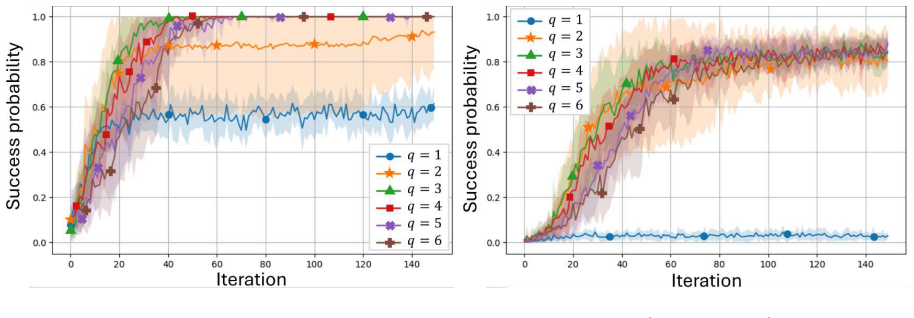
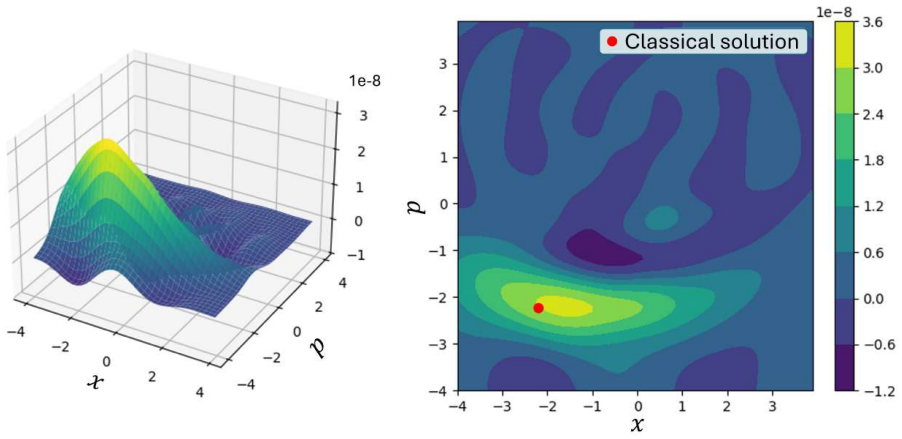
Continuous-variable (CV) quantum systems offer a natural framework for continuous optimization through their infinite-dimensional Hilbert spaces. In this paper, we propose the Complex Continuous-Variable Quantum Approximate Optimization Algorithm (CCV-QAOA), a variational framework operating in the complex domain that optimizes over complex decision variables. The method efficiently solves real and complex multivariate optimization problems. To demonstrate its versatility, we apply CCV-QAOA across a broad suite of optimization use cases, including convex quadratic minimization, scaling studies with circuit depth and cutoff dimension, constrained quadratic programs using penalty constructions, and non-convex benchmarks such as the Styblinski-Tang function and complex quartic landscapes.
Editorial analysis
A structured set of objections, weighed in public.
Referee Report
Summary. The manuscript proposes the Complex Continuous-Variable Quantum Approximate Optimization Algorithm (CCV-QAOA), a variational framework operating on continuous-variable quantum systems in the complex domain to optimize over complex decision variables. It claims this approach efficiently solves real and complex multivariate optimization problems and demonstrates versatility through applications to convex quadratic minimization, scaling studies with circuit depth and cutoff dimension, constrained quadratic programs via penalty constructions, and non-convex benchmarks including the Styblinski-Tang function and complex quartic landscapes.
Significance. If the demonstrations are substantiated with quantitative validation, the work could meaningfully extend variational quantum algorithms beyond discrete binary variables to continuous and complex-valued settings, which arise in signal processing, control, and certain quantum simulation tasks. The inclusion of scaling studies with circuit depth and cutoff dimension, along with explicit penalty constructions for constraints, represents a constructive step toward practical CV variational methods.
major comments (3)
- [convex quadratic minimization experiments] In the convex quadratic minimization experiments, the reported solutions are not compared to the known closed-form global minimum (obtainable via linear algebra for quadratic forms); without this, it is impossible to quantify the accuracy or bias introduced by the complex-valued ansatz and variational optimization.
- [constrained quadratic programs] For the constrained quadratic programs, the penalty term is introduced but no analysis is given of the feasibility gap (distance to the constraint manifold) or the shift in the attained optimum as a function of penalty strength; this is load-bearing for the claim that the method correctly handles constraints.
- [non-convex benchmarks] In the non-convex benchmark section (Styblinski-Tang and complex quartic landscapes), the final objective values are not benchmarked against the known global minima or against classical global optimizers (e.g., differential evolution or basin-hopping) run on identical instances; this leaves the effectiveness of the CCV-QAOA ansatz unverified.
minor comments (1)
- [Abstract] The abstract asserts that the method 'efficiently solves' the problems but provides no quantitative metrics (wall-clock time, number of function evaluations, or comparison to classical solvers) to support the efficiency claim.
Simulated Author's Rebuttal
We thank the referee for the constructive and detailed comments on our manuscript. We address each major comment point by point below. Revisions have been made to incorporate the suggested comparisons and analyses, strengthening the validation of CCV-QAOA.
read point-by-point responses
-
Referee: In the convex quadratic minimization experiments, the reported solutions are not compared to the known closed-form global minimum (obtainable via linear algebra for quadratic forms); without this, it is impossible to quantify the accuracy or bias introduced by the complex-valued ansatz and variational optimization.
Authors: We agree that comparison to the closed-form global minimum is necessary to assess accuracy and any bias from the ansatz. In the revised manuscript, we have added direct comparisons between the CCV-QAOA solutions and the analytical global minima computed via linear algebra for the convex quadratic problems. These additions quantify the achieved accuracy and confirm the reliability of the variational optimization. revision: yes
-
Referee: For the constrained quadratic programs, the penalty term is introduced but no analysis is given of the feasibility gap (distance to the constraint manifold) or the shift in the attained optimum as a function of penalty strength; this is load-bearing for the claim that the method correctly handles constraints.
Authors: The referee correctly notes the absence of quantitative analysis on the penalty approach. We have revised the manuscript to include a dedicated analysis of the feasibility gap and the dependence of the attained optimum on penalty strength. New figures and discussion show how increasing the penalty strength reduces the feasibility gap while tracking shifts in the objective value, supporting the effectiveness of the constraint handling. revision: yes
-
Referee: In the non-convex benchmark section (Styblinski-Tang and complex quartic landscapes), the final objective values are not benchmarked against the known global minima or against classical global optimizers (e.g., differential evolution or basin-hopping) run on identical instances; this leaves the effectiveness of the CCV-QAOA ansatz unverified.
Authors: We acknowledge the value of benchmarking against known global minima and classical methods to verify the ansatz performance. In the revised manuscript, we now include comparisons of the CCV-QAOA objective values to the known global minima for the Styblinski-Tang function and complex quartic landscapes. We have also added results from classical global optimizers (differential evolution and basin-hopping) run on identical instances, where feasible, to provide direct verification of effectiveness. revision: yes
Circularity Check
No circularity detected in CCV-QAOA proposal
full rationale
The manuscript introduces CCV-QAOA as a new variational framework for complex continuous-variable optimization problems. No load-bearing derivations, ansatzes, or predictions are shown that reduce by construction to fitted inputs, self-definitions, or prior self-citations. The algorithm is defined directly via its complex-domain operators and penalty constructions, with applications to convex, constrained, and non-convex benchmarks presented as independent demonstrations rather than forced outcomes. This qualifies as a self-contained algorithmic proposal with no circular steps.
Axiom & Free-Parameter Ledger
Reference graph
Works this paper leans on
-
[1]
Robert A Abrams. Nonlinear programming in complex space: sufficient conditions and duality.Journal of mathematical analysis and applications, 38(3):619–632, 1972. doi: https: //doi.org/10.1016/0022-247X(72)90073-X
-
[2]
A variable neighborhood search algorithm for mas- sive mimo resource allocation
Pablo Adasme and Abdel Lisser. A variable neighborhood search algorithm for mas- sive mimo resource allocation. InInternational Conference on Mobile Web and Intel- ligent Information Systems, pages 3–15. Springer, 2019. doi: https://doi.org/10.1007/ 978-3-030-27192-3_1
2019
-
[3]
Pablo Adasme and Abdel Lisser. A stochastic geometric programming approach for power allocation in wireless networks.Wireless Networks, 29(5):2235–2250, 2023. doi: https: //doi.org/10.1007/s11276-023-03295-8
-
[4]
Amir Ali Ahmadi, Alex Olshevsky, Pablo A Parrilo, and John N Tsitsiklis. Np-hardness of decidingconvexityofquarticpolynomialsandrelatedproblems.Mathematical programming, 137(1):453–476, 2013. doi: https://doi.org/10.1007/s10107-011-0499-2
-
[5]
Marco Ancona, Enea Ceolini, Cengiz Öztireli, and Markus Gross.Gradient-based attribution methods. Springer, 2019. doi: https://doi.org/10.1007/978-3-030-28954-6_9
-
[6]
Quantum Science and Technology4(2), 024004 (2019) https: //doi.org/10.1088/2058-9565/aaf59e
Juan Miguel Arrazola, Thomas R Bromley, Josh Izaac, Casey R Myers, Kamil Brádler, and Nathan Killoran. Machine learning method for state preparation and gate synthesis on photonic quantum computers.Quantum Science and Technology, 4(2):024004, 2019. doi: 10.1088/2058-9565/aaf59e
-
[7]
Wigner distribution function and its application to first-order optics
Martin J Bastiaans. Wigner distribution function and its application to first-order optics. Journal of the Optical Society of America, 69(12):1710–1716, 1979. doi: https://doi.org/ 10.1364/JOSA.69.001710
-
[8]
Dimitri Bertsekas, Angelia Nedic, and Asuman Ozdaglar.Convex analysis and optimization, volume 1. Athena Scientific, 2003. doi: https://doi.org/10.1007/978-3-319-31484-6
-
[9]
Microwave cavity searches for dark-matter 17 axions.Reviews of Modern Physics, 75(3):777, 2003
Richard Bradley, John Clarke, Darin Kinion, Leslie J Rosenberg, Karl van Bibber, Seishi Matsuki, Michael Mück, and Pierre Sikivie. Microwave cavity searches for dark-matter 17 axions.Reviews of Modern Physics, 75(3):777, 2003. doi: https://doi.org/10.1103/ RevModPhys.75.777
2003
-
[10]
Anthony J Brady, Alec Eickbusch, Shraddha Singh, Jing Wu, and Quntao Zhuang. Ad- vances in bosonic quantum error correction with gottesman–kitaev–preskill codes: Theory, engineering and applications.Progress in Quantum Electronics, 93:100496, 2024. doi: https://doi.org/10.1016/j.pquantelec.2023.100496
-
[11]
A complex gradient operator and its application in adaptive array theory
David H Brandwood. A complex gradient operator and its application in adaptive array theory. InIEE Proceedings F (Communications, Radar and Signal Processing), volume 130, pages 11–16. IET, 1983. doi: https://doi.org/10.1049/ip-h-1.1983.0004
-
[12]
Quantum information with continuous vari- ables.Reviews of modern physics, 77(2):513–577, 2005
Samuel L Braunstein and Peter Van Loock. Quantum information with continuous vari- ables.Reviews of modern physics, 77(2):513–577, 2005. doi: https://doi.org/10.1103/ RevModPhys.77.513
2005
-
[13]
MJ Collett, R Loudon, and CW Gardiner. Quantum theory of optical homodyne and heterodyne detection.Journal of Modern Optics, 34(6-7):881–902, 1987. doi: https://doi. org/10.1080/09500348714550811
-
[14]
On duality in complex linear programming.Journal of the Australian Mathematical Society, 16(2):172–175, 1973
BD Craven and B Mond. On duality in complex linear programming.Journal of the Australian Mathematical Society, 16(2):172–175, 1973. doi: https://doi.org/10.1017/ S144678870001418X
1973
-
[15]
Neelam Datta and Davinder Bhatia. Duality for a class of nondifferentiable mathematical programming problems in complex space.Journal of Mathematical Analysis and Applica- tions, 101(1):1–11, 1984. doi: https://doi.org/10.1016/0022-247X(84)90053-2
-
[16]
Daoyi Dong and Ian R Petersen. Quantum control theory and applications: a survey.IET control theory & applications, 4(12):2651–2671, 2010. doi: https://doi.org/10.1049/iet-cta. 2009.050
-
[17]
YutaroEnomoto, KeitaroAnai, KentaUdagawa, andShuntaroTakeda. Continuous-variable quantum approximate optimization on a programmable photonic quantum processor.Phys- ical Review Research, 5(4):043005, 2023. doi: https://doi.org/10.1103/PhysRevResearch.5. 043005
-
[18]
A Quantum Approximate Optimization Algorithm
Edward Farhi, Jeffrey Goldstone, and Sam Gutmann. A quantum approximate optimization algorithm.arXiv preprint arXiv:1411.4028, 2014. doi: https://doi.org/10.48550/arXiv. 1411.4028
work page internal anchor Pith review Pith/arXiv arXiv doi:10.48550/arxiv 2014
-
[19]
Oscar Ferrero. On nonlinear programming in complex spaces.Journal of mathematical anal- ysis and applications, 164(2):399–416, 1992. doi: https://doi.org/10.1016/0022-247X(92) 90123-U
-
[20]
Kosuke Fukui and Shuntaro Takeda. Building a large-scale quantum computer with continuous-variable optical technologies.Journal of Physics B: Atomic, Molecular and Optical Physics, 55(1):012001, 2022. doi: 10.1088/1361-6455/ac489c
-
[22]
2016, arXiv e-prints, arXiv:1604.00772, doi: 10.48550/arXiv.1604.00772
Nikolaus Hansen. The cma evolution strategy: A tutorial.arXiv preprint arXiv:1604.00772,
-
[23]
doi: https://doi.org/10.48550/arXiv.1604.00772. 18
-
[24]
Completely derandomized self-adaptation in evolution strategies
Nikolaus Hansen and Andreas Ostermeier. Completely derandomized self-adaptation in evolution strategies.Evolutionary computation, 9(2):159–195, 2001. doi: https://doi.org/ 10.1162/106365601750190398
-
[25]
Nathan Killoran, Josh Izaac, Nicolás Quesada, Ville Bergholm, Matthew Amy, and Chris- tian Weedbrook. Strawberry fields: A software platform for photonic quantum computing. Quantum, 3:129, 2019. doi: https://doi.org/10.22331/q-2019-03-11-129
-
[26]
The complex gradient operator and the CR- calculus,
Ken Kreutz-Delgado. The complex gradient operator and the cr-calculus.arXiv preprint arXiv:0906.4835, 2009. doi: https://doi.org/10.48550/arXiv.0906.4835
-
[27]
Luigi Di Lauro, Sciara, et al. Optimization methods for integrated and programmable photonics in next-generation classical and quantum smart communication and signal pro- cessing systems.Advances in Optics and Photonics, 17(3):526–622, 2025. doi: https: //doi.org/10.1364/AOP.533504
-
[28]
Inspirations from biological optics for advanced photonic systems.science, 310(5751):1148–1150, 2005
Luke P Lee and Robert Szema. Inspirations from biological optics for advanced photonic systems.science, 310(5751):1148–1150, 2005. doi: https://doi.org/10.1126/science.1115248
-
[29]
Norman Levinson. Linear programming in complex space.Journal of Mathematical Analysis and Applications, 14(1):44–62, 1966. doi: https://doi.org/10.1016/0022-247X(66)90061-8
-
[30]
Panchi Li and Shiyong Li. Quantum-inspired evolutionary algorithm for continuous space optimization based on bloch coordinates of qubits.Neurocomputing, 72(1-3):581–591, 2008. doi: https://doi.org/10.1016/j.neucom.2007.11.017
-
[31]
Quantum computation over continuous variables
Seth Lloyd and Samuel L Braunstein. Quantum computation over continuous variables. Physical Review Letters, 82(8):1784, 1999. doi: https://doi.org/10.1103/PhysRevLett.82. 1784
-
[32]
Dynamic cheatsheet: Test-time learning with adaptive memory.arXiv, 2025
Raneem Madani and Abdel Lisser. Chance-constrained optimization with complex vari- ables.arXiv preprint arXiv:2504.03028, 2025. doi: https://doi.org/10.48550/arXiv.2504. 03028
-
[33]
Nikolaj Moll, Panagiotis Barkoutsos, Lev S Bishop, Jerry M Chow, Andrew Cross, Daniel J Egger, Stefan Filipp, Andreas Fuhrer, Jay M Gambetta, Marc Ganzhorn, et al. Quantum optimization using variational algorithms on near-term quantum devices.Quantum Science and Technology, 3(3):030503, 2018. doi: 10.1088/2058-9565/aab822
-
[34]
Katta G. Murty and Santosh N. Kabadi. Some np-complete problems in quadratic and nonlinear programming.Mathematical Programming, 39(2):117–129, 1987. ISSN 1436-4646. doi: https://doi.org/10.1007/BF02592948
-
[35]
Cambridge University Press, Cambridge (2010)
Michael A Nielsen and Isaac L Chuang.Quantum computation and quantum information. Cambridge university press, 2010. doi: https://doi.org/10.1017/CBO9780511976667
-
[36]
Optical quantum computing.Science, 318(5856):1567–1570, 2007
Jeremy L O’brien. Optical quantum computing.Science, 318(5856):1567–1570, 2007. doi: 10.1126/science.1142892
-
[37]
Zhangjie Peng, Zhibo Zhang, Cunhua Pan, Marco Di Renzo, Octavia A Dobre, and Jiangzhou Wang. Beamforming optimization for active ris-aided multiuser communica- tions with hardware impairments.IEEE Transactions on Wireless Communications, 23(8): 9884–9898, 2024. doi: 10.1109/TWC.2024.3367131
-
[38]
Nature Communications5(1), 4213 (2014) https://doi.org/ 10.1038/ncomms5213
Alberto Peruzzo, Jarrod McClean, Peter Shadbolt, Man-Hong Yung, Xiao-Qi Zhou, Peter J Love, Alán Aspuru-Guzik, and Jeremy L O’brien. A variational eigenvalue solver on a photonic quantum processor.Nature communications, 5(1):4213, 2014. doi: https://doi. org/10.1038/ncomms5213. 19
-
[39]
Quantum Computing in the NISQ era and beyond.Quantum, 2:79, August 2018
John Preskill. Quantum computing in the nisq era and beyond.Quantum, 2:79, 2018. doi: https://doi.org/10.22331/q-2018-08-06-79
-
[40]
Searching for Activation Functions
Prajit Ramachandran, Barret Zoph, and Quoc V Le. Searching for activation functions. arXiv preprint arXiv:1710.05941, 2017. doi: https://doi.org/10.48550/arXiv.1710.05941
work page internal anchor Pith review doi:10.48550/arxiv.1710.05941 2017
-
[41]
Springer Science & Business Media, 1991
Reinhold Remmert.Theory of complex functions, volume 122. Springer Science & Business Media, 1991. doi: https://doi.org/10.1007/978-1-4612-0939-3
-
[42]
Aaijet al.[LHCb Collaboration]
Maria Schuld and Nathan Killoran. Quantum machine learning in feature hilbert spaces. Physical review letters, 122(4):040504, 2019. doi: https://doi.org/10.1103/PhysRevLett. 122.040504
-
[43]
Jieqiu Shao, Mantas Naris, John Hauser, and Marco M Nicotra. Solving quantum optimal control problems using projection-operator-based newton steps.Physical Review A, 109(1): 012609, 2024. doi: https://doi.org/10.1103/PhysRevA.109.012609
-
[44]
A framework for few-shot language model evaluation
Haowen Shu, Lin Chang, Yuansheng Tao, Bitao Shen, Weiqiang Xie, Ming Jin, Andrew Netherton, Zihan Tao, Xuguang Zhang, Ruixuan Chen, et al. Microcomb-driven silicon photonic systems.Nature, 605(7910):457–463, 2022. doi: https://doi.org/10.5281/zenodo. 6092678
-
[45]
Penalty functions.Handarticle of evolutionary computation, 97(1):C5, 1997
Alice E Smith, David W Coit, Thomas Baeck, David Fogel, and Zbigniew Michalewicz. Penalty functions.Handarticle of evolutionary computation, 97(1):C5, 1997
1997
-
[46]
Laurent Sorber, Marc Van Barel, and Lieven De Lathauwer. Unconstrained optimization of real functions in complex variables.SIAM Journal on Optimization, 22(3):879–898, 2012. doi: https://doi.org/10.1137/110832124
-
[47]
Stein and Rami Shakarchi.Complex Analysis, volume 2
Elias M. Stein and Rami Shakarchi.Complex Analysis, volume 2. Princeton University Press, Princeton, NJ, 2010. doi: https://doi.org/10.1017/S0025557200175564
-
[48]
Experiments in nonconvex optimization: stochastic approxi- mation with function smoothing and simulated annealing.Neural Networks, 3(4):467–483,
MA Styblinski and T-S Tang. Experiments in nonconvex optimization: stochastic approxi- mation with function smoothing and simulated annealing.Neural Networks, 3(4):467–483,
-
[49]
doi: https://doi.org/10.1016/0893-6080(90)90029-K
-
[50]
Hichem Talbi and Amer Draa. A new real-coded quantum-inspired evolutionary algorithm for continuous optimization.Applied Soft Computing, 61:765–791, 2017. doi: https://doi. org/10.1016/j.asoc.2017.07.046
-
[51]
Maximizing signal to interference noise ratio for massive mimo: A stochastic neurodynamic approach
Siham Tassouli and Abdel Lisser. Maximizing signal to interference noise ratio for massive mimo: A stochastic neurodynamic approach. InInternational Conference on Mobile Web and Intelligent Information Systems, pages 221–234. Springer, 2023. doi: https://doi.org/ 10.1007/978-3-031-39764-6_15
-
[52]
The variational quantum eigensolver: A review of methods and best practices,
Jules Tilly, Hongxiang Chen, Shuxiang Cao, Dario Picozzi, Kanav Setia, Ying Li, Edward Grant, Leonard Wossnig, Ivan Rungger, George H Booth, et al. The variational quantum eigensolver: a review of methods and best practices.Physics Reports, 986:1–128, 2022. doi: https://doi.org/10.1016/j.physrep.2022.08.003
-
[53]
A quantum approximate optimization algorithm for continuous problems,
Guillaume Verdon, Juan Miguel Arrazola, Kamil Brádler, and Nathan Killoran. A quantum approximate optimization algorithm for continuous problems.arXiv preprint arXiv:1902.00409, 2019. doi: https://doi.org/10.48550/arXiv.1902.00409
-
[54]
Squeezed states of light.nature, 306(5939):141–146, 1983
Daniel F Walls. Squeezed states of light.nature, 306(5939):141–146, 1983. doi: https: //doi.org/10.1038/306141a0
-
[55]
Direct application of qaoa algorithm to pubo problem
Junya Wang. Direct application of qaoa algorithm to pubo problem. In2025 4th Asia 20 Conference on Algorithms, Computing and Machine Learning (CACML), pages 1–8. IEEE,
-
[56]
doi: https://doi.org/10.1109/CACML64929.2025.11010958
-
[57]
Weedbrooket al., Gaussian quantum in- formation, Rev
Christian Weedbrook, Stefano Pirandola, Raúl García-Patrón, Nicolas J Cerf, Timothy C Ralph, Jeffrey H Shapiro, and Seth Lloyd. Gaussian quantum information.Reviews of Modern Physics, 84(2):621–669, 2012. doi: https://doi.org/10.1103/RevModPhys.84.621
-
[58]
On the quantum correction for thermodynamic equ ilibrium,
Eugene Wigner. On the quantum correction for thermodynamic equilibrium.Physical review, 40(5):749, 1932. doi: https://doi.org/10.1103/PhysRev.40.749
-
[59]
Xanadu.https://www.xanadu.ai
Xanadu Quantum Technologies Inc. Xanadu.https://www.xanadu.ai. Accessed: 2025- 02-25
2025
-
[60]
Muqing Zheng, Bo Peng, Ang Li, Xiu Yang, and Karol Kowalski. Unleashed from constrained optimization: quantum computing for quantum chemistry employing gen- erator coordinate inspired method.npj Quantum Information, 10(1):127, 2024. doi: https://doi.org/10.1038/s41534-024-00916-8. 21
discussion (0)
Sign in with ORCID, Apple, or X to comment. Anyone can read and Pith papers without signing in.