Recognition: unknown
Structural Conjectures for 4 x n Chomp: Unique Extension, Asymptotic Ratios, and Period-112 Geometry
Pith reviewed 2026-05-08 08:54 UTC · model grok-4.3
The pith
P-positions in 4 by n Chomp exhibit unique fourth-row extensions, converging ratios, period-112 structure, and linear cone geometry.
A machine-rendered reading of the paper's core claim, the machinery that carries it, and where it could break.
Core claim
Exhaustive enumeration of 4,316,097 P-positions for n ≤ 500 shows that the set of losing positions obeys four structural rules: the unique-extension property that each (a, b, c) triple extends in at most one way to a P-position (a, b, c, d), convergence of row-length ratios to fixed constants, a period-112 modular constraint on extendable triples, and containment of all such positions inside a linear cone in (a, b, c)-space.
What carries the argument
The unique-extension property, which states that for any triple of row lengths there is at most one fourth-row length that completes a P-position.
Load-bearing premise
The four patterns observed in the computed P-positions for n up to 500 continue to hold without exception for all larger n.
What would settle it
Discovery of even one n > 500 in which a single (a, b, c) triple admits two distinct completing d values that both produce P-positions, or in which the observed row-length ratios deviate from the conjectured limits.
Figures
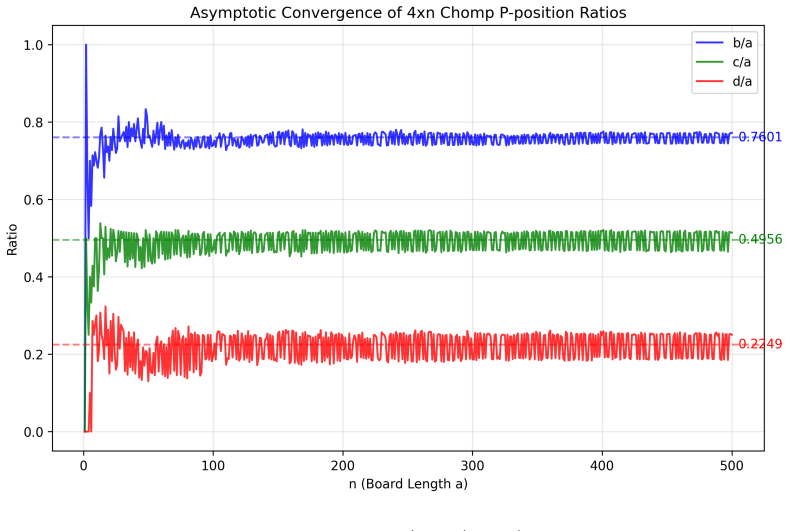

read the original abstract
This paper presents a computational study of P-positions (losing positions for the player to move) in 4 x n Chomp, the combinatorial game played on a 4 x n rectangular grid. An optimized C++ solver with bitpacked state representation tabulates all 4,316,097 P-positions for boards with n <= 500, constituting the most extensive computational study of 4 x n Chomp to date. The analysis reveals four structural conjectures: (1) a Unique Extension property, stating that for any triple (a,b,c) of row lengths, there is at most one valid fourth-row length d completing a P-position; (2) convergence of row-length ratios to fixed asymptotic constants; (3) a period-112 modular structure governing the set of extendable triples; and (4) a linear cone geometry for the P-position set in (a,b,c)-space. These findings suggest a richer deterministic structure in 4 x n Chomp than previously suspected and raise new questions about the relationship between k-row games for consecutive k.
Editorial analysis
A structured set of objections, weighed in public.
Referee Report
Summary. The manuscript presents a computational enumeration of all P-positions in 4 × n Chomp for n ≤ 500, yielding 4,316,097 positions via an optimized C++ solver. From this dataset the authors extract four structural conjectures: (1) the Unique Extension property (at most one d completing any (a,b,c) to a P-position), (2) convergence of row-length ratios to fixed asymptotic constants, (3) a period-112 modular structure on extendable triples, and (4) a linear cone geometry for the P-position set in (a,b,c)-space.
Significance. If the conjectures hold, the work would supply the most detailed structural description yet of P-positions in a fixed-row Chomp variant, potentially enabling closed-form or geometric characterizations and illuminating the relationship between k-row and (k+1)-row games. The sheer scale of the enumeration (over four million positions) constitutes a concrete, reproducible dataset that future analytic work could exploit.
major comments (2)
- [sections presenting the four structural conjectures] The four conjectures rest entirely on patterns observed in the finite set of 4,316,097 positions for n ≤ 500. No recurrence, invariance argument, or larger-scale verification is supplied to establish that the Unique Extension property, the period-112 structure, or the linear cone persist for all n > 500; a single counterexample beyond the computed range would falsify the central claims.
- [computational method section] The manuscript supplies neither the source code nor a detailed error-analysis or verification protocol for the bit-packed solver. Consequently the correctness of the enumerated list itself—the sole empirical foundation for all conjectures—cannot be independently checked within the paper.
minor comments (2)
- [abstract and results] The abstract and results sections would benefit from explicit statements that the conjectures are empirical extrapolations rather than proven theorems.
- [introduction] Prior literature on 3 × n Chomp and general Chomp P-position geometry should be cited more systematically to clarify the novelty of the period-112 and cone observations.
Simulated Author's Rebuttal
We thank the referee for their thorough review and valuable suggestions. We address the major comments point by point below, and have prepared revisions accordingly.
read point-by-point responses
-
Referee: The four conjectures rest entirely on patterns observed in the finite set of 4,316,097 positions for n ≤ 500. No recurrence, invariance argument, or larger-scale verification is supplied to establish that the Unique Extension property, the period-112 structure, or the linear cone persist for all n > 500; a single counterexample beyond the computed range would falsify the central claims.
Authors: We fully agree that the conjectures are empirical observations from the finite dataset up to n=500 and lack a general proof or recurrence relation. The paper presents these as conjectures rather than theorems. In the revised version, we will expand the discussion to explicitly state the finite nature of the evidence, include a caveat about possible counterexamples for larger n, and outline plans for further computational verification. This addresses the concern by clarifying the scope of the claims. revision: partial
-
Referee: The manuscript supplies neither the source code nor a detailed error-analysis or verification protocol for the bit-packed solver. Consequently the correctness of the enumerated list itself—the sole empirical foundation for all conjectures—cannot be independently checked within the paper.
Authors: We acknowledge this limitation in the current manuscript. To improve verifiability, the revised manuscript will include a more detailed description of the solver's implementation, including the bit-packing technique, and a verification protocol consisting of matching known P-positions for small n (n≤20) from prior literature and cross-validation with an independent Python implementation on a subset of the data. Furthermore, we will provide a link to the open-source C++ code repository. revision: yes
- A rigorous analytic proof that the observed structural properties hold for all n > 500
Circularity Check
No circularity: conjectures are direct empirical observations from standard enumeration
full rationale
The paper performs exhaustive computation of all P-positions in 4xn Chomp for n≤500 using the standard recursive definition (P-positions are those with no move to another P-position). It then tabulates the 4,316,097 positions and extracts four observed patterns as conjectures about infinite behavior. No step defines a quantity in terms of itself, fits a parameter to data and renames the fit as a prediction, invokes self-citations for uniqueness theorems, or smuggles an ansatz. The computation relies only on the external, non-circular game-theoretic definition of P-positions; the conjectures are simply extrapolations from the finite list, not derivations that reduce to their inputs by construction. This is a standard, non-circular computational study.
Axiom & Free-Parameter Ledger
axioms (1)
- domain assumption P-positions are defined by the standard recursive rule in normal-play impartial games: a position is P if every move leads to an N-position.
Reference graph
Works this paper leans on
-
[1]
Berlekamp, J
E. Berlekamp, J. H. Conway, and R. K. Guy,Winning Ways for Your Mathematical Plays, 2nd ed., A K Peters, 2001
2001
-
[2]
On three-rowed Chomp,
A. E. Brouwer, G. Horv´ ath, I. Moln´ ar-S´ aska, and C. Szab´ o, “On three-rowed Chomp,” Integers: Electronic Journal of Combinatorial Number Theory, vol. 5, no. 1, 2005, #G07
2005
-
[3]
A curious Nim-type game,
D. Gale, “A curious Nim-type game,”American Mathematical Monthly, vol. 81, pp. 876– 879, 1974
1974
-
[4]
Mathematical Games: Sim, Chomp and Race Track,
M. Gardner, “Mathematical Games: Sim, Chomp and Race Track,”Scientific American, vol. 228, no. 1, January 1973, pp. 108–115
1973
-
[5]
Three-rowed Chomp,
D. Zeilberger, “Three-rowed Chomp,”Advances in Applied Mathematics, vol. 26, pp. 168– 179, 2001. 7
2001
discussion (0)
Sign in with ORCID, Apple, or X to comment. Anyone can read and Pith papers without signing in.