Recognition: unknown
Lattice triangles whose centers are lattice points
Pith reviewed 2026-05-07 17:21 UTC · model grok-4.3
The pith
Acute lattice triangles have a lattice-point orthocenter precisely when their lattice perimeter is 6 or at least 8.
A machine-rendered reading of the paper's core claim, the machinery that carries it, and where it could break.
Core claim
For any integer ℓ there exists an acute integer lattice triangle of lattice perimeter ℓ whose orthocenter is a lattice point if and only if ℓ = 6 or ℓ ≥ 8. Analogous if-and-only-if statements hold when the orthocenter is replaced by the circumcenter or the centroid. The existence thresholds for obtuse and right lattice triangles are different.
What carries the argument
The lattice perimeter (sum of Euclidean side lengths of a triangle whose vertices are integer lattice points) together with the geometric condition that the orthocenter coincides with a lattice point.
If this is right
- Acute lattice triangles with lattice orthocenter exist for every integer perimeter at least 8.
- The same perimeter thresholds govern when the circumcenter and centroid are lattice points.
- Obtuse and right lattice triangles obey different existence rules for lattice centers.
- For every sufficiently large integer perimeter at least one acute lattice triangle realizes a lattice orthocenter.
Where Pith is reading between the lines
- The classification supplies a practical way to enumerate all minimal-perimeter examples with each center type.
- Similar perimeter thresholds may exist for other triangle centers such as the incenter.
- The distinction between acute and non-acute cases suggests that angle constraints interact strongly with lattice-point conditions.
Load-bearing premise
The triangles are non-degenerate with positive area, vertices strictly at lattice points, acute means all angles strictly less than 90 degrees, and the lattice perimeter equals exactly the given integer using Euclidean lengths.
What would settle it
An acute lattice triangle with lattice perimeter exactly 7 whose orthocenter is a lattice point, or the non-existence of any acute lattice triangle with lattice orthocenter for some specific ℓ ≥ 8.
Figures
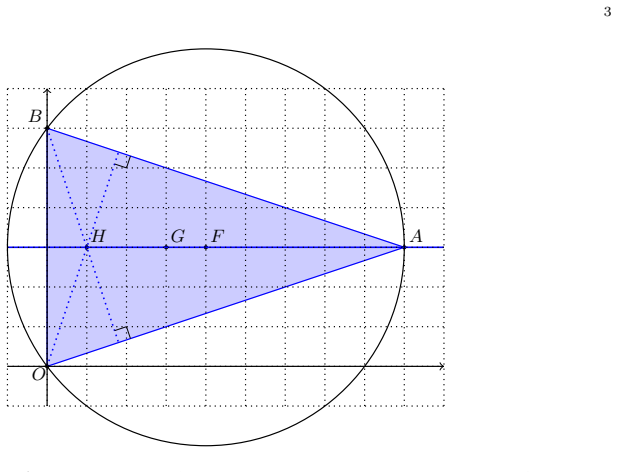
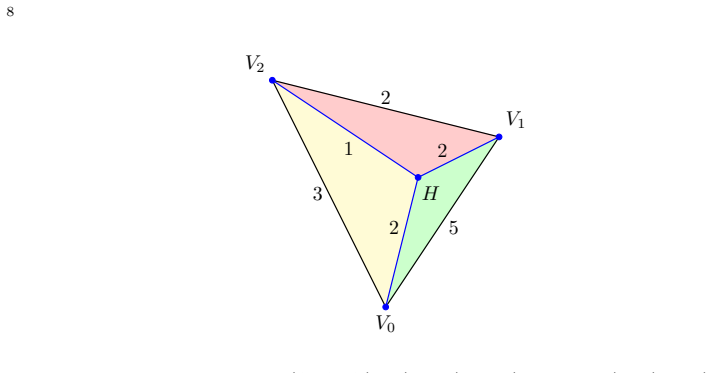
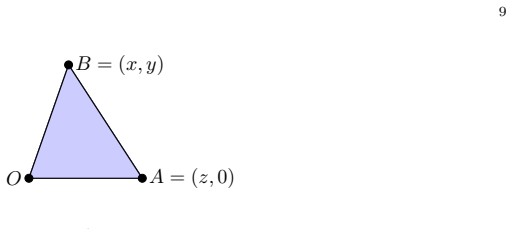


read the original abstract
We show that for an integer $\ell$, there exists an acute integer lattice triangle of lattice perimeter $\ell$ such that its orthocenter is an integer lattice point, if and only if $\ell=6 $ or $\ell\ge 8$. Analogous results are obtained for the circumcenter and the centroid, and the results are contrasted with those for obtuse and right triangles.
Editorial analysis
A structured set of objections, weighed in public.
Referee Report
Summary. The paper proves that for any integer ℓ, there exists an acute lattice triangle (vertices at integer lattice points, all angles strictly acute) with lattice perimeter ℓ (sum of Euclidean side lengths equal to ℓ) whose orthocenter is also a lattice point if and only if ℓ=6 or ℓ≥8. Analogous if-and-only-if characterizations are given for the circumcenter and centroid. The results are contrasted with the corresponding (different) conditions for obtuse and right lattice triangles.
Significance. If the proofs hold, the manuscript delivers clean, complete existence characterizations for three standard triangle centers in the setting of acute lattice triangles with integer perimeter. This is a precise, falsifiable contribution to lattice geometry that resolves the possible perimeters for which such centered triangles exist, and the contrast with obtuse/right cases adds comparative value. The iff structure and restriction to acute triangles are strengths.
minor comments (3)
- §1: The definition of 'lattice perimeter' as the sum of Euclidean lengths equaling an integer ℓ should be stated explicitly with a short example (e.g., the ℓ=6 case) to avoid any ambiguity with Manhattan or other lattice metrics.
- §3 (orthocenter case): The proof of the 'only if' direction for ℓ=7 relies on exhaustive enumeration of small-perimeter acute triangles; a brief remark on why no further cases arise for larger odd ℓ< some bound would improve readability.
- Figure 2: The plotted example triangle for the circumcenter case has vertices that are hard to read at the given scale; adding coordinate labels would help verification.
Simulated Author's Rebuttal
We thank the referee for the positive summary, significance assessment, and recommendation of minor revision. No specific major comments were raised in the report.
Circularity Check
No significant circularity detected
full rationale
The paper states an external existence theorem: for integer ℓ there exists an acute lattice triangle of lattice perimeter ℓ with orthocenter (or other centers) at a lattice point, iff ℓ=6 or ℓ≥8. No equations, parameters, or derivations are exhibited in the abstract or described context that reduce the claimed result to a fitted input, self-definition, or self-citation chain. The definitions of lattice vertices, Euclidean perimeter summing to integer ℓ, and strict acuteness are standard and independent of the existence claim. The central result is a clean iff statement whose verification would rely on case analysis or enumeration external to any internal fit, making the derivation self-contained against the given benchmarks.
Axiom & Free-Parameter Ledger
axioms (2)
- standard math Euclidean plane geometry holds for distances and angles between lattice points
- standard math Lattice points are points with integer coordinates in the plane
Reference graph
Works this paper leans on
-
[1]
A census of convex lattice polygons with at most one interior lattice point
Rabinowitz S. A census of convex lattice polygons with at most one interior lattice point. Ars Combin. 1989;28:83–96
1989
-
[2]
Reflexive polytopes in dimension 2 and certain relations in SL 2(Z)
Hille L, Skarke H. Reflexive polytopes in dimension 2 and certain relations in SL 2(Z). J. Algebra Appl. 2002;1:159–173
2002
-
[3]
Lattice polygons with two interior lattice points, Translation of Mat
Wei X, Ding R. Lattice polygons with two interior lattice points, Translation of Mat. Zametki91 (2012), no. 6, 920–933. Math. Notes 2012;91:868–877
2012
-
[4]
Algebraic capacities
Wormleighton B. Algebraic capacities. Selecta Math. (N.S.) 2022;28:Paper No. 9, 45
2022
-
[5]
Lecture Notes on Lattice Polytopes.https://www2.mathematik
Haase C, Nill B, Paffenholz A. Lecture Notes on Lattice Polytopes.https://www2.mathematik. tu-darmstadt.de/~paffenholz/daten/preprints/20210628_Lattice_Polytopes.pdf. Technische Universit¨ at Berlin; 2021
-
[6]
The fascination of the elementary
Scott PR. The fascination of the elementary. Amer. Math. Monthly 1987; 94:759–768
1987
-
[7]
Lattice polygons and the number 2i+7
Haase C, Schicho J. Lattice polygons and the number 2i+7. Amer. Math. Monthly 2009;116:151–165
2009
-
[8]
Integer area dissections of lattice polygons via a non-abelian Sperner’s Lemma
Abrams A, Pommersheim J. Integer area dissections of lattice polygons via a non-abelian Sperner’s Lemma. Amer. Math. Monthly 2025;132:737–753
2025
-
[9]
Lattice polygons and the number 12
Poonen B, Rodriguez-Villegas F. Lattice polygons and the number 12. Amer. Math. Monthly 2000; 107:238–250
2000
-
[10]
Icons of mathematics, an exploration of twenty key images
Alsina C, Nelsen RB. Icons of mathematics, an exploration of twenty key images. Dolciani Mathe- matical Expositions vol. 45. Washington DC: Mathematical Association of America; 2011
2011
-
[11]
Charming proofs, a journey into elegant mathematics
Alsina C, Nelsen RB. Charming proofs, a journey into elegant mathematics. Dolciani Mathematical Expositions vol. 42. Washington DC: Mathematical Association of America; 2010. Coll`ege Calvin, Geneva, Switzerland 1211 Email address:christian.aebi@edu.ge.ch Department of Mathematical and Physical Sciences, La Trobe University, Melbourne, Australia 3086 Emai...
2010
discussion (0)
Sign in with ORCID, Apple, or X to comment. Anyone can read and Pith papers without signing in.