Recognition: unknown
Non-thermal electron cyclotron emission during runaway plateau in tokamak disruptions from an analytic hot plasma dispersion tensor
Pith reviewed 2026-05-07 14:23 UTC · model grok-4.3
The pith
An analytic hot plasma dispersion tensor for Gaussian pitch-angle distributions yields direct expressions for non-thermal electron cyclotron emission during tokamak runaway plateaus.
A machine-rendered reading of the paper's core claim, the machinery that carries it, and where it could break.
Core claim
We derive an analytic hot plasma dispersion tensor for particle distribution functions characterized by Gaussian pitch-angle distributions. The formalism provides direct analytic expressions for non-thermal electron cyclotron emission coefficients and kinetic instability drive rate. We show the verification of the solutions using the KIAT and SYNO codes. The results offer possible mechanisms that could generate non-thermal electron cyclotron emission during tokamak disruption experiments, even when kinetic instability onset is forbidden.
What carries the argument
The analytic hot plasma dispersion tensor obtained for Gaussian pitch-angle distributions, which supplies closed-form expressions for the emission coefficients and the kinetic drive rate without requiring numerical integration over velocity space.
If this is right
- Emission and instability calculations for runaway electrons can be performed with algebraic expressions rather than repeated numerical integrations.
- Non-thermal cyclotron radiation is possible in the runaway plateau phase without the plasma crossing the kinetic instability threshold.
- The same tensor supplies both the emission coefficients and the instability drive, allowing consistent treatment of radiation and wave growth in a single framework.
- Verification against existing codes establishes that the analytic forms reproduce known numerical results for the chosen distribution class.
Where Pith is reading between the lines
- The approach could reduce computational cost when modeling radiation transport in disruption scenarios for future fusion devices.
- Similar analytic reductions might be possible for other common distribution shapes once the dispersion tensor is recast in the same manner.
- Measurements of the frequency spectrum and polarization of non-thermal ECE during disruptions could be used to infer the pitch-angle width of the runaway population.
Load-bearing premise
The velocity distributions of the energetic electrons are accurately described by Gaussian functions of pitch angle.
What would settle it
A side-by-side numerical comparison of the analytic emission coefficients against a full Vlasov integration performed on an identical Gaussian distribution, or a quantitative match between the predicted spectra and measured electron cyclotron emission data recorded during the runaway plateau of an actual tokamak disruption.
Figures
read the original abstract
We derive an analytic hot plasma dispersion tensor for particle distribution functions characterized by Gaussian pitch-angle distributions. The formalism provides direct analytic expressions for non-thermal electron cyclotron emission coefficients and kinetic instability drive rate. We show the verification of the solutions using the KIAT and SYNO codes. The results offer possible mechanisms that could generate non-thermal electron cyclotron emission during tokamak disruption experiments, even when kinetic instability onset is forbidden.
Editorial analysis
A structured set of objections, weighed in public.
Referee Report
Summary. The manuscript derives an analytic hot plasma dispersion tensor for particle distributions restricted to Gaussian pitch-angle forms. It supplies closed-form expressions for the non-thermal electron cyclotron emission coefficients and the kinetic instability drive rate. Verification is reported against the KIAT and SYNO codes. The results are presented as possible mechanisms for non-thermal ECE during tokamak disruption runaway plateaus even when kinetic instability onset is forbidden.
Significance. If the Gaussian pitch-angle restriction proves representative of runaway-electron distributions, the closed-form expressions would constitute a useful analytic tool for interpreting ECE measurements and exploring emission physics without repeated numerical dispersion evaluations. The reported verification against two independent codes is a positive feature that supports the internal consistency of the derived formulas.
major comments (1)
- The central claim that the formalism explains non-thermal ECE in runaway plateaus rests on the Gaussian pitch-angle assumption stated in the abstract. No comparison is provided to distributions obtained from Fokker-Planck or Monte-Carlo runaway simulations, nor is the sensitivity of the emission coefficient to deviations from Gaussianity (e.g., loss-cone or beam-like features) quantified. This leaves the mapping from the analytic results to the physical regime advertised in the title unestablished.
Simulated Author's Rebuttal
We thank the referee for the detailed review and for recognizing the value of the analytic derivations and code verifications. We address the single major comment below and will make the indicated revisions to strengthen the connection between the Gaussian assumption and the physical context of runaway plateaus.
read point-by-point responses
-
Referee: The central claim that the formalism explains non-thermal ECE in runaway plateaus rests on the Gaussian pitch-angle assumption stated in the abstract. No comparison is provided to distributions obtained from Fokker-Planck or Monte-Carlo runaway simulations, nor is the sensitivity of the emission coefficient to deviations from Gaussianity (e.g., loss-cone or beam-like features) quantified. This leaves the mapping from the analytic results to the physical regime advertised in the title unestablished.
Authors: We acknowledge that the manuscript does not include direct comparisons of the Gaussian pitch-angle distributions to those generated by Fokker-Planck or Monte-Carlo simulations of runaway electrons, nor does it quantify sensitivity to non-Gaussian features such as loss cones or beam-like components. The Gaussian form is adopted precisely because it permits closed-form analytic expressions for the hot-plasma dispersion tensor, emission coefficients, and kinetic drive rates; this analytic tractability is the central contribution. A full numerical sensitivity analysis would require integration methods outside the scope of the present derivation. In the revised manuscript we will expand the discussion section to reference representative distributions reported in the Fokker-Planck literature for disruption runaway plateaus, explicitly state the limitations of the Gaussian assumption, and clarify that the expressions are intended as an analytic baseline for interpreting ECE measurements under that approximation. revision: partial
Circularity Check
No significant circularity; derivation self-contained under explicit assumption
full rationale
The paper starts from the standard hot-plasma dispersion relation and imposes the Gaussian pitch-angle distribution as an explicit modeling choice, then performs the analytic integrals to obtain closed-form expressions for the dispersion tensor, emission coefficients, and drive rate. These results are direct mathematical consequences of the chosen distribution and the underlying Vlasov-Maxwell formalism; they are not obtained by fitting parameters to the target observables nor by renaming prior results. Verification against the independent KIAT and SYNO codes supplies an external consistency check. No self-citations are invoked as load-bearing uniqueness theorems, no ansatz is smuggled via prior work, and no fitted input is relabeled as a prediction. The derivation chain therefore remains non-circular.
Axiom & Free-Parameter Ledger
axioms (1)
- domain assumption Particle distribution functions are characterized by Gaussian pitch-angle distributions.
Reference graph
Works this paper leans on
-
[1]
Indeed, we confirm that an error from the small angle approximations of sin θ ≈ θ and cos θ ≈ 1 are less than 10 % for this specific example with θ 0 = 0.15
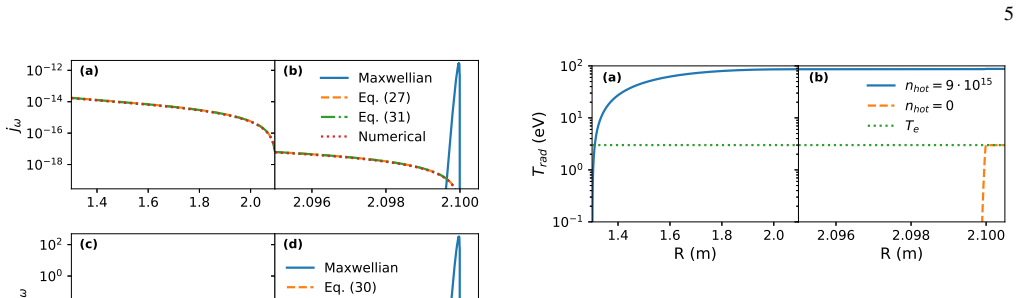
Moreover, even the simplified form derived in the small- Λ limit (green curve) retains a high level of accuracy. Indeed, we confirm that an error from the small angle approximations of sin θ ≈ θ and cos θ ≈ 1 are less than 10 % for this specific example with θ 0 = 0.15. The resonance condition near the Maxwellian core is satis- fied only within a spatially lo...
-
[2]
Optimal Basic Design of DEMO Fusion Reac- tor, CN2502-1
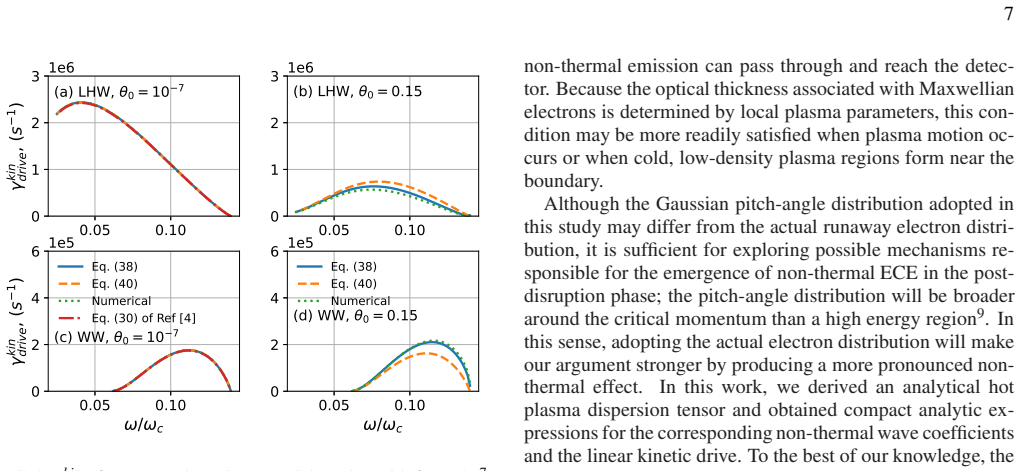
Figure 3 shows the an- alytic γ kin drive (38) (blue curve) agrees well with the results from numerical integration (green curve), where we only conside r the lower hybrid wave (LHW or magnetized plasma wave) and whistler wave (WW) and anomalous Doppler resonance (l =− 1). The maximum absolute errors are 7 .4× 104s− 1 and 1.5× 10⁴s− 1 for LHW and WW , res...
1992
discussion (0)
Sign in with ORCID, Apple, or X to comment. Anyone can read and Pith papers without signing in.