Recognition: unknown
DFT-assisted natural abundance 13C zero-field NMR via optical magnetometry
Pith reviewed 2026-05-07 14:17 UTC · model grok-4.3
The pith
Natural-abundance 13C zero-field NMR spectra are obtained from ordinary liquids using a compact commercial rubidium magnetometer and predicted accurately by vibrationally corrected density functional theory.
A machine-rendered reading of the paper's core claim, the machinery that carries it, and where it could break.
Core claim
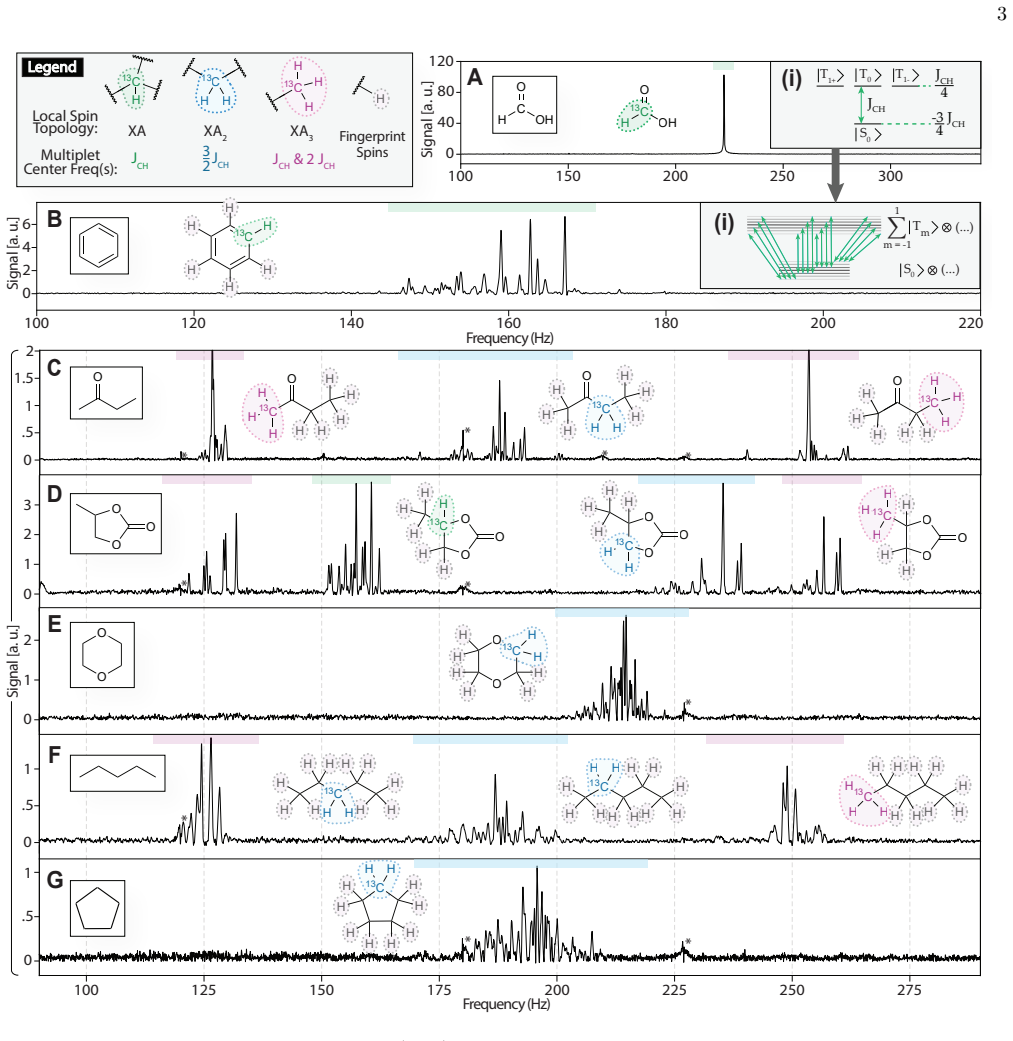
We demonstrate natural-abundance (1.1%) 13C ZF spectroscopy on off-the-shelf liquids using a compact commercial 87Rb magnetometer for the first time, without hyperpolarization or special sample preparation. Instrumental advances yield improved sensitivity, <250-mHz linewidths and >week-long stability, enabling isotopomer-resolved fingerprint spectra across a 13-molecule library, including the ability to discern rare (0.0121%) doubly 13C-labelled species. In parallel, we demonstrate vibrationally corrected density-functional theory (DFT) based prediction of ZF NMR spectra for chemically diverse molecules with few-hertz accuracy. Comparing experiment with these calculations renders residualdev
What carries the argument
Vibrationally corrected density-functional theory predictions of J-couplings combined with zero-field spectra detected by an 87Rb optical magnetometer.
Load-bearing premise
The assumption that vibrational corrections alone suffice for DFT to predict the J-couplings to few-hertz accuracy without molecule-specific adjustments.
What would settle it
A measurement on a new molecule where the experimental zero-field spectrum deviates by more than a few hertz from the vibrationally corrected DFT prediction after accounting for all known couplings.
Figures



read the original abstract
Zero-field (ZF) nuclear magnetic resonance (NMR) spectroscopy probes scalar J-couplings between nuclei while dispensing with large homogeneous magnetic fields, enabling low-cost and geometrically flexible detection, including through conductive enclosures. Despite these advantages, its broader use for chemical analysis has been limited by sensitivity and by the difficulty of predicting the dense spectral multiplets that arise at zero field. Here we demonstrate natural-abundance (1.1%) 13C ZF spectroscopy on off-the-shelf liquids using a compact commercial 87Rb magnetometer for the first time, without hyperpolarization or special sample preparation. Instrumental advances yield improved sensitivity, <250-mHz linewidths and >week-long stability, enabling isotopomer-resolved fingerprint spectra across a 13-molecule library, including the ability to discern rare (0.0121%) doubly 13C-labelled species. In parallel, we demonstrate vibrationally corrected density-functional theory (DFT) based prediction of ZF NMR spectra for chemically diverse molecules with few-hertz accuracy. Comparing experiment with these calculations renders residual deviations as chemically informative, reporting on hydrogen bonding, hydration and ion pairing at high ionic strength. Together, these results contribute towards DFT-assisted ZF NMR as a general platform for field-constraint-free molecular identification and for extracting transient solution-state structure from responsive J-coupling observables.
Editorial analysis
A structured set of objections, weighed in public.
Referee Report
Summary. The paper demonstrates natural-abundance (1.1%) 13C zero-field NMR spectroscopy on standard liquid samples using a compact commercial 87Rb optical magnetometer, without hyperpolarization or special preparation. Instrumental improvements enable <250 mHz linewidths and week-long stability, yielding isotopomer-resolved spectra for a 13-molecule library. In parallel, vibrationally corrected DFT calculations are shown to predict the ZF spectra with few-Hz accuracy, allowing experimental residuals to be interpreted as signatures of hydrogen bonding, hydration, and ion pairing.
Significance. If the reported experimental sensitivity and DFT prediction accuracy hold, the work would establish a practical, low-cost platform for field-free molecular fingerprinting and for using J-couplings to probe transient solution structure. The combination of commercial hardware with parameter-free (post-vibrational-correction) theory is a notable strength that could broaden ZF NMR adoption in chemical analysis.
major comments (2)
- [DFT prediction and comparison section] The central claim of few-Hz DFT accuracy across chemically diverse molecules rests on the assertion that vibrational corrections alone suffice without molecule-specific fitting or functional tuning. However, no table or figure in the results section provides a complete side-by-side list of all experimental versus calculated J-couplings (with residuals and uncertainties) for the 13-molecule library, making it impossible to verify that the reported accuracy is achieved uniformly and without implicit parameter adjustment.
- [Experimental results and methods] The experimental sensitivity claims (natural-abundance 13C detection at <250 mHz linewidths with week-long stability on a commercial magnetometer) are load-bearing for the demonstration. The methods and results sections lack quantitative supporting data such as signal-to-noise ratios, acquisition parameters, and time-series stability metrics that would confirm these performance levels are routinely achieved for the reported spectra.
minor comments (2)
- [Figures] Figure captions and axis labels should explicitly state whether the displayed spectra are raw, processed, or simulated, and include the number of averages or total acquisition time.
- [Abstract and introduction] The abstract states 'few-hertz accuracy' but the main text should clarify the precise metric (RMS residual, maximum deviation, etc.) and the reference set of molecules used for validation.
Simulated Author's Rebuttal
We thank the referee for their constructive comments and positive overall assessment. We address each major point below and have revised the manuscript to improve verifiability of both the DFT predictions and the experimental performance metrics.
read point-by-point responses
-
Referee: [DFT prediction and comparison section] The central claim of few-Hz DFT accuracy across chemically diverse molecules rests on the assertion that vibrational corrections alone suffice without molecule-specific fitting or functional tuning. However, no table or figure in the results section provides a complete side-by-side list of all experimental versus calculated J-couplings (with residuals and uncertainties) for the 13-molecule library, making it impossible to verify that the reported accuracy is achieved uniformly and without implicit parameter adjustment.
Authors: We agree that a single consolidated table would facilitate independent verification. Although the per-molecule comparisons appear in the figures, the revised Supplementary Information now includes Table S2, which tabulates every experimental and vibrationally corrected DFT J-coupling for all 13 molecules together with residuals and experimental uncertainties (derived from observed linewidths). The vibrational corrections were obtained with a uniform computational protocol (B3LYP/6-311++G(d,p) with fixed scaling factors) applied identically to every species; no molecule-specific parameters or functional adjustments were introduced. This addition directly demonstrates that the few-hertz accuracy is achieved uniformly without implicit fitting. revision: yes
-
Referee: [Experimental results and methods] The experimental sensitivity claims (natural-abundance 13C detection at <250 mHz linewidths with week-long stability on a commercial magnetometer) are load-bearing for the demonstration. The methods and results sections lack quantitative supporting data such as signal-to-noise ratios, acquisition parameters, and time-series stability metrics that would confirm these performance levels are routinely achieved for the reported spectra.
Authors: We acknowledge that additional quantitative metrics strengthen the experimental claims. The revised Methods section now specifies acquisition parameters (typical averaging of 100–500 transients, magnetometer bandwidth, and 0.5 mL sample volumes), while the Results section reports representative signal-to-noise ratios. A new supplementary figure (Fig. S4) presents multi-day time-series data and Allan-deviation analysis confirming that linewidths remain below 250 mHz and that stability is maintained over at least seven days under routine operating conditions. These additions substantiate that the stated performance levels are routinely achieved for the library spectra. revision: yes
Circularity Check
No significant circularity; experimental spectra compared to independent DFT predictions
full rationale
The paper's central claims rest on direct experimental acquisition of natural-abundance 13C ZF spectra using a commercial Rb magnetometer and separate comparison to vibrationally corrected DFT calculations performed with standard methods. No equations or procedures are shown that define the predicted spectra in terms of the measured data, nor do any 'predictions' reduce to fitted parameters from the same dataset. Self-citations, if present for instrumental or computational details, are not load-bearing for the uniqueness or accuracy claims, as the DFT results remain falsifiable against external benchmarks and the experimental spectra are acquired independently. The derivation chain is therefore self-contained and externally validated.
Axiom & Free-Parameter Ledger
axioms (1)
- domain assumption Standard assumptions underlying density functional theory calculations of molecular electronic structure and vibrational corrections
Reference graph
Works this paper leans on
-
[1]
Slichter,Principles of Magnetic Resonance
C. Slichter,Principles of Magnetic Resonance
-
[2]
R. R. Ernst, G. Bodenhausen, and A. Wokaun,Prin- ciples of Nuclear Magnetic Resonance in One and Two Dimensions(Oxford University PressOxford, 1990)
1990
-
[3]
Shapira and L
B. Shapira and L. Frydman, Journal of the American Chemical Society126, 7184 (2004)
2004
-
[4]
P. C. Van Zijl, Journal of Magnetic Resonance (1969)75, 335 (1987)
1969
-
[5]
J. W. Blanchard, M. P. Ledbetter, T. Theis, M. C. But- ler, D. Budker, and A. Pines, Journal of the American 10 Chemical Society135, 3607 (2013)
2013
-
[6]
D. B. Zax, A. Bielecki, K. W. Zilm, A. Pines, and D. P. Weitekamp, The Journal of Chemical Physics83, 4877 (1985)
1985
-
[7]
D. P. Weitekamp, A. Bielecki, D. Zax, K. Zilm, and A. Pines, Physical Review Letters50, 1807 (1983)
1983
-
[8]
M. C. D. Tayler, T. Theis, T. F. Sjolander, J. W. Blan- chard, A. Kentner, S. Pustelny, A. Pines, and D. Budker, Review of Scientific Instruments88, 091101 (2017)
2017
-
[9]
M. C. Tayler and D. Sakellariou, Journal of Magnetic Resonance277, 143 (2017)
2017
-
[10]
Theis, J
T. Theis, J. W. Blanchard, M. C. Butler, M. P. Ledbet- ter, D. Budker, and A. Pines, Chemical Physics Letters 580, 160 (2013)
2013
-
[11]
Andrews, M
B. Andrews, M. Lai, Z. Wang, N. Kato, M. C. D. Tayler, E. Druga, and A. Ajoy, PNAS Nexus4, pgaf187 (2025)
2025
-
[12]
D. B. Burueva, J. Eills, J. W. Blanchard, A. Garcon, R. Picazo-Frutos, K. V. Kovtunov, I. V. Koptyug, and D. Budker, Angewandte Chemie International Edition 59, 17026 (2020)
2020
-
[13]
Bodenstedt, M
S. Bodenstedt, M. W. Mitchell, and M. C. D. Tayler, Nature Communications12, 4041 (2021)
2021
-
[14]
Theis, P
T. Theis, P. Ganssle, G. Kervern, S. Knappe, J. Kitch- ing, M. P. Ledbetter, D. Budker, and A. Pines, Nature Physics7, 571 (2011)
2011
-
[15]
J. W. Blanchard and D. Budker, ineMagRes, edited by R. K. Harris and R. L. Wasylishen (John Wiley & Sons, Ltd, Chichester, UK, 2016) pp. 1395–1410
2016
-
[16]
J. W. Blanchard, T. Wu, J. Eills, Y. Hu, and D. Budker, Journal of Magnetic Resonance314, 106723 (2020)
2020
-
[17]
T. Wu, J. W. Blanchard, G. P. Centers, N. L. Figueroa, A. Garcon, P. W. Graham, D. F. J. Kimball, S. Rajen- dran, Y. V. Stadnik, A. O. Sushkov, A. Wickenbrock, and D. Budker, Physical Review Letters122, 191302 (2019)
2019
-
[18]
A directly observable, Zeeman-insensitive nuclear spin coherence in solution,
J. Eills, A. Singh, A.-M. Teimoori, I. Marco-Rius, M. W. Mitchell, and M. C. D. Tayler, “A directly observable, Zeeman-insensitive nuclear spin coherence in solution,” (2026), arXiv:2601.07614 [physics]
-
[19]
D. A. Barskiy, M. C. D. Tayler, I. Marco-Rius, J. Kurhanewicz, D. B. Vigneron, S. Cikrikci, A. Ay- dogdu, M. Reh, A. N. Pravdivtsev, J.-B. H¨ ovener, J. W. Blanchard, T. Wu, D. Budker, and A. Pines, Nature Communications10, 3002 (2019)
2019
-
[20]
Picazo-Frutos, K
R. Picazo-Frutos, K. F. Sheberstov, J. W. Blanchard, E. Van Dyke, M. Reh, T. Sjoelander, A. Pines, D. Bud- ker, and D. A. Barskiy, Nature Communications15, 4487 (2024)
2024
-
[21]
M. C. Butler, M. P. Ledbetter, T. Theis, J. W. Blan- chard, D. Budker, and A. Pines, The Journal of Chemi- cal Physics138, 184202 (2013)
2013
-
[22]
Mandzhieva, F
I. Mandzhieva, F. Theiss, X. He, A. Ortmeier, A. Koirala, S. J. McBride, S. J. DeVience, M. S. Rosen, V. Blum, and T. Theis, Journal of Chemical Information and Mod- eling65, 7554 (2025)
2025
-
[23]
Helgaker, M
T. Helgaker, M. Jaszu´ nski, and M. Pecul, Progress in Nuclear Magnetic Resonance Spectroscopy53, 249 (2008)
2008
-
[24]
QZFM Gen-3,
V. Shah, “QZFM Gen-3,”
-
[25]
M. C. Tayler and S. Bodenstedt, Journal of Magnetic Resonance362, 107665 (2024)
2024
-
[26]
D. A. Barskiy, J. W. Blanchard, D. Budker, J. Eills, S. Pustelny, K. F. Sheberstov, M. C. Tayler, and A. H. Trabesinger, Progress in Nuclear Magnetic Resonance Spectroscopy148–149, 101558 (2025)
2025
-
[27]
M. J. Hadad, W. Zhang, T. Turney, L. Sernau, X. Wang, R. J. Woods, A. Incandela, I. Surjancev, A. Wang, M.-K. Yoon, A. Coscia, C. Euell, R. Meredith, I. Carmichael, and A. S. Serianni, inNMR in Glycoscience and Gly- cotechnology, edited by K. Kato and T. Peters (The Royal Society of Chemistry, 2017) pp. 20–100
2017
-
[28]
Sternhell, Quarterly Reviews, Chemical Society23, 236 (1969)
S. Sternhell, Quarterly Reviews, Chemical Society23, 236 (1969)
1969
-
[29]
Barfield and B
M. Barfield and B. Chakrabarti, Chemical Reviews69, 757 (1969)
1969
-
[30]
Wilzewski, S
A. Wilzewski, S. Afach, J. Blanchard, and D. Budker, Journal of Magnetic Resonance284, 66 (2017)
2017
-
[31]
Bodenstedt, M
S. Bodenstedt, M. W. Mitchell, and M. C. D. Tayler, Optically Detected Nuclear Magnetic Resonance above and Far below Earth’s Magnetic Field: Spin Dynam- ics and Relaxation in Unconventional Regimes, Ph.D. thesis, Universitat Polit` ecnica de Catalunya (2024), 2117/406472
2024
-
[32]
D. M. Doddrell, D. T. Pegg, and M. R. Bendall, Journal of Magnetic Resonance (1969)48, 323 (1982)
1969
-
[33]
G. M. Hale and M. R. Querry, Applied Optics12, 555 (1973)
1973
-
[34]
D. I. Hoult and R. E. Richards, Journal of Magnetic Res- onance (1969)24, 71 (1976)
1969
-
[35]
Kovacs, D
H. Kovacs, D. Moskau, and M. Spraul, Progress in Nu- clear Magnetic Resonance Spectroscopy46, 131 (2005)
2005
-
[36]
H. J. Hogben, M. Krzystyniak, G. T. P. Charnock, P. J. Hore, and I. Kuprov, Journal of Magnetic Resonance 208, 179 (2011)
2011
-
[37]
T. A. Ruden, O. B. Lutnæs, T. Helgaker, and K. Ruud, Journal of Chemical Physics118, 9572 (2003)
2003
-
[38]
Adamo and V
C. Adamo and V. Barone, Journal of Chemical Physics 110, 6158 (1999)
1999
-
[39]
Shimizu, J
Y. Shimizu, J. Blanchard, S. Pustelny, G. Saielli, A. Bagno, M. Ledbetter, D. Budker, and A. Pines, Jour- nal of Magnetic Resonance250, 1 (2015)
2015
-
[40]
M. A. Z. Chowdhury, T. E. Rice, and M. A. Oehlschlaeger, Applied Physics B127, 34 (2021)
2021
-
[41]
McCarthy and K
M. McCarthy and K. L. K. Lee, The Journal of Physical Chemistry A124, 3002 (2020)
2020
-
[42]
Horai, M
H. Horai, M. Arita, S. Kanaya, Y. Nihei, T. Ikeda, K. Suwa, Y. Ojima, K. Tanaka, S. Tanaka, K. Aoshima, Y. Oda, Y. Kakazu, M. Kusano, T. Tohge, F. Mat- suda, Y. Sawada, M. Y. Hirai, H. Nakanishi, K. Ikeda, N. Akimoto, T. Maoka, H. Takahashi, T. Ara, N. Sakurai, H. Suzuki, D. Shibata, S. Neumann, T. Iida, K. Tanaka, K. Funatsu, F. Matsuura, T. Soga, R. Tag...
2010
-
[43]
Scheiner,Hydrogen bonding: a theoretical perspective, Vol
S. Scheiner,Hydrogen bonding: a theoretical perspective, Vol. 7 (Oxford University Press, 1997)
1997
-
[44]
Chelli, R
R. Chelli, R. Righini, and S. Califano, Journal of Phys- ical Chemistry B109, 17006 (2005)
2005
-
[45]
Giovannini, F
T. Giovannini, F. Egidi, and C. Cappelli, Chemical So- ciety Reviews49, 5664 (2020)
2020
-
[46]
H. M. Rahman, G. Hefter, and R. Buchner, Journal of Physical Chemistry B116, 314 (2012)
2012
-
[47]
Leung and S
K. Leung and S. B. Rempe, Journal of the American Chemical Society126, 344 (2004)
2004
-
[48]
W. W. Rudolph and G. Irmer, Journal of Solution Chem- istry51, 935 (2022)
2022
-
[49]
K. Trapp, S. Kosasang, J. Ingenmey, D. Gomez Vazquez, M. Salanne, and M. Lukatskaya, ChemRxiv (2025), 11 https://doi.org/10.26434/chemrxiv-2025-7j1vd-v2
-
[50]
E. A. Meyer, R. K. Castellano, and F. Diederich, Ange- wandte Chemie International Edition42, 1210 (2003)
2003
-
[51]
P. Zhou, J. Huang, and F. Tian, Current medicinal chemistry19, 226 (2012)
2012
-
[52]
T. Hong, Y. Wang, Z. Shao, Q. Li, M. Jiang, and X. Peng, Magnetic Resonance Letters5, 200170 (2025)
2025
-
[53]
P.-H. Chen, C. Gao, N. Alaniva, S. Bj¨ orgvinsd´ ottir, I. G. Pagonakis, M. A. Urban, A. D¨ app, R. Gunzenhauser, and A. B. Barnes, Journal of Magnetic Resonance357, 107588 (2023)
2023
-
[54]
W. Lee, D. Park, J. Bascu˜ n´ an, and Y. Iwasa, Supercon- ductor Science and Technology35, 105007 (2022)
2022
-
[55]
Neese, WIREs Computational Molecular Science15, e70019 (2025)
F. Neese, WIREs Computational Molecular Science15, e70019 (2025)
2025
-
[56]
Helmich-Paris, B
B. Helmich-Paris, B. de Souza, F. Neese, and R. Izs´ ak, Journal of Chemical Physics155, 104109 (2021)
2021
-
[57]
G. L. Stoychev, A. A. Auer, and F. Neese, Journal of Chemical Theory and Computation13, 554 (2017)
2017
-
[58]
de Souza, Angewandte Chemie International Edition 64, e202500393 (2025)
B. de Souza, Angewandte Chemie International Edition 64, e202500393 (2025)
2025
-
[59]
Bannwarth, S
C. Bannwarth, S. Ehlert, and S. Grimme, Journal of Chemical Theory and Computation15, 1652 (2019)
2019
-
[60]
Grimme, J
S. Grimme, J. Antony, S. Ehrlich, and H. Krieg, Journal of Chemical Physics132, 154104 (2010)
2010
-
[61]
T. H. Dunning Jr, Journal of Chemical Physics90, 1007 (1989)
1989
-
[62]
R. A. Kendall, T. H. Dunning Jr, and R. J. Harrison, Journal of Chemical Physics96, 6796 (1992)
1992
-
[63]
D. E. Woon and T. H. Dunning Jr, Journal of Chemical Physics103, 4572 (1995)
1995
-
[64]
Jensen, Journal of Chemical Theory and Computation 2, 1360 (2006)
F. Jensen, Journal of Chemical Theory and Computation 2, 1360 (2006)
2006
-
[65]
P. R. Franke, J. F. Stanton, and G. E. Douberly, Journal of Physical Chemistry A125, 1301 (2021)
2021
-
[66]
Pavoˇ sevi´ c, F
F. Pavoˇ sevi´ c, F. Neese, and E. F. Valeev, Journal of chemical physics141, 054106 (2014)
2014
-
[67]
K. A. Peterson, T. B. Adler, and H.-J. Werner, Journal of Chemical Physics128, 084102 (2008)
2008
-
[68]
Cossi, N
M. Cossi, N. Rega, G. Scalmani, and V. Barone, Journal of Computational Chemistry24, 669 (2003)
2003
-
[69]
Jensen, Journal of Physical Chemistry A111, 11198 (2007)
F. Jensen, Journal of Physical Chemistry A111, 11198 (2007)
2007
-
[70]
Jensen, Journal of Chemical Physics136, 114107 (2012)
F. Jensen, Journal of Chemical Physics136, 114107 (2012)
2012
-
[71]
P. R. Horn, Y. Mao, and M. Head-Gordon, Physical Chemistry Chemical Physics18, 23067 (2016)
2016
-
[72]
Epifanovsky, A
E. Epifanovsky, A. T. Gilbert, X. Feng, J. Lee, Y. Mao, N. Mardirossian, P. Pokhilko, A. F. White, M. P. Coons, A. L. Dempwolff,et al., Journal of Chemical Physics155, 084801 (2021)
2021
-
[73]
Chai and M
J.-D. Chai and M. Head-Gordon, Journal of Chemical Physics128, 084106 (2008)
2008
-
[74]
Chai and M
J.-D. Chai and M. Head-Gordon, Physical Chemistry Chemical Physics10, 6615 (2008)
2008
-
[75]
Lin, G.-D
Y.-S. Lin, G.-D. Li, S.-P. Mao, and J.-D. Chai, Journal of Chemical Theory and Computation9, 263 (2013)
2013
-
[76]
Weigend and R
F. Weigend and R. Ahlrichs, Physical Chemistry Chem- ical Physics7, 3297 (2005)
2005
-
[77]
Rappoport and F
D. Rappoport and F. Furche, Journal of Chemical Physics133, 134105 (2010)
2010
-
[78]
Mao,Advances in Density Functional Theory Calcula- tions and Their Analysis(University of California, Berke- ley, 2017)
Y. Mao,Advances in Density Functional Theory Calcula- tions and Their Analysis(University of California, Berke- ley, 2017)
2017
-
[79]
E. F. Valeev, Chemical Physics Letters395, 190 (2004)
2004
-
[80]
Weigend, A
F. Weigend, A. K¨ ohn, and C. H¨ attig, Journal of Chem- ical Physics116, 3175 (2002)
2002
discussion (0)
Sign in with ORCID, Apple, or X to comment. Anyone can read and Pith papers without signing in.