Recognition: unknown
Properties of the Stormtime Plasma Sheet at the Lunar Distance
Pith reviewed 2026-05-07 13:42 UTC · model grok-4.3
The pith
Storm recovery phases raise electron temperatures fourfold in the distant magnetotail plasma sheet while ion temperatures rise less than twofold.
A machine-rendered reading of the paper's core claim, the machinery that carries it, and where it could break.
Core claim
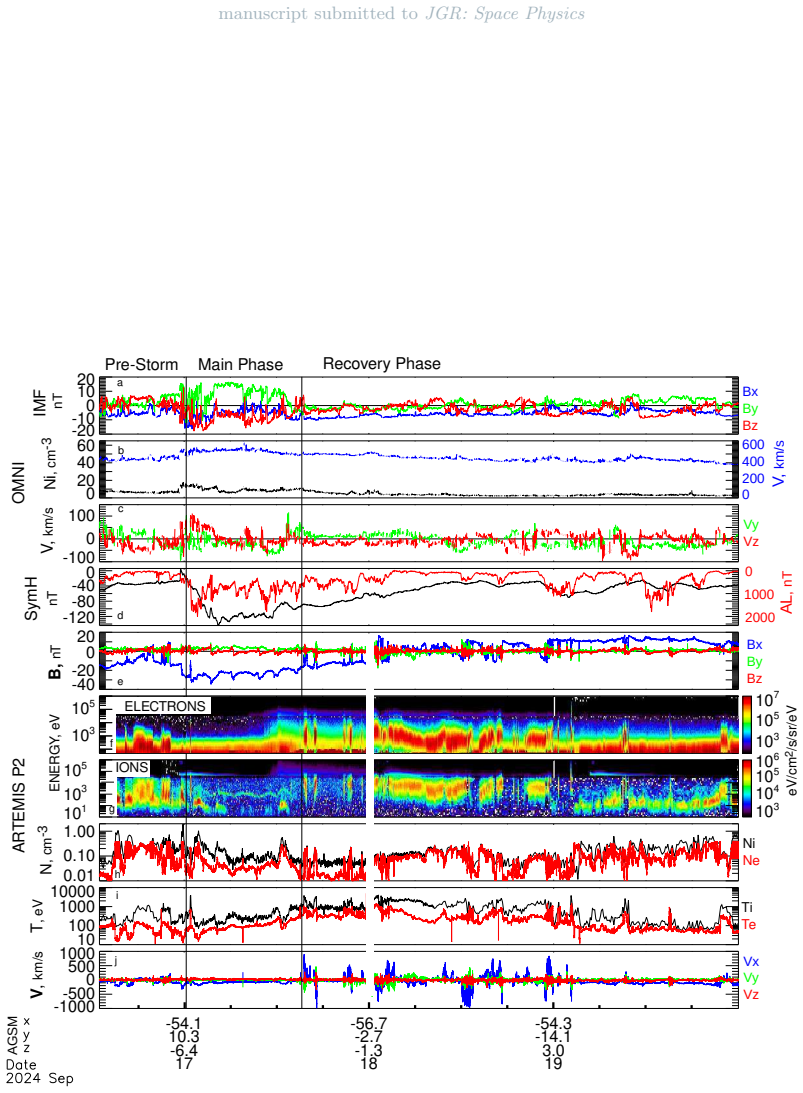
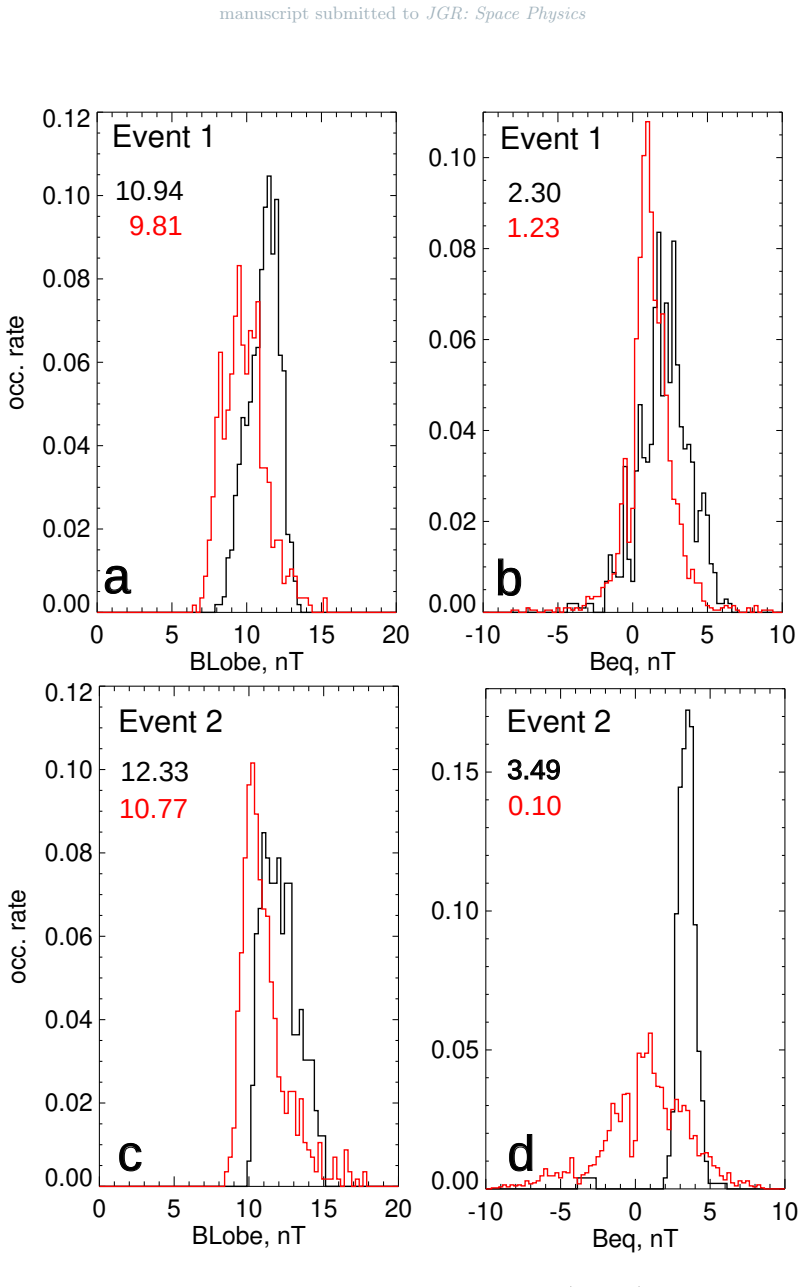
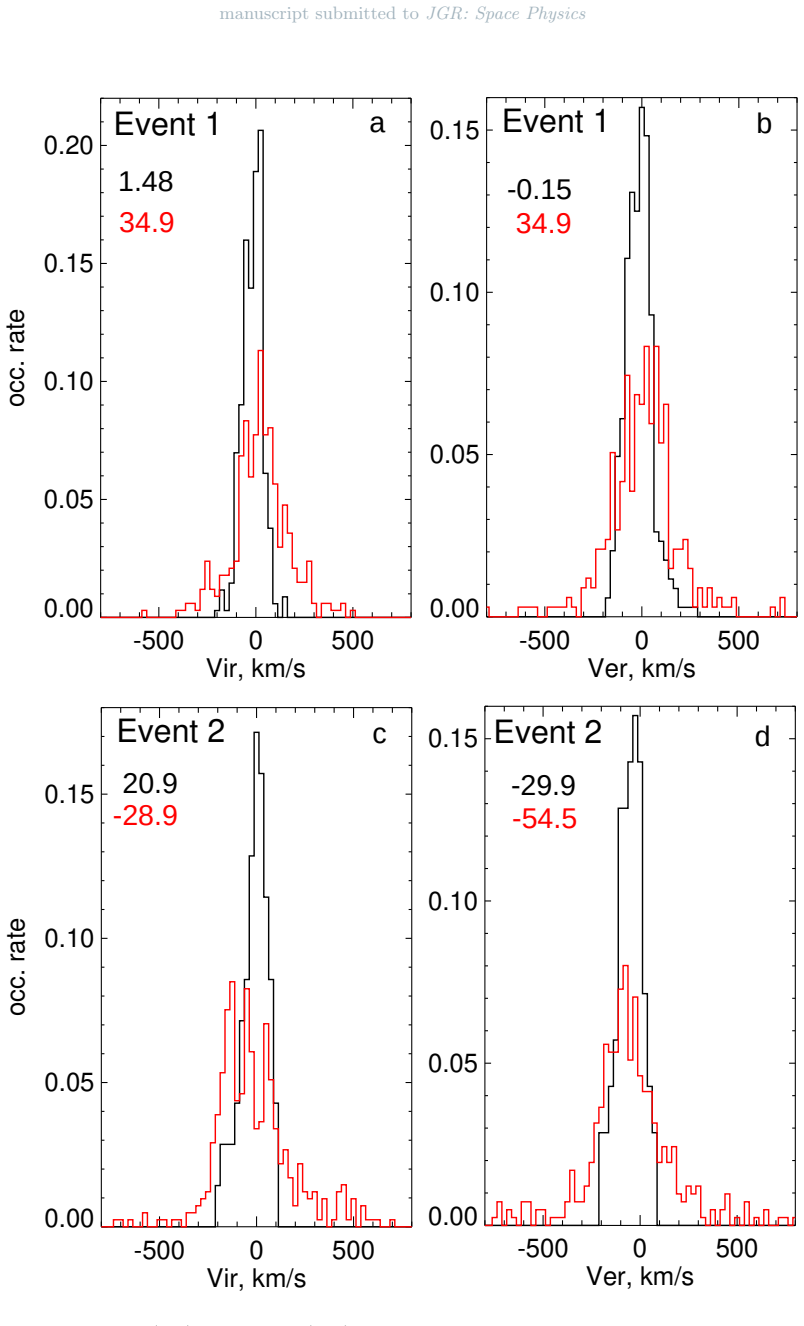
During the recovery phases of two magnetic storms the average electron temperature in the plasma sheet at 60 Earth radii increased by a factor of 4 relative to pre-storm values, while the ion temperature increased by less than a factor of 2; the resulting ion-to-electron temperature ratio fell to approximately 3 from pre-storm values of 7-9. Integral power of electrostatic fluctuations reached about 2 mV/m. Quiet-time electron fluxes above 100 keV were absent, but the storm-time data indicate that electrons reached energies exceeding 100 keV inside the magnetotail, possibly through continuous sporadic electron-only reconnection tied to the observed turbulence.
What carries the argument
Differential response of electron and ion temperatures plus electrostatic fluctuation power measured in pre-storm versus storm-recovery intervals at lunar distance.
If this is right
- Electrons reach energies above 100 keV inside the magnetotail during disturbed conditions.
- The ion-to-electron temperature ratio drops to roughly 3 during storm recovery phases.
- Electrostatic fluctuation power increases to about 2 mV/m in the distant plasma sheet.
- Sporadic electron-only reconnection events linked to turbulence can account for the observed electron energization.
Where Pith is reading between the lines
- Local energization at 60 Earth radii may supply high-energy seed electrons that are later transported inward and further accelerated.
- The same temperature-ratio shift and turbulence signature could appear in other distant-tail crossings during geomagnetic activity.
- Numerical models of tail reconnection should incorporate electron-only modes sustained by electrostatic fluctuations at large distances.
Load-bearing premise
The measured temperature increases and fluctuation enhancements during the two storm recovery phases reflect in-situ energization inside the plasma sheet at 60 Earth radii rather than particle transport from other regions, differences in spacecraft trajectories, or biases in how quiet and disturbed data intervals were chosen.
What would settle it
Multi-point measurements that show the same plasma sheet region exhibiting no net electron temperature rise or no drop in the Ti/Te ratio when sampled before and during a storm recovery phase would indicate that the changes are not produced locally.
Figures




read the original abstract
The electron fluxes at energies $E>$100\,keV are shown to be vanishing in the quiet time plasma sheet at geocentric distance of 60 Earth's radii (R$_E$) where the Moon traverses the magnetotail. Fluxes of energetic electrons up to relativistic energies were, however, observed during disturbed space weather conditions. In this paper, we study the data collected by the two lunar-orbiting Acceleration, Reconnection, Turbulence and Electrodynamics of Moon's Interaction with the Sun (ARTEMIS) spacecraft during their magnetotail traverses at two magnetic storm events. These observations allow us to compare plasma and field properties obtained at prior to storm and during the storm, including the storm recovery phase. We found that on the storms' recovery phases the average electron temperature increased by a factor of 4 compare to the pre-storm electron temperature. The ion temperature gain, however, did not increase a factor of 2. That leads to a decrease of ion to electron temperature ration to $\langle{T_i}/{T_e}\rangle\approx$3, in contrast to the pre-storm value of 7 to 9. We also found an increase in integral power of electrostatic fluctuations up to $\approx$2\,|mV/m|. Our observations suggest that the electrons were energized to energies $E>$100\,keV in the magnetotail. Although the exact mechanism of this energization remains unclear, we suggest that energization via continuous sporadic electron-only reconnection associated with electrostatic turbulence may be responsible for the anomalous electron energization.
Editorial analysis
A structured set of objections, weighed in public.
Referee Report
Summary. The manuscript presents ARTEMIS spacecraft observations of the plasma sheet at lunar distances (~60 R_E) during two magnetic storm events. It compares pre-storm intervals with storm recovery phases, reporting a factor-of-4 increase in average electron temperature, a sub-factor-of-2 increase in ion temperature (yielding a drop in ⟨Ti/Te⟩ from 7–9 to ~3), enhanced electrostatic fluctuations (integral power up to ~2 mV/m), and the inference that electrons are energized to E > 100 keV locally in the distant magnetotail, possibly via electron-only reconnection associated with turbulence.
Significance. If the temperature and fluctuation changes are shown to arise from in-situ processes rather than sampling differences, the work would provide rare direct constraints on electron energization at large geocentric distances during storms, complementing near-Earth studies. The use of lunar-orbiting probes for tail traverses during specific events is a strength, though the limited event count restricts broader applicability.
major comments (2)
- [Abstract and data-analysis section] The central temperature-ratio claims (abstract and results) rest on direct pre-storm vs. recovery-phase averages from only two events without explicit controls for spacecraft position relative to the neutral sheet, |Y_GSM|, radial distance, or plasma beta. Because quiet-time plasma-sheet temperatures and energetic-electron content vary strongly with these coordinates, mismatches in sampling can produce the reported differences without requiring local energization at 60 R_E.
- [Results and discussion] The inference of local E > 100 keV electron energization is drawn from the factor-of-4 Te rise and fluctuation increase, yet no quantitative link is provided between the observed electrostatic turbulence power and the required energy gain, nor are spectra or distribution functions shown to confirm the high-energy tail development.
minor comments (2)
- [Abstract] Abstract contains grammatical issues: 'increased by a factor of 4 compare to' should read 'compared to'; 'ration' should be 'ratio'.
- [Abstract] The fluctuation power is stated as '≈2 |mV/m|'; the absolute-value notation is unclear and should be corrected to a standard unit such as 2 mV/m.
Simulated Author's Rebuttal
We thank the referee for the thoughtful and constructive review. The comments highlight important considerations for interpreting the limited-event observations. We address each major comment below and have revised the manuscript to strengthen the analysis and clarify the inferences.
read point-by-point responses
-
Referee: [Abstract and data-analysis section] The central temperature-ratio claims (abstract and results) rest on direct pre-storm vs. recovery-phase averages from only two events without explicit controls for spacecraft position relative to the neutral sheet, |Y_GSM|, radial distance, or plasma beta. Because quiet-time plasma-sheet temperatures and energetic-electron content vary strongly with these coordinates, mismatches in sampling can produce the reported differences without requiring local energization at 60 R_E.
Authors: We selected the pre-storm and recovery intervals from the same ARTEMIS tail traversals for each of the two events, which inherently constrains radial distance and |Y_GSM| to be comparable within each storm. We will add a new subsection in the data-analysis section that explicitly tabulates the average spacecraft positions (including Z_GSM relative to the neutral sheet), |Y_GSM|, radial distance, and plasma beta for all intervals used. This will demonstrate that the reported temperature changes occur under similar sampling conditions. While the small number of events precludes a broad statistical control, the event-by-event comparison minimizes the sampling-bias concern raised. revision: partial
-
Referee: [Results and discussion] The inference of local E > 100 keV electron energization is drawn from the factor-of-4 Te rise and fluctuation increase, yet no quantitative link is provided between the observed electrostatic turbulence power and the required energy gain, nor are spectra or distribution functions shown to confirm the high-energy tail development.
Authors: The suggestion of local energization to E > 100 keV follows directly from the observed fourfold rise in electron temperature together with the increase in electrostatic fluctuation power, which we associate with possible electron-only reconnection. We agree that a quantitative energy-gain calculation would be valuable but requires additional assumptions about wave-particle interaction rates that lie outside the present observational scope. We will revise the discussion to state this limitation clearly and will add electron energy spectra (from the ARTEMIS ESA and SST instruments) for the pre-storm and recovery intervals to document the development of the high-energy tail. revision: yes
Circularity Check
No circularity: purely observational data comparison
full rationale
The paper reports direct pre-storm versus storm-recovery averages of electron and ion temperatures, fluxes, and fluctuation power from ARTEMIS measurements at ~60 RE. No equations, fitted parameters, or predictive models are introduced whose outputs reduce by construction to the input data or to self-citations. The central claims (factor-of-4 Te increase, Ti/Te drop to ~3, suggestion of local energization) are independent empirical comparisons; they do not rely on any derivation chain that loops back to the same observations. Self-citations, if present in the full text, are not load-bearing for the reported ratios or flux statements.
Axiom & Free-Parameter Ledger
axioms (1)
- domain assumption Pre-storm and storm recovery intervals can be reliably identified from available space weather indices and spacecraft position data
Reference graph
Works this paper leans on
-
[1]
doi: 10.3847/1538-4357/ac8157 Lu, S., Wang, R., & Lu, Q. e. a. (2020, October). Magnetotail reconnection onset caused by electron kinetics with a strong external driver.Nature Communica- tions,11, 5049. doi: 10.1038/s41467-020-18787-w McFadden, J. P., Carlson, C. W., Larson, D., Angelopolos, V., Ludlam, M., Abiad, R., & Elliot, B. (2008). The THEMIS ESA p...
-
[2]
doi: 10.1029/2018JA025506 Stawarz, J. E., Mu˜ noz, P. A., Bessho, N., Bandyopadhyay, R., Nakamura, T. K. M., Eriksson, S., . . . Wilder, F. D. (2024, December). The Interplay Between Collisionless Magnetic Reconnection and Turbulence.Space Science Reviews, 220(8), 90. doi: 10.1007/s11214-024-01124-8 Turner, D. L., Cohen, I. J., Bingham, S. T., Stephens, G...
discussion (0)
Sign in with ORCID, Apple, or X to comment. Anyone can read and Pith papers without signing in.