Recognition: unknown
Sensitivity of binary pulsar timing to spin-0 and spin-1 ultralight dark matter
Pith reviewed 2026-05-07 14:27 UTC · model grok-4.3
The pith
Binary pulsar timing constrains quadratic scalar and vector ultralight dark matter couplings in new mass ranges.
A machine-rendered reading of the paper's core claim, the machinery that carries it, and where it could break.
Core claim
By extending the two-step Bayesian inference framework with explicit marginalization over nuisance orbital parameters, binary pulsar timing yields new constraints on the quadratic scalar coupling β between 2 × 10^{-22} eV and 2 × 10^{-21} eV, plus bounds on the vector coupling g from 10^{-23} eV to 10^{-18} eV, while identifying resonant timing signatures that appear even for circular orbits.
What carries the argument
The two-step Bayesian marginalization over nuisance orbital parameters (phase Ψ' and projected semi-major axis x) that avoids artificial overestimation of sensitivity to dark-matter-induced timing residuals.
Load-bearing premise
The two-step Bayesian marginalization over orbital phase and projected semi-major axis fully removes artificial overestimation of sensitivity, and the modeled resonant signatures for vector dark matter remain valid even for circular orbits.
What would settle it
Reanalysis of timing residuals from a specific binary pulsar system showing either a clear absence of the predicted oscillatory signal at frequencies corresponding to dark-matter masses near 10^{-21} eV or a detection whose amplitude and phase dependence fail to match the quadratic or vector models.
Figures


read the original abstract
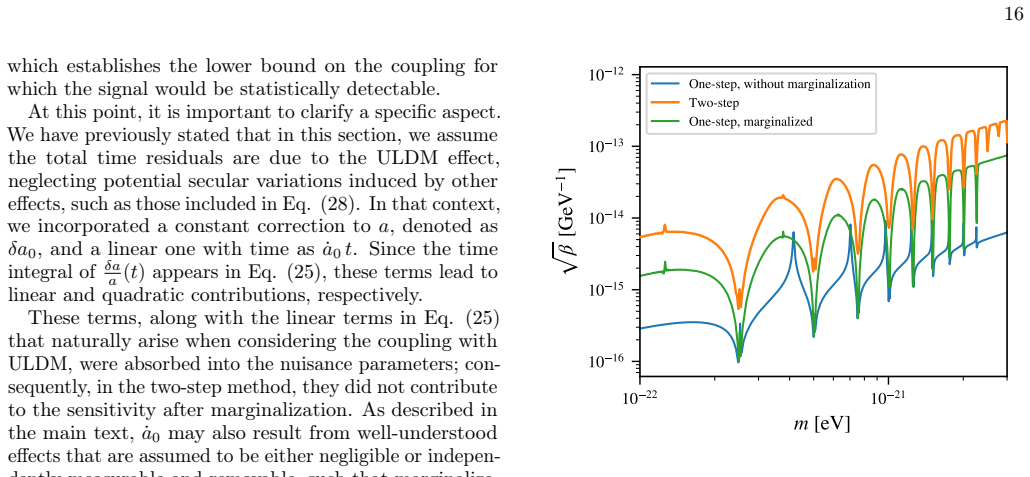
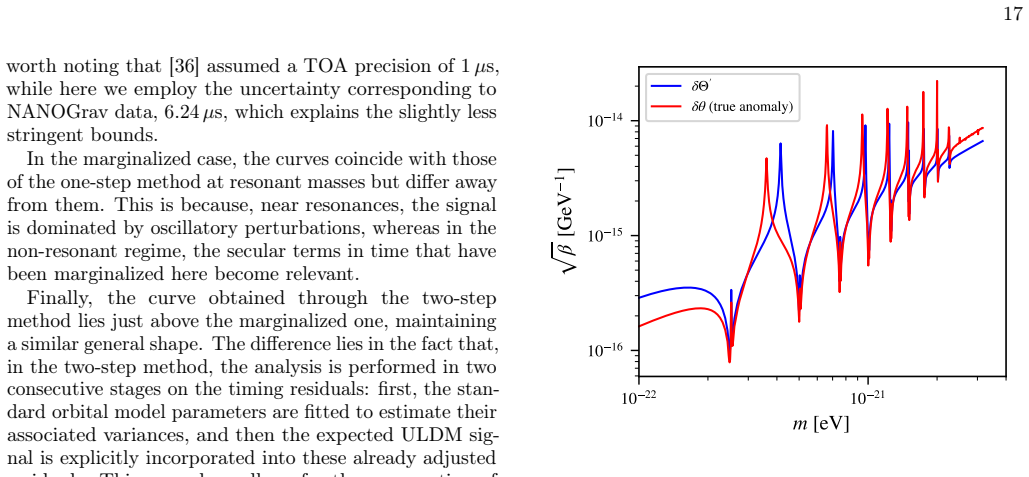
If dark matter consists of ultralight bosons, on galactic scales it can be effectively described as a coherent classical field experiencing oscillations. Such a field could perturb the dynamics of celestial bodies via a direct coupling to ordinary matter, introducing signatures detectable through high-precision pulsar timing analysis. In this work, we extend a two-step Bayesian inference framework, originally developed for linearly coupled scalar ultralight dark matter (ULDM), to probe a quadratic scalar coupling and spin-1 vector dark matter. By explicitly marginalising over nuisance orbital parameters, our approach provides robust sensitivity limits that avoid the artificial overestimation often associated with direct fitting techniques. For quadratic scalar ULDM, we establish new constraints on the coupling $\beta$ in the range between $2 \times 10^{-22}$ eV and $2 \times 10^{-21}$ eV inaccessible to other experiments, while identifying mass regimes where the sensitivity is dominated by the orbital phase $\Psi'$ or the projected semi-major axis $x$. For vector ULDM, we characterize resonant signatures present even in circular orbits and obtain bounds on the coupling $g$ within the $10^{-23}$ eV to $10^{-18}$ eV range, yielding results within the same orders of magnitude as current laboratory and space-based experiments.
Editorial analysis
A structured set of objections, weighed in public.
Referee Report
Summary. The paper extends a two-step Bayesian marginalization procedure, originally for linear scalar ULDM, to quadratic scalar couplings and spin-1 vector ULDM. It models the induced timing residuals in binary pulsars, marginalizes over nuisance orbital parameters (phase Ψ' and projected semi-major axis x), and reports new sensitivity limits: constraints on the quadratic scalar coupling β for masses between 2×10^{-22} eV and 2×10^{-21} eV, plus bounds on the vector coupling g spanning 10^{-23} eV to 10^{-18} eV, claiming these avoid overestimation from direct fitting and are competitive with lab experiments.
Significance. If the marginalization procedure is rigorously validated for the vector case, the work would provide useful forecasts for ULDM constraints from pulsar timing arrays, highlighting regimes where orbital parameters dominate sensitivity and offering a statistical framework that could be applied to real data sets.
major comments (2)
- [Abstract; method section describing the two-step procedure] The central claim that two-step marginalization over Ψ' and x fully removes artificial overestimation for vector ULDM resonant signatures (even in circular orbits) is load-bearing for the reported bounds on g. The abstract and method description assert that resonant signatures persist and that the procedure eliminates bias, but no explicit demonstration of the joint posterior, likelihood factorizability after the first marginalization step, or numerical validation of the resulting limits is provided. This directly affects the headline constraints in the 10^{-23}–10^{-18} eV range.
- [Results section on quadratic scalar ULDM] For the quadratic scalar case, the paper identifies mass regimes where sensitivity is dominated by Ψ' or x, but does not quantify how the marginalization alters the posterior width or compare the marginalized limits against an un-marginalized fit on the same simulated data to confirm the claimed avoidance of overestimation.
minor comments (2)
- [Abstract] The abstract phrasing 'constraints on the coupling β in the range between 2 × 10^{-22} eV and 2 × 10^{-21} eV' is ambiguous; it should explicitly state whether this interval refers to boson mass or to the value of β itself.
- [Introduction] Notation for the vector DM coupling g and the quadratic scalar β should be defined with units or dimensions at first use to improve readability for readers outside the immediate subfield.
Simulated Author's Rebuttal
We thank the referee for their careful and constructive review of our manuscript. We address each major comment in detail below and have revised the paper to incorporate additional demonstrations and comparisons that strengthen the presentation of the marginalization procedure and its validation.
read point-by-point responses
-
Referee: [Abstract; method section describing the two-step procedure] The central claim that two-step marginalization over Ψ' and x fully removes artificial overestimation for vector ULDM resonant signatures (even in circular orbits) is load-bearing for the reported bounds on g. The abstract and method description assert that resonant signatures persist and that the procedure eliminates bias, but no explicit demonstration of the joint posterior, likelihood factorizability after the first marginalization step, or numerical validation of the resulting limits is provided. This directly affects the headline constraints in the 10^{-23}–10^{-18} eV range.
Authors: We agree that an explicit demonstration of the procedure for the vector case would improve clarity. The two-step marginalization extends the framework previously validated for linear scalar ULDM, where the timing residual model permits analytic marginalization because the orbital parameters Ψ' and x enter linearly. For vector ULDM, the resonant signatures in circular orbits arise from the same linear dependence on the orbital elements in the phase perturbation, preserving the factorizability of the likelihood after the first marginalization step. In the revised manuscript we add a new figure in the methods section that shows the joint posterior for a representative vector signal before and after marginalization, together with a short derivation confirming the factorizability. We also include numerical validation on simulated data sets, comparing the two-step limits directly against un-marginalized fits to demonstrate that overestimation is removed. These additions support the reported bounds on g. revision: yes
-
Referee: [Results section on quadratic scalar ULDM] For the quadratic scalar case, the paper identifies mass regimes where sensitivity is dominated by Ψ' or x, but does not quantify how the marginalization alters the posterior width or compare the marginalized limits against an un-marginalized fit on the same simulated data to confirm the claimed avoidance of overestimation.
Authors: We accept that a quantitative comparison would make the claim more robust. In the revised results section we have added a direct comparison for the quadratic scalar case. For representative masses between 2×10^{-22} eV and 2×10^{-21} eV we show the posterior width on β obtained with and without marginalization over Ψ' and x, using the same simulated data sets. The comparison confirms that marginalization broadens the posterior and yields more conservative limits, thereby avoiding the artificial overestimation that occurs when orbital parameters are fixed. We also tabulate the resulting sensitivity bounds from both approaches to illustrate the effect in the mass regimes where Ψ' or x dominates. revision: yes
Circularity Check
No significant circularity in sensitivity forecast
full rationale
The paper frames its results as a forward sensitivity analysis that extends a prior two-step Bayesian marginalization procedure to quadratic scalar and vector ULDM cases. The reported bounds on β and g are obtained by propagating the model through this marginalization over nuisance parameters (Ψ' and x), not by fitting the same data used to define the model or by renaming fitted quantities as predictions. No equation or step in the abstract reduces the final constraints to the inputs by construction, and the self-citation to the original framework is not load-bearing for the new extensions. The derivation remains self-contained against external benchmarks.
Axiom & Free-Parameter Ledger
axioms (2)
- domain assumption Ultralight dark matter on galactic scales behaves as a coherent classical oscillating field that couples directly to ordinary matter.
- domain assumption Binary pulsar timing residuals can be modeled by marginalizing over orbital nuisance parameters to obtain robust limits on dark-matter-induced effects.
Reference graph
Works this paper leans on
-
[1]
cos((n ωb + 2m)t+ 2Υ−n ω bT0) n ωb + 2m + cos((n ωb −2m)t−2Υ−n ω bT0) n ωb −2m # + 1 4
The term δa a (t′), as well as the remaining variations of the orbital parameters, is provided in Appendix B. In the case of circular orbits, we can assume that the true anomaly evolves according toθ = ωb (t−T 0)(with T0 = Tasc − ω ωb ) and thatr→a . Taking the limite→ 0, Eq.(22) becomes ˙a a = ˙x x =−2βΦ ˙Φ(27a) ˙η η = ˙κ κ = ˙e e =− β e Φ2 2 ωb sin ωb ˜...
-
[2]
Oxford University Press, Oxford, 2008
Steven Weinberg.Cosmology. Oxford University Press, Oxford, 2008
2008
-
[3]
SciPost Physics Reviews1, 001 (2026) https://doi.org/10.21468/SciPostPhysRev.1
Marco Cirelli, Alessandro Strumia, and Jure Zu- pan. Dark matter.SciPost Phys. Rev., 2026. doi: 10.21468/SciPostPhysRev.1. URL https://scipost. org/10.21468/SciPostPhysRev.1
-
[4]
D. J. E. Marsh, D. Ellis, and V. M. Mehta.Dark Matter: Evidence, Theory, and Constraints. Princeton University Press, 2024
2024
-
[5]
Secular effects of ultralight dark matter on binary pulsars.Phys
Diego Blas, Diana López Nacir, and Sergey Sibiryakov. Secular effects of ultralight dark matter on binary pulsars.Phys. Rev. D, 101(6):063016, 2020. doi: 10.1103/PhysRevD.101.063016
-
[6]
JuanManuelArmaleo, DianaLópezNacir, andFedericoR. Urban. Binary pulsars as probes for spin-2 ultralight dark matter.Journal of Cosmology and Astroparticle Physics, 01:053, 2020. doi:10.1088/1475-7516/2020/01/053
-
[7]
Ultralight dark matter resonates with binary pulsars
Diego Blas, Diana López Nacir, and Sergey Sibiryakov. Ultralight dark matter resonates with binary pulsars. Physical Review Letters, 118(26):261102, June 2017. doi: 10.1103/PhysRevLett.118.261102. URL https://doi.or g/10.1103/PhysRevLett.118.261102 . Published un- der the Creative Commons Attribution 4.0 International License
-
[8]
Diana López Nacir and Federico R. Urban. Vector fuzzy dark matter, fifth forces, and binary pulsars.Journal of Cosmology and Astroparticle Physics, 2018(10):044, oct
2018
-
[9]
URL https: //doi.org/10.1088/1475-7516/2018/10/044
doi:10.1088/1475-7516/2018/10/044. URL https: //doi.org/10.1088/1475-7516/2018/10/044
-
[10]
Pavel Kůs, Diana López Nacir, and Federico R. Urban. Deep neural networks hunting ultra-light dark matter. Arxiv preprint, 2025. doi:10.48550/arXiv.2506.04100
-
[11]
Bourke et al
T. Bourke et al. Advancing astrophysics with the square kilometre array. InProceedings of Science, volume AASKA14, 2015. PoS(AASKA14)001
2015
-
[12]
Pavel Kůs, Diana López Nacir, and Federico R. Urban. Bayesian sensitivity of binary pulsars to ultra-light dark matter.Astronomy and Astrophysics, 690:A51, 2024. doi: 10.1051/0004-6361/202449953. URL https://doi.org/ 10.1051/0004-6361/202449953. Received 12 March 2024 / Accepted 5 June 2024
-
[13]
Teukolsky
Roger Blandford and Saul A. Teukolsky. Arrivaltime analysis for a pulsar in a binary system.The Astrophysical Journal, 205:580–591, 1976
1976
-
[14]
On the variation of the initial mass function,
Christian Lange, Fernando Camilo, Norbert Wex, Michael Kramer, Donald C. Backer, Andrew G. Lyne, and Oleg Doroshenko. Precision timing measurements of psr j1012+5307.Monthly Notices of the Royal Astronom- ical Society, 326(1):274–282, 2001. doi:10.1046/j.1365- 8711.2001.04606.x
-
[15]
Lectures on Dark Matter Physics
Mariangela Lisanti. Lectures on Dark Matter Physics. In Thomas DeGrand and John Terning, editors,New Frontiers in Fields and Strings: Proceedings of the 2015 Theoretical Advanced Study Institute in Elementary Par- ticle Physics, chapter 7, pages 399–446. World Scien- tific, 2017. doi:10.1142/9789813149441_0007. URL https://doi.org/10.1142/9789813149441_0007
-
[16]
Madappa Prakash, Ignazio Bombaci, Manju Prakash, Paul J. Ellis, James M. Lattimer, and Roland Knor- ren. Composition and structure of protoneutron stars. Physics Reports, 280(1):1–77, 1997. ISSN 0370-1573. doi: https://doi.org/10.1016/S0370-1573(96)00023-3. URL https://www.sciencedirect.com/science/articl e/pii/S0370157396000233
-
[17]
Peter W. Graham, David E. Kaplan, Jeremy Mardon, Surjeet Rajendran, and William A. Terrano. Dark mat- ter direct detection with accelerometers.Phys. Rev. D, 93:075029, Apr 2016. doi:10.1103/PhysRevD.93.075029. URL https://link.aps.org/doi/10.1103/PhysRevD. 93.075029
-
[18]
Will.Gravity: Newtonian, Post-Newtonian, Relativistic
Eric Poisson and Clifford M. Will.Gravity: Newtonian, Post-Newtonian, Relativistic. Cambridge University Press, Cambridge, 2014. ISBN 9780521834865
2014
-
[19]
I. S. Shklovskii. Possible causes of the secular increase in pulsar periods.Soviet Astronomy, 13:562, 1970
1970
-
[20]
Thibault Damour and J. H. Taylor. On the orbital period change of the binary pulsar psr 1913+16.The Astrophys- ical Journal, 366:501, 1991. doi:10.1086/169585
-
[21]
Christopher J. Moore, Stephen R. Taylor, and Jonathan R. Gair. Estimating the sensitivity of pulsar timing arrays. Classical and Quantum Gravity, 32(5):055004, 2015. doi: 10.1088/0264-9381/32/5/055004
-
[22]
G. B. Hobbs, R. T. Edwards, and R. N. Manchester. TEMPO2, a new pulsar-timing package.Monthly Notices of the Royal Astronomical Society, 369(2):655–672, 2006. doi:10.1111/j.1365-2966.2006.10302.x
-
[23]
Jing Luo, Scott Ransom, Paul Demorest, Paul S. Ray, Anne Archibald, Matthew Kerr, Ross J. Jennings, Mat- 19 teo Bachetti, Rutger van Haasteren, Chloe A. Cham- pagne, Jonathan Colen, Camryn Phillips, Josef Zimmer- man, Kevin Stovall, Michael T. Lam, and Fredrick A. Jenet. PINT: A modern software package for pulsar timing.The Astrophysical Journal, 911(1):4...
-
[24]
Gabriella Agazie, others, and The NANOGrav Collab- oration. The NANOGrav 15 yr data set: Observations and timing of 68 millisecond pulsars.The Astrophysi- cal Journal Letters, 951(1):L9, 2023. doi:10.3847/2041- 8213/acda9a
-
[25]
B. Bertotti, L. Iess, and P. Tortora. A test of general relativity using radio links with the Cassini spacecraft. Nature, 425:374–376, 2003. doi:10.1038/nature01997
-
[26]
J. W. Armstrong, L. Iess, P. Tortora, and B. Bertotti. Stochastic gravitational wave background: Upper limits in the10 −6–10−3 hz band.Astrophysical Journal, 599(2): 806–813, 2003. doi:10.1086/379505
-
[27]
N. K. Porayko et al. Parkes Pulsar Timing Ar- ray constraints on ultralight scalar-field dark mat- ter.Phys. Rev. D, 98(10):102002, 2018. doi: 10.1103/PhysRevD.98.102002
-
[28]
C. Smarra et al. Second data release from the European Pulsar Timing Array: Challenging the ultralight dark matter paradigm.Phys. Rev. Lett., 131(17):171001, 2023. doi:10.1103/PhysRevLett.131.171001
-
[29]
Dorian W.P. Amaral, Mudit Jain, Mustafa A. Amin, and Christopher Tunnell. Vector wave dark matter and terrestrial quantum sensors.Journal of Cosmology and Astroparticle Physics, 2024(06):050, jun 2024. doi: 10.1088/1475-7516/2024/06/050. URL https://doi.or g/10.1088/1475-7516/2024/06/050
-
[30]
E. A. Shaw, M. P. Ross, C. A. Hagedorn, E. G. Adelberger, and J. H. Gundlach. Torsion-balance search for ultralow- mass bosonic dark matter.Phys. Rev. D, 105:042007, Feb
-
[31]
URL https: //link.aps.org/doi/10.1103/PhysRevD.105.042007
doi:10.1103/PhysRevD.105.042007. URL https: //link.aps.org/doi/10.1103/PhysRevD.105.042007
-
[32]
Riding the dark matter wave: Novel limits on general dark photons from LISA Pathfinder
Jonas Frerick, Joerg Jaeckel, Felix Kahlhoefer, and Kai Schmidt-Hoberg. Riding the dark matter wave: Novel limits on general dark photons from LISA Pathfinder. Physics Letters B, 848:138328, 2024. ISSN 0370-2693. doi:https://doi.org/10.1016/j.physletb.2023.138328. URL https://www.sciencedirect.com/science/article/pi i/S0370269323006627
-
[33]
High- precision search for dark photon dark matter with the Parkes Pulsar Timing Array.Phys
Xiao Xue, Zi-Qing Xia, Xingjiang Zhu, et al. High- precision search for dark photon dark matter with the Parkes Pulsar Timing Array.Phys. Rev. Res., 4:L012022, Feb 2022. doi:10.1103/PhysRevResearch.4.L012022. URL https://link.aps.org/doi/10.1103/PhysRevResearch .4.L012022
-
[34]
Federico Huxhagen. bayesian_sensitivity_2026. Zen- odo: https://doi.org/10.5281/zenodo.19582583 , April 2026. URL https://github.com/fedehux/bayes ian_sensitivity_2026
-
[35]
M. S. Turner. Influence of a weak gravitational wave on a bound system of two point-masses.Astrophysical Journal, 233:685–693, 1979. doi:10.1086/157429
-
[36]
G. N. Watson.A Treatise on the Theory of Bessel Functions. Cambridge Mathematical Library. Cambridge University Press, 1995. ISBN 9780521483919. URL https://books.google.ch/books?id=Mlk3FrNoEVoC
1995
-
[37]
R. N. Manchester, G. B. Hobbs, A. Teoh, and M. Hobbs. The ATNF pulsar catalogue.Astronomical Journal, 129: 1993–2006, 2005. doi:10.1086/428488
-
[38]
Joel M. Weisberg and Joseph H. Taylor. Relativistic binary pulsar B1913+16: Thirty years of observations and analysis. In F. A. Rasio and I. H. Stairs, editors, Binary Radio Pulsars, volume 328 ofASP Conference Series, page 25, July 2005. arXiv:astro-ph/0407149
work page internal anchor Pith review arXiv 2005
-
[39]
Joshua W. Foster, Diego Blas, Adrien Bourgoin, Aurelien Hees, Míriam Herrero-Valea, Alexander C. Jenkins, and Xiao Xue. DiscoveringµHz gravitational waves and ultra- light dark matter with binary resonances.arXiv preprint, April 2025. doi:10.48550/arXiv.2504.15334
discussion (0)
Sign in with ORCID, Apple, or X to comment. Anyone can read and Pith papers without signing in.