Recognition: unknown
Formation of gaseous, doubly charged cerium monofluoride CeF²⁺ and its sensitivity to new physics
Pith reviewed 2026-05-07 13:44 UTC · model grok-4.3
The pith
Gas-phase cerium monofluoride dications are formed and their electronic structure is shown to parallel a proposed radioactive ion for testing physics beyond the Standard Model.
A machine-rendered reading of the paper's core claim, the machinery that carries it, and where it could break.
Core claim
The paper reports the formation of gaseous CeF^{2+} ions and presents quantum chemical calculations showing that its electronic structure parallels that of ^{229}PaF^{3+}. This parallelism enables estimates of the CeF^{2+} sensitivity to various P,T-odd properties, positioning it as a surrogate system for probing new physics, with a discussion of quantum control specifics to guide future symmetry violation searches.
What carries the argument
The CeF^{2+} molecular ion and its computed electronic wavefunctions, which enable the identification of P,T-odd sensitivities through isoelectronic comparison.
Load-bearing premise
That the electronic structure of the stable CeF^{2+} sufficiently parallels that of PaF^{3+} so that the calculated sensitivities are transferable as a surrogate.
What would settle it
Spectroscopic measurements or direct calculations revealing that the P,T-odd interaction parameters in CeF^{2+} do not match the expected values from the isoelectronic analogy within theoretical uncertainties.
Figures




read the original abstract
Tricationic protactinium monofluoride ($^{229}$PaF$^{3+}$) has been proposed as a candidate for probing physics beyond the Standard Model of particle physics. Since studies with $^{229}$PaF$^{3+}$ require significant experimental advances, we exploit the stable, valence-isoelectronic dicationic cerium monofluoride (CeF$^{2+}$) as a surrogate. Gas-phase fluorinated-cerium molecular ions are formed and identified using the Off-Line Ion Source and TITAN mass measurement facilities at TRIUMF. Quantum chemical calculations are performed on the electronic structure of CeF$^{2+}$, revealing a parallel to that of $^{229}$PaF$^{3+}$. Moreover, these calculations provide estimates on the sensitivity of CeF$^{2+}$ itself to various $\mathcal{P,T}$-odd properties. A brief discourse on the specifics of the quantum control of CeF$^{2+}$ is presented which anticipates future searches for symmetry violations.
Editorial analysis
A structured set of objections, weighed in public.
Referee Report
Summary. The manuscript reports the experimental formation and mass-spectrometric identification of gaseous CeF^{2+} using the Off-Line Ion Source and TITAN facilities at TRIUMF, together with quantum-chemical calculations on its electronic structure that estimate sensitivities to P,T-odd properties and position CeF^{2+} as a valence-isoelectronic surrogate for the radioactive ^{229}PaF^{3+}.
Significance. If the surrogate relation can be placed on a quantitative footing, the work supplies a stable-ion route to precision searches for physics beyond the Standard Model and demonstrates a concrete experimental platform at TRIUMF. The combination of ion production with ab-initio estimates of effective fields and moments is a useful first step toward quantum-control protocols for symmetry-violation measurements.
major comments (2)
- [Abstract and quantum-chemical calculations section] Abstract and the section on quantum-chemical results: the claim that the electronic structure of CeF^{2+} 'reveals a parallel' to ^{229}PaF^{3+} is not accompanied by any numerical metric (overlap integrals, percentage deviation in E_eff or MQM, or side-by-side tabulation of the relevant P,T-odd matrix elements); valence-isoelectronicity alone does not guarantee transferability of the observables that depend on the relativistic wavefunction near the heavy nucleus and on the molecular charge state.
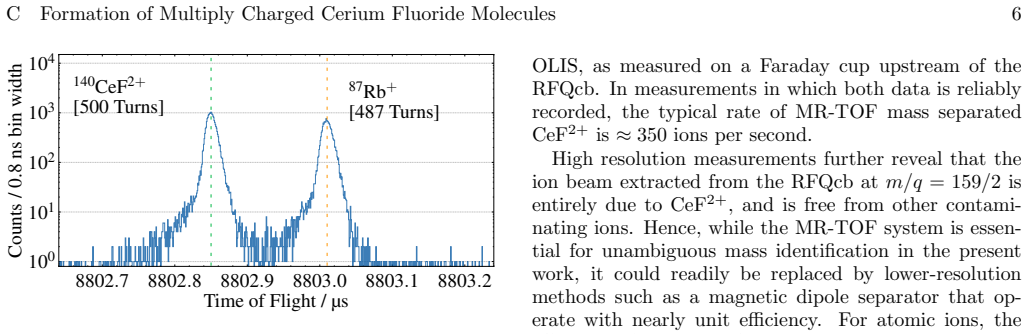
- [Experimental identification section] Experimental identification section: the mass-spectrometry data are presented without reported error bars, abundance ratios, or explicit validation against possible isobaric contaminants, leaving the strength of the formation claim difficult to assess quantitatively.
minor comments (2)
- [Quantum control discussion] The brief discourse on quantum control would benefit from concrete laser-cooling or state-preparation schemes rather than remaining at the level of general anticipation.
- A short table comparing key spectroscopic constants (bond length, vibrational frequency, ionization energy) of CeF^{2+} with those of PaF^{3+} would make the surrogate discussion more transparent.
Simulated Author's Rebuttal
We thank the referee for the constructive comments on our manuscript. We address each major point below and have revised the manuscript accordingly to improve quantitative support and clarity.
read point-by-point responses
-
Referee: [Abstract and quantum-chemical calculations section] Abstract and the section on quantum-chemical results: the claim that the electronic structure of CeF^{2+} 'reveals a parallel' to ^{229}PaF^{3+} is not accompanied by any numerical metric (overlap integrals, percentage deviation in E_eff or MQM, or side-by-side tabulation of the relevant P,T-odd matrix elements); valence-isoelectronicity alone does not guarantee transferability of the observables that depend on the relativistic wavefunction near the heavy nucleus and on the molecular charge state.
Authors: We agree that the original wording could be strengthened by quantitative context. The parallel is grounded in the identical valence-electron configuration (one unpaired electron in a similar sigma orbital) and comparable bond lengths, which lead to analogous relativistic enhancements near the heavy nucleus. In the revised manuscript we have added a dedicated paragraph and a small comparison table listing the calculated E_eff, MQM, and W_s parameters for CeF^{2+} together with the corresponding literature values reported for PaF^{3+}. Percentage deviations are now quoted where the quantities can be compared at similar levels of theory. We have also softened the abstract claim to 'suggests a close electronic parallel' and explicitly note the limitations arising from the different molecular charge states. revision: yes
-
Referee: [Experimental identification section] Experimental identification section: the mass-spectrometry data are presented without reported error bars, abundance ratios, or explicit validation against possible isobaric contaminants, leaving the strength of the formation claim difficult to assess quantitatively.
Authors: We thank the referee for highlighting this omission. The experimental section has been expanded to include statistical error bars on all peak intensities (derived from repeated scans), the measured abundance ratio of CeF^{2+} relative to Ce^{+} and CeF^{+}, and a short paragraph addressing possible isobaric interferences (e.g., ^{140}Ce^{16}O^{2+} or other doubly charged species at m/z = 78). The high mass resolving power of TITAN and the selective production route via the Off-Line Ion Source are now used to argue that such contaminants are excluded at the observed signal-to-noise level. A supplementary figure with the full mass spectrum and annotations has also been added. revision: yes
Circularity Check
No significant circularity; derivation chain is self-contained
full rationale
The paper separates experimental ion formation/identification at TRIUMF facilities from independent quantum-chemical computations of CeF²⁺ electronic structure and P,T-odd sensitivities. The surrogate parallel to ²²⁹PaF³⁺ is asserted via valence-isoelectronicity and direct calculation results rather than any self-definition, fitted-parameter renaming, or load-bearing self-citation. No equations or claims reduce by construction to prior inputs within the manuscript; the experimental and computational components do not feed back into each other. This is the normal case of an honest non-finding.
Axiom & Free-Parameter Ledger
axioms (1)
- domain assumption Standard quantum chemical methods accurately capture the electronic structure of CeF²⁺ and its comparison to PaF³⁺
Reference graph
Works this paper leans on
-
[1]
For the excited state in CeF 3+ the same number of grid points and start of the grid were used but the grid ended at 4.710a 0
using 1000 evenly spaced grid points for the vi- bronic transitions between the ground states of CeF 2+ and CeF 3+ with the grid starting at 1.807a 0 and end- ing at 7.226a 0. For the excited state in CeF 3+ the same number of grid points and start of the grid were used but the grid ended at 4.710a 0
-
[2]
Patrignani,Review of particle physics, Chinese Physics C40, 100001 (2016)
C. Patrignani,Review of particle physics, Chinese Physics C40, 100001 (2016)
2016
-
[3]
Pospelov and A
M. Pospelov and A. Ritz,Electric dipole moments as probes of new physics, Annals of Physics318, 119 (2005), Special Issue
2005
-
[4]
Engel, M
J. Engel, M. J. Ramsey-Musolf, and U. van Kolck,Elec- tric dipole moments of nucleons, nuclei, and atoms: The standard model and beyond, Progress in Particle and Nu- clear Physics71, 21 (2013)
2013
-
[5]
T. E. Chupp, P. Fierlinger, M. J. Ramsey-Musolf, and J. T. Singh,Electric dipole moments of atoms, molecules, nuclei, and particles, Review of Modern Physics91, 015001 (2019)
2019
-
[6]
D. Cho, K. Sangster, and E. A. Hinds,Search for time- reversal-symmetry violation in thallium fluoride using a jet source, Physical Review A44, 2783 (1991)
1991
-
[7]
J. J. Hudson, D. M. Kara, I. J. Smallman, B. E. Sauer, M. R. Tarbutt, and E. A. Hinds,Improved measurement of the shape of the electron, Nature473, 493 (2011)
2011
-
[8]
Andreev, D
V. Andreev, D. G. Ang, D. DeMille, J. M. Doyle, G. Gabrielse, J. Haefner, N. R. Hutzler, Z. Lasner, C. Meisenhelder, B. R. O’Leary, C. D. Panda, A. D. West, E. P. West, and X. Wu,Improved limit on the electric dipole moment of the electron, Nature562, 355 (2018)
2018
-
[9]
T. S. Roussy, L. Caldwell, T. Wright, W. B. Cairncross, Y. Shagam, K. B. Ng, N. Schlossberger, S. Y. Park, A. Wang, J. Ye, and E. A. Cornell,An improved bound on the electron’s electric dipole moment, Science381, 46 (2023)
2023
-
[10]
DeMille, F
D. DeMille, F. Bay, S. Bickman, D. Kawall, L. Hunter, D. Krause, S. Maxwell, and K. Ulmer,Search for the electric dipole moment of the electron using metastable PbO, inAIP Conference Proceedings, Vol. 596 (AIP,
-
[11]
E. B. Norrgard, E. R. Edwards, D. J. McCarron, M. H. Steinecker, D. DeMille, S. S. Alam, S. K. Peck, N. S. Wa- dia, and L. R. Hunter,Hyperfine structure of theB 3Π1 state and predictions of optical cycling behavior in the X→Btransition of TlF, Physical Review A95, 062506 (2017)
2017
-
[12]
N. J. Fitch, J. Lim, E. A. Hinds, B. E. Sauer, and M. R. Tarbutt,Methods for measuring the electron’s electric dipole moment using ultracold YbF molecules, Quantum Science Technology6, 014006 (2021)
2021
-
[13]
K. B. Ng, Y. Zhou, L. Cheng, N. Schlossberger, S. Y. Park, T. S. Roussy, L. Caldwell, Y. Shagam, A. J. Vigil, E. A. Cornell, and J. Ye,Spectroscopy on the electron- electric-dipole-moment–sensitive states of ThF +, Phys- ical Review A105, 022823 (2022)
2022
-
[14]
X. Wu, P. Hu, Z. Han, D. Ang, C. Meisenhelder, G. Gabrielse, J. M. Doyle, and D. DeMille,Electrostatic focusing of cold and heavy molecules for the ACME elec- tron EDM search, New Journal of Physics24, 073043 (2022)
2022
-
[15]
M. D. DiRosa,Laser-cooling molecules, The European Physics Journal D31, 395 (2004)
2004
-
[16]
T. A. Isaev, S. Hoekstra, and R. Berger,Laser-cooled RaF as a promising candidate to measure molecular par- ity violation, Physical Review A82, 052521 (2010)
2010
-
[17]
T. A. Isaev and R. Berger,Polyatomic candidates for cooling of molecules with lasers from simple theoretical concepts, Physical Review Letters116, 063006 (2016)
2016
-
[18]
Verma, A
M. Verma, A. M. Jayich, and A. C. Vutha,Electron elec- tric dipole moment searches using clock transitions in ul- tracold molecules, Physical Review Letters125, 153201 (2020)
2020
-
[19]
K los, H
J. K los, H. Li, E. Tiesinga, and S. Kotochigova, Prospects for assembling ultracold radioactive molecules from laser-cooled atoms, New Journal of Physics24, 025005 (2022)
2022
-
[20]
C. Z¨ ulch, K. Gaul, S. M. Giesen, R. F. Garcia Ruiz, and R. Berger,Cool molecular highly charged ions for precision tests of fundamental physics, arXiv preprint arXiv:2203.10333 (2022)
-
[21]
A. Marc, M. Hubert, and T. Fleig,Candidate molecules for next-generation searches of hadronic charge-parity violation, Physical Review A108, 062815 (2023)
2023
-
[22]
Anderegg, N
L. Anderegg, N. B. Vilas, C. Hallas, P. Robichaud, A. Jadbabaie, J. M. Doyle, and N. R. Hutzler,Quan- tum control of trapped polyatomic molecules for eEDM searches, Science382, 665 (2023)
2023
-
[23]
Arrowsmith-Kron, M
G. Arrowsmith-Kron, M. Athanasakis-Kaklamanakis, M. Au, J. Ballof, R. Berger, A. Borschevsky, A. A. Breier, F. Buchinger, D. Budker, L. Caldwell, C. Charles, N. Dattani, R. P. de Groote, D. DeMille, 22 T. Dickel, J. Dobaczewski, C. E. D¨ ullmann, E. Eliav, J. Engel, M. Fan, V. Flambaum, K. T. Flanagan, A. N. Gaiser, R. F. Garcia Ruiz, K. Gaul, T. F. Giese...
2024
-
[24]
Garcia Ruiz, R
R. Garcia Ruiz, R. Berger, J. Billowes, C. Binner- sley, M. Bissell, A. Breier, A. Brinson, K. Chrysa- lidis, T. Cocolios, B. Cooper, K. Flanagan, T. Giesen, R. de Groote, S. Franchoo, F. Gustafsson, T. Isaev, ´A. Koszor´ us, G. Neyens, H. Perrett, C. Ricketts, S. Rothe, L. Schweikhard, A. Vernon, K. Wendt, F. Wienholtz, S. Wilkins, and X. Yang,Spectrosco...
2020
-
[25]
M. Fan, C. A. Holliman, X. Shi, H. Zhang, M. W. Straus, X. Li, S. W. Buechele, and A. M. Jayich,Opti- cal mass spectrometry of coldRaOH + andRaOCH 3 +, Physical Review Letters126, 023002 (2021)
2021
-
[26]
M. Au, M. Athanasakis-Kaklamanakis, L. Nies, J. Ballof, R. Berger, K. Chrysalidis, P. Fischer, R. Heinke, J. Johnson, U. K¨ oster, D. Leimbach, B. Marsh, M. Mougeot, B. Reich, J. Reilly, E. Reis, M. Schlaich, C. Schweiger, L. Schweikhard, S. Stege- mann, J. Wessolek, F. Wienholtz, S. G. Wilkins, W. Wo- jtaczka, C. E. D¨ ullmann, and S. Rothe,In-source and...
2023
-
[27]
M. Au, L. Nies, S. Stegemann, M. Athanasakis- Kaklamanakis, T. E. Cocolios, P. Fischer, P. F. Giesel, J. D. Johnson, U. K¨ oster, D. Lange, M. Mougeot, J. Reilly, M. Schlaich, C. Schweiger, L. Schweikhard, F. Wienholtz, W. Wojtaczka, C. E. D¨ ullmann, and S. Rothe,Production and purification of molecular 225Ac at CERN-ISOLDE, Journal of Radioanalytical an...
2025
-
[28]
S. M. Udrescu, S. G. Wilkins, A. A. Breier, M. Athanasakis-Kaklamanakis, R. F. Garcia Ruiz, M. Au, I. Beloˇ sevi´ c, R. Berger, M. L. Bissell, C. L. Binnersley, A. J. Brinson, K. Chrysalidis, T. E. Co- colios, R. P. de Groote, A. Dorne, K. T. Flana- gan, S. Franchoo, K. Gaul, S. Geldhof, T. F. Giesen, D. Hanstorp, R. Heinke, ´A. Koszor´ us, S. Kujanp¨ a¨ ...
2024
-
[29]
Athanasakis-Kaklamanakis, S
M. Athanasakis-Kaklamanakis, S. G. Wilkins, P. Lass` egues, L. Lalanne, J. R. Reilly, O. Ah- mad, M. Au, S. W. Bai, J. Berbalk, C. Bernerd, A. Borschevsky, A. A. Breier, K. Chrysalidis, T. E. Co- colios, R. P. de Groote, C. M. Fajardo-Zambrano, K. T. Flanagan, S. Franchoo, R. F. G. Ruiz, D. Hanstorp, R. Heinke, P. Imgram, ´A. Koszor´ us, A. A. Kyuberis, J...
2024
-
[30]
S. G. Wilkins, S. M. Udrescu, M. Athanasakis- Kaklamanakis, R. F. Garcia Ruiz, M. Au, I. Beloˇ sevi´ c, R. Berger, M. L. Bissell, A. A. Breier, A. J. Brin- son, K. Chrysalidis, T. E. Cocolios, R. P. de Groote, A. Dorne, K. T. Flanagan, S. Franchoo, K. Gaul, S. Geldhof, T. F. Giesen, D. Hanstorp, R. Heinke, T. Isaev, ´A. Koszor´ us, S. Kujanp¨ a¨ a, L. Lal...
2025
-
[31]
Athanasakis-Kaklamanakis, S
M. Athanasakis-Kaklamanakis, S. G. Wilkins, L. V. Skripnikov, ´A. Koszor´ us, A. A. Breier, O. Ahmad, M. Au, S. W. Bai, I. Beloˇ sevi´ c, J. Berbalk, R. Berger, C. Bernerd, M. L. Bissell, A. Borschevsky, A. Brin- son, K. Chrysalidis, T. E. Cocolios, R. P. de Groote, A. Dorne, C. M. Fajardo-Zambrano, R. W. Field, K. T. Flanagan, S. Franchoo, R. F. Garcia R...
2025
-
[32]
Athanasakis-Kaklamanakis, M
M. Athanasakis-Kaklamanakis, M. Au, A. Kyuberis, C. Z¨ ulch, K. Gaul, H. Wibowo, L. Skripnikov, L. Lalanne, J. R. Reilly, ´A. Koszor´ us, S. Bara, J. Ballof, R. Berger, C. Bernerd, A. Borschevsky, A. A. Breier, K. Chrysalidis, T. E. Cocolios, R. P. de Groote, A. Dorne, J. Dobaczewski, C. M. F. Zambrano, K. T. Flanagan, S. Franchoo, J. D. Johnson, R. F. G....
2025
-
[33]
V. V. Flambaum and V. A. Dzuba,Electric dipole mo- ments of atoms and molecules produced by enhanced nu- clear Schiff moments, Physical Review A101, 042504 (2020)
2020
-
[34]
Spevak, N
V. Spevak, N. Auerbach, and V. V. Flambaum,En- hancedT-odd,P-odd electromagnetic moments in re- flection asymmetric nuclei, Physical Review C56, 1357 (1997)
1997
-
[35]
Gaul and R
K. Gaul and R. Berger,Global analysis ofCP-violation in atoms, molecules and role of medium-heavy systems, Journal of High Energy Physics2024, 100 (2024)
2024
-
[36]
C. U. Jost, J. R. Griswold, S. H. Bruffey, S. Mirzadeh, 23 D. W. Stracener, and C. L. Williams,Measurement of cross sections for the 232Th(p,4n)229Pa reaction at low proton energies, AIP Conference Proceedings1525, 520 (2013)
2013
-
[37]
J. R. Griswold, C. U. Jost, D. W. Stracener, S. H. Bruffey, D. Denton, M. Garland, L. Heilbronn, and S. Mirzadeh,Production of 229Th for medical applica- tions: Excitation functions of low-energy protons on 232Th targets, Physical Review C98, 044607 (2018)
2018
-
[38]
Burahmah, J
N. Burahmah, J. R. Griswold, L. H. Heilbronn, L. A. Bernstein, A. S. Voyles, J. T. Morrell, M. Zach, and R. Copping, 229Pa cross section measurements via deuteron irradiation of 232Th, Physical Review C108, 024609 (2023)
2023
-
[39]
Shigekawa, X
Y. Shigekawa, X. Yin, A. Nambu, Y. Wang, and H. Haba,Production and chemical separation of 229Pa toward observation ofγrays of 229mTh, Journal of Ra- dioanalytical and Nuclear Chemistry333, 1479 (2024)
2024
-
[40]
J. L. Egido and L. M. Robledo,A systematic study of the octupole correlations in the lanthanides with realistic forces, Nuclear Physics A545, 589 (1992)
1992
-
[41]
Cheal, M
B. Cheal, M. Avgoulea, J. Billowes, P. Campbell, K. T. Flanagan, D. H. Forest, M. D. Gardner, J. Huikari, B. A. Marsh, A. Nieminen, H. L. Thayer, G. Tungate, and J. ¨Ayst¨ o,Collinear laser spectroscopy of neutron- rich cerium isotopes near the N = 88 shape transition, Journal of Physics G: Nuclear and Particle Physics29, 2479 (2003)
2003
-
[42]
Sharipov and M
S. Sharipov and M. S. Nadirbekov,About collective states of even-even nuclei with quadrupole and octupole deformations, Journal of Nuclear and Radiation Physics 3, 63 (2007)
2007
-
[43]
N. T. Brewer, E. H. Wang, W. A. Yzaguirre, J. H. Hamilton, A. V. Ramayya, S. H. Liu, J. K. Hwang, Y. X. Luo, C. J. Zachary, J. O. Rasmussen,et al.,Oc- tupole deformation in 144Ba and 148Ce, inFission and Properties of Neutron-Rich Nuclei: Proceedings of the Sixth International Conference on ICFN6(World Sci- entific, 2018) pp. 197–202
2018
-
[44]
Beckers, C
M. Beckers, C. M¨ uller-Gatermann, A. Blazhev, T. Braunroth, A. Dewald, C. Fransen, A. Goldkuhle, L. Kornwebel, J. Litzinger, F. von Spee, and K.-O. Zell, Lifetime measurement of excited states in 144Ce: En- hancedE1strengths in a candidate for octupole defor- mation, Physical Review C102, 014324 (2020)
2020
-
[45]
Alexa, M
P. Alexa, M. Abolghasem, G. Thiamova, D. Bonatsos, T. R. Rodr´ ıguez, and P.-G. Reinhard,Macroscopic and microscopic description of phase transition in cerium isotopes, Physical Review C106, 054304 (2022)
2022
-
[46]
C. Z¨ ulch, K. Gaul, and R. Berger,Enhanced sensi- tivity to variations of fundamental constants in highly charged molecules from analytic perturbation theory, arXiv preprint arXiv:2511.10791 (2025)
-
[47]
Uzan,The fundamental constants and their vari- ation: observational and theoretical status, Reviews of Modern Physics75, 403 (2003)
J.-P. Uzan,The fundamental constants and their vari- ation: observational and theoretical status, Reviews of Modern Physics75, 403 (2003)
2003
-
[48]
P. L. Sarma and M. S. Davis,Reactions between cer- ous and fluoride ions, Journal of Inorganic and Nuclear Chemistry29, 2607 (1967)
1967
-
[49]
S. J. Lyle and S. J. Naqvi,The distribution of positively charged cerium (III) and gadolinium complexes between a cation-exchanger and an aqueous phase, Journal of Inorganic and Nuclear Chemistry29, 2441 (1967)
1967
-
[50]
J. B. Walker and G. R. Choppin,Thermodynamic pa- rameters of fluoride complexes of the lanthanides, in Lanthanide/Actinide Chemistry(American Chemical Society, 1967) Chap. 10, pp. 127–140
1967
-
[51]
Arisaka, N
M. Arisaka, N. Takuwa, and H. Suganuma,Inflection points in the coordination number around Ce 3+ and CeF2+ in a mixed system of methanol and water, Bul- letin of the Chemical Society of Japan72, 2235 (1999)
1999
-
[52]
A. A. Migdisov, A. E. Williams-Jones, and T. Wagner, An experimental study of the solubility and speciation of the rare earth elements (III) in fluoride- and chloride- bearing aqueous solutions at temperatures up to 300°c, Geochimica et Cosmochimica Acta73, 7087 (2009)
2009
-
[53]
G. K. Koyanagi, X. Zhao, V. Blagojevic, M. J. Y. Jarvis, and D. K. Bohme,Gas-phase reactions of atomic lan- thanide cations with methyl fluoride: periodicities reac- tivity, International Journal of Mass Spectrometry241, 189 (2005), special Issue in Honour of William L. Hase
2005
-
[54]
Cheng and D
P. Cheng and D. K. Bohme,Gas-phase reactions of atomic lanthanide cations with sulfur hexafluoride: Pe- riodicity in reactivity, Inorganic Chemistry45, 7856 (2006)
2006
-
[55]
J. L¨ orinˇ c` ık and Z.ˇSroubek,Doubly charged ion emis- sion in sputtering of monocrystalline fluorides, Nuclear Instruments and Methods in Physics Research Section B: Beam Interactions with Materials and Atoms187, 447 (2002)
2002
-
[56]
J. R. Haas, E. L. Shock, and D. C. Sassani,Rare earth elements in hydrothermal systems: Estimates of stan- dard partial molal thermodynamic properties of aqueous complexes of the rare earth elements at high pressures and temperatures, Geochimica et Cosmochimica Acta 59, 4329 (1995)
1995
-
[57]
J. K. Gibson,Transition-metal fluoride ions, MF + n , from gas-phase reactions of nascent laser-ablated M + with fluorocarbons, Journal of Fluorine Chemistry78, 65 (1996)
1996
-
[58]
I. Gotkis,Field-stimulated electron promotion from core 4f-orbital to out-of-coreσ 6s orbital phenomenon in sim- ple lanthanide compounds, The Journal of Physical Chemistry95, 6086 (1991)
1991
-
[59]
G. C. Ball, G. Hackman, and R. Kr¨ ucken,The TRIUMF-ISAC facility: two decades of discovery with rare isotope beams, Physica Scripta91, 093002 (2016)
2016
-
[60]
G. Ball, I. Dillmann, A. Garnsworthy, G. Gwinner, R. Kanungo, G. Morris, and C. Ruiz,The TRIUMF- ISAC facility: Recent highlights in RIB science and fu- ture prospects with ARIEL, Nuclear Physics News30, 27 (2020)
2020
-
[61]
Jayamanna, G
K. Jayamanna, G. Wight, D. Gallop, R. Dube, V. Jovi- cic, C. Laforge, M. Marchetto, M. Leross, D. Louie, R. Laplante, R. Laxdal, M. McDonald, G. J. Wiebe, V. Wang, and F. Yan,A multicharge ion source (Su- pernanogan) for the OLIS facility at ISAC/TRIUMF, Review of Scientific Instruments81, 02A331 (2010)
2010
-
[62]
A. A. Kwiatkowski, J. Dilling, S. Malbrunot-Ettenauer, et al.,15 years of precision mass measurements at TI- TAN, The European Physics Journal A60(2024)
2024
-
[63]
Brunner, M
T. Brunner, M. J. Smith, M. Brodeur, S. Ettenauer, A. T. Gallant, V. V. Simon, A. Chaudhuri, A. Lapierre, E. Man´ e, R. Ringle,et al.,TITAN’s digital RFQ ion beam cooler and buncher, operation and performance, Nuclear Instruments and Methods in Physics Research Section A: Accelerators, Spectrometers, Detectors and Associated Equipment676, 32 (2012). 24
2012
-
[64]
M. P. Reiter, S. A. San Andr´ es, J. Bergmann, T. Dickel, J. Dilling, A. Jacobs, A. A. Kwiatkowski, W. R. Plaß, C. Scheidenberger, D. Short,et al.,Commissioning and performance of TITAN’s Multiple-Reflection Time-of- Flight Mass-Spectrometer and isobar separator, Nuclear Instruments and Methods in Physics Research Section A: Accelerators, Spectrometers, D...
2021
-
[65]
W. R. Plass, T. Dickel, S. A. S. Andres, J. Ebert, F. Greiner, C. Hornung, C. Jesch, J. Lang, W. Lippert, T. Majoros, D. Short, H. Geissel, E. Haettner, M. P. Reiter, A.-K. Rink, C. Scheidenberger, and M. I. Ya- vor,High-performance multiple-reflection time-of-flight mass spectrometers for research with exotic nuclei and for analytical mass spectrometry, ...
2015
-
[66]
Justus, C
P. Justus, C. Charles, F. Ames, K. Jayamanna, and S. Malbrunot-Ettenauer,Creation and characterisation of multi-charged cerium beams at TRIUMF’s OLIS, Journal of Physics: Conference Series2743, 012055 (2024)
2024
-
[67]
Jayamanna, J
K. Jayamanna, J. Adegun, F. Ames, T. Angus, C. Charles, S. Kiy, M. Lovera, D. Louie, B. Minato, S. Saminathan, and B. Schultz,Dual frequency enhance- ment of the supernanogan multi-charged ion source at TRIUMF ISAC facility, Journal of Physics: Conference Series2743, 012053 (2024)
2024
-
[68]
Ettenauer, M
S. Ettenauer, M. C. Simon, A. T. Gallant, T. Brunner, U. Chowdhury, V. V. Simon, M. Brodeur, A. Chaud- huri, E. Man´ e, C. Andreoiu, G. Audi, J. R. C. L´ opez- Urrutia, P. Delheij, G. Gwinner, A. Lapierre, D. Lun- ney, M. R. Pearson, R. Ringle, J. Ullrich, and J. Dilling, First use of high charge states for mass measurements of short-lived nuclides in a P...
2011
-
[69]
S. D. Tanner, V. I. Baranov, and D. R. Bandura,Reac- tion cells and collision cells for ICP-MS: a tutorial re- view, Spectrochimica Acta Part B: Atomic Spectroscopy 57, 1361 (2002)
2002
-
[70]
Dickel, S
T. Dickel, S. A. S. Andres, S. Beck, J. Bergmann, J. Dilling, F. Greiner, C. Horstrung, G. Kripko.Koncz, A. Kwiatkowski, E. Leistenschneider, A. Pikthtelev, W. R. Plass, M. P. Reiter, C. Schneidenberger, and C. Will,Recent upgrades of the multiple-reflection time- of-flight mass spectrometer at TITAN, TRIUMF, Hy- perfine Interactions240(2019)
2019
-
[71]
W. J. Huang, M. Wang, F. G. Kondev, G. Audi, and S. Naimi,The AME 2020 atomic mass evaluation (I). Evaluation of input data, and adjustment procedures, Chinese Physics C45, 030002 (2021)
2020
-
[72]
D. K. Bohme,Charge state chemistry: What a difference a charge makes in gas-phase chemistry!, International Journal of Mass Spectrometry472, 116674 (2022)
2022
-
[73]
W. C. Martin,Atomic energy levels: The rare earth elements (the spectra of lanthanum, cerium, praseodymium, neodymium, promethium, samarium, europium, gadolinium, terbium, dysprosium, holmium, ebrium, thulium, ytterbium, and lutetium)(U.S. Gov- ernment Printing Office, 1978)
1978
-
[74]
D. Z. Kandula, C. Gohle, T. J. Pinkert, W. Ubachs, and K. S. E. Eikema,Extreme ultraviolet frequency comb metrology, Physical Review Letters105, 063001 (2010)
2010
-
[75]
Jacobs, C
A. Jacobs, C. Andreoiu, J. Bergmann, T. Brunner, I. Dickel, T.and Dillmann, E. Dunling, J. Flowerdew, L. Graham, G. Gwinner, Z. Hockenbery, B. Kootte, Y. Lan, K. Leach, E. Leistenschneider, E. Lykiar- dopoulou, V. Monier, I. Mukul, S. Paul, W. Plaß, M. Reiter, C. Scheidenberger, R. Thompson, J. Tracy, C. Will, M. Wieser, M. Yavor, J. Dilling, and A. Kwiat...
2022
-
[76]
Cao and M
X. Cao and M. Dolg,Theoretical prediction of the sec- ond to fourth actinide ionization potentials, Molecular Physics101, 961 (2003)
2003
-
[77]
A. J. Yencha, D. B. Thompson, A. J. Cormack, D. R. Cooper, M. Zubek, P. Bolognesi, and G. C. King, Threshold photoelectron spectroscopy of SF 6, Chemical Physics216, 227 (1997)
1997
-
[78]
Schr¨ oder and H
D. Schr¨ oder and H. Schwarz,Generation, stability, and reactivity of small, multiply charged ions in the gas phase, The Journal of Physical Chemistry A103, 7385 (1999)
1999
-
[79]
Schr¨ oder, M
D. Schr¨ oder, M. Diefenbach, T. M. Klap¨ otke, and H. Schwarz, UF 3+ — a thermochemically stable di- atomic trication with a covalent bond, Angewandte Chemie International Edition38, 137 (2004)
2004
-
[80]
Lapierre, M
A. Lapierre, M. Brodeur, T. Brunner, S. Ettenauer, A. T. Gallant, V. Simon, M. Good, M. W. Froese, J. R. Crespo L´ opez-Urrutia, P. Delheij, S. Epp, R. Ringle, S. Schwarz, J. Ullrich, and J. Dilling,The TITAN EBIT charge breeder for mass measurements on highly charged short-lived isotopes—first online operation, Nuclear In- struments and Methods in Physic...
2010
discussion (0)
Sign in with ORCID, Apple, or X to comment. Anyone can read and Pith papers without signing in.