Recognition: unknown
From Wavefunction Collapse to Superconductivity: Evolution of the Electronic State in Compressed GaNb4Se8
Pith reviewed 2026-05-07 12:55 UTC · model grok-4.3
The pith
In GaNb4Se8 electronic delocalization begins well before the structural phase transition under pressure.
A machine-rendered reading of the paper's core claim, the machinery that carries it, and where it could break.
Core claim
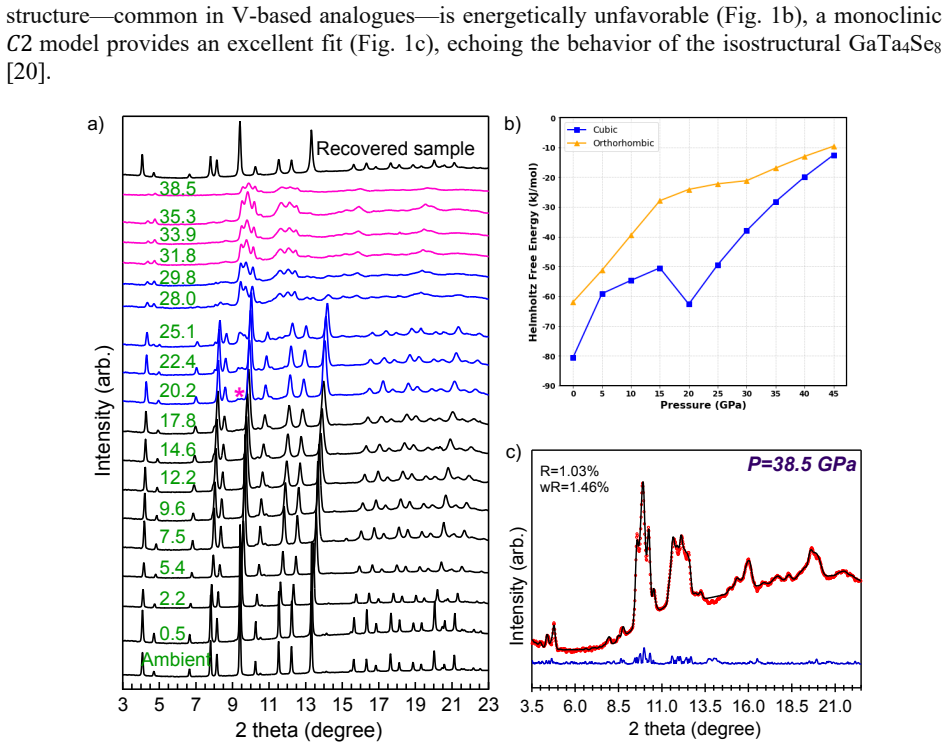
GaNb4Se8 starts as a Mott insulator with Efros-Shklovskii variable-range hopping at low pressure. Metallic transport emerges near 5 GPa, preceding the cubic to monoclinic C2 transition at 20 GPa. From this metallic regime, superconductivity appears with a coherence length of approximately 80-90 Angstrom. The results demonstrate that electronic delocalization can be decoupled from crystallographic symmetry breaking in this material.
What carries the argument
The pressure-induced hierarchy decoupling electronic delocalization from structural symmetry change.
Load-bearing premise
The transport measurements accurately reflect the intrinsic electronic behavior of the bulk sample rather than experimental artifacts from the pressure cell or contacts.
What would settle it
Detection of the structural transition at pressures near or below 5 GPa in diffraction experiments, or the absence of metallic crossover until after 20 GPa, would contradict the reported decoupling of electronic and structural changes.
Figures


read the original abstract
Understanding how electronic transport evolves from localized to itinerant regimes in correlated cluster solids remains an important challenge in condensed-matter physics. Here we investigate the pressure-dependent transport properties of the lacunar spinel GaNb4Se8, a cluster Mott insulator at ambient conditions. At low pressures, the resistivity follows Efros-Shklovskii variable-range hopping, indicating Coulomb-gap-controlled carrier localization (x ~ 6.1 Angstrom). A crossover toward metallic transport begins near ~ 5 GPa, whereas a crystallographic transition from the cubic phase to a monoclinic C2 phase occurs at significantly higher pressure (~ 20 GPa), establishing a hierarchy characterized by the decoupling of electronic delocalization from structural symmetry change. At higher pressures, superconductivity (xi(0) ~ 80-90 Angstrom) emerges from the correlated metallic regime. These results identify GaNb4Se8 as a platform for studying correlation-controlled transport evolution in cluster-based solids.
Editorial analysis
A structured set of objections, weighed in public.
Referee Report
Summary. The manuscript reports pressure-dependent resistivity measurements on the lacunar spinel GaNb4Se8, a cluster Mott insulator at ambient pressure. At low pressures, transport follows Efros-Shklovskii variable-range hopping with localization length x ≈ 6.1 Å. A crossover toward metallic behavior is identified near 5 GPa, while the cubic-to-monoclinic C2 structural transition occurs at ~20 GPa. Superconductivity emerges at higher pressures with coherence length ξ(0) ≈ 80–90 Å. The central claim is that electronic delocalization decouples from the structural symmetry change.
Significance. If the resistivity evolution is intrinsic, the work positions GaNb4Se8 as a platform for studying correlation-controlled transport in cluster solids, with the reported hierarchy (electronic crossover preceding structural change) and subsequent superconductivity providing concrete experimental benchmarks. The application of standard VRH analysis and coherence-length estimates supplies a reproducible foundation for the claims.
major comments (2)
- [Abstract and Results] Abstract and Results section: the crossover to metallic transport is stated to begin near ~5 GPa, yet no quantitative criterion (sign change in dρ/dT, residual resistivity ratio, or scaling collapse) is supplied to define the onset. This definition is load-bearing for the claimed decoupling from the ~20 GPa structural transition.
- [Methods] Experimental details (Methods): the manuscript provides no information on pressure calibration, hydrostaticity of the transmitting medium, contact geometry, or sample homogeneity. These omissions directly affect the central claim that the 5 GPa scale reflects bulk carrier delocalization rather than cell-induced artifacts or interface resistance.
minor comments (2)
- [Abstract] Abstract: inclusion of uncertainty estimates or error bars on the reported pressures (5 GPa, 20 GPa) and lengths (6.1 Å, 80–90 Å) would improve clarity and allow readers to assess the precision of the hierarchy.
- [Throughout] Notation: the localization length is given as “x ~ 6.1 Angstrom” while the coherence length uses “xi(0)”; consistent use of ξ or x throughout the text and figures would reduce ambiguity.
Simulated Author's Rebuttal
We thank the referee for the careful reading of our manuscript and the constructive comments. We address each major point below and will revise the manuscript to incorporate clarifications where needed.
read point-by-point responses
-
Referee: [Abstract and Results] Abstract and Results section: the crossover to metallic transport is stated to begin near ~5 GPa, yet no quantitative criterion (sign change in dρ/dT, residual resistivity ratio, or scaling collapse) is supplied to define the onset. This definition is load-bearing for the claimed decoupling from the ~20 GPa structural transition.
Authors: We agree that an explicit quantitative definition of the crossover is necessary to support the decoupling claim. The original manuscript identifies the ~5 GPa scale from the evolution of resistivity curves but does not state a precise criterion. In the revision we will add a clear definition in the Results section (e.g., the pressure at which dρ/dT at the lowest measured temperature changes sign from negative to positive, or the pressure where the data deviate from Efros-Shklovskii VRH fits), together with supporting figures or analysis. The abstract will be updated accordingly. revision: yes
-
Referee: [Methods] Experimental details (Methods): the manuscript provides no information on pressure calibration, hydrostaticity of the transmitting medium, contact geometry, or sample homogeneity. These omissions directly affect the central claim that the 5 GPa scale reflects bulk carrier delocalization rather than cell-induced artifacts or interface resistance.
Authors: We acknowledge the omission of these experimental details. In the revised Methods section we will specify the pressure calibration procedure (ruby fluorescence or calibrated manometer), the pressure-transmitting medium and its hydrostaticity range, the four-probe contact geometry, and evidence of sample homogeneity (consistent behavior across multiple crystals and supporting X-ray diffraction). These additions will strengthen the interpretation that the observed crossover is intrinsic to the bulk electronic state. revision: yes
Circularity Check
Purely experimental report; no derivations or predictions reduce to fitted inputs
full rationale
The manuscript presents pressure-dependent resistivity and XRD data on GaNb4Se8. It reports an observed Efros-Shklovskii VRH regime at low pressure, a transport crossover near 5 GPa, a structural transition at ~20 GPa, and the subsequent appearance of superconductivity. These are direct experimental findings with no theoretical derivation chain, no parameters fitted to one data subset and then relabeled as predictions for another, and no load-bearing self-citations. The claimed hierarchy (electronic delocalization preceding crystallographic change) follows immediately from the measured pressure scales and requires no internal reduction to the paper's own inputs.
Axiom & Free-Parameter Ledger
free parameters (1)
- localization length x =
~6.1 Angstrom
axioms (2)
- domain assumption Efros-Shklovskii variable-range hopping governs the low-pressure insulating regime
- domain assumption The coherence length xi(0) ~80-90 Angstrom is correctly estimated from upper critical field or similar data
Reference graph
Works this paper leans on
-
[1]
Reschke, F
S. Reschke, F. Meggle, F. Mayr, V. Tsurkan, L. Prodan, H. Nakamura, J. Deisenhofer, C.A. Kuntscher, I. Kézsmárki, Lapce dynamics and electronic excitaFons in a large family of lacunar spinels with a breathing pyrochlore lapce structure, Physical Review B, 101 (2020) 075118. [18] R. Pocha, D. Johrendt, B. Ni, M.M. Abd-Elmeguid, Crystal Structures, Electron...
2020
-
[2]
Kresse, D
G. Kresse, D. Joubert, From ultrasoq pseudopotenLals to the projector augmented-wave method, Physical review b, 59 (1999) 1758. [19] M. Sitaula, V. Barone, S. Kandel, B. KC, B. Dumre, R. Ellingson, S. Khare, Optoelectronic and mechanical properLes of anLmony sulfide selenide ternary Sb2 (SxSe1-x) 3 alloys using first principles methods, ComputaLonal Condens...
1999
discussion (0)
Sign in with ORCID, Apple, or X to comment. Anyone can read and Pith papers without signing in.