Recognition: unknown
Search for new physics in B to K π π γ with Belle II data
Pith reviewed 2026-05-07 12:43 UTC · model grok-4.3
The pith
An amplitude analysis of B to K pi pi gamma decays is required to measure time-dependent CP asymmetry and search for new physics.
A machine-rendered reading of the paper's core claim, the machinery that carries it, and where it could break.
Core claim
The measurement of the time-dependent CP-asymmetry of B0 to KS0 pi+ pi- gamma decays is sensitive to contributions from physics beyond the Standard Model. To translate this measurement into a constraint on new physics, it is necessary to distinguish between decay modes that contribute to the final state via a kaonic resonance that is a CP eigenstate, and those that proceed through non-CP eigenstates. This requires an amplitude analysis of the B to K_res gamma to K pi+ pi- gamma decay.
What carries the argument
Amplitude analysis of the B to K_res gamma to K pi+ pi- gamma decay chain, which separates resonant contributions according to whether each resonance is a CP eigenstate.
If this is right
- The time-dependent CP asymmetry can be measured specifically for CP-eigenstate resonant modes.
- Constraints on new physics parameters can be derived directly from the extracted asymmetry.
- Belle II data can support the amplitude analysis with adequate statistics for resonance separation.
- Proper mode separation reduces background and systematic effects in the CP asymmetry result.
Where Pith is reading between the lines
- This separation technique could extend to other multi-body B radiative decays for similar new physics tests.
- The method might benefit from cross-checks with simulated datasets before real data application.
- Combined analyses across experiments could improve the statistical power once the amplitude framework is established.
Load-bearing premise
The amplitude analysis can reliably separate the resonant contributions in the B to K pi pi gamma final state using the available Belle II data statistics and detector resolution.
What would settle it
A failure of the amplitude fit to separate CP-eigenstate resonances from non-CP ones, due to overlapping contributions or limited resolution in Belle II data, would prevent clean extraction of the CP asymmetry for new physics constraints.
Figures


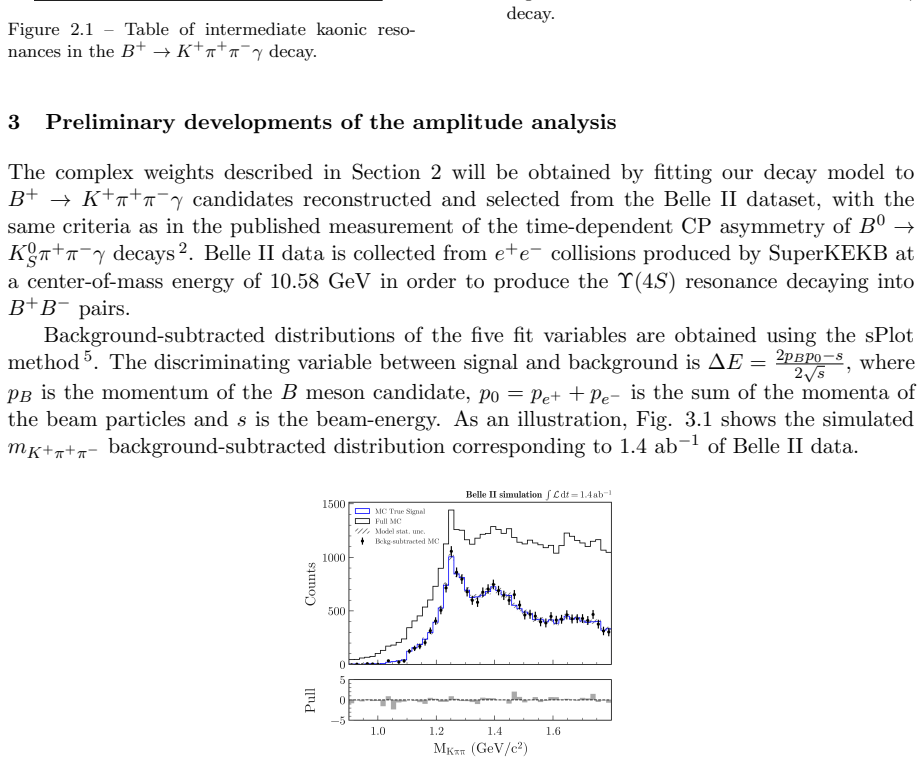
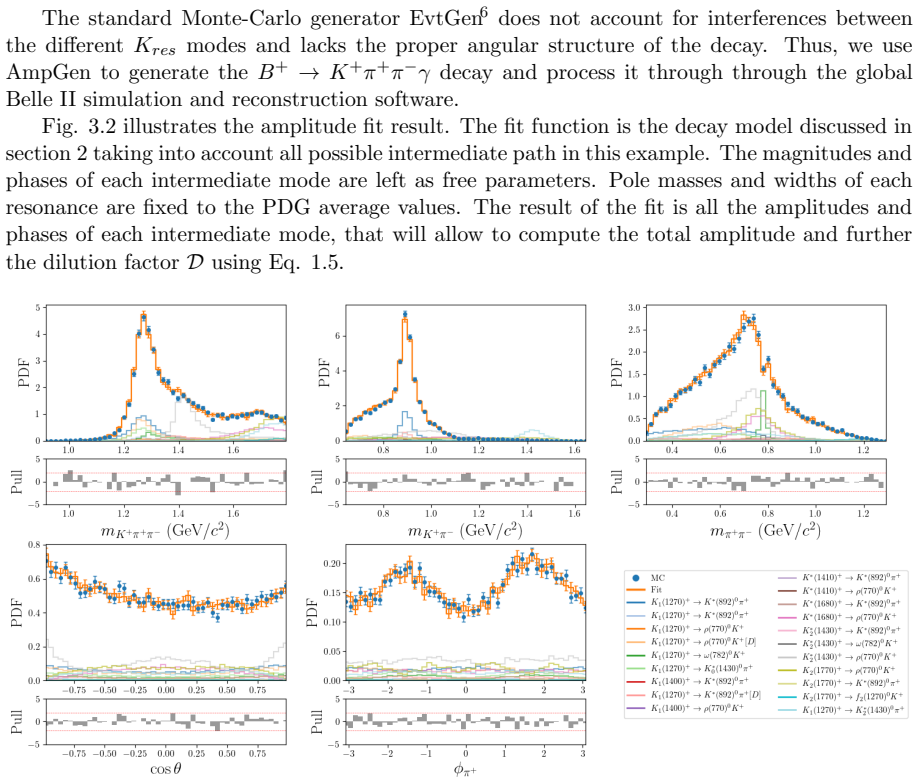
read the original abstract
The measurement of the time-dependent CP-asymmetry of $B^0 \to K_S^0 \pi^+ \pi^- \gamma$ decays is sensitive to contributions from physics beyond the Standard Model. To translate this measurement into a constraint on new physics, it is necessary to distinguish between decay modes that contribute to the final state via a kaonic resonance that is a CP eigenstate, and those that proceed through non-CP eigenstates. This requires an amplitude analysis of the $B \to K_{res} \gamma \to K \pi^+ \pi^- \gamma$ decay, that is discussed in this article.
Editorial analysis
A structured set of objections, weighed in public.
Referee Report
Summary. The paper motivates and discusses an amplitude analysis of the decay chain B → K_res γ → K π⁺ π⁻ γ in order to separate contributions from CP-eigenstate resonances (such as K*(892) and K1(1270)) from non-CP-eigenstate modes. This separation is required to extract a clean time-dependent CP asymmetry in B⁰ → K_S⁰ π⁺ π⁻ γ decays, which the authors state is sensitive to BSM contributions in the b → sγ transition, using Belle II data.
Significance. If the amplitude analysis can be shown to be robust, the approach would enable more reliable constraints on new physics in radiative B decays by reducing model-dependent uncertainties in the CP fractions. The motivation is logically sound and aligns with standard techniques in B-physics analyses, but the paper's impact hinges on whether the method is demonstrated to be feasible rather than merely motivated.
major comments (1)
- [Amplitude analysis discussion] The central claim that the amplitude analysis enables a clean separation of CP eigenstates rests on the ability to constrain multiple interfering complex amplitudes in the Kππ system. The manuscript provides no quantitative study (e.g., toy Monte Carlo or fit stability tests) demonstrating that Belle II statistics (typically O(10³–10⁴) events for this mode) and detector resolution on dipion mass and angular variables suffice to avoid underconstrained fits or large model-dependent ambiguities. This directly affects the reliability of the extracted CP fractions and the subsequent time-dependent CP asymmetry measurement.
Simulated Author's Rebuttal
We thank the referee for the thoughtful review and constructive feedback on our manuscript. The paper is intended to motivate and outline an amplitude analysis approach for separating CP-eigenstate contributions in B → K_res γ → K π⁺ π⁻ γ decays to enable cleaner time-dependent CP asymmetry measurements in B⁰ → K_S⁰ π⁺ π⁻ γ. We address the major comment below.
read point-by-point responses
-
Referee: The central claim that the amplitude analysis enables a clean separation of CP eigenstates rests on the ability to constrain multiple interfering complex amplitudes in the Kππ system. The manuscript provides no quantitative study (e.g., toy Monte Carlo or fit stability tests) demonstrating that Belle II statistics (typically O(10³–10⁴) events for this mode) and detector resolution on dipion mass and angular variables suffice to avoid underconstrained fits or large model-dependent ambiguities. This directly affects the reliability of the extracted CP fractions and the subsequent time-dependent CP asymmetry measurement.
Authors: We acknowledge that the manuscript does not contain a quantitative feasibility study such as toy Monte Carlo simulations or explicit fit stability tests. This paper focuses on motivating the need for the amplitude analysis and describing its general structure, following established techniques from prior B-physics analyses (e.g., those performed by Belle and BaBar on related Kππ systems). Detailed quantitative assessments of fit constraints, model ambiguities, and sensitivity with Belle II event yields and resolution will be presented in a forthcoming publication that executes the full analysis on data. We will revise the manuscript to include a brief discussion of expected event yields (O(10³–10⁴) reconstructed events) and note that the angular and mass distributions provide sufficient observables to constrain the dominant amplitudes, consistent with successful prior amplitude analyses of similar final states. revision: partial
Circularity Check
No circularity: derivation chain self-contained with no reductions to inputs
full rationale
The paper describes the sensitivity of time-dependent CP asymmetry in B0 to KS0 pi+ pi- gamma to BSM contributions and states that an amplitude analysis of B to K_res gamma to K pi+ pi- gamma is needed to separate CP-eigenstate resonances from non-eigenstates. No equations, fitted parameters, self-citations, or ansatze are shown that would make any claimed result equivalent to its inputs by construction. The amplitude analysis is presented as a methodological requirement for the measurement rather than a derived prediction that loops back on itself. This matches the default case of an experimental search paper with independent content.
Axiom & Free-Parameter Ledger
Reference graph
Works this paper leans on
-
[1]
Akar et al.JHEP, 2019(9), September 2019
S. Akar et al.JHEP, 2019(9), September 2019
2019
-
[2]
Abumusabh et al
M. Abumusabh et al. (Belle II Collaboration).JHEP, 2026(1), January 2026
2026
-
[3]
Straub.JHEP, 2017(4), April 2017
Ayan Paul and David M. Straub.JHEP, 2017(4), April 2017
2017
-
[4]
Theses, Universit´ e Paris Saclay (COmUE), September 2017
Jeremy Hebinger. Theses, Universit´ e Paris Saclay (COmUE), September 2017
2017
-
[5]
Pivk.Nucl.Instrum.Meth.A, 555, December 2005
F.R Le Diberder M. Pivk.Nucl.Instrum.Meth.A, 555, December 2005
2005
-
[6]
EvtGen: A Monte Carlo Generator for B-Physics
Anders Ryd et al. EvtGen: A Monte Carlo Generator for B-Physics. 5 2005
2005
discussion (0)
Sign in with ORCID, Apple, or X to comment. Anyone can read and Pith papers without signing in.