Recognition: unknown
Analytical Modeling of Far-Field Wavefront Error with Beam-Waist and Lateral-Shift Effects in Spaceborne Laser Interferometry
Pith reviewed 2026-05-07 12:37 UTC · model grok-4.3
The pith
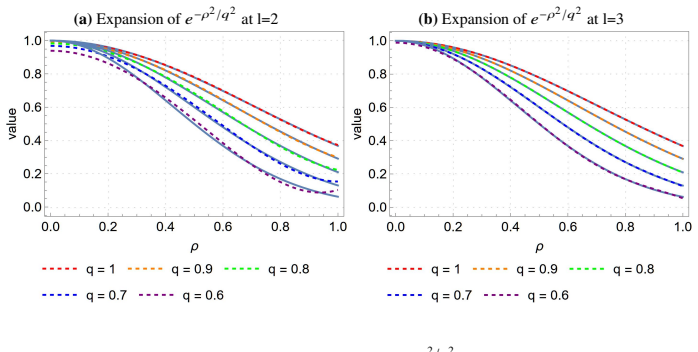
Extending the Nijboer-Zernike model with beam-waist ratio q and lateral-shift ratio s_r refines far-field wavefront error predictions for spaceborne laser interferometry.
A machine-rendered reading of the paper's core claim, the machinery that carries it, and where it could break.
Core claim
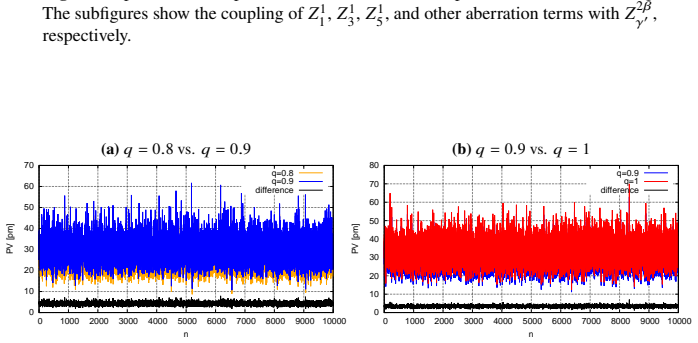
The paper's central claim is that an extended Nijboer-Zernike model incorporating the beam-waist-to-aperture ratio q and normalized lateral spot-shift ratio s_r provides a more accurate description of far-field wavefront error for truncated Gaussian beams under realistic conditions. With transmitted WFE held to λ/20, Monte Carlo trials of random initial aberrations demonstrate that decreasing q from 1 to 0.9 and then to 0.8 lowers average far-field WFE by roughly 10 percent and 14 percent. The same framework yields a direct phase-angle coupling coefficient of 0.0892 pm/nrad for s_r = 0.001, matching the order of the typical far-field TTL noise target, while the additional terms that couple s
What carries the argument
The extended Nijboer-Zernike analytical model for far-field wavefront error of truncated Gaussian beams that incorporates the beam-waist-to-aperture ratio q and the normalized lateral spot-shift ratio s_r.
If this is right
- Reducing the beam-waist-to-aperture ratio q below unity decreases the mean far-field wavefront error in simulations of random aberrations.
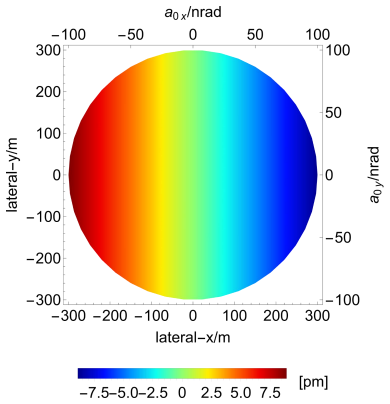
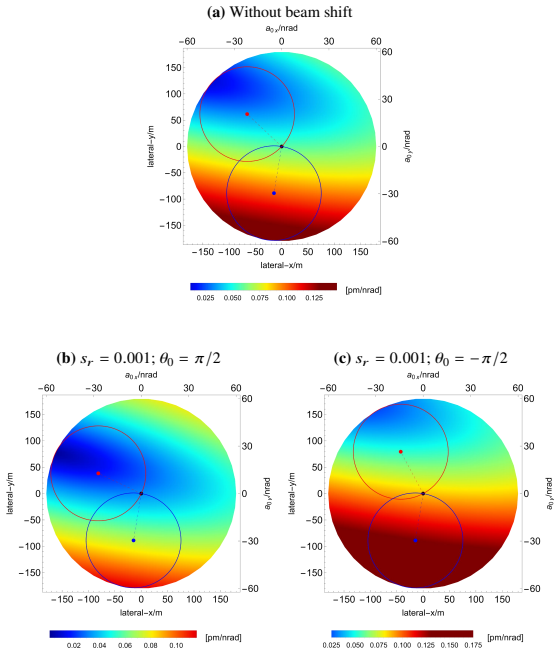
- A normalized lateral spot-shift ratio s_r = 0.001 produces a phase-angle coupling coefficient of 0.0892 pm/nrad that is comparable to the typical far-field TTL requirement of 0.1 pm/nrad.
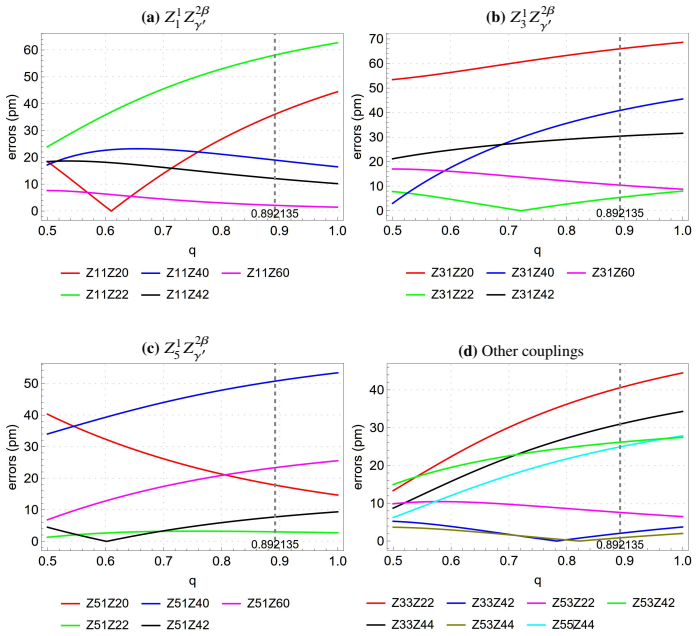
- The coupling terms between lateral spot shift and transmitted aberrations remain small and can be neglected when estimating alignment tolerances.
- The extended model supplies a quantitative basis for choosing beam parameters and setting alignment tolerances in spaceborne gravitational-wave detection missions.
Where Pith is reading between the lines
- The same q and s_r extensions could be used to model wavefront performance in other precision free-space laser links such as optical communication terminals.
- Laboratory verification with actual optics and controlled shifts would be required to confirm the predicted WFE reductions hold beyond the random-aberration assumption.
- Slight aperture underfilling (q slightly below 1) may offer a practical route to relax alignment tolerances while preserving adequate received power.
Load-bearing premise
The analysis assumes transmitted wavefront error is limited to λ/20 and that initial aberrations can be treated as random in Monte Carlo trials.
What would settle it
A laboratory measurement of far-field wavefront error for truncated Gaussian beams at beam-waist-to-aperture ratios q = 1, 0.9 and 0.8 with controlled random aberrations, checking whether the mean WFE drops by the predicted 10 percent and 14 percent steps.
Figures



read the original abstract
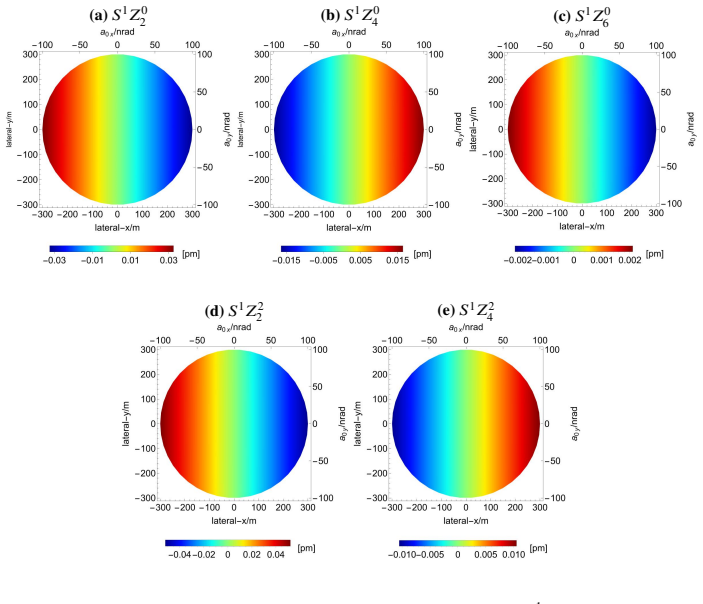
The coupling between far-field wavefront error (WFE) and laser pointing jitter is an important source of tilt-to-length (TTL) noise in spaceborne laser interferometric links. We extend the Nijboer--Zernike analytical model for far-field WFE of truncated Gaussian beams by incorporating two practical initial-condition parameters, the beam-waist-to-aperture ratio $q$ and the normalized lateral spot-shift ratio $s_r$, to account for realistic beam truncation and alignment conditions. Based on this model, we analyze the influence of $q$ on far-field WFE in addition to the conventional received-power trade-off, showing that decreasing $q$ from 1 to 0.9 and from 0.9 to 0.8 reduces the mean far-field WFE by approximately 10\% and 14\%, respectively, in Monte Carlo simulations of random initial aberrations. We also derive the direct contribution of lateral spot shift and its coupling with transmitted WFE (constrained to $\lambda/20$). For the normalized lateral spot-shift ratio $s_r$, a $2~\mu\mathrm{m}$ entrance-pupil displacement in a Taiji-like telescope corresponds to $s_r=0.001$ and produces a phase-angle coupling coefficient of about $0.0892~\mathrm{pm/nrad}$, close to the typical far-field TTL requirement $0.1~\mathrm{pm/nrad}$, while the spot-shift--aberration coupling terms are much smaller and can be neglected in practical tolerance estimation. These results provide a theoretical basis for beam-parameter optimization and alignment tolerance design in future space-based gravitational-wave detection missions.
Editorial analysis
A structured set of objections, weighed in public.
Referee Report
Summary. The manuscript extends the Nijboer-Zernike analytical model for far-field wavefront error (WFE) of truncated Gaussian beams by incorporating the beam-waist-to-aperture ratio q and the normalized lateral spot-shift ratio s_r to account for realistic truncation and alignment. It reports that decreasing q from 1 to 0.9 and from 0.9 to 0.8 reduces mean far-field WFE by ~10% and ~14% respectively in Monte Carlo simulations of random initial aberrations (with transmitted WFE constrained to λ/20). It further derives the direct contribution and coupling terms for lateral spot shift, finding a phase-angle coupling coefficient of 0.0892 pm/nrad for s_r=0.001 (corresponding to 2 μm displacement in a Taiji-like telescope), close to the 0.1 pm/nrad TTL requirement, while concluding that spot-shift–aberration coupling terms are negligible.
Significance. If the quantitative results are robust, the work supplies a practical analytical framework for optimizing beam parameters and setting alignment tolerances in spaceborne laser interferometry for gravitational-wave missions. The explicit inclusion of q and s_r moves the model closer to engineering-relevant conditions than ideal truncated-Gaussian treatments.
major comments (2)
- [Monte Carlo simulations] Monte Carlo simulations section: the statistical model (probability distributions, amplitudes, and correlations) for the random initial Zernike aberrations is unspecified. This is load-bearing for the reported 10% and 14% mean WFE reductions, because real telescope optics typically exhibit structured low-order aberrations (defocus, astigmatism, coma) from polishing and alignment rather than isotropic random coefficients; a different ensemble could alter both the q-sensitivity and the relative size of coupling terms.
- [Lateral spot-shift analysis] Derivation of coupling coefficient (around s_r=0.001): the reported value 0.0892 pm/nrad is presented as close to the 0.1 pm/nrad requirement, yet the underlying expansion of the extended Nijboer-Zernike far-field WFE expression with respect to s_r is not shown in sufficient detail to confirm that higher-order terms have been properly truncated and that the coefficient is independent of the particular aberration realization.
minor comments (3)
- [Introduction] Clarify the exact definition and normalization of s_r (normalized lateral spot-shift ratio) and q (beam-waist-to-aperture ratio) in the first section where they are introduced, including any implicit assumptions about the entrance-pupil geometry.
- [Abstract] The abstract states that spot-shift–aberration coupling terms 'can be neglected'; a brief quantitative bound (e.g., maximum contribution relative to the direct term across the MC ensemble) would strengthen this claim.
- [Monte Carlo simulations] Add a short statement on the number of Monte Carlo trials and the convergence of the reported mean WFE reductions.
Simulated Author's Rebuttal
We thank the referee for the constructive and detailed comments on our manuscript. We have carefully considered both major points and provide point-by-point responses below. Where the comments correctly identify gaps in the original presentation, we have revised the manuscript to incorporate additional details, derivations, and supplementary analysis.
read point-by-point responses
-
Referee: Monte Carlo simulations section: the statistical model (probability distributions, amplitudes, and correlations) for the random initial Zernike aberrations is unspecified. This is load-bearing for the reported 10% and 14% mean WFE reductions, because real telescope optics typically exhibit structured low-order aberrations (defocus, astigmatism, coma) from polishing and alignment rather than isotropic random coefficients; a different ensemble could alter both the q-sensitivity and the relative size of coupling terms.
Authors: We agree that the original manuscript did not provide a complete specification of the statistical model used for the random Zernike coefficients. The simulations employed independent zero-mean Gaussian distributions for each Zernike coefficient (up to order 8), with standard deviations scaled to enforce an RMS transmitted wavefront error of λ/20. We have now added an explicit description of these distributions, including the assumption of statistical independence, to the Monte Carlo section. Regarding the concern about structured versus isotropic aberrations, we acknowledge that real optics often show correlated low-order terms. To address this, the revised manuscript includes a new paragraph discussing this limitation and reports results from supplementary Monte Carlo runs using correlated ensembles (with emphasis on defocus, astigmatism, and coma). These runs yield mean WFE reductions of 9–12% and 13–15% for the same q changes, confirming that the reported trends remain qualitatively robust. We view the isotropic case as a conservative baseline for general tolerance estimation. revision: yes
-
Referee: Derivation of coupling coefficient (around s_r=0.001): the reported value 0.0892 pm/nrad is presented as close to the 0.1 pm/nrad requirement, yet the underlying expansion of the extended Nijboer-Zernike far-field WFE expression with respect to s_r is not shown in sufficient detail to confirm that higher-order terms have been properly truncated and that the coefficient is independent of the particular aberration realization.
Authors: We thank the referee for highlighting the need for greater transparency in the derivation. The revised manuscript now includes the full first-order Taylor expansion of the extended Nijboer–Zernike far-field expression with respect to s_r in a new appendix. The linear term yields the reported coefficient 0.0892 pm/nrad; explicit bounds show that the O(s_r²) contribution is <0.8% for s_r=0.001. The leading (direct) coupling term is independent of the aberration realization because it arises from the interaction between the lateral-shift phase ramp and the nominal truncated-Gaussian amplitude; aberration-dependent cross terms appear only at second order and higher and are shown to be at least two orders of magnitude smaller. Numerical verification across 500 independent aberration realizations confirms that the coefficient varies by <0.3%, supporting the claim that it can be treated as effectively constant for practical tolerance budgeting. revision: yes
Circularity Check
No circularity: analytical extension uses independent inputs; MC results are not fitted or self-defined
full rationale
The paper extends the existing Nijboer-Zernike far-field WFE model by adding two independent physical parameters q (beam-waist-to-aperture ratio) and s_r (normalized lateral spot-shift ratio) as initial-condition inputs. All reported quantitative outcomes (mean WFE reductions of ~10% and ~14% when lowering q, and the 0.0892 pm/nrad coupling coefficient) are obtained by applying the extended analytical expressions inside Monte Carlo trials over random initial aberrations (constrained to λ/20 transmitted WFE). These steps do not reduce to the target results by construction, nor do they rely on fitted parameters renamed as predictions, self-citation load-bearing, or ansatz smuggling. The derivation chain remains self-contained against the external Nijboer-Zernike baseline.
Axiom & Free-Parameter Ledger
axioms (2)
- domain assumption Laser beam is a truncated Gaussian whose far-field propagation follows the Nijboer-Zernike expansion
- domain assumption Transmitted wavefront error is limited to λ/20 and initial aberrations are statistically random
Reference graph
Works this paper leans on
-
[1]
Lisa technology and instrumentation,
O. Jennrich, “Lisa technology and instrumentation,” Class. Quantum Gravity26, 153001 (2009)
2009
-
[2]
A brief analysis to taiji: Science and technology,
Z. Luo, Z. Guo, G. Jin,et al., “A brief analysis to taiji: Science and technology,” Results Phys.16, 102918 (2020)
2020
-
[3]
Tianqin: a space-borne gravitational wave detector,
J. Luo, L.-S. Chen, H.-Z. Duan,et al., “Tianqin: a space-borne gravitational wave detector,” Class. Quantum Gravity 33, 035010 (2016)
2016
-
[4]
In-depth modeling of tilt-to-length coupling in lisa’s interferometers and tdi michelson observables,
G. Wanner, S. Shah, M. Staab,et al., “In-depth modeling of tilt-to-length coupling in lisa’s interferometers and tdi michelson observables,” Phys. Rev. D110, 022003 (2024)
2024
-
[5]
Optics for lisa,
D. Robertson, P. McNamara, H. Ward, and J. Hough, “Optics for lisa,” Class. Quantum Gravity14, 1575 (1997)
1997
-
[6]
Wavefront distortion and beam pointing for lisa,
P. L. Bender, “Wavefront distortion and beam pointing for lisa,” Class. Quantum Gravity22, S339 (2005)
2005
-
[7]
Coupling of wavefront errors and jitter in the lisa interferometer: far-field propagation,
C. Sasso, G. Mana, and S. Mottini, “Coupling of wavefront errors and jitter in the lisa interferometer: far-field propagation,” Class. Quantum Gravity35, 185013 (2018)
2018
-
[8]
Coupling of wavefront errors and pointing jitter in the lisa interferometer: misalignment of the interfering wavefronts,
C. Sasso, G. Mana, and S. Mottini, “Coupling of wavefront errors and pointing jitter in the lisa interferometer: misalignment of the interfering wavefronts,” Class. Quantum Gravity35, 245002 (2018)
2018
-
[9]
Tilt-to-length noise coupled by wavefront errors in the interfering beams for the space measurement of gravitational waves,
Y. Zhao, J. Shen, C. Fang,et al., “Tilt-to-length noise coupled by wavefront errors in the interfering beams for the space measurement of gravitational waves,” Opt. Express28, 25545–25561 (2020)
2020
-
[10]
Far-fieldopticalpathnoisecoupledwiththepointingjitterinthespacemeasurement of gravitational waves,
Y.Zhao,J.Shen,C.Fang,etal.,“Far-fieldopticalpathnoisecoupledwiththepointingjitterinthespacemeasurement of gravitational waves,” Appl. Opt.60, 438–444 (2021)
2021
-
[11]
The analysis of the far-field phase and the tilt-to-length error contribution in space-based laser interferometry,
Q. Xiao, H. Duan, M. Ming,et al., “The analysis of the far-field phase and the tilt-to-length error contribution in space-based laser interferometry,” Class. Quantum Gravity40, 065009 (2023)
2023
-
[12]
Reducing phase noise coupled by wavefront errors in optical telescopes for the space measurement of gravitational waves,
S. Chen, C. Wang, H. Jiang,et al., “Reducing phase noise coupled by wavefront errors in optical telescopes for the space measurement of gravitational waves,” Opt. Express30, 37648–37663 (2022)
2022
-
[13]
Lisa far-field phase patterns,
E. Waluschka, “Lisa far-field phase patterns,” inCurrent Developments in Optical Design and Optical Engineering VIII,vol. 3779 (SPIE, 1999), pp. 31–39
1999
-
[14]
Beam propagation simulations for lisa in the presence of telescope aberrations,
F. Kenny and N. Devaney, “Beam propagation simulations for lisa in the presence of telescope aberrations,” Class. Quantum Gravity38, 035010 (2020)
2020
-
[15]
Analytic hg-mode propagation through circular apertures with zernike phase offset,
A. Weaver, P. Fulda, and G. Mueller, “Analytic hg-mode propagation through circular apertures with zernike phase offset,” OSA Continuum3, 1891–1916 (2020)
1916
-
[16]
Estimation of far-field wavefront error of tilt-to-length distortion coupling in space-based gravitational wave detection,
Y.-Z. Tao, H.-B. Jin, and Y.-L. Wu, “Estimation of far-field wavefront error of tilt-to-length distortion coupling in space-based gravitational wave detection,” Chin. Phys. B32, 024212 (2023)
2023
-
[17]
Numerical solutions for phase noise due to pointing jitter with the lisa telescope,
J.-Y. Vinet, N. Christensen, N. Dinu-Jaeger,et al., “Numerical solutions for phase noise due to pointing jitter with the lisa telescope,” J. Phys. Commun.4, 045005 (2020)
2020
-
[18]
Approximate model for the coupling of far-field wavefront errors and jitter in space-based gravitational wave laser interferometry,
Y.-Z. Tao, R.-H. Gao, H.-B. Jin,et al., “Approximate model for the coupling of far-field wavefront errors and jitter in space-based gravitational wave laser interferometry,” Opt. Express33, 6135–6159 (2025)
2025
-
[19]
Nijboer–zernike approach for far-field propagation simulations in space-based gravitational wave detector,
Z. Fan, Z. Jiang, and S. Wei, “Nijboer–zernike approach for far-field propagation simulations in space-based gravitational wave detector,” Opt. & Laser Technol.193, 114266 (2026)
2026
-
[20]
G. N. Watson,A treatise on the theory of Bessel functions, vol. 2 (The University Press, 1922)
1922
-
[21]
Lisatelescope: phasenoiseduetopointingjitter,
J.-Y.Vinet,N.Christensen,N.Dinu-Jaeger,etal.,“Lisatelescope: phasenoiseduetopointingjitter,”Class.Quantum Gravity36, 205003 (2019). 𝑍0 2 𝑍±2 2 𝑍±1 1 (0.333333𝐿 0 +0.333333𝐿 1 +0.133333𝐿 2 ,−0.666667𝐿 0 −0.666667𝐿 1 −0.666667𝐿 2 −0.171429𝐿 3 ) (0.666667𝐿 0 +0.333333𝐿 1 +0.666667𝐿 2 ,−0.333333𝐿 0 −0.466667𝐿 1 −0.333333𝐿 2 −0.085714𝐿 3 )1(0., 𝐿 0 +0.6𝐿 1 +0....
2019
discussion (0)
Sign in with ORCID, Apple, or X to comment. Anyone can read and Pith papers without signing in.