Recognition: unknown
System-Level Design of Scalable Fluxonium Quantum Processors with Double-Transmon Couplers
Pith reviewed 2026-05-07 13:26 UTC · model grok-4.3
The pith
A frequency-partitioned architecture with double-transmon couplers yields feasible parameters for scalable fluxonium processors supporting high-fidelity gates, fast reset, and robust readout.
A machine-rendered reading of the paper's core claim, the machinery that carries it, and where it could break.
Core claim
The central discovery is a tractable workflow that formulates device design as a multi-objective optimization problem. Under realistic constraints and modeled fabrication-induced disorder, the frequency-partitioned architecture allows determination of a feasible parameter set that concurrently optimizes for high-fidelity operations, reset, and readout.
What carries the argument
The frequency-partitioned architecture, which allocates qubit transitions, tunable-coupler excitations, and resonator modes into well-separated spectral regions to minimize parameter interdependence and enable concurrent optimization.
Load-bearing premise
The frequency-partitioned architecture sufficiently decouples parameters so that optimization under modeled fabrication disorder produces values that remain stable against unmodeled stray couplings or higher-order effects in real devices.
What would settle it
Fabricate a small array of fluxonium qubits and double-transmon couplers using the reported optimized frequencies and spacings, then measure whether single-qubit gate fidelities exceed 99.9 percent, two-qubit fidelities exceed 99 percent, reset times fall below one microsecond, and dispersive readout remains robust without excess crosstalk.
Figures




read the original abstract
Fluxonium qubits combine long coherence times with strong anharmonicity, making them a promising platform for scalable superconducting quantum processors. Recent experiments have demonstrated high-fidelity operations in multi-qubit processors while suppressing stray qubit interactions using fluxonium-transmon-fluxonium (FTF) architectures. However, scaling such systems to larger arrays is constrained by a trade-off between achievable coupling strength, crosstalk suppression and qubit-qubit spacing required for wiring in a two-dimensional architecture. Multimode couplers, such as the double-transmon coupler (DTC), provide a promising pathway to overcome this limitation by enabling stronger interactions without compromising qubit spacing and isolation. Here, we develop a quantitative design framework for fluxonium-based quantum processors employing DTCs. Central to this work is a frequency-partitioned architecture that places qubit transitions, tunable-coupler excitations, and resonator modes in well-separated spectral regions. This structured allocation reduces parameter interdependence and enables the concurrent optimization of gate operations, readout, and qubit reset. By formulating device design as a multi-objective optimization problem under realistic experimental constraints and fabrication-induced disorder, we develop a tractable sequential workflow and determine a feasible parameter regime that simultaneously supports high-fidelity single- and two-qubit gates, fast qubit reset, and robust dispersive readout. These results establish a system-level architectural methodology that links circuit parameters to processor-level performance, and provide an experimentally actionable pathway toward scalable fluxonium quantum processors.
Editorial analysis
A structured set of objections, weighed in public.
Referee Report
Summary. The manuscript develops a system-level design framework for scalable fluxonium quantum processors that employ double-transmon couplers (DTCs). It introduces a frequency-partitioned architecture to place qubit transitions, tunable-coupler excitations, and resonator modes in separated spectral regions, formulates device design as a multi-objective optimization problem that incorporates realistic experimental constraints and fabrication-induced disorder, and reports a sequential workflow that identifies a feasible parameter regime supporting high-fidelity single- and two-qubit gates, fast qubit reset, and robust dispersive readout.
Significance. If the optimized parameters and performance metrics can be shown to hold under the modeled conditions, the work supplies a practical, experimentally actionable methodology that connects microscopic circuit parameters to processor-level metrics. The explicit treatment of fabrication disorder within a multi-objective setting is a constructive contribution toward scaling fluxonium arrays beyond current FTF demonstrations.
major comments (2)
- [Abstract] Abstract and central claims: the manuscript asserts that the frequency-partitioned architecture and multi-objective optimization yield a feasible regime for simultaneous high-fidelity gates, fast reset, and dispersive readout, yet supplies no explicit Hamiltonian, objective functions, optimized parameter values, or simulation outputs with error bars. Without these, the decoupling assumption and the stability of the reported regime cannot be evaluated.
- [Optimization and Results sections] Optimization workflow: the claim that modeled fabrication disorder is sufficient rests on the untested premise that unmodeled stray couplings (next-nearest-neighbor or parasitic modes) and higher-order nonlinearities will not shift spectral features into overlap; no sensitivity analysis or robustness test against such terms is referenced.
minor comments (1)
- [Abstract] The abstract is information-dense; a brief enumeration of the sequential workflow steps would improve readability.
Simulated Author's Rebuttal
We thank the referee for the constructive and detailed review. The comments identify key areas where additional explicit detail and analysis would strengthen the presentation of our system-level design framework. We address each major comment below and have revised the manuscript to improve accessibility and robustness.
read point-by-point responses
-
Referee: [Abstract] Abstract and central claims: the manuscript asserts that the frequency-partitioned architecture and multi-objective optimization yield a feasible regime for simultaneous high-fidelity gates, fast reset, and dispersive readout, yet supplies no explicit Hamiltonian, objective functions, optimized parameter values, or simulation outputs with error bars. Without these, the decoupling assumption and the stability of the reported regime cannot be evaluated.
Authors: The referee correctly notes that the abstract itself does not contain these elements. The body of the manuscript presents the Hamiltonian in Section II, the multi-objective formulation and constraints in Section III, and optimized parameters with Monte Carlo error bars in Section IV. To allow immediate evaluation without requiring the reader to locate these details, we have added a compact table of key optimized values (including disorder-averaged metrics and standard deviations) to the Results section and inserted a brief reference to the Hamiltonian and objective functions in the revised abstract. These changes preserve the abstract's length while making the central claims directly verifiable. revision: yes
-
Referee: [Optimization and Results sections] Optimization workflow: the claim that modeled fabrication disorder is sufficient rests on the untested premise that unmodeled stray couplings (next-nearest-neighbor or parasitic modes) and higher-order nonlinearities will not shift spectral features into overlap; no sensitivity analysis or robustness test against such terms is referenced.
Authors: We agree that the original analysis did not include explicit sensitivity tests for next-nearest-neighbor couplings or higher-order nonlinearities. In the revised manuscript we have added a dedicated subsection to the Optimization workflow that performs a sensitivity study: next-nearest-neighbor couplings are varied from 0 to 5 MHz and higher-order terms up to 1% of the leading nonlinearities are included. The results show that the frequency-partitioning margins remain sufficient to avoid spectral overlap under these perturbations, with only modest degradation in gate fidelity. We note, however, that exhaustive coverage of every possible parasitic mode lies beyond the scope of the present modeling and would ultimately require device-level electromagnetic simulation and experiment. revision: partial
Circularity Check
No circularity: optimization workflow is forward design, not self-referential
full rationale
The paper presents a frequency-partitioned architecture and formulates device design as multi-objective optimization under constraints and modeled disorder to identify a feasible parameter regime. No load-bearing derivation, equation, or claim reduces by construction to its own inputs. The optimization identifies parameters meeting performance targets rather than fitting values and then treating the same values as independent predictions. No self-citations, uniqueness theorems, or ansatzes are invoked in a load-bearing way within the provided text. This is a standard, non-circular design methodology.
Axiom & Free-Parameter Ledger
Reference graph
Works this paper leans on
-
[1]
Leakage minimization In addition to decoherence, the primary limitation of MAP gate operation arises from driven leakage transi- tions, particularly when short gate times are used to mit- igate decoherence. For a given parameter setx q ∪xc∪xqc, ηjβ,kα denotes the probability of a leakage transition |k⟩ → |α⟩induced while driving the target MAP tran- sitio...
-
[2]
turn-off
Two-qubit gate fidelities During MAP gate operation, the device is subject to various noise channels, primarily flux noise and dielec- tric loss. The theoretical framework for estimating gate fidelities is detailed in Appendix E. Figure 6 presents the estimated MAP gate fidelities with various selected energy transitions calculated using the parameters fr...
-
[3]
DTC Hamiltonian parameter definitions.C c,m denotes the capacitance ofm-th transmon,C c,12 is the mutual capacitance between 1-st and 2-nd transmon
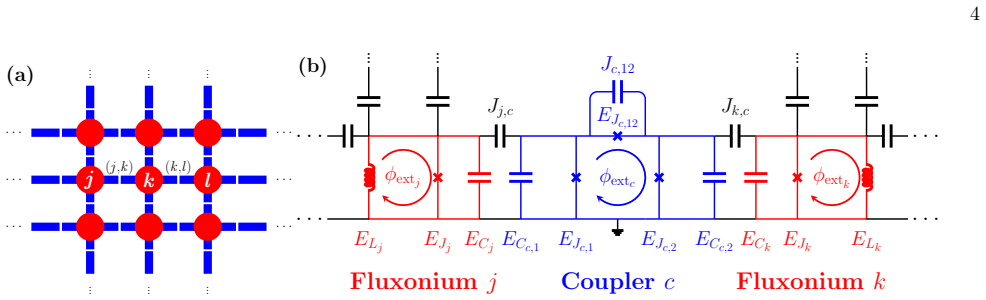
DTC Hamiltonian in the harmonic oscillator basis The DTC HamiltonianH c can be alternatively ex- pressed in the harmonic oscillator basis by introducing the operators [31] ˆϕj =−iϕ zpf,j (ˆaj −ˆa† j),(A1a) ˆnj =n zpf,j (ˆaj + ˆa† j),(A1b) 17 Term Value ϕzpf,c,m 1√ 2 r ¯hωc,m/ E′ Jc,m +E ′ Jc,12 nzpf,c,m 1√ 2 p ¯hωc,m/(8ECc,m) E′ Jc,12 EJc,12 cosϕ extc E′ ...
-
[4]
Effective fluxonium-fluxonium interaction It is instructive to derive the effective interaction be- tween neighboring fluxonium qubits, indexedjandk, mediated by the intervening DTCc= (j, k). Given the strong anharmonicity of the fluxonium spectrum, we re- strict our analysis to the relevant two-level subspaces of the qubits and the DTC, assuming coupling...
-
[5]
DTC “turn-on” mechanism and MAP gate protocol The effective interaction between neighboring fluxo- nium qubits,jandk, is mediated by the intervening DTC c= (j, k). Since the physical coupling between the fluxo- niums and the DTC is capacitive, achieving a significant effective coupling strength requires exploiting the large charge matrix elements associat...
-
[6]
intended
Leakage estimation Here, we adopt the parameters from Table. IV as an example to illustrate the discussion on leakage in the MAP gate scenario. At the operating point of the MAP gate (ϕonc ≈π), a manifold of eight transitions arises, as shown in Fig. 11(a). Since any of these eight transitions can be utilized to perform the MAP gate operation, we must sel...
-
[7]
turn-off
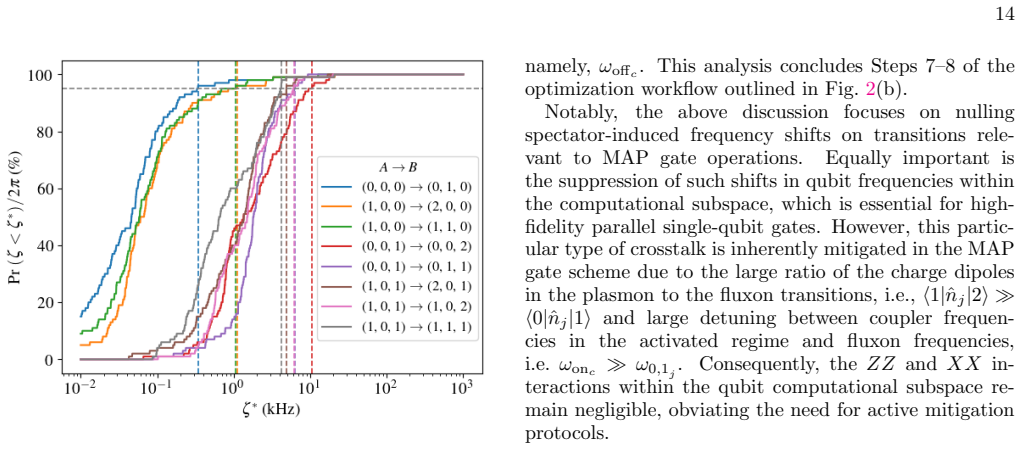
Definition and “turn-off” mechanism To quantify the isolation between qubits, we first define a metric for spectator-induced crosstalk. We consider a composite system of three fluxonium qubits (q 1, q2, q3) connected via DTCs. We focus on a scenario where a MAP gate is applied to the active pair (q2, q3) by driving a transition between states|A⟩and|B⟩, wh...
-
[8]
To determine the maximum FIG
Effect of crosstalk on MAP gate fidelities The impact of crosstalk on two-qubit gate fidelity is highly sensitive to the specific system parameters and the chosen gate scheme. To determine the maximum FIG. 13. Crosstalk-induced reduction in MAP gate fidelity, denoted asδF, evaluated in the absence of relaxation and pure dephasing. The fidelity reduction i...
-
[9]
Relaxation rateΓ 1 Consider a Hamiltonian parameterized by an external parameterλ, ˆH(λ), we assume that the overall parameter can be decomposed into an externally controlled value and a small noise term, i.e.λ=λ e +λ n withλ n ≪λ e. A Taylor expansion of the Hamiltonian yields [1] ˆH→ ˆH+λ n ˆH(1) λ ,(D1) where ˆH(1) λ = ∂ ˆH ∂λ λe .(D2) The depolarizati...
-
[10]
Pure dephasing rateΓ ϕ For 1/fnoise spectrum, the first and second-order de- phasing rate are [52, 67] Γλ ϕ,kl =A λ ∂ωk,l ∂Φ ,(D4a) Γλ2 ϕ,kl =A 2 λ ∂2ωk,l ∂Φ2 ,(D4b)
-
[11]
Estimates for fluxonium single-qubit relaxation (T1) and pure dephasing time (T ϕ) a. Flux noise Assuming the flux noise exhibits a 1/fcharacter, the relaxation rate (at the half-integer flux) between state|i⟩ and|j⟩of the fluxonium qubit are [52, 60] ΓΦ 1,kl = 8 πEL ¯hΦ0 2 ⟨k| ˆϕ|l⟩ 2 SΦ(ωk,l).(D5) The dephasing rate directly follows from Eq. (D4). b. Di...
-
[12]
Flux noise From Eq
Estimates for DTC relaxation (T 1) and pure dephasing time (T ϕ) a. Flux noise From Eq. (4), the Hamiltonian derivative with respect to external flux is ˆH(1) Φ = 2π Φ0 " 2X m=1 EJc,m sin ˆϕc,m + eCc,mϕext,c EJc,12 sin ˆϕc,2 − ˆϕc,1 − eCc,12ϕextc i . (D9) The relaxation rate can then be estimated with Eq. (D3). b. Dielectric loss The MAP gate operation ex...
-
[13]
Average gate fidelity Given a pure dephasing timeT ϕ (with 1/fnoise spec- trum) and relaxation timeT 1, the average gate fidelity is [70] F1q = 1− " tg 3T1 + 1 3 tg Tϕ 2# (D13) Appendix E: Multi-qubit coherence time and average two-qubit gate fidelity
-
[14]
Relaxation rateΓ 1 and pure dephasing rateΓ ϕ The relaxation rate for the multi-qubit composite sys- tem is derived by generalizing Eq. (D3). This derivation involves replacing the bare states|i⟩and|j⟩with the dressed eigenstates of the composite system and promot- ing the local operators, such as the phase operator ˆϕin Eqs. (D5), (D6), and (D9), to the ...
-
[15]
We model the operation of a two-qubit gate as a com- pletely positive trace-preserving mapKacting on an in- put density stateρ, such thatρ ′ =K(ρ)
Gate error modeling In this section, we present analytical estimates of MAP gate fidelities in the presence of incoherent errors. We model the operation of a two-qubit gate as a com- pletely positive trace-preserving mapKacting on an in- put density stateρ, such thatρ ′ =K(ρ). To derive the gate fidelity, we expressKin the Kraus representation, K(ρ) =P k ...
-
[16]
J. Koch, T. M. Yu, J. Gambetta, A. A. Houck, D. I. Schuster, J. Majer, A. Blais, M. H. Devoret, S. M. Girvin, and R. J. Schoelkopf, Charge-insensitive qubit design de- rived from the cooper pair box, Phys. Rev. A76, 042319 (2007)
2007
-
[17]
Arute, K
F. Arute, K. Arya, R. Babbush, D. Bacon, J. C. Bardin, R. Barends, R. Biswas, S. Boixo, F. G. S. L. Brandao, D. A. Buell, B. Burkett, Y. Chen, Z. Chen, B. Chiaro, R. Collins, W. Courtney, A. Dunsworth, E. Farhi, B. Foxen, A. Fowler, C. Gidney, M. Giustina, R. Graff, K. Guerin, S. Habegger, M. P. Harrigan, M. J. Hartmann, A. Ho, M. Hoffmann, T. Huang, T. S...
2019
-
[18]
Wu, W.-S
Y. Wu, W.-S. Bao, S. Cao, F. Chen, M.-C. Chen, X. Chen, T.-H. Chung, H. Deng, Y. Du, D. Fan, M. Gong, C. Guo, C. Guo, S. Guo, L. Han, L. Hong, H.-L. Huang, Y.-H. Huo, L. Li, N. Li, S. Li, Y. Li, F. Liang, C. Lin, J. Lin, H. Qian, D. Qiao, H. Rong, H. Su, L. Sun, L. Wang, S. Wang, D. Wu, Y. Xu, K. Yan, W. Yang, Y. Yang, Y. Ye, J. Yin, C. Ying, J. Yu, C. Zh...
2021
-
[19]
Google Quantum AI and Collaborators, Quantum error correction below the surface code threshold, Nature638, 920 (2025)
2025
-
[20]
T. He, W. Lin, R. Wang, Y. Li, J. Bei, J. Cai, S. Cao, D. Chen, K. Chen, X. Chen, Z. Chen, Z. Chen, Z. Chen, W. Chu, H. Deng, X. Ding, Z. Ding, B. Fan, D. Fan, Y. Fu, D. Gao, M. Gong, J. Gui, C. Guo, S. Guo, L. Han, L. Hong, Y. Hu, H.-L. Huang, Y.-H. Huo, C. Jiang, L. Jiang, T. Jiang, Z. Jiang, H. Jin, D. Li, D. Li, J. Li, J. Li, J. Li, J. Li, N. Li, S. L...
2025
-
[21]
Besedin, M
I. Besedin, M. Kerschbaum, J. Knoll, I. Hesner, L. B¨ odeker, L. Colmenarez, L. Hofele, N. Lacroix, C. Hellings, F. Swiadek, A. Flasby, M. Bahrami Panah, D. Colao Zanuz, M. M¨ uller, and A. Wallraff, Lattice surgery realized on two distance-three repetition codes 24 with superconducting qubits, Nat. Phys.22, 189 (2026)
2026
-
[22]
K. Wang, Z. Lu, C. Zhang, G. Liu, J. Chen, Y. Wang, Y. Wu, S. Xu, X. Zhu, F. Jin, Y. Gao, Z. Tan, Z. Cui, N. Wang, Y. Zou, A. Zhang, T. Li, F. Shen, J. Zhong, Z. Bao, Z. Zhu, Y. Han, Y. He, J. Shen, H. Wang, J.- N. Yang, Z. Song, J. Deng, H. Dong, Z.-Z. Sun, W. Li, Q. Ye, S. Jiang, Y. Ma, P.-X. Shen, P. Zhang, H. Li, Q. Guo, Z. Wang, C. Song, H. Wang, and...
2026
-
[23]
F. Yan, P. Krantz, Y. Sung, M. Kjaergaard, D. L. Camp- bell, T. P. Orlando, S. Gustavsson, and W. D. Oliver, Tunable coupling scheme for implementing high-fidelity two-qubit gates, Phys. Rev. Appl.10, 054062 (2018)
2018
-
[24]
P. V. Klimov, A. Bengtsson, C. Quintana, A. Bourassa, S. Hong, A. Dunsworth, K. J. Satzinger, W. P. Liv- ingston, V. Sivak, M. Y. Niu, T. I. Andersen, Y. Zhang, D. Chik, Z. Chen, C. Neill, C. Erickson, A. Grajales Dau, A. Megrant, P. Roushan, A. N. Korotkov, J. Kelly, V. Smelyanskiy, Y. Chen, and H. Neven, Optimizing quantum gates towards the scale of log...
2024
-
[25]
S. Vall´ es-Sanclemente, T. H. F. Vroomans, T. R. van Abswoude, F. Brulleman, T. Stavenga, S. L. M. van der Meer, Y. Xin, A. Lawrence, V. Singh, M. A. Rol, and L. DiCarlo, Optimizing the frequency positioning of tun- able couplers in a circuit qed processor to mitigate spec- tator effects on quantum operations, ArXiv:2503.13225
-
[26]
V. E. Manucharyan, J. Koch, L. I. Glazman, and M. H. Devoret, Fluxonium: Single cooper-pair circuit free of charge offsets, Science326, 113 (2009)
2009
-
[27]
Somoroff, Q
A. Somoroff, Q. Ficheux, R. A. Mencia, H. Xiong, R. Kuzmin, and V. E. Manucharyan, Millisecond coher- ence in a superconducting qubit, Phys. Rev. Lett.130, 267001 (2023)
2023
-
[28]
F. Wang, K. Lu, H. Zhan, L. Ma, F. Wu, H. Sun, H. Deng, Y. Bai, F. Bao, X. Chang, R. Gao, X. Gao, G. Gong, L. Hu, R. Hu, H. Ji, X. Ma, L. Mao, Z. Song, C. Tang, H. Wang, T. Wang, Z. Wang, T. Xia, H. Xu, Z. Zhan, G. Zhang, T. Zhou, M. Zhu, Q. Zhu, S. Zhu, X. Zhu, Y. Shi, H.-H. Zhao, and C. Deng, High- coherence fluxonium qubits manufactured with a wafer- s...
2025
-
[29]
L. Ding, M. Hays, Y. Sung, B. Kannan, J. An, A. Di Paolo, A. H. Karamlou, T. M. Hazard, K. Azar, D. K. Kim, B. M. Niedzielski, A. Melville, M. E. Schwartz, J. L. Yoder, T. P. Orlando, S. Gustavsson, J. A. Grover, K. Serniak, and W. D. Oliver, High- fidelity, frequency-flexible two-qubit fluxonium gates with a transmon coupler, Phys. Rev. X13, 031035 (2023)
2023
-
[30]
Z. Zhan, Z. Li, F. Wang, W. Lan, X. Pan, L. Xiang, X. Dou, R. Gao, G. Gong, Y. Guo, Q. Guan, L. Hu, R. Hu, H. Ji, L. Jin, Y. Jin, C. Li, K. Lu, L. Ma, X. Ma, H. Wang, J. Wang, H. Zhan, T. Zhou, X. Zhu, C. Deng, and T. Wang, Scalable fluxonium quantum processors via tunable-coupler architecture, ArXiv:2604.13363
work page internal anchor Pith review Pith/arXiv arXiv
-
[31]
F. Bao, H. Deng, D. Ding, R. Gao, X. Gao, C. Huang, X. Jiang, H.-S. Ku, Z. Li, X. Ma, X. Ni, J. Qin, Z. Song, H. Sun, C. Tang, T. Wang, F. Wu, T. Xia, W. Yu, F. Zhang, G. Zhang, X. Zhang, J. Zhou, X. Zhu, Y. Shi, J. Chen, H.-H. Zhao, and C. Deng, Fluxonium: An alter- native qubit platform for high-fidelity operations, Phys. Rev. Lett.129, 010502 (2022)
2022
-
[32]
Dogan, D
E. Dogan, D. Rosenstock, L. Le Guevel, H. Xiong, R. A. Mencia, A. Somoroff, K. N. Nesterov, M. G. Vavilov, V. E. Manucharyan, and C. Wang, Two-fluxonium cross- resonance gate, Phys. Rev. Appl.20, 024011 (2023)
2023
- [33]
-
[34]
L. B. Nguyen, G. Koolstra, Y. Kim, A. Morvan, T. Chis- tolini, S. Singh, K. N. Nesterov, C. J¨ unger, L. Chen, Z. Pedramrazi, B. K. Mitchell, J. M. Kreikebaum, S. Puri, D. I. Santiago, and I. Siddiqi, Blueprint for a high-performance fluxonium quantum processor, PRX Quantum3, 037001 (2022)
2022
-
[35]
A. Chakraborty, B. Bhandari, D. D. Brise˜ no-Colunga, N. Stevenson, Z. Pedramrazi, C.-H. Liu, D. I. Santiago, I. Siddiqi, J. Dressel, and A. N. Jordan, Tunable super- conducting quantum interference device coupler for flux- onium qubits, ArXiv:2508.16907
-
[36]
W.-J. Lin, H. Cho, Y. Chen, M. G. Vavilov, C. Wang, and V. E. Manucharyan, Verifying the analogy between transversely coupled spin-1/2 systems and inductively- coupled fluxoniums, New J. Phys.27, 033012 (2025)
2025
-
[37]
W.-J. Lin, H. Cho, Y. Chen, M. G. Vavilov, C. Wang, and V. E. Manucharyan, 24 days-stable cnot gate on flux- onium qubits with over 99.9% fidelity, PRX Quantum6, 010349 (2025)
2025
-
[38]
X. Ma, G. Zhang, F. Wu, F. Bao, X. Chang, J. Chen, H. Deng, R. Gao, X. Gao, L. Hu, H. Ji, H.-S. Ku, K. Lu, L. Ma, L. Mao, Z. Song, H. Sun, C. Tang, F. Wang, H. Wang, T. Wang, T. Xia, M. Ying, H. Zhan, T. Zhou, M. Zhu, Q. Zhu, Y. Shi, H.-H. Zhao, and C. Deng, Na- tive approach to controlled-zgates in inductively coupled fluxonium qubits, Phys. Rev. Lett.13...
2024
-
[39]
E. L. Rosenfeld, C. T. Hann, D. I. Schuster, M. H. Ma- theny, and A. A. Clerk, High-fidelity two-qubit gates be- tween fluxonium qubits with a resonator coupler, PRX Quantum5, 040317 (2024)
2024
- [40]
-
[41]
Singh, E
S. Singh, E. Y. Huang, J. Hu, F. Yilmaz, M. F. S. Zwa- nenburg, P. Kumaravadivel, S. Wang, T. V. Stefanski, and C. K. Andersen, Fast microwave-driven two-qubit gates between fluxonium qubits with a transmon coupler, Phys. Rev. Appl.25, 024020 (2026)
2026
- [42]
-
[43]
L. Heunisch, L. Huang, S. Tasler, J. Schirk, F. Wall- ner, V. Feulner, B. Sarma, K. Liegener, C. M. F. Schnei- der, S. Filipp, and M. J. Hartmann, Scalable fluxonium- transmon architecture for error corrected quantum pro- cessors, ArXiv:2508.09267
-
[44]
Goto, Double-transmon coupler: Fast two-qubit gate with no residual coupling for highly detuned supercon- ducting qubits, Phys
H. Goto, Double-transmon coupler: Fast two-qubit gate with no residual coupling for highly detuned supercon- ducting qubits, Phys. Rev. Appl.18, 034038 (2022)
2022
-
[45]
K. Kubo, Y. Ho, and H. Goto, High-performance mul- tiqubit system with double-transmon couplers: Toward scalable superconducting quantum computers, Phys. Rev. Appl.22, 024057 (2024)
2024
-
[46]
D. L. Campbell, A. Kamal, L. Ranzani, M. Senatore, and M. D. LaHaye, Modular tunable coupler for super- 25 conducting circuits, Phys. Rev. Appl.19, 064043 (2023)
2023
-
[47]
R. Li, K. Kubo, Y. Ho, Z. Yan, Y. Nakamura, and H. Goto, Realization of high-fidelity cz gate based on a double-transmon coupler, Phys. Rev. X14, 041050 (2024)
2024
-
[48]
R. Li, K. Kubo, Y. Ho, Z. Yan, S. Inoue, Y. Nakamura, and H. Goto, Capacitively shunted double-transmon cou- pler realizing bias-free idling and a high-fidelity cz gate, Phys. Rev. Appl.23, 064069 (2025)
2025
- [49]
- [50]
-
[51]
Lange, L
F. Lange, L. Heunisch, H. Fehske, D. P. DiVincenzo, and M. J. Hartmann, Cross-talk in superconducting qubit lattices with tunable couplers—comparing trans- mon and fluxonium architectures, Quantum Sci. Technol. 11, 015020 (2025)
2025
- [52]
-
[53]
Weiss, H
D. Weiss, H. Zhang, C. Ding, Y. Ma, D. I. Schuster, and J. Koch, Fast high-fidelity gates for galvanically- coupled fluxonium qubits using strong flux modulation, PRX Quantum3, 040336 (2022)
2022
-
[54]
Zhang, C
H. Zhang, C. Ding, D. Weiss, Z. Huang, Y. Ma, C. Guinn, S. Sussman, S. P. Chitta, D. Chen, A. A. Houck, J. Koch, and D. I. Schuster, Tunable inductive coupler for high- fidelity gates between fluxonium qubits, PRX Quantum 5, 020326 (2024)
2024
-
[55]
I. N. Moskalenko, I. S. Besedin, I. A. Simakov, and A. V. Ustinov, Tunable coupling scheme for implementing two- qubit gates on fluxonium qubits, Applied Physics Letters 119, 194001 (2021)
2021
-
[56]
I. N. Moskalenko, I. A. Simakov, N. N. Abramov, A. A. Grigorev, D. O. Moskalev, A. A. Pishchimova, N. S. Smirnov, E. V. Zikiy, I. A. Rodionov, and I. S. Besedin, High fidelity two-qubit gates on fluxoniums using a tun- able coupler, npj Quantum Inf.8, 130 (2022)
2022
-
[57]
P. Zhao, P. Xu, and Z.-Y. Xue, Long-range tunable cou- pler for modular fluxonium quantum processors (2026), ArXiv:2604.12261
work page internal anchor Pith review Pith/arXiv arXiv 2026
-
[58]
J.-H. Wang, H. Xiong, J.-Z. Yang, H.-Y. Zhang, Y.-P. Song, and L.-M. Duan, Transmon-assisted high-fidelity controlled-zgates for integer fluxonium qubits, Phys. Rev. Appl.24, 034044 (2025)
2025
-
[59]
E. A. Sete, A. Q. Chen, R. Manenti, S. Kulshreshtha, and S. Poletto, Floating tunable coupler for scalable quantum computing architectures, Phys. Rev. Appl.15, 064063 (2021)
2021
-
[60]
Y. Chen, C. Neill, P. Roushan, N. Leung, M. Fang, R. Barends, J. Kelly, B. Campbell, Z. Chen, B. Chiaro, A. Dunsworth, E. Jeffrey, A. Megrant, J. Y. Mu- tus, P. J. J. O’Malley, C. M. Quintana, D. Sank, A. Vainsencher, J. Wenner, T. C. White, M. R. Geller, A. N. Cleland, and J. M. Martinis, Qubit architecture with high coherence and fast tunable coupling, ...
2014
-
[61]
Q. Guan, G. Chan, X. Dou, C. Deng, and L. Jin, manuscript in preparation
-
[62]
X. You, J. A. Sauls, and J. Koch, Circuit quantization in the presence of time-dependent external flux, Phys. Rev. B99, 174512 (2019)
2019
-
[64]
D. P. DiVincenzo, The physical implementation of quan- tum computation, Fortschritte der Physik48, 771 (2000)
2000
-
[65]
Motzoi and F
F. Motzoi and F. K. Wilhelm, Improving frequency se- lection of driven pulses using derivative-based transition suppression, Phys. Rev. A88, 062318 (2013)
2013
-
[66]
M. Zhu, M. Hassanpourghadi, Q. Zhang, M. S.-W. Chen, A. Levi, and S. Gupta, An active learning framework for analog circuit multi-objective customization, ACM Trans. Des. Autom. Electron. Syst. (2026)
2026
-
[67]
L. B. Nguyen, Y.-H. Lin, A. Somoroff, R. Mencia, N. Grabon, and V. E. Manucharyan, High-coherence flux- onium qubit, Phys. Rev. X9, 041041 (2019)
2019
-
[68]
Xiong, Q
H. Xiong, Q. Ficheux, A. Somoroff, L. B. Nguyen, E. Do- gan, D. Rosenstock, C. Wang, K. N. Nesterov, M. G. Vavilov, and V. E. Manucharyan, Arbitrary controlled- phase gate on fluxonium qubits using differential ac stark shifts, Phys. Rev. Res.4, 023040 (2022)
2022
-
[69]
G. Bothara, S. Das, K. V. Salunkhe, M. Chand, J. Deshmukh, M. P. Patankar, and R. Vijay, High- fidelity qnd readout and measurement back-action in a tantalum-based high-coherence fluxonium qubit, ArXiv:2501.16691
-
[70]
Y.-H. Lin, L. B. Nguyen, N. Grabon, J. San Miguel, N. Pankratova, and V. E. Manucharyan, Demonstration of protection of a superconducting qubit from energy de- cay, Phys. Rev. Lett.120, 150503 (2018)
2018
-
[71]
Earnest, S
N. Earnest, S. Chakram, Y. Lu, N. Irons, R. K. Naik, N. Leung, L. Ocola, D. A. Czaplewski, B. Baker, J. Lawrence, J. Koch, and D. I. Schuster, Realization of a Λ system with metastable states of a capacitively shunted fluxonium, Phys. Rev. Lett.120, 150504 (2018)
2018
-
[72]
Ficheux, L
Q. Ficheux, L. B. Nguyen, A. Somoroff, H. Xiong, K. N. Nesterov, M. G. Vavilov, and V. E. Manucharyan, Fast logic with slow qubits: Microwave-activated controlled- z gate on low-frequency fluxoniums, Phys. Rev. X11, 021026 (2021)
2021
-
[73]
E. J. Zhang, S. Srinivasan, N. Sundaresan, D. F. Bogorin, Y. Martin, J. B. Hertzberg, J. Timmerwilke, E. J. Pritch- ett, J.-B. Yau, C. Wang, W. Landers, E. P. Lewandowski, A. Narasgond, S. Rosenblatt, G. A. Keefe, I. Lauer, M. B. Rothwell, D. T. McClure, O. E. Dial, J. S. Or- cutt, M. Brink, and J. M. Chow, High-performance su- perconducting quantum proce...
2022
-
[74]
Nuerbolati, Z
W. Nuerbolati, Z. Han, J. Chu, Y. Zhou, X. Tan, Y. Yu, S. Liu, and F. Yan, Canceling microwave crosstalk with fixed-frequency qubits, Appl. Phys. Lett.120, 174001 (2022)
2022
-
[75]
L. Ateshian, M. Hays, D. A. Rower, H. Zhang, K. Azar, R. Assouly, L. Ding, M. Gingras, H. Stickler, B. M. Niedzielski, M. E. Schwartz, T. P. Orlando, J. ˆI- j. Wang, S. Gustavsson, J. A. Grover, K. Serniak, and W. D. Oliver, Temperature and magnetic-field de- pendence of energy relaxation in a fluxonium qubit, ArXiv:2507.01175
-
[76]
[14, 59]
More sophisticated strategies exist that exploit multiple drive lines or parasitic coupling to the coupler to suppress leakage transitions, e.g., Refs. [14, 59]. However, such 26 comprehensive drive optimization is beyond the scope of this work
-
[77]
Guo, S.-B
Q. Guo, S.-B. Zheng, J. Wang, C. Song, P. Zhang, K. Li, W. Liu, H. Deng, K. Huang, D. Zheng, X. Zhu, H. Wang, C.-Y. Lu, and J.-W. Pan, Dephasing-insensitive quantum information storage and processing with superconducting qubits, Phys. Rev. Lett.121, 130501 (2018)
2018
-
[78]
Explicitly, we quantify the robustness of the reset op- eration against flux variations asδϕ ∗ extj . This metric is defined as the width of the flux interval over which the reset timet reset remains below a specified thresholdt ∗ reset: δϕ∗ ext,j = max{ϕextj |t reset < t ∗ reset}−min{ϕ extj |t reset < t∗ reset}
-
[79]
Denote the qubit wavefunction at reset durationt reset as|ψ(t reset)⟩, Freset =|⟨ψ(t reset)|0⟩|2
Reset fidelity is defined as the probability of qubit in ground state after the reset operation. Denote the qubit wavefunction at reset durationt reset as|ψ(t reset)⟩, Freset =|⟨ψ(t reset)|0⟩|2
-
[80]
Gambetta, A
J. Gambetta, A. Blais, M. Boissonneault, A. A. Houck, D. I. Schuster, and S. M. Girvin, Quantum trajectory approach to circuit qed: Quantum jumps and the zeno effect, Phys. Rev. A77, 012112 (2008)
2008
-
[81]
Walter, P
T. Walter, P. Kurpiers, S. Gasparinetti, P. Mag- nard, A. Potoˇ cnik, Y. Salath´ e, M. Pechal, M. Mondal, M. Oppliger, C. Eichler, and A. Wallraff, Rapid high- fidelity single-shot dispersive readout of superconducting qubits, Phys. Rev. Appl.7, 054020 (2017)
2017
discussion (0)
Sign in with ORCID, Apple, or X to comment. Anyone can read and Pith papers without signing in.