Recognition: unknown
Quantum Complexity and New Directions in Nuclear Physics and High-Energy Physics Phenomenology
Pith reviewed 2026-05-07 13:20 UTC · model grok-4.3
The pith
Quantum information science is defining new frontiers in nuclear and high-energy physics through complexity insights into many-body systems.
A machine-rendered reading of the paper's core claim, the machinery that carries it, and where it could break.
Core claim
Advances in quantum information science are providing transformative insights into the complexity of quantum many-body systems, defining new frontiers in nuclear and high-energy physics. QIS-derived techniques are fostering new analytic frameworks and algorithms to tackle barriers to discovery, shedding light on hadrons, nuclei, and matter in extreme conditions, and playing an essential role in large-scale quantum simulations by balancing quantum and classical resources.
What carries the argument
QIS techniques for analyzing quantum complexity in many-body systems, applied to create new frameworks and algorithms for nuclear and high-energy physics phenomenology.
If this is right
- New analytic frameworks and algorithms from QIS will address barriers in fundamental physics.
- Insights will emerge on the structure and dynamics of hadrons, nuclei, and extreme matter.
- Large-scale quantum simulations will be developed with an optimal balance of quantum and classical resources.
- The techniques will apply to other science domains beyond physics.
Where Pith is reading between the lines
- Such approaches might allow simulations of nuclear reactions under conditions impossible to replicate in labs.
- Cross-pollination could accelerate progress in related areas like quantum chemistry or materials science.
- Future work may focus on identifying specific QIS algorithms most suited to particular nuclear physics problems.
Load-bearing premise
That techniques from quantum information science will successfully create new frameworks and algorithms able to overcome the current barriers in nuclear and high-energy physics research.
What would settle it
Computational tests or experiments showing that QIS-based methods fail to improve simulation accuracy or yield new physical insights for hadrons and nuclei beyond existing classical approaches.
Figures












read the original abstract
Advances in quantum information science (QIS) are providing transformative insights into the complexity of quantum many-body systems, potentially defining new frontiers in nuclear and high-energy physics. This review explores how QIS-derived techniques are fostering new analytic frameworks and algorithms - both classical and quantum - to tackle (some of the) present barriers to discovery in fundamental physics, with applicability to other science domains. We highlight how these techniques are shedding new light on the structure and dynamics of hadrons, nuclei, matter in extreme conditions, and beyond. Importantly, they are expected to play an essential role in the development of large-scale quantum simulations of such systems, particularly in setting the balance among quantum and classical computational resources.
Editorial analysis
A structured set of objections, weighed in public.
Referee Report
Summary. This review article surveys the emerging intersections between quantum information science (QIS) and nuclear/high-energy physics phenomenology. It claims that QIS advances are supplying transformative insights into the complexity of quantum many-body systems, thereby fostering new analytic frameworks and both classical and quantum algorithms to address longstanding barriers in fundamental physics. The manuscript highlights applications to hadron and nuclear structure, dynamics under extreme conditions, and the anticipated role of QIS methods in large-scale quantum simulations that optimally balance quantum and classical resources.
Significance. If the synthesis is accurate, the paper offers a timely, high-level map of how QIS concepts are being imported into nuclear and HEP phenomenology. Its value lies in collating disparate literature strands into a coherent narrative that could guide experimentalists and theorists toward productive cross-disciplinary questions. The explicitly cautious language (advances are 'providing transformative insights' and 'potentially defining new frontiers'; techniques are 'expected to play an essential role') is a strength, as it avoids overstating current capabilities while still identifying plausible future directions.
minor comments (1)
- The abstract states that QIS techniques are 'shedding new light on the structure and dynamics of hadrons, nuclei, matter in extreme conditions, and beyond,' yet the manuscript would benefit from a short table or bulleted list in the introduction that explicitly maps the QIS concepts (e.g., entanglement measures, variational quantum algorithms) to the specific nuclear/HEP observables discussed later.
Simulated Author's Rebuttal
We thank the referee for their positive and insightful review of our manuscript. We are pleased that the synthesis of QIS advances with nuclear and high-energy physics phenomenology was found timely and valuable, and we appreciate the recognition of our cautious language regarding current capabilities and future directions.
Circularity Check
No significant circularity in review synthesis
full rationale
This is a review article synthesizing QIS literature for applications in nuclear and HEP phenomenology. It advances no derivations, equations, predictions, fitted parameters, or new theorems. Claims use explicitly forward-looking and cautious phrasing (e.g., 'potentially defining new frontiers', 'expected to play an essential role') rather than asserting demonstrated results. No load-bearing steps reduce by construction to inputs or self-citations; the content rests on external benchmarks and existing work. This is the standard honest non-finding for a synthesis paper with no internal derivation chain.
Axiom & Free-Parameter Ledger
Forward citations
Cited by 1 Pith paper
-
The nonlocal magic of a holographic Schwinger pair
Holographic Schwinger pair creation generates nonlocal magic for spacetime dimensions d>2, as shown by a non-flat entanglement spectrum that can be read from the probe brane free energy.
Reference graph
Works this paper leans on
-
[1]
Einstein, B
A. Einstein, B. Podolsky, N. Rosen, Can quantum mechan- ical description of physical reality be considered complete? Phys. Rev.47, 777–780 (1935). https://doi.org/10. 1103/PhysRev.47.777
1935
-
[2]
On the Einstein Podolsky Rosen paradox,
J.S. Bell, On the Einstein Podolsky Rosen Paradox. Physics Physique Fizika1, 195–200 (1964). https:// doi.org/10.1103/PhysicsPhysiqueFizika.1.195
-
[3]
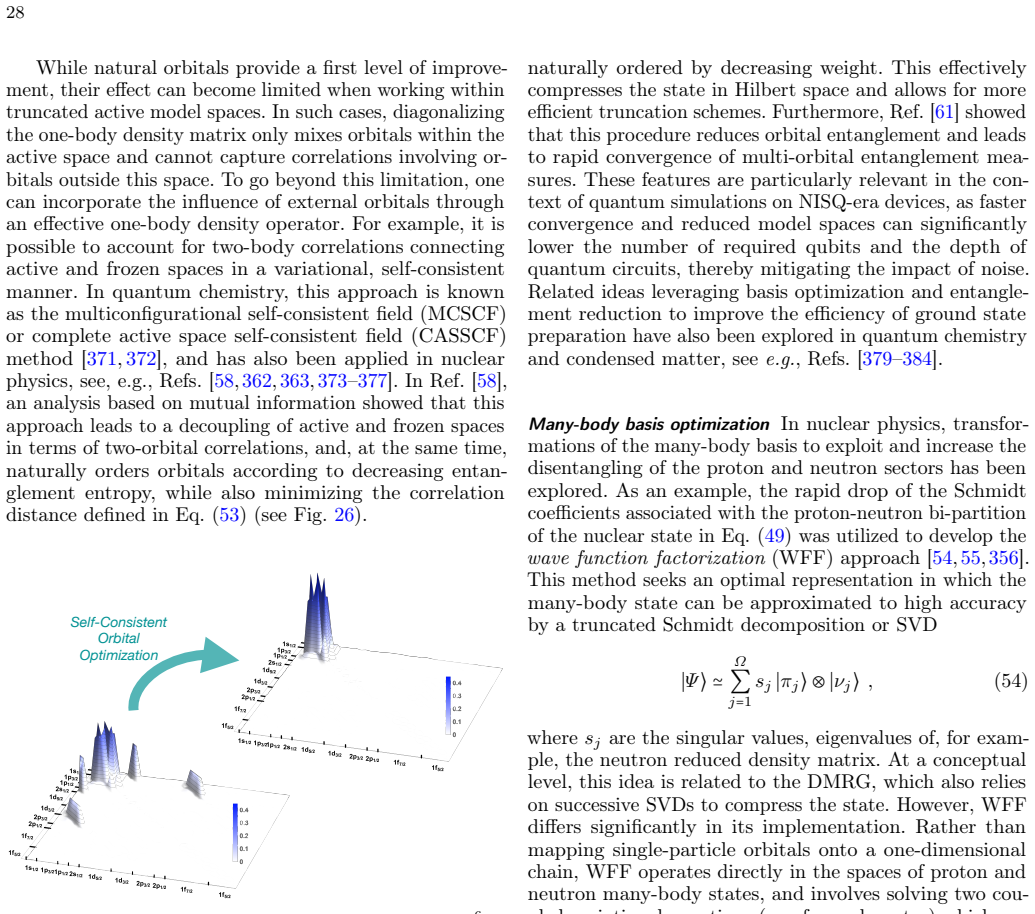
J.F. Clauser, M.A. Horne, A. Shimony, R.A. Holt, Pro- posed Experiment to Test Local Hidden-Variable The- ories. Phys. Rev. Lett.23, 880–884 (1969). https: //doi.org/10.1103/PhysRevLett.23.880
-
[5]
A. Aspect, P. Grangier, G. Roger, Experimental tests of realistic local theories via bell’s theorem. Phys. Rev. Lett.47, 460–463 (1981). https://doi.org/10.1103/ PhysRevLett.47.460. URLhttps://link.aps.org/doi/ 10.1103/PhysRevLett.47.460
-
[6]
Aspect, J
A. Aspect, J. Dalibard, G. Roger, Experimental Test of Bell’s Inequalities Using Time-Varying Analyzers. Phys. Rev. Lett.49, 1804–1807 (1982).https://doi.org/10. 1103/PhysRevLett.49.1804
1982
-
[7]
Aspect, P
A. Aspect, P. Grangier, G. Roger, Experimental Real- ization of Einstein-Podolsky-Rosen-Bohm Gedankenex- periment: A New Violation of Bell’s Inequalities. Phys. Rev. Lett.49, 91–94 (1982).https://doi.org/10.1103/ PhysRevLett.49.91
1982
-
[8]
J.F. Clauser, A. Shimony, Bell’s theorem: Experimen- tal tests and implications. Rept. Prog. Phys.41, 1881– 1927 (1978). https://doi.org/10.1088/0034-4885/41/ 12/002
- [9]
-
[10]
Simulating physics with computers,
R.P. Feynman, Simulating physics with computers. In- ternational Journal of Theoretical Physics21, 467–488 (1982). https://doi.org/10.1007/BF02650179. URL https://doi.org/10.1007/BF02650179
-
[11]
Feynman, Quantum mechanical computers
R.P. Feynman, Quantum mechanical computers. Founda- tions of Physics16, 507–531 (1986).https://doi.org/ 10.1007/BF01886518. URL https://doi.org/10.1007/ BF01886518
-
[12]
Manin,Vychislimoe i nevychislimoe (Computable and Uncomputable)(Sovetskoe Radio, Moscow, 1980)
Y.I. Manin,Vychislimoe i nevychislimoe (Computable and Uncomputable)(Sovetskoe Radio, Moscow, 1980). In Rus- sian
1980
-
[13]
Manin, inMathematics as Metaphor: Selected Essays of Yuri I
Y.I. Manin, inMathematics as Metaphor: Selected Essays of Yuri I. Manin(American Mathematical Society, 2007), pp. 69–77
2007
-
[14]
Landauer, Irreversibility and heat generation in the computing process
R. Landauer, Irreversibility and heat generation in the computing process. IBM Journal of Research and Develop- ment5(3), 183–191 (1961).https://doi.org/10.1147/ rd.53.0183
1961
-
[15]
Bennett, Logical reversibility of computation
C.H. Bennett, Logical reversibility of computation. IBM Journal of Research and Development17(6), 525–532 (1973).https://doi.org/10.1147/rd.176.0525
-
[16]
International Journal of Theo- retical Physics 21, 905–940
C.H. Bennett, The thermodynamics of computation—a re- view. International Journal of Theoretical Physics21(12), 905–940 (1982).https://doi.org/10.1007/BF02084158
-
[17]
P.W. Shor, inProceedings of the 35th Annual Symposium on Foundations of Computer Science(IEEE Computer Society, Los Alamitos, CA, 1994), FOCS ’94, pp. 124–134. https://doi.org/10.1109/SFCS.1994.365700
-
[18]
SIAM Journal on Computing26(5), 1484–1509 (1997) https: //doi.org/10.1137/s0097539795293172
P.W. Shor, Polynomial-time algorithms for prime fac- torization and discrete logarithms on a quantum com- puter. SIAM Journal on Computing26(5), 1484–1509 (1997). https://doi.org/10.1137/S0097539795293172. URLhttps://arxiv.org/abs/quant-ph/9508027
-
[19]
Shor, Scheme for reducing decoherence in quantum computer memory
P.W. Shor, Scheme for reducing decoherence in quantum computer memory. Physical Review A52(4), R2493– R2496 (1995). https://doi.org/10.1103/PhysRevA.52. R2493
-
[20]
A.R. Calderbank, P.W. Shor, Good quantum error- correcting codes exist. Physical Review A54(2), 1098– 1105 (1996). https://doi.org/10.1103/PhysRevA.54. 1098
-
[21]
Steane, Error correcting codes in quantum theory
A.M. Steane, Error correcting codes in quantum theory. Physical Review Letters77(5), 793–797 (1996).https: //doi.org/10.1103/PhysRevLett.77.793
-
[22]
Steane, Multiple-particle interference and quan- tum error correction
A.M. Steane, Multiple-particle interference and quan- tum error correction. Proceedings of the Royal So- ciety A: Mathematical, Physical and Engineering Sci- ences452(1954), 2551–2577 (1996). https://doi.org/ 10.1098/rspa.1996.0136
-
[23]
Preskill, Reliable quantum computers
J. Preskill, Reliable quantum computers. Proceedings of the Royal Society A: Mathematical, Physical and En- gineering Sciences454(1969), 385–410 (1998). https: //doi.org/10.1098/rspa.1998.0167. URL https:// arxiv.org/abs/quant-ph/9705031
-
[24]
Lloyd, Universal quantum simulators
S. Lloyd, Universal quantum simulators. Science 273(5278), 1073–1078 (1996). https://doi.org/ 10.1126/science.273.5278.1073. URL https://www. science.org/doi/10.1126/science.273.5278.1073
-
[25]
Savage, D
M.J. Savage, D. Beck, A. Boehnlein, J. Carlson, D. Dean, M. Dietrich, et al., Nuclear physics and quantum infor- mation science. Tech. rep., Nuclear Science Advisory Committee (NSAC) Subcommittee on Quantum Informa- tion Science (2019). URL https://science.osti.gov/ -/media/np/pdf/Reports/NSAC_QIS_Report.pdf. A Re- port to the Nuclear Science Advisory Committee
2019
-
[26]
Bauer, et al., Quantum Simulation for High- Energy Physics
C.W. Bauer, et al., Quantum Simulation for High- Energy Physics. PRX Quantum4(2), 027001 (2023). https://doi.org/10.1103/PRXQuantum.4.027001. arXiv:2204.03381 [quant-ph]
-
[27]
Becket al.(2023) arXiv:2303.00113 [nucl-ex]
D. Beck, et al. Quantum Information Science and Tech- nology for Nuclear Physics. Input into U.S. Long-Range Planning, 2023 (2023). URL https://arxiv.org/abs/ 2303.00113
- [28]
-
[29]
Quantum Computing in the NISQ era and beyond.Quantum, 2:79, August 2018
J. Preskill, Quantum Computing in the NISQ era and beyond. Quantum2, 79 (2018). https://doi.org/10. 22331/q-2018-08-06-79. arXiv:1801.00862 [quant-ph]
work page internal anchor Pith review arXiv 2018
- [30]
-
[31]
The Heisenberg Representation of Quantum Computers
D. Gottesman. The Heisenberg representation of quan- tum computers (1998). URL https://arxiv.org/abs/ quant-ph/9807006 45
work page internal anchor Pith review arXiv 1998
-
[33]
S.Bravyi,A.Kitaev,Universalquantumcomputationwith ideal Clifford gates and noisy ancillas. Phys. Rev. A71(2), 022316 (2005). https://doi.org/10.1103/PhysRevA.71. 022316. arXiv:quant-ph/0403025
-
[34]
C. Cao, G. Cheng, A. Hamma, L. Leone, W. Munizzi, S.F.E. Oliviero, Gravitational Backreaction is Magical. PRX Quantum6(4), 040375 (2025). https://doi.org/ 10.1103/z3vr-w5c5. arXiv:2403.07056 [hep-th]
-
[35]
Science376(6594), 5197 (2022) https://doi.org/10.1126/science
S.P. Jordan, K.S.M. Lee, J. Preskill, Quantum algo- rithms for quantum field theories. Science336(6085), 1130–1133 (2012).https://doi.org/10.1126/science. 1217069. URL http://dx.doi.org/10.1126/science. 1217069
-
[36]
S.P. Jordan, K.S.M. Lee, J. Preskill, Quantum computa- tion of scattering in scalar quantum field theories. Quan- tum Info. Comput.14(11–12), 1014–1080 (2014). URL https://dl.acm.org/doi/10.5555/2685155.2685163
-
[37]
Quantum Algorithms for Fermionic Quantum Field Theories
S.P. Jordan, K.S.M. Lee, J. Preskill. Quantum algorithms for fermionic quantum field theories (2014). URLhttps: //arxiv.org/abs/1404.7115
work page Pith review arXiv 2014
-
[38]
Classical and Quantum Computation
A.Y. Kitaev, A.H. Shen, M.N. Vyalyi,Classical and Quantum Computation,Graduate Studies in Mathematics, vol. 47 (American Mathematical Society, Providence, RI, 2002). URLhttps://doi.org/10.1090/gsm/047
-
[39]
The Complexity of the Local Hamiltonian Problem
J. Kempe, A. Kitaev, O. Regev, The complexity of the local hamiltonian problem. SIAM Journal on Comput- ing35(5), 1070–1097 (2006). https://doi.org/https: //doi.org/10.1137/S0097539704445226. arXiv:quant- ph/0406180 [quant-ph]
-
[40]
S. Bravyi, M. Vyalyi, Commutative version of the lo- cal hamiltonian problem and common eigenspace prob- lem. Quantum Info. Comput.5(3), 187–215 (2005). URL https://dl.acm.org/doi/10.5555/2011637.2011639
-
[41]
Osborne, Hamiltonian complexity
T.J. Osborne, Hamiltonian complexity. Reports on Progress in Physics75(2), 022001 (2012). https:// doi.org/10.1088/0034-4885/75/2/022001. URL http: //dx.doi.org/10.1088/0034-4885/75/2/022001
- [42]
-
[43]
G. Passetti, D. Hofmann, P. Neitemeier, L. Grun- wald, M.A. Sentef, D.M. Kennes, Can Neural Quantum States Learn Volume-Law Ground States? Phys. Rev. Lett.131(3), 036502 (2023). https://doi.org/10.1103/ PhysRevLett.131.036502. arXiv:2212.02204 [quant-ph]
-
[44]
URLhttp://dx.doi.org/10.1103/PhysRevLett.134
Z. Denis, A. Sinibaldi, G. Carleo, Comment on “Can Neural Quantum States Learn Volume-Law Ground States?”. Phys. Rev. Lett.134(7), 079701 (2025). https://doi.org/10.1103/PhysRevLett.134. 079701. arXiv:2309.11534 [quant-ph]
- [45]
-
[46]
Entan- glement and optimization within autoregressive neural quantum states,
A. Jreissaty, H. Zhang, J.C. Quijano, J. Carrasquilla, R. Wiersema, Entanglement and optimization within au- toregressive neural quantum states. Phys. Rev. Res.8(1), 013147 (2026). https://doi.org/10.1103/t2cg-kr7y. arXiv:2509.12365 [quant-ph]
-
[47]
Paul, Bound on Entanglement in Neural Quantum States
N. Paul, Bound on Entanglement in Neural Quantum States. Phys. Rev. Lett.136(12), 120403 (2026).https:// doi.org/10.1103/rpj5-cns6. arXiv:2510.11797 [quant- ph]
- [48]
-
[49]
A. Sinibaldi, A.F. Mello, M. Collura, G. Carleo, Nonstabi- lizerness of neural quantum states. Phys. Rev. Res.7(4), 043289 (2025). https://doi.org/10.1103/v5tw-yn1f. arXiv:2502.09725 [quant-ph]
- [50]
-
[51]
S.R. Beane, D.B. Kaplan, N. Klco, M.J. Savage, En- tanglement Suppression and Emergent Symmetries of Strong Interactions. Phys. Rev. Lett.122(10), 102001 (2019). https://doi.org/10.1103/PhysRevLett.122. 102001. arXiv:1812.03138 [nucl-th]
-
[52]
C.E.P. Robin, M.J. Savage, Quantum complexity fluctu- ations from nuclear and hypernuclear forces. Phys. Rev. C112(4), 044004 (2025). https://doi.org/10.1103/ r8rq-y9tb. arXiv:2405.10268 [nucl-th]
-
[53]
C.E.P. Robin, M.J. Savage, Anti-Flatness and Non- Local Magic in Two-Particle Scattering Processes (2025). arXiv:2510.23426 [quant-ph]
-
[54]
T. Papenbrock, D.J. Dean, Factorization of shell model ground states. Phys. Rev. C67, 051303 (2003).https: //doi.org/10.1103/PhysRevC.67.051303. arXiv:nucl- th/0301006
-
[55]
T. Papenbrock, A. Juodagalvis, D.J. Dean, Solution of large scale nuclear structure problems by wave function factorization. Phys. Rev. C69, 024312 (2004). https: //doi.org/10.1103/PhysRevC.69.024312. arXiv:nucl- th/0308027
-
[57]
Ö. Legeza, L. Veis, A. Poves, J. Dukelsky, Advanced density matrix renormalization group method for nu- clear structure calculations. Phys. Rev. C92(5), 051303 (2015). https://doi.org/10.1103/PhysRevC.92.051303. arXiv:1507.00161 [nucl-th]
-
[58]
C. Robin, M.J. Savage, N. Pillet, Entanglement Rearrange- ment in Self-Consistent Nuclear Structure Calculations. Phys. Rev. C103(3), 034325 (2021).https://doi.org/ 10.1103/PhysRevC.103.034325. arXiv:2007.09157 [nucl- th]
-
[60]
C.E.P. Robin, M.J. Savage, Quantum simulations in effec- tive model spaces: Hamiltonian-learning variational quan- tum eigensolver using digital quantum computers and ap- plication to the Lipkin-Meshkov-Glick model. Phys. Rev. C108(2), 024313 (2023). https://doi.org/10.1103/ PhysRevC.108.024313. arXiv:2301.05976 [quant-ph] 46
- [62]
-
[63]
Aaronson, S.M
S. Aaronson, S.M. Carroll, L. Ouellette. Quantifying the rise and fall of complexity in closed systems: The coffee automaton (2014). URL https://arxiv.org/abs/1405. 6903
2014
-
[64]
Exact solutions and perturbation theory , author =
H. Lipkin, N. Meshkov, A. Glick, Validity of many- body approximation methods for a solvable model: (i). exact solutions and perturbation theory. Nuclear Physics62(2), 188–198 (1965).https://doi.org/https: //doi.org/10.1016/0029-5582(65)90862-X. URL https://www.sciencedirect.com/science/article/ pii/002955826590862X
-
[65]
Robin, Stabilizer-accelerated quantum many- body ground-state estimation
C.E.P. Robin, Stabilizer-accelerated quantum many- body ground-state estimation. Phys. Rev. A112(5), 052408 (2025). https://doi.org/10.1103/5qr5-7jkz. arXiv:2505.02923 [quant-ph]
-
[66]
S. Grieninger, D.E. Kharzeev, E. Marroquin, Thermal nature of confining strings. Phys. Rev. D113(3), 036013 (2026). https://doi.org/10.1103/v8mv-185x. arXiv:2510.23919 [hep-ph]
-
[67]
The Quantum Complexity of String Breaking in the Schwinger Model
S. Grieninger, M.J. Savage, N.A. Zemlevskiy, The Quan- tum Complexity of String Breaking in the Schwinger Model (2026). arXiv:2601.08825 [hep-ph]
work page internal anchor Pith review Pith/arXiv arXiv 2026
-
[68]
Chernyshev, Three-flavor collective neutrino oscil- lation simulations on a qubit quantum annealer
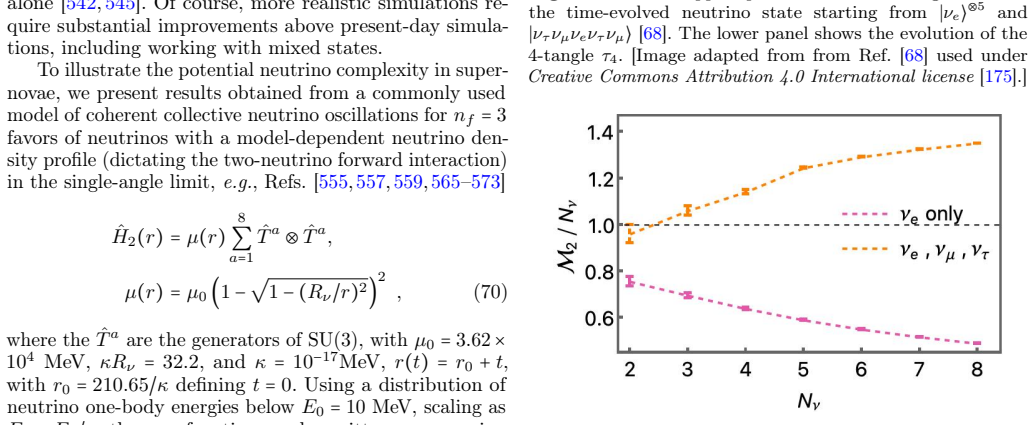
I.A. Chernyshev, Three-flavor collective neutrino oscil- lation simulations on a qubit quantum annealer. Phys. Rev. D111, 043017 (2025).https://doi.org/10.1103/ PhysRevD.111.043017. URL https://link.aps.org/ doi/10.1103/PhysRevD.111.043017
-
[69]
F. Brökemeier, S.M. Hengstenberg, J.W.T. Keeble, C.E.P. Robin, F. Rocco, M.J. Savage, Quantum magic and multi- partite entanglement in the structure of nuclei. Phys. Rev. C111(3), 034317 (2025). https://doi.org/10.1103/ PhysRevC.111.034317. arXiv:2409.12064 [nucl-th]
-
[71]
M. Carena, G. Coloretti, W. Liu, M. Littmann, I. Low, C.E.M. Wagner, Entanglement maximization and mir- ror symmetry in two-Higgs-doublet models. JHEP08, 016 (2025). https://doi.org/10.1007/JHEP08(2025)
- [72]
-
[73]
S.L. Glashow, S. Weinberg, Natural conservation laws for neutral currents. Phys. Rev. D15, 1958– 1965 (1977). https://doi.org/10.1103/PhysRevD. 15.1958. URL https://link.aps.org/doi/10.1103/ PhysRevD.15.1958
-
[74]
Paschos, Diagonal neutral currents
E.A. Paschos, Diagonal neutral currents. Phys. Rev. D15, 1966–1972 (1977). https://doi.org/10.1103/ PhysRevD.15.1966. URL https://link.aps.org/doi/ 10.1103/PhysRevD.15.1966
-
[75]
S. Baiguera, V. Balasubramanian, P. Caputa, S. Chap- man, J. Haferkamp, M.P. Heller, N.Y. Halpern, Quan- tum complexity in gravity, quantum field theory, and quantum information science. Phys. Rept.1159, 1–77 (2026). https://doi.org/10.1016/j.physrep.2025.11
- [76]
-
[77]
The Large N limit of superconformal field theories and supergravity,
J.Maldacena,Thelarge-nlimitofsuperconformalfieldthe- ories and supergravity. International Journal of Theoreti- cal Physics38(4), 1113–1133 (1999).https://doi.org/ 10.1023/a:1026654312961. URL http://dx.doi.org/ 10.1023/A:1026654312961
-
[78]
Susskind, Computational Complexity and Black Hole Interiors
L. Susskind, Computational Complexity and Black Hole Interiors. Fortsch. Phys.64, 24–39 (2016).https://doi. org/10.1002/prop.201500092. arXiv:1403.5695 [hep-th]
-
[79]
Complexity and Shock Wave Geometries,
D. Stanford, L. Susskind, Complexity and Shock Wave Ge- ometries. Phys. Rev. D90(12), 126007 (2014).https:// doi.org/10.1103/PhysRevD.90.126007. arXiv:1406.2678 [hep-th]
-
[80]
Holographic Complexity Equals Bulk Action?,
A.R. Brown, D.A. Roberts, L. Susskind, B. Swingle, Y. Zhao, Holographic Complexity Equals Bulk Ac- tion? Phys. Rev. Lett.116(19), 191301 (2016). https://doi.org/10.1103/PhysRevLett.116.191301. arXiv:1509.07876 [hep-th]
-
[81]
A.R. Brown, D.A. Roberts, L. Susskind, B. Swingle, Y. Zhao, Complexity, Action, and Black Holes. Phys. Rev. D93(8), 086006 (2016).https://doi.org/10.1103/ PhysRevD.93.086006. arXiv:1512.04993 [hep-th]
-
[82]
S. Chapman, G. Policastro, Quantum computational com- plexity from quantum information to black holes. Eur. Phys. J. C82(2), 128 (2022).https://doi.org/10.1140/ epjc/s10052-022-10037-1. arXiv:2110.14672 [hep-th]
-
[84]
D. Carmi, R.C. Myers, P. Rath, Comments on Holographic Complexity. JHEP03, 118 (2017). https://doi.org/10. 1007/JHEP03(2017)118. arXiv:1612.00433 [hep-th]
-
[85]
A. Bouland, B. Fefferman, U. Vazirani. Computational pseudorandomness, the wormhole growth paradox, and constraints on the AdS/CFT duality (2019). URLhttps: //arxiv.org/abs/1910.14646
-
[86]
C. Cao, S.M. Carroll, S. Michalakis, Space from Hilbert Space: Recovering Geometry from Bulk Entanglement. Phys. Rev. D95(2), 024031 (2017).https://doi.org/10. 1103/PhysRevD.95.024031. Develops the framework for spacetime geometry as an emergent property of quantum information and entanglement. arXiv:1606.08444 [hep-th]
-
[87]
Cover, J.A
T.M. Cover, J.A. Thomas,Elements of Information The- ory, 2nd edn. (Wiley-Interscience, Hoboken, NJ, 2006)
2006
discussion (0)
Sign in with ORCID, Apple, or X to comment. Anyone can read and Pith papers without signing in.