Recognition: unknown
Study on the systematic effects on b to c inclusive semileptonic decays
Pith reviewed 2026-05-07 11:40 UTC · model grok-4.3
The pith
Lattice QCD can suppress reconstruction systematics in inclusive B_s semileptonic decays by confining them to sub-dominant excited states.
A machine-rendered reading of the paper's core claim, the machinery that carries it, and where it could break.
Core claim
The inclusive semileptonic decay rate for B_s to X_c l nu can be reconstructed on the lattice using Chebyshev polynomials applied exclusively to excited-state contributions, after the ground-state contributions have been isolated and treated with conventional exclusive methods; this separation ensures that the dominant systematic uncertainties of the reconstruction affect only the sub-dominant excited states, thereby reducing their impact on the total rate.
What carries the argument
Inclusive reconstruction restricted to excited states after exclusive treatment of the ground state
If this is right
- The method allows systematic studies of smearing and separation effects to be performed while keeping reconstruction errors small.
- Results from Chebyshev reconstruction can be extrapolated to the continuum and infinite-volume limits.
- The approach supplies an independent lattice input for the inclusive |V_cb| determination that can be compared with exclusive results.
- Ground-state contributions remain under conventional control, preserving the accuracy of the dominant part of the rate.
Where Pith is reading between the lines
- If the suppression holds, similar isolation techniques could be applied to other inclusive heavy-quark decays where excited states are also sub-dominant.
- A successful calculation would allow direct comparison of lattice inclusive rates with experimental spectra, testing whether the current |V_cb| tension survives improved theory.
- The method suggests a general strategy: subtract well-controlled exclusive pieces first, then reconstruct the remainder inclusively.
Load-bearing premise
Excited-state contributions are sub-dominant, so confining reconstruction systematics to them reduces the overall uncertainty.
What would settle it
A direct lattice calculation showing that excited states contribute more than a few percent to the total inclusive rate, making the expected suppression ineffective.
Figures


read the original abstract
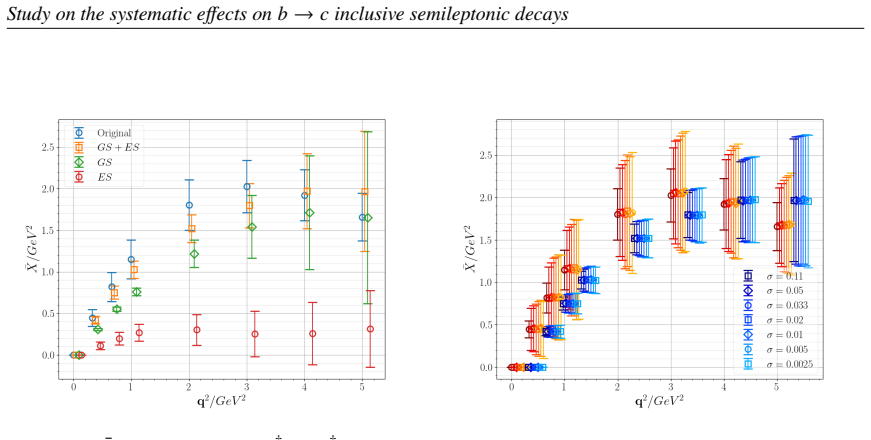
We discuss the calculation of the inclusive semileptonic decay for the process $B_s \to X_c \, l \nu_l$ using lattice QCD. This calculation could be decisive in understanding the long-standing tension between inclusive and exclusive determinations of the CKM matrix element, $|V_{cb}|$. In this talk, we investigate the main sources of systematic uncertainty in these decays, including the impact of Jacobi smearing at the source and sink, variations in source-sink separation, and the intrinsic uncertainties of the inclusive reconstruction method itself. In addition, we explain how we can restrict the reconstruction of the inclusive decay rate to just the excited-state contributions. This is achieved by treating the ground-state contributions as an exclusive decay with well-controlled conventional techniques. Systematic effects from the reconstruction then only affect excited-state contributions. Where these are sub-dominant, a suppression of systematic effects is expected. We show results based on Chebyshev reconstruction, which are part of a larger effort towards a first phenomenologically relevant computation of the inclusive decay rate in the continuum and infinite-volume limits.
Editorial analysis
A structured set of objections, weighed in public.
Referee Report
Summary. The manuscript studies systematic effects in a lattice QCD calculation of the inclusive semileptonic decay Bs → Xc l νl. It examines Jacobi smearing at source and sink, variations in source-sink separation, and uncertainties intrinsic to the inclusive reconstruction method. The central methodological proposal is to treat the ground-state contribution as a conventional exclusive decay while restricting Chebyshev (or similar) reconstruction to the excited-state contributions only; the authors argue that this suppresses overall systematics because excited states are sub-dominant. Preliminary results from Chebyshev reconstruction are presented as part of a larger program toward a continuum, infinite-volume result.
Significance. If the proposed separation works and the excited-state fraction is demonstrably small, the approach could yield a controlled lattice determination of the inclusive rate and thereby provide an independent handle on the long-standing |Vcb| tension. The work is therefore potentially significant for phenomenology, but its impact hinges on quantitative validation of the sub-dominance assumption.
major comments (1)
- [Abstract / reconstruction-method description] Abstract and the paragraph describing the reconstruction restriction: the claim that 'systematic effects from the reconstruction then only affect excited-state contributions' and that 'a suppression of systematic effects is expected' where these are sub-dominant is load-bearing for the phenomenological utility. No numerical value or plot is given for the excited-state fraction of the total rate in the kinematic region used for |Vcb| extraction, so the suppression argument remains untested on the ensembles studied.
minor comments (2)
- The text refers to 'this talk' and 'we show results based on Chebyshev reconstruction' without referencing specific figures or tables; ensure all displayed results are captioned, labeled, and explicitly discussed in the body.
- Clarify the precise kinematic cuts or q² range in which the ground/excited separation is performed and the Chebyshev reconstruction is applied.
Simulated Author's Rebuttal
We thank the referee for their careful reading and for recognizing the potential phenomenological relevance of this work. We respond to the single major comment below and will revise the manuscript to address it.
read point-by-point responses
-
Referee: [Abstract / reconstruction-method description] Abstract and the paragraph describing the reconstruction restriction: the claim that 'systematic effects from the reconstruction then only affect excited-state contributions' and that 'a suppression of systematic effects is expected' where these are sub-dominant is load-bearing for the phenomenological utility. No numerical value or plot is given for the excited-state fraction of the total rate in the kinematic region used for |Vcb| extraction, so the suppression argument remains untested on the ensembles studied.
Authors: We agree that the absence of a quantitative estimate of the excited-state fraction leaves the suppression argument untested in the current version. The manuscript is a conference proceeding presenting preliminary results, with the primary focus on describing the method of isolating ground-state contributions via exclusive techniques and showing initial Chebyshev reconstruction outcomes. In the revised manuscript we will add a plot (or table) of the excited-state fraction in the kinematic region relevant to |Vcb| extraction, obtained by subtracting the ground-state contribution (computed with standard exclusive methods on the same ensembles) from the total rate. This addition will directly test the sub-dominance assumption on the ensembles studied and support the expected reduction in reconstruction systematics. revision: yes
Circularity Check
No circularity: method is a standard separation technique with external assumptions
full rationale
The paper presents a lattice QCD approach to inclusive B_s → X_c l ν decays by separating ground-state contributions (treated via conventional exclusive methods) from excited-state contributions (subject to Chebyshev reconstruction). This separation is introduced as a methodological choice to localize reconstruction systematics, with the expectation of overall suppression stated conditionally on excited states being sub-dominant. No equation or claim reduces to its own inputs by construction, no parameter is fitted to a subset and then relabeled as a prediction, and no load-bearing step relies on a self-citation chain or imported uniqueness theorem. The derivation chain remains self-contained, drawing on standard lattice techniques whose validity is independent of the target inclusive rate.
Axiom & Free-Parameter Ledger
axioms (2)
- domain assumption Lattice QCD can accurately compute hadronic matrix elements in the continuum limit
- ad hoc to paper Chebyshev reconstruction can accurately reconstruct the inclusive decay rate from lattice correlators
Reference graph
Works this paper leans on
-
[1]
Y. Aoki et al. FLAG Review 2021.Eur. Phys. J. C, 82(10):869, 2022.arXiv:2111.09849, doi:10.1140/epjc/s10052-022-10536-1
-
[2]
Threeloopcalculationsandinclusive v.Physics Letters B, 822:136679, November 2021
MarziaBordone,BernatCapdevila,andPaoloGambino. Threeloopcalculationsandinclusive v.Physics Letters B, 822:136679, November 2021. URL:http://dx.doi.org/10.1016/ j.physletb.2021.136679,doi:10.1016/j.physletb.2021.136679
-
[3]
The𝑞2 moments in inclusive semileptonic𝑏decays, 2024
Gael Finauri and Paolo Gambino. The𝑞2 moments in inclusive semileptonic𝑏decays, 2024. URL:https://arxiv.org/abs/2310.20324,arXiv:2310.20324
-
[4]
GabrielaBailas,ShojiHashimoto,andTsutomuIshikawa. Reconstructionofsmearedspectral functionfromEuclideancorrelationfunctions.PTEP,2020(4):043B07,2020.arXiv:2001. 11779,doi:10.1093/ptep/ptaa044
-
[5]
Shoji Hashimoto. Inclusive semi-leptonic B meson decay structure functions from lattice QCD.PTEP, 2017(5):053B03, 2017.arXiv:1703.01881,doi:10.1093/ptep/ptx052
-
[6]
Aaijet al.[LHCb Collaboration]
Paolo Gambino and Shoji Hashimoto. Inclusive Semileptonic Decays from Lattice QCD. Phys.Rev.Lett., 125(3):032001, 2020.arXiv:2005.13730,doi:10.1103/PhysRevLett. 125.032001
-
[7]
Paolo Gambino, Shoji Hashimoto, Sandro Mächler, Marco Panero, Francesco Sanfilippo, Silvano Simula, Antonio Smecca, and Nazario Tantalo. Lattice QCD study of inclusive semileptonic decays of heavy mesons.JHEP, 07:083, 2022.arXiv:2203.11762,doi: 10.1007/JHEP07(2022)083
-
[8]
AlessandroBarone,ShojiHashimoto,AndreasJüttner,TakashiKaneko,andRyanKellermann. Approaches to inclusive semileptonic B(𝑠)-meson decays from Lattice QCD.JHEP, 07:145, 2023.arXiv:2305.14092,doi:10.1007/JHEP07(2023)145. 9 Study on the systematic effects on𝑏→𝑐inclusive semileptonic decays
-
[9]
On the extraction of spectral densities from lattice correlators
Martin Hansen, Alessandro Lupo, and Nazario Tantalo. Extraction of spectral densities from lattice correlators.Phys. Rev. D, 99(9):094508, 2019.arXiv:1903.06476,doi: 10.1103/PhysRevD.99.094508
-
[10]
Alessandro De Santis et al. Inclusive Semileptonic Decays of the Ds Meson: Lattice QCD Confronts Experiments.Phys. Rev. Lett., 135(12):121901, 2025.arXiv:2504.06064,doi: 10.1103/snc6-cpz6
-
[11]
AlessandroDeSantisetal. InclusivesemileptonicdecaysoftheDsmeson: Afirst-principles lattice QCD calculation.Phys. Rev. D, 112(5):054503, 2025.arXiv:2504.06063,doi: 10.1103/3cxg-k322
-
[12]
Sys- tematiceffectsinthelatticecalculationofinclusivesemileptonicdecays
R.Kellermann,A.Barone,A.Elgaziari,S.Hashimoto,Z.Hu,A.Jüttnerc,andT.Kaneko. Sys- tematiceffectsinthelatticecalculationofinclusivesemileptonicdecays. In41stInternational Symposium on Lattice Field Theory, 11 2024.arXiv:2411.18058
-
[13]
Ryan Kellermann, Zhi Hu, Alessandro Barone, Ahmed Elgaziari, Shoji Hashimoto, Takashi Kaneko, and Andreas Jüttner. Inclusive semileptonic decays from lattice QCD: Analysis of systematiceffects.Phys.Rev.D,112(1):014501,2025.arXiv:2504.03358,doi:10.1103/ kltp-1p1f
-
[14]
C.Alltonetal. Physicalresultsfrom2+1flavordomainwallqcdandsu(2)chiralperturbation theory.Phys.Rev.D,78:114509,Dec2008.URL:https://link.aps.org/doi/10.1103/ PhysRevD.78.114509,doi:10.1103/PhysRevD.78.114509
-
[15]
Y.Iwasaki. Renormalizationgroupanalysisoflatticetheoriesandimprovedlatticeaction.ii– four-dimensional non-abelian su(n) gauge model. 1983. URL:https://arxiv.org/abs/ 1111.7054,arXiv:1111.7054
work page Pith review arXiv 1983
-
[16]
The M\"obius Domain Wall Fermion Algorithm
Richard C. Brower, Harmut Neff, and Kostas Orginos. The Möbius domain wall fermion algorithm.Comput. Phys. Commun., 220:1–19, 2017.arXiv:1206.5214,doi:10.1016/ j.cpc.2017.01.024
work page Pith review arXiv 2017
-
[17]
Christ, Min Li, and Huey-Wen Lin
Norman H. Christ, Min Li, and Huey-Wen Lin. Relativistic Heavy Quark Effective Action. Phys. Rev. D, 76:074505, 2007.arXiv:hep-lat/0608006,doi:10.1103/PhysRevD.76. 074505
-
[18]
Grid: Data parallel c++ mathematical object library
Peter Boyle, Azusa Yamaguchi, Guido Cossu, and Antonin Portelli. Grid: Data parallel c++ mathematical object library. URL:https://github.com/paboyle/Grid
-
[19]
A.Portelli,R.Abott,N.Asmussen,A.Barone,P.A.Boyle,andF.Erbenetal.aportelli/hadrons: Hadrons v1.3, 2022.doi:10.5281/zenodo.4063666
-
[20]
Gauge-invariant smearing and matrix correlators using wilson fermions at𝛽= 6.2.Physical Review D, 47(11):5128, 1993
ChristopherRAllton, ChristopherTSachrajda, RMBaxter, SPBooth, KCBowler,SCollins, DS Henty, RD Kenway, BJ Pendleton, DG Richards, et al. Gauge-invariant smearing and matrix correlators using wilson fermions at𝛽= 6.2.Physical Review D, 47(11):5128, 1993
1993
-
[21]
Z. Hu, A. Barone, A. Elgaziari, S. Hashimoto, A. Jüttner, T. Kaneko, and R. Kellermann. Study on the𝑃-wave form factors contributing to𝐵𝑠 to𝐷 𝑠 inclusive semileptonic decays from lattice simulations. In41st International Symposium on Lattice Field Theory, 1 2025. arXiv:2501.19284
-
[22]
Inclusiveandexclusivesemileptonicdecaysofheavymesons on the lattice
Zhi Hu, Alessandro Barone, Ahmed Elgaziari, Shoji Hashimoto, Andreas Jüttner, Takashi Kaneko,andRyanKellermann. Inclusiveandexclusivesemileptonicdecaysofheavymesons on the lattice. 2026. URL:https://arxiv.org/abs/2601.09480,arXiv:2601.09480. 10
discussion (0)
Sign in with ORCID, Apple, or X to comment. Anyone can read and Pith papers without signing in.