Recognition: unknown
Templates in Rewriting Induction
Pith reviewed 2026-05-07 11:34 UTC · model grok-4.3
The pith
Templates integrated into bounded rewriting induction generate lemmas by matching common programming constructs to higher-order functions, extending the equivalences that can be proved automatically.
A machine-rendered reading of the paper's core claim, the machinery that carries it, and where it could break.
Core claim
Integrating templates into Bounded RI lets the prover recognize typical programming constructs as instances of higher-order functions; the resulting lemmas then serve as induction hypotheses that close proofs of program equivalence in higher-order LCSTRSs where earlier techniques stalled.
What carries the argument
A template-based heuristic that detects instances of higher-order functions in the source term and emits the corresponding induction lemmas for use inside Bounded RI.
If this is right
- Equivalences that mix calculations, constraints, and higher-order functions become reachable without manual lemmas.
- The template method can be combined with existing lemma-generation tactics rather than replacing them.
- Proof attempts on realistic LCSTRS encodings of programs gain an additional source of candidate hypotheses.
- The same recognition step may shorten the search space explored by the bounded induction procedure.
Where Pith is reading between the lines
- If the recognition step is fast, it could be tried early in every proof attempt to reduce backtracking.
- The same template library might transfer to other induction frameworks that also need higher-order lemmas.
- Wider adoption would lower the expertise barrier for verifying optimizations that rely on common functional patterns.
Load-bearing premise
Typical programming constructs can be recognized reliably and soundly as instances of higher-order functions, producing lemmas that are both useful and safe for the induction process.
What would settle it
A concrete program equivalence involving a standard construct such as map, fold, or recursion for which the template method produces no lemma, the automated proof fails, yet supplying the lemma by hand allows the same proof to succeed.
Figures

read the original abstract
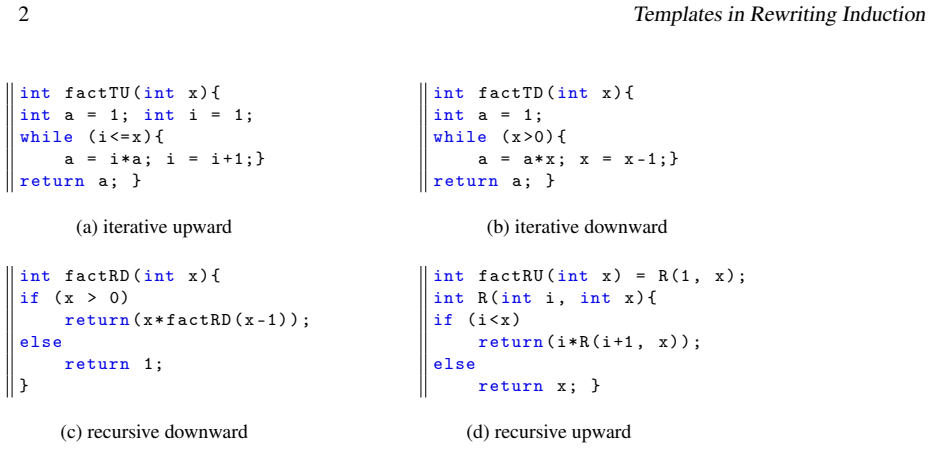
Rewriting Induction (RI) is a formal system in term rewriting to establish program equivalence. The recently defined Bounded RI for higher-order Logically Constrained Term Rewriting Systems (LCSTRSs) yields a convenient proof system for analyzing real programming code. A practical challenge in RI is the automatic generation of induction hypotheses, called lemmas. While various lemma generation techniques exist for plain term rewriting, there are much fewer that consider the intricacies brought on by calculations or constraints. Taking advantage of recent developments in higher-order RI, we here present a new approach based on templates, which operates by recognising typical programming constructs as instances of higher-order functions. While templates have been used as a stand-alone method to justify the correctness of program transformations, we here consider their integration in Bounded RI to obtain a complementary lemma generation heuristic. This allows us to prove equivalences that were previously out of reach.
Editorial analysis
A structured set of objections, weighed in public.
Referee Report
Summary. The manuscript proposes integrating template-based recognition of common programming constructs as instances of higher-order functions into Bounded Rewriting Induction (RI) for higher-order Logically Constrained Term Rewriting Systems (LCSTRSs). Templates, previously used standalone to justify program transformations, are repurposed here as a complementary heuristic for automatic generation of induction lemmas (hypotheses). The central claim is that this integration enables proofs of program equivalences that were previously unreachable within the Bounded RI framework.
Significance. If the template integration is shown to be sound and to produce useful lemmas without introducing new proof obligations or missing critical cases, the work could meaningfully extend the practical reach of automated equivalence proofs for real programming code. It builds on existing higher-order RI developments and template techniques without claiming a fully new proof system, positioning the contribution as an engineering-level heuristic that addresses the known bottleneck of lemma generation in RI.
major comments (2)
- [Abstract] The abstract asserts that the template approach 'allows us to prove equivalences that were previously out of reach,' yet the manuscript provides no concrete examples, case studies, or before/after derivations demonstrating any such newly reachable proof. Without at least one worked example showing a specific LCSTRS equivalence that fails under prior Bounded RI but succeeds with the template heuristic, the central claim cannot be evaluated for effectiveness or soundness.
- [Introduction / Method description] The description of the method as 'recognising typical programming constructs as instances of higher-order functions' to generate lemmas lacks a precise definition of the recognition procedure, the template language, or the conditions under which a construct is safely mapped to a higher-order function. This is load-bearing for the claim of soundness as a complementary heuristic, because any unsound recognition would invalidate the generated induction hypotheses.
minor comments (2)
- The relationship between the new template heuristic and existing lemma-generation techniques for plain term rewriting (mentioned as 'various' but not cited) should be clarified with specific references to prior work on RI lemma generation.
- Notation for LCSTRSs, Bounded RI steps, and the template instances should be introduced with a small running example early in the paper to make the integration concrete for readers unfamiliar with higher-order RI.
Simulated Author's Rebuttal
We thank the referee for the careful reading of the manuscript and the constructive comments. We address each major comment below and will revise the manuscript to incorporate the suggested improvements.
read point-by-point responses
-
Referee: [Abstract] The abstract asserts that the template approach 'allows us to prove equivalences that were previously out of reach,' yet the manuscript provides no concrete examples, case studies, or before/after derivations demonstrating any such newly reachable proof. Without at least one worked example showing a specific LCSTRS equivalence that fails under prior Bounded RI but succeeds with the template heuristic, the central claim cannot be evaluated for effectiveness or soundness.
Authors: We agree that a concrete worked example is necessary to substantiate the central claim. In the revised manuscript we will include at least one fully worked LCSTRS equivalence, showing the proof attempt under standard Bounded RI (which fails) and the successful derivation once the template heuristic supplies the required induction lemma. The example will be placed in the introduction or a new illustrative section, with explicit before/after derivations. revision: yes
-
Referee: [Introduction / Method description] The description of the method as 'recognising typical programming constructs as instances of higher-order functions' to generate lemmas lacks a precise definition of the recognition procedure, the template language, or the conditions under which a construct is safely mapped to a higher-order function. This is load-bearing for the claim of soundness as a complementary heuristic, because any unsound recognition would invalidate the generated induction hypotheses.
Authors: We acknowledge that the current description of the recognition procedure and template language is insufficiently precise. In the revision we will supply a formal definition of the template language, a clear specification of the recognition algorithm (including pseudocode), and explicit conditions under which a programming construct is mapped to a higher-order function. We will also add a short soundness argument showing that the generated lemmas remain valid within the Bounded RI framework. revision: yes
Circularity Check
No significant circularity
full rationale
The paper presents a methodological integration of existing template techniques into Bounded RI for LCSTRSs as a lemma-generation heuristic. No equations, derivations, fitted parameters, or self-referential definitions appear in the provided text. The central claim rests on the soundness of recognizing programming constructs as higher-order function instances, positioned as complementary to prior work without reducing any result to a fit or self-citation chain by construction. The approach is described at a high level with no load-bearing steps that collapse to inputs.
Axiom & Free-Parameter Ledger
Reference graph
Works this paper leans on
-
[1]
Aoto (2006):Dealing with Non-orientable Equations in Rewriting Induction
T. Aoto (2006):Dealing with Non-orientable Equations in Rewriting Induction. In:Proc. RTA 06,LNCS 4098, pp. 242–256, doi:10.1007/11805618_18
-
[2]
Aoto (2008):Designing a rewriting induction prover with an increased capability of non-orientable theo- rems
T. Aoto (2008):Designing a rewriting induction prover with an increased capability of non-orientable theo- rems. In:Proc. SCSS 08, pp. 1–15
2008
-
[3]
Aoto (2008):Soundness of Rewriting Induction Based on an Abstract Principle.Inf
T. Aoto (2008):Soundness of Rewriting Induction Based on an Abstract Principle.Inf. Media Technol.3(2), pp. 225–235, doi:10.11185/IMT.3.225
-
[4]
T. Aoto, N. Nishida & J. Schöpf (2024):Equational Theories and Validity for Logically Constrained Term Rewriting. In:Proc. FSCD 24,LIPIcs299, pp. 31:1–31:21, doi:10.4230/LIPICS.FSCD.2024.31
-
[5]
T. Aoto & Y . Toyama (2016):Ground Confluence Prover based on Rewriting Induction. In:Proc. FSCD 16, LIPIcs52, pp. 33:1–33:12, doi:10.4230/LIPICS.FSCD.2016.33
-
[6]
F. Baader & T. Nipkow (1998):Term rewriting and all that. Cambridge University Press, doi:10.1017/CBO9781139172752
-
[7]
Y . Chiba, T. Aoto & Y . Toyama (2010):Program Transformation Templates for Tupling Based on Term Rewriting.IEICE TRANSACTIONS on Information and SystemsE93-D(5), pp. 963–973, doi:10.1587/transinf.E93.D.963
-
[8]
Rewriting Induction + Linear Arithmetic = Decision Procedure , volume =
S. Falke & D. Kapur (2012):Rewriting Induction + Linear Arithmetic = Decision Procedure. In:Proc. IJCAR 12,LNAI7364, pp. 241–255, doi:10.1007/978-3-642-31365-3_20
-
[9]
C. Fuhs, C. Kop & N. Nishida (2017):Verifying Procedural Programs via Constrained Rewriting Induction. ACM Transactions On Computational Logic (TOCL)18(2), pp. 14:1–14:50, doi:10.1145/3060143
-
[10]
L. Guo, K. Hagens, C Kop & D. Vale (2024):Higher-Order Constrained Dependency Pairs for (Universal) Computability. In:Proc. MFCS 24, pp. 57:1–57:15, doi:10.48550/arXiv.2406.19379
-
[11]
L. Guo & C. Kop (2024):Higher-Order LCTRSs and Their Termination. In:Proc. ESOP 24,LNCS14577, pp. 331–357, doi:10.1007/978-3-031-57267-8_13
-
[12]
Hagens & C Kop (2023):Matrix invariants for program equivalence in LCTRSs
K. Hagens & C Kop (2023):Matrix invariants for program equivalence in LCTRSs. In:Proc. WPTE 23, pp. 2:1–2:13. Available athttps://wpte2023.github.io/paper2.pdf
2023
-
[13]
K. Hagens & C. Kop (2024):Rewriting Induction for Higher-Order Constrained Term Rewriting Systems. In:Proc. LOPSTR 24, 14919, pp. 202–219, doi:10.1007/978-3-031-71294-4_12
-
[14]
K. Hagens & C. Kop (2026):Bounded Rewriting Induction for LCSTRSs. Technical Report, Arxiv, doi:10.48550/arXiv.2601.02803
-
[15]
Kop (2025):COnstrained Rewriting Analyser (CORA)
C. Kop (2025):COnstrained Rewriting Analyser (CORA). Available athttps://github.com/hezzel/ cora. Open-source analysis tool for higher-order constrained term rewriting
2025
-
[16]
C. Kop & N. Nishida (2013):Term Rewriting with Logical Constraints. In:Proc. FroCoS 13,LNAI8152, pp. 343–358, doi:10.1007/978-3-642-40885-4_24
-
[17]
C. Kop & N. Nishida (2015):ConsTrained Rewriting tooL. In:Proc. LPAR 15,LNCS9450, pp. 549–557, doi:10.1007/978-3-662-48899-7_38
-
[18]
C. Kop & F. van Raamsdonk (2012):Dynamic dependency pairs for Algebraic Functional Systems.LMCS 8(2), pp. 1–51, doi:10.2168/LMCS-8(2:10)2012
-
[19]
Kusakari (2001):On Proving Termination of Term Rewriting Systems with Higher-Order Variables.IPSJ Transactions on Programming42(7), pp
K. Kusakari (2001):On Proving Termination of Term Rewriting Systems with Higher-Order Variables.IPSJ Transactions on Programming42(7), pp. 35–45. Available athttp://id.nii.ac.jp/1001/00016864/
2001
-
[20]
K. Kusakari, Y . Isogai, M. Sakai & F. Blanqui (2009):Static Dependency Pair Method based on Strong Computability for Higher-Order Rewrite Systems.IEICE TRANSACTIONS on Information and Systems E92-D(10), pp. 2007–2015, doi:10.1587/transinf.E92.D.2007
-
[21]
Nakabayashi, N
N. Nakabayashi, N. Nishida, K. Kusakari, T. Sakabe & M. Sakai (2010):Lemma Generation Method in Rewriting Induction for Constrained Term Rewriting Systems.Computer Software28(1), pp. 173–189. Avail- able athttps://www.trs.css.i.nagoya-u.ac.jp/crisys/nakabayashi10.pdf. 18Templates in Rewriting Induction
2010
-
[22]
N. Nishida, M. Kojima & T. Kato (2025):Transforming Imperative Programs into bisimilar Logically Con- strained Term Rewrite Systems via Injective Functions from Configurations to Terms.Journal of Logical and Algebraic Methods in Programming145(1), doi:10.1016/j.jlamp.2025.101056. Special issue for WPTE 22
-
[23]
U.S. Reddy (1990):Term Rewriting Induction. In:Proc. CADE ’90,LNCS449, pp. 162–177, doi:10.1007/3- 540-52885-7_86
work page doi:10.1007/3- 1990
-
[24]
K. Sato, K. Kikuchi, T. Aoto & Y . Toyama (2015):Correctness of Context-Moving Transformations for Term Rewriting Systems. In:Proc. LOPSTR 15,LNCS9527, pp. 331–345, doi:10.1007/978-3-319-27436-2_20
-
[25]
J. Schöpf & A. Middeldorp (2023):Confluence Criteria for Logically Constrained Rewrite Systems. In:Proc. CADE 23,LNCS14132, pp. 474–490, doi:10.1007/978-3-031-38499-8_27
discussion (0)
Sign in with ORCID, Apple, or X to comment. Anyone can read and Pith papers without signing in.