Recognition: unknown
Phases and dynamics of an impurity immersed in one-dimensional quantum droplets
Pith reviewed 2026-05-07 10:59 UTC · model grok-4.3
The pith
Tuning impurity interactions with a one-dimensional quantum droplet controls its density profile, correlations, and post-release expansion.
A machine-rendered reading of the paper's core claim, the machinery that carries it, and where it could break.
Core claim
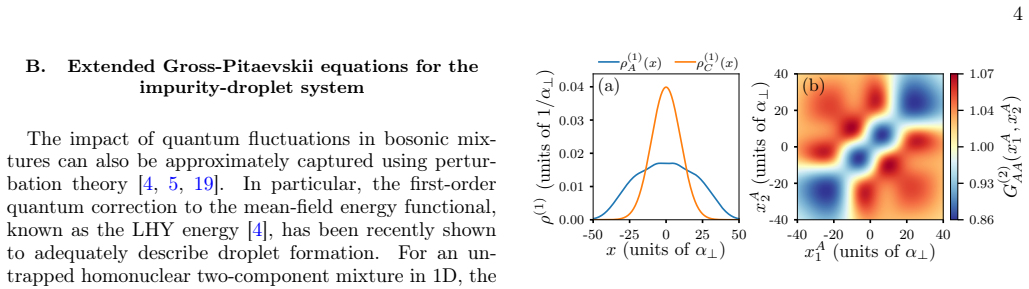
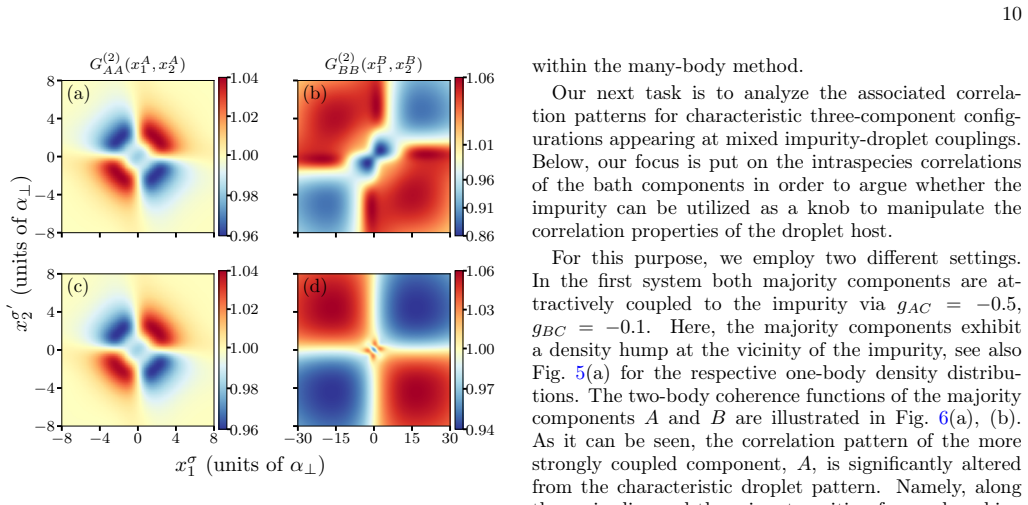
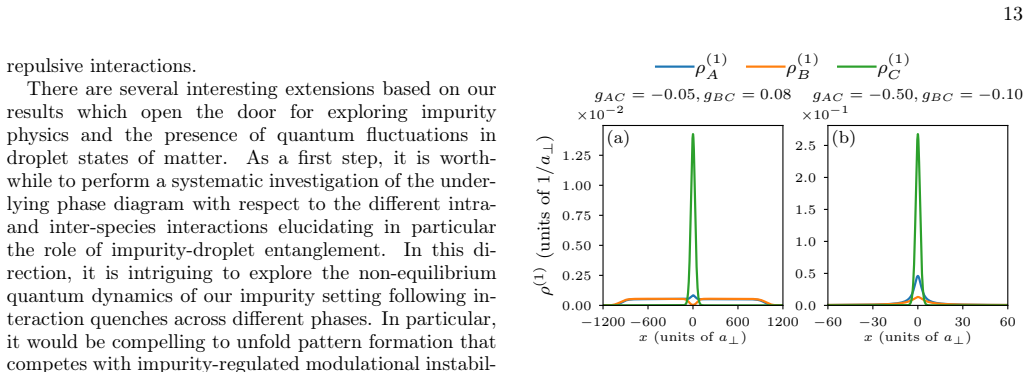
Relying on ab-initio many-body simulations, we demonstrate that tuning the impurity-droplet interactions allows to controllably reshape the droplets density profiles and associated correlation patterns. For attractive impurity-medium couplings, the impurity becomes localized within the droplet which exhibits a density hump at the vicinity of the impurity, while repulsive interactions facilitate their phase-separation. Comparing our many-body results to the appropriate extended Gross-Pitaevskii description, we find adequate agreement for the droplet density profiles, with the effective field approach systematically overestimating impurity localization. Following a release of the external trap
What carries the argument
The tunable sign and strength of the impurity-medium coupling in a three-component one-dimensional Bose system, which governs whether the impurity localizes inside the droplet or phase-separates and whether the mixture remains bound after trap release.
If this is right
- Attractive impurity couplings produce a localized impurity accompanied by a nearby density hump in the droplet.
- Repulsive couplings drive spatial separation between the impurity and the droplet components.
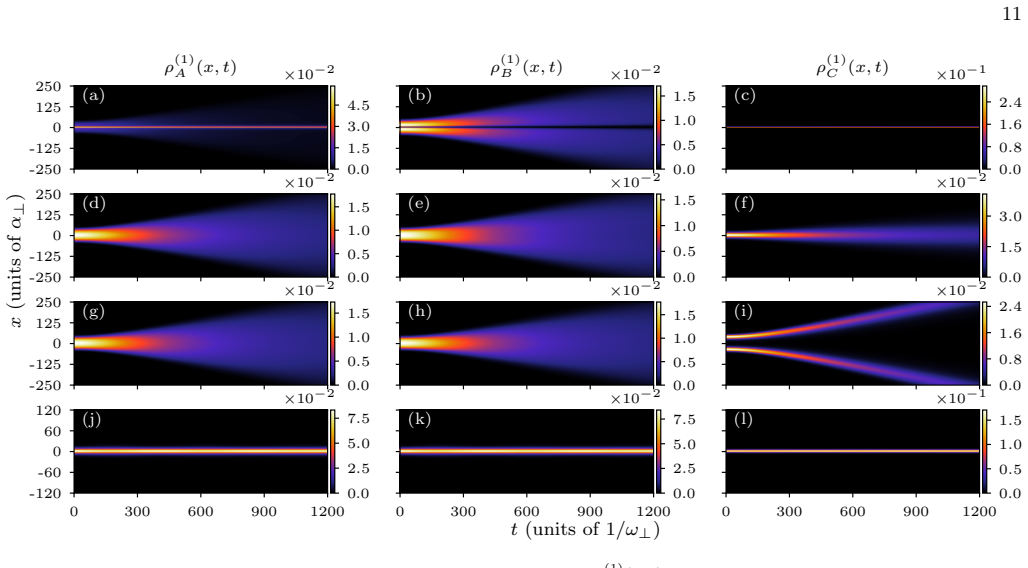
- The overall system expands after trap release except when intercomponent attractions are strongly attractive.
- Many-body correlations reduce the degree of impurity localization relative to the extended Gross-Pitaevskii prediction.
Where Pith is reading between the lines
- Impurity position and density hump measurements could serve as an experimental diagnostic for droplet internal structure.
- The same interaction-tuning approach might be used to stabilize or destabilize droplets in time-dependent protocols.
- Multiple impurities could produce collective effects on droplet shape that go beyond the single-impurity case studied here.
- The expansion threshold identified here provides a concrete target for testing correlation-sensitive theories in other low-dimensional mixtures.
Load-bearing premise
The chosen ab-initio many-body method accurately captures all relevant correlations while the extended Gross-Pitaevskii equation provides a meaningful benchmark without uncontrolled approximations in the one-dimensional droplet regime.
What would settle it
An experiment that measures the impurity position and droplet density for varying interaction strengths and finds either no density hump for attractive couplings or continued expansion even under strongly attractive couplings after trap release would contradict the predicted reshaping and dynamics.
Figures



read the original abstract
We explore the ground-state properties of a single impurity immersed in a one-dimensional quantum droplet medium formed by a two-component Bose mixture. Relying on ab-initio simulations, we demonstrate that tuning the impurity-droplet interactions allows to controllably reshape the droplets density profiles and associated correlation patterns. For attractive impurity-medium couplings, the impurity becomes localized within the droplet which exhibits a density hump at the vicinity of the impurity, while repulsive interactions facilitate their phase-separation. Comparing our many-body results to the appropriate extended Gross-Pitaevskii description, we find adequate agreement for the droplet density profiles, with the effective field approach systematically overestimating impurity localization. Following a release of the external trap, we unveil that the sign and magnitude of the interactions between the impurity and the droplet hosts dictate the response of the three-component setting which experiences expansion unless strongly attractive intercomponent couplings are present. These results corroborate the role and presence of correlations in impurity-droplet mixtures and inspire future investigations on impurity physics for probing droplet configurations.
Editorial analysis
A structured set of objections, weighed in public.
Referee Report
Summary. The manuscript investigates the ground-state properties and post-release dynamics of a single impurity immersed in a one-dimensional quantum droplet formed by a two-component Bose mixture. Using ab-initio many-body simulations, it demonstrates that attractive impurity-droplet couplings localize the impurity within the droplet accompanied by a local density hump, while repulsive couplings induce phase separation. Density profiles show adequate agreement with the extended Gross-Pitaevskii equation, though the latter systematically overestimates impurity localization. Upon trap release, the three-component system expands unless intercomponent couplings are strongly attractive. The work emphasizes the role of correlations in shaping droplet responses.
Significance. If the numerical findings hold, the results establish impurity interactions as a controllable knob for reshaping 1D quantum droplet profiles and correlation patterns, while quantifying the limitations of the extended GPE in capturing localization. This provides a benchmark for beyond-mean-field effects in low-dimensional Bose mixtures and suggests impurities as probes for droplet stability, with potential relevance to quantum simulation experiments.
major comments (2)
- [Methods and Results sections] The abstract states that ab-initio many-body simulations are employed and that they agree adequately with the extended GPE for density profiles, yet no details are provided on the specific method (e.g., DMRG, exact diagonalization), system sizes, convergence criteria, or error bars on the reported profiles and correlations. This information is load-bearing for assessing whether the observed trends (localization vs. phase separation) and the systematic GPE overestimation are robust.
- [Dynamics subsection] The dynamical claims after trap release—that the system expands unless intercomponent couplings are strongly attractive—are presented without quantitative measures of expansion rates, density evolution, or comparison to GPE dynamics. Without these, it is difficult to evaluate how decisively the sign and magnitude of couplings dictate the response.
minor comments (2)
- [Abstract] The abstract refers to a 'three-component setting' without explicitly clarifying that this consists of the two droplet components plus the impurity; a brief parenthetical would improve clarity for readers unfamiliar with the setup.
- [Introduction and Results] Notation for the impurity-medium coupling strengths (attractive vs. repulsive) should be defined consistently with any equations or figures in the main text to avoid ambiguity when comparing many-body and GPE results.
Simulated Author's Rebuttal
We thank the referee for their careful reading of our manuscript and for the constructive comments, which have helped us improve the clarity and completeness of the presentation. We address each major comment below and have revised the manuscript accordingly.
read point-by-point responses
-
Referee: [Methods and Results sections] The abstract states that ab-initio many-body simulations are employed and that they agree adequately with the extended GPE for density profiles, yet no details are provided on the specific method (e.g., DMRG, exact diagonalization), system sizes, convergence criteria, or error bars on the reported profiles and correlations. This information is load-bearing for assessing whether the observed trends (localization vs. phase separation) and the systematic GPE overestimation are robust.
Authors: We agree that additional methodological details are required for a proper assessment of the results. The ab-initio simulations were performed with the density-matrix renormalization group (DMRG) method. In the revised manuscript we have added a dedicated 'Numerical Methods' subsection that specifies the lattice sizes employed (up to 200 sites), maximum bond dimensions (up to 300), energy convergence threshold (10^{-10}), and the procedure used to estimate error bars on densities and correlations from truncation error and independent runs with varied initial states. These additions allow the reader to evaluate the robustness of the localization, phase-separation, and GPE-comparison trends. revision: yes
-
Referee: [Dynamics subsection] The dynamical claims after trap release—that the system expands unless intercomponent couplings are strongly attractive—are presented without quantitative measures of expansion rates, density evolution, or comparison to GPE dynamics. Without these, it is difficult to evaluate how decisively the sign and magnitude of couplings dictate the response.
Authors: We acknowledge that quantitative characterization of the post-release dynamics strengthens the claims. The revised manuscript now includes explicit measures of expansion: the time-dependent root-mean-square width of each component and the asymptotic expansion velocity obtained from linear fits at late times. We also present direct side-by-side comparisons of the many-body and extended-GPE density profiles at selected evolution times. These data appear in an updated Figure 4 together with accompanying text in the Dynamics subsection, making the dependence on the sign and strength of the couplings quantitatively clear. revision: yes
Circularity Check
No significant circularity detected
full rationale
The paper is entirely simulation-driven: it reports ab-initio many-body results for an impurity immersed in a 1D quantum droplet, with interaction strengths treated as externally tuned parameters. Density profiles, localization, phase separation, and post-release dynamics are direct numerical outputs, benchmarked against the extended Gross-Pitaevskii equation. No load-bearing step reduces by construction to a fitted input, self-definition, or self-citation chain; the derivation chain consists of standard numerical methods whose validity is assessed by internal consistency and comparison rather than by re-deriving the inputs.
Axiom & Free-Parameter Ledger
axioms (2)
- domain assumption The many-body Schrödinger equation for the three-component 1D Bose system with contact interactions accurately describes the physics.
- domain assumption The extended Gross-Pitaevskii equation provides a controlled mean-field benchmark for the droplet-impurity system.
Reference graph
Works this paper leans on
-
[1]
Z.-H. Luo, W. Pang, B. Liu, Y.-Y. Li, and B. A. Mal- omed, A new form of liquid matter: Quantum droplets, Front. Phys.16, 1 (2021)
2021
-
[2]
Böttcher, J.-N
F. Böttcher, J.-N. Schmidt, J. Hertkorn, K. S. H. N g, S. D. Graham, M. Guo, T. Langen, and T. Pfau, New states of matter with fine-tuned interactions: quantum droplets and dipolar supersolids, Rep. Progr. Phys.84, 012403 (2020)
2020
-
[3]
Mistakidis, A
S. Mistakidis, A. Volosniev, R. Barfknecht, T. Fogarty, T. Busch, A. Foerster, P. Schmelcher, and N. Zinner, Few-body Bose gases in low dimensions—a laboratory for quantum dynamics, Phys. Rep.1042, 1 (2023). 15
2023
-
[4]
D. S. Petrov, Quantum mechanical stabilization of a col- lapsing Bose-Bose mixture, Phys. Rev. Lett.115, 155302 (2015)
2015
-
[5]
D. S. Petrov and G. E. Astrakharchik, Ultradilute low- dimensional liquids, Phys. Rev. Lett.117, 100401 (2016)
2016
-
[6]
Ferrier-Barbut, H
I. Ferrier-Barbut, H. Kadau, M. Schmitt, M. Wenzel, and T. Pfau, Observation of quantum droplets in a strongly dipolar Bose gas, Phys. Rev. Lett.116, 215301 (2016)
2016
-
[7]
Chomaz, I
L. Chomaz, I. Ferrier-Barbut, F. Ferlaino, B. Laburthe- Tolra, B. L. Lev, and T. Pfau, Dipolar physics: a re- view of experiments with magnetic quantum gases, Rep. Progr. Phys.86, 026401 (2022)
2022
-
[8]
C. R. Cabrera, L. Tanzi, J. Sanz, B. Naylor, P. Thomas, P. Cheiney, and L. Tarruell, Quantum liquid droplets in a mixture of Bose-Einstein condensates, Science359, 301 (2018)
2018
-
[9]
Cheiney, C
P. Cheiney, C. R. Cabrera, J. Sanz, B. Naylor, L. Tanzi, and L. Tarruell, Bright soliton to quantum droplet tran- sition in a mixture of Bose-Einstein condensates, Phys. Rev. Lett.120, 135301 (2018)
2018
-
[10]
Semeghini, G
G. Semeghini, G. Ferioli, L. Masi, C. Mazzinghi, L. Wol- swijk, F. Minardi, M. Modugno, G. Modugno, M. In- guscio, and M. Fattori, Self-bound quantum droplets of atomic mixtures in free space, Phys. Rev. Lett.120, 235301 (2018)
2018
-
[11]
Z. Guo, F. Jia, L. Li, Y. Ma, J. M. Hutson, X. Cui, and D. Wang, Lee-Huang-Yang effects in the ultracold mixture of 23Naand 87Rbwith attractive interspecies interactions, Phys. Rev. Research3, 033247 (2021)
2021
-
[12]
D’Errico, A
C. D’Errico, A. Burchianti, M. Prevedelli, L. Salasnich, F. Ancilotto, M. Modugno, F. Minardi, and C. Fort, Ob- servation of quantum droplets in a heteronuclear bosonic mixture, Phys. Rev. Research1, 033155 (2019)
2019
-
[13]
Cavicchioli, C
L. Cavicchioli, C. Fort, F. Ancilotto, M. Modugno, F. Mi- nardi, and A. Burchianti, Dynamical formation of multi- ple quantum droplets in a Bose-Bose mixture, Phys. Rev. Lett.134, 093401 (2025)
2025
-
[14]
T. D. Lee, K. Huang, and C. N. Yang, Eigenvalues and eigenfunctions of a Bose system of hard spheres and its low-temperatureproperties,Phys.Rev.106,1135(1957)
1957
-
[15]
P. Zin, M. Pylak, T. Wasak, M. Gajda, and Z. Idziaszek, Quantum Bose-Bose droplets at a dimensional crossover, Phys. Rev. A98, 051603 (2018)
2018
-
[16]
T. Ilg, J. Kumlin, L. Santos, D. S. Petrov, and H. P. Büchler,Dimensionalcrossoverforthebeyond-mean-field correction in Bose gases, Phys. Rev. A98, 051604 (2018)
2018
-
[17]
J. C. Pelayo, G. Bougas, T. Fogarty, T. Busch, and S. I. Mistakidis, Phases and dynamics of quantum droplets in the crossover to two-dimensions, SciPost Phys.18, 129 (2025)
2025
- [18]
-
[19]
I. A. Englezos, P. Schmelcher, and S. I. Mistakidis, Multi- component one-dimensional quantum droplets across the mean-field stability regime, SciPost Phys.19, 133 (2025)
2025
-
[20]
G. E. Astrakharchik and B. A. Malomed, Dynamics of one-dimensional quantum droplets, Phys. Rev. A98, 013631 (2018)
2018
-
[21]
I. A. Englezos, P. Schmelcher, and S. I. Mistakidis, Particle-imbalancedweaklyinteractingquantumdroplets in one dimension, Phys. Rev. A110, 023324 (2024)
2024
-
[22]
Y. V. Kartashov and D. A. Zezyulin, Multipole quantum droplets in quasi-one-dimensional asymmetric mixtures, Phys. Rev. A110, L021304 (2024)
2024
- [23]
-
[24]
T. A. Flynn, L. Parisi, T. P. Billam, and N. G. Parker, Quantum droplets in imbalanced atomic mixtures, Phys. Rev. Research5, 033167 (2023)
2023
-
[25]
Flynn, N
T. Flynn, N. Keepfer, N. Parker, and T. Billam, Har- monically trapped imbalanced quantum droplets, Phys. Rev. Research6, 013209 (2024)
2024
-
[26]
J. C. Pelayo, G. A. Bougas, T. Fogarty, T. Busch, and S. I. Mistakidis, Droplet-gas phases and their dynamical formation in particle imbalanced mixtures, Quant. Sci. Techn.10, 045074 (2025)
2025
-
[27]
Tylutki, G
M. Tylutki, G. E. Astrakharchik, B. A. Malomed, and D. S. Petrov, Collective excitations of a one-dimensional quantum droplet, Phys. Rev. A101, 051601 (2020)
2020
-
[28]
G. C. Katsimiga, S. I. Mistakidis, G. N. Koutsokostas, D. J. Frantzeskakis, R. Carretero-González, and P. G. Kevrekidis, Solitary waves in a quantum droplet-bearing system, Phys. Rev. A107, 063308 (2023)
2023
-
[29]
E. G. Charalampidis and S. I. Mistakidis, Two- component droplet phases and their spectral stability in one dimension, Phys. Rev. A111, 013318 (2025)
2025
-
[30]
Y. Li, Z. Chen, Z. Luo, C. Huang, H. Tan, W. Pang, and B. A. Malomed, Two-dimensional vortex quantum droplets, Phys. Rev. A98, 063602 (2018)
2018
-
[31]
T. A. Yoğurt, U. Tanyeri, A. Keleş, and M. O. Oktel, Vortex lattices in strongly confined quantum droplets, Phys. Rev. A108, 033315 (2023)
2023
-
[32]
M. N. Tengstrand, P. Stürmer, E. O. Karabulut, and S. M. Reimann, Rotating binary Bose-Einstein conden- sates and vortex clusters in quantum droplets, Phys. Rev. Lett.123, 160405 (2019)
2019
-
[33]
Bougas, G
G. Bougas, G. C. Katsimiga, P. G. Kevrekidis, and S. I. Mistakidis, Stability and dynamics of nonlinear excita- tions in a two-dimensional droplet-bearing environment, Phys. Rev. A110, 033317 (2024)
2024
-
[34]
Chandramouli, S
S. Chandramouli, S. I. Mistakidis, G. C. Katsimiga, and P. G. Kevrekidis, Dispersive shock waves in a one- dimensional droplet-bearing environment, Phys. Rev. A 110, 023304 (2024)
2024
-
[35]
Chandramouli, S
S. Chandramouli, S. I. Mistakidis, G. C. Katsimiga, D. J. Ratliff, D. J. Frantzeskakis, and P. G. Kevrekidis, Rogue waves in extended Gross-Pitaevskii models with a Lee-Huang-Yang correction, Phys. Rev. A113, 013308 (2026)
2026
-
[36]
Mithun, A
T. Mithun, A. Maluckov, K. Kasamatsu, B. A. Malomed, and A. Khare, Modulational instability, inter-component asymmetry, and formation of quantum droplets in one- dimensionalbinaryBosegases,Symmetry12,174(2020)
2020
-
[37]
S. R. Otajonov, E. N. Tsoy, and F. K. Abdullaev, Mod- ulational instability and quantum droplets in a two- dimensional Bose-Einstein condensate, Phys. Rev. A 106, 033309 (2022)
2022
-
[38]
Y. V. Kartashov, V. M. Lashkin, M. Modugno, and L. Torner, Spinor-induced instability of kinks, holes and quantum droplets, New J. Phys.24, 073012 (2022)
2022
-
[39]
G. C. Katsimiga, S. I. Mistakidis, B. A. Mal- omed, D. J. Frantzeskakis, R. Carretero-Gonzalez, and P. G. Kevrekidis, Interactions and dynamics of one- dimensional droplets, bubbles and kinks, Condensed Matter8, 67 (2023). 16
2023
-
[40]
S. I. Mistakidis, G. Bougas, G. C. Katsimiga, and P. G. Kevrekidis,Generictransversestabilityofkinkstructures in atomic and optical nonlinear media with competing at- tractive and repulsive interactions, Phys. Rev. Lett.134, 123402 (2025)
2025
-
[41]
Parisi and S
L. Parisi and S. Giorgini, Quantum droplets in one- dimensional Bose mixtures: A quantum monte carlo study, Phys. Rev. A102, 023318 (2020)
2020
-
[42]
Parisi, G
L. Parisi, G. E. Astrakharchik, and S. Giorgini, Liq- uid state of one-dimensional Bose mixtures: A quantum monte carlo study, Phys. Rev. Lett.122, 105302 (2019)
2019
-
[44]
I. A. Englezos, S. I. Mistakidis, and P. Schmelcher, Corre- lated dynamics of collective droplet excitations in a one- dimensional harmonic trap, Phys. Rev. A107, 023320 (2023)
2023
-
[45]
Hu and X.-J
H. Hu and X.-J. Liu, Consistent theory of self-bound quantum droplets with bosonic pairing, Phys. Rev. Lett. 125, 195302 (2020)
2020
-
[46]
Gu and L
Q. Gu and L. Yin, Phonon stability and sound velocity of quantum droplets in a boson mixture, Phys. Rev. B 102, 220503 (2020)
2020
-
[47]
J. Pan, S. Yi, and T. Shi, Quantum phases of self-bound droplets of Bose-Bose mixtures, Phys. Rev. Research4, 043018 (2022)
2022
-
[48]
Ota and G
M. Ota and G. E. Astrakharchik, Beyond Lee-Huang- Yang description of self-bound Bose mixtures, SciPost Phys.9, 020 (2020)
2020
- [49]
-
[50]
Y. Ma, C. Peng, and X. Cui, Borromean droplet in three- component ultracold Bose gases, Phys. Rev. Lett.127, 043002 (2021)
2021
-
[51]
Ma and X
Y. Ma and X. Cui, Shell-shaped quantum droplet in a three-component ultracold Bose gas, Phys. Rev. Lett. 134, 043402 (2025)
2025
-
[52]
Scazza, M
F. Scazza, M. Zaccanti, P. Massignan, M. M. Parish, and J. Levinsen, Repulsive Fermi and Bose polarons in quan- tum gases, Atoms10, 55 (2022)
2022
-
[53]
Grusdt, N
F. Grusdt, N. Mostaan, E. Demler, and L. A. P. Ardila, Impurities and polarons in bosonic quantum gases: a re- view on recent progress, Rep. Progr. Phys.88, 066401 (2025)
2025
-
[54]
Sinha, S
S. Sinha, S. Biswas, L. Santos, and S. Sinha, Impurities in quasi-one-dimensional droplets of binary Bose mixtures, Phys. Rev. A108, 023311 (2023)
2023
-
[55]
F. K. Abdullaev and R. Galimzyanov, Bosonic impurity in a one-dimensional quantum droplet in the Bose–Bose mixture, J. Phys. B: At., Mol. and Opt. Phys.53, 165301 (2020)
2020
-
[56]
Bighin, A
G. Bighin, A. Burchianti, F. Minardi, and T. Macrì, Im- purity in a heteronuclear two-component Bose mixture, Phys. Rev. A106, 023301 (2022)
2022
-
[57]
Debnath, A
A. Debnath, A. Khan, and B. Malomed, Interaction of one-dimensional quantum droplets with potential wells and barriers, Commun. Nonlinear Sci. Numer. Simul. 126, 107457 (2023)
2023
-
[58]
Bristy, G
F. Bristy, G. Bougas, G. Katsimiga, and S. Mistakidis, Localization and splitting of a quantum droplet with a potential defect, Chaos, Solitons & Fractals201, 117383 (2025)
2025
-
[59]
Wenzel, T
M. Wenzel, T. Pfau, and I. Ferrier-Barbut, A fermionic impurity in a dipolar quantum droplet, Phys. Scripta93, 104004 (2018)
2018
-
[60]
J. C. Pelayo, T. Fogarty, T. Busch, and S. I. Mistakidis, Phases and dynamics of few fermionic impurities im- mersed in two-dimensional boson droplets, Phys. Rev. Research6, 033219 (2024)
2024
-
[61]
L. Cao, S. Krönke, O. Vendrell, and P. Schmelcher, The multi-layer multi-configuration time-dependent Hartree method for bosons: Theory, implementation, and appli- cations, J. Chem. Phys.139, 134103 (2013)
2013
-
[62]
L. Cao, V. Bolsinger, S. I. Mistakidis, G. M. Koutentakis, S. Krönke, J. M. Schurer, and P. Schmelcher, A unified ab initio approach to the correlated quantum dynamics of ultracold fermionic and bosonic mixtures, J. Chem. Phys.147, 044106 (2017)
2017
-
[63]
C. J. Pethick and H. Smith,Bose–Einstein Condensation in Dilute Gases, 2nd ed. (Cambridge University Press, 2008)
2008
-
[64]
Görlitz, J
A. Görlitz, J. M. Vogels, A. E. Leanhardt, C. Raman, T. L. Gustavson, J. R. Abo-Shaeer, A. P. Chikkatur, S. Gupta, S. Inouye, T. Rosenband, and W. Ketterle, Realization of Bose-Einstein condensates in lower dimen- sions, Phys. Rev. Lett.87, 130402 (2001)
2001
-
[65]
Romero-Ros, G
A. Romero-Ros, G. C. Katsimiga, S. I. Mistakidis, S. Mossman, G. Biondini, P. Schmelcher, P. Engels, and P. G. Kevrekidis, Experimental realization of the pere- grine soliton in repulsive two-component Bose-Einstein condensates, Phys. Rev. Lett.132, 033402 (2024)
2024
-
[66]
Köhler, K
T. Köhler, K. Góral, and P. S. Julienne, Production of cold molecules via magnetically tunable Feshbach reso- nances, Rev. Mod. Phys.78, 1311 (2006)
2006
-
[67]
C. Chin, R. Grimm, P. Julienne, and E. Tiesinga, Fesh- bach resonances in ultracold gases, Rev. Mod. Phys.82, 1225 (2010)
2010
-
[68]
Olshanii, Atomic scattering in the presence of an ex- ternal confinement and a gas of impenetrable bosons, Phys
M. Olshanii, Atomic scattering in the presence of an ex- ternal confinement and a gas of impenetrable bosons, Phys. Rev. Lett.81, 938 (1998)
1998
-
[69]
J.I.Kim, V.S.Melezhik,andP.Schmelcher,Suppression ofquantumscatteringinstronglyconfinedsystems,Phys. Rev. Lett.97, 193203 (2006)
2006
-
[70]
Krönke, L
S. Krönke, L. Cao, O. Vendrell, and P. Schmelcher, Non-equilibrium quantum dynamics of ultra-cold atomic mixtures: The multi-layer multi-configuration time- dependent Hartree method for bosons, New J. Phys.15, 063018 (2013)
2013
-
[71]
A. U. J. Lode, C. Lévêque, L. B. Madsen, A. I. Streltsov, and O. E. Alon, Colloquium: Multiconfigurational time- dependent hartree approaches for indistinguishable par- ticles, Rev. Mod. Phys.92, 011001 (2020)
2020
-
[72]
Vidal and R
G. Vidal and R. F. Werner, Computable measure of en- tanglement, Phys. Rev. A65, 032314 (2002)
2002
-
[73]
Theel, S
F. Theel, S. I. Mistakidis, and P. Schmelcher, Crossover from attractive to repulsive induced interactions and bound states of two distinguishable Bose polarons, Sci- Post Phys.16, 023 (2024)
2024
-
[74]
Theel, S
F. Theel, S. I. Mistakidis, and P. Schmelcher, Effec- tive approaches to the dynamical properties of two dis- tinguishable Bose polarons, Phys. Rev. A111, 013306 (2025)
2025
-
[75]
Frenkel, Wave mechanics; elementary theory (1934)
J. Frenkel, Wave mechanics; elementary theory (1934). 17
1934
-
[76]
Pitaevskii and S
L. Pitaevskii and S. Stringari,Bose-Einstein Conden- sation, International Series of Monographs on Physics (Clarendon Press, 2003)
2003
-
[77]
Sakmann, A
K. Sakmann, A. I. Streltsov, O. E. Alon, and L. S. Cederbaum, Reduced density matrices and coherence of trapped interacting bosons, Phys. Rev. A78, 023615 (2008)
2008
-
[78]
S. I. Mistakidis, G. C. Katsimiga, P. G. Kevrekidis, and P. Schmelcher, Correlation effects in the quench-induced phase separation dynamics of a two species ultracold quantum gas, New J. Phys.20, 043052 (2018)
2018
-
[79]
Naraschewski and R
M. Naraschewski and R. J. Glauber, Spatial coherence and density correlations of trapped Bose gases, Phys. Rev. A59, 4595 (1999)
1999
-
[80]
Endres, M
M. Endres, M. Cheneau, T. Fukuhara, C. Weitenberg, P. Schauß, C. Gross, L. Mazza, M. C. Bañuls, L. Pol- let, I. Bloch, and S. Kuhr, Single-site- and single-atom- resolved measurement of correlation functions, Appl. Phys. B113, 27 (2013)
2013
-
[81]
P. E. S. Tavares, A. R. Fritsch, G. D. Telles, M. S. Hus- sein, F. Impens, R. Kaiser, and V. S. Bagnato, Matter wave speckle observed in an out-of-equilibrium quantum fluid, Proc. Natl. Acad. Sci.114, 12691 (2017)
2017
discussion (0)
Sign in with ORCID, Apple, or X to comment. Anyone can read and Pith papers without signing in.