Recognition: unknown
aim2dat: A Python infrastructure for automated ab initio material modeling and data analysis
Pith reviewed 2026-05-07 10:56 UTC · model grok-4.3
The pith
The aim2dat Python package automates generation and analysis of large datasets from density functional theory calculations in materials research.
A machine-rendered reading of the paper's core claim, the machinery that carries it, and where it could break.
Core claim
The authors introduce aim2dat, a Python package offering a user-friendly interface to generate and handle big data, design high-throughput workflows based on density functional theory calculations, and analyze the output, with key features that include interfaces to online databases for structure query and analysis, high-throughput screening routines, and seamless integration of machine learning models, as demonstrated in use-cases ranging from photocathode materials to metal-organic frameworks.
What carries the argument
The aim2dat Python package, which serves as the central infrastructure linking database queries, automated density functional theory workflows, and machine learning analysis for material data handling.
If this is right
- High-throughput screening of material candidates can proceed with reduced need for custom scripting.
- Structures and properties from online databases become directly accessible inside the same analysis environment.
- Machine learning models can be applied to the output of density functional theory runs without separate data export steps.
- Researchers can apply the same infrastructure to problems such as photocathode design and metal-organic framework studies.
Where Pith is reading between the lines
- Shared use of the package across groups could reduce duplicated effort in building similar automation scripts.
- Standardized data flows from the toolkit might improve consistency when combining results from different studies.
- The same structure could later support additional simulation methods beyond the current density functional theory focus.
Load-bearing premise
The package interfaces to databases, density functional theory workflows, and machine learning models operate reliably and require little user customization in practice.
What would settle it
A researcher setting up and running one of the paper's use-case workflows, such as high-throughput screening for photocathode materials, and checking whether the full process completes with consistent outputs on standard hardware.
Figures


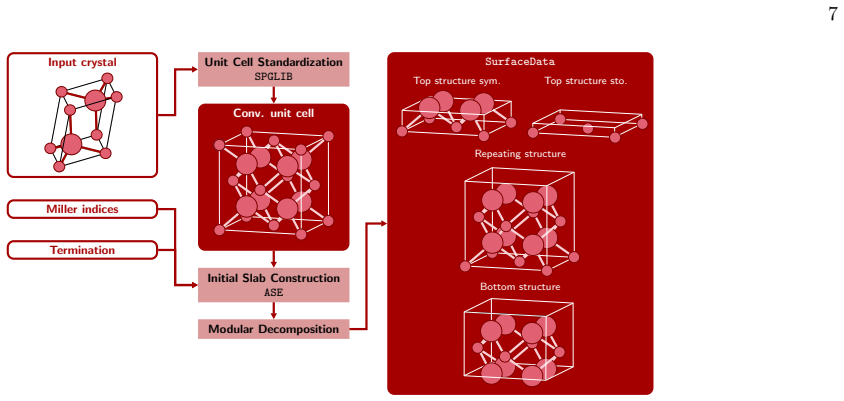


read the original abstract
The emergence of data-driven computational materials science offers unprecedented opportunities to explore complex material landscapes, complementing experimental research with the discovery of novel compounds. To enable these developments, it is essential to establish robust, reliable, and easy-to-use software supporting workflow automation and large dataset processing. Herein, we introduce the Automated Ab Initio Materials Modeling and Data Analysis Toolkit (aim2dat), a Python package offering a user-friendly interface to generate and handle big data, design high-throughput workflows based on density functional theory calculations, and analyze the output. Its key features include interfaces to online databases for structure query and analysis, high-throughput screening routines, and seamless integration of machine learning models. The capabilities of aim2dat are showcased with a variety of use-cases, ranging from photocathode materials to metal-organic frameworks.
Editorial analysis
A structured set of objections, weighed in public.
Referee Report
Summary. The paper introduces the Automated Ab Initio Materials Modeling and Data Analysis Toolkit (aim2dat), a Python package providing a user-friendly interface to generate and handle large datasets, design high-throughput DFT-based workflows, query and analyze structures from online databases, and integrate machine learning models. Capabilities are illustrated via use-cases on photocathode materials and metal-organic frameworks.
Significance. If the described interfaces and workflows prove robust in practice, aim2dat could meaningfully lower barriers to high-throughput computational materials discovery by unifying database access, automated screening, and ML post-processing within a single Python framework. This addresses a genuine need for reproducible automation in the field.
major comments (2)
- [Abstract and key-features section] Abstract and key-features section: the central claims that the package offers 'robust, reliable, and easy-to-use' database interfaces, high-throughput DFT routines, and 'seamless' ML integration are load-bearing but unsupported by any systematic validation, quantitative benchmarks, failure-mode analysis, API-stability tests, or head-to-head comparisons against established packages (ASE, pymatgen, atomate).
- [Use-cases section] Use-cases section: only illustrative examples are presented for photocathodes and MOFs; no performance metrics, error rates, or edge-case handling data are reported, leaving the practical reliability of the claimed workflows unverified.
minor comments (2)
- The manuscript would benefit from a dedicated methods or implementation subsection detailing error handling, dependency management, and testing procedures.
- Consider adding a feature-comparison table against similar tools to clarify the novel contributions of aim2dat.
Simulated Author's Rebuttal
We thank the referee for the constructive feedback and positive view of aim2dat's potential. We address the major comments point by point below, proposing targeted revisions to the manuscript.
read point-by-point responses
-
Referee: [Abstract and key-features section] Abstract and key-features section: the central claims that the package offers 'robust, reliable, and easy-to-use' database interfaces, high-throughput DFT routines, and 'seamless' ML integration are load-bearing but unsupported by any systematic validation, quantitative benchmarks, failure-mode analysis, API-stability tests, or head-to-head comparisons against established packages (ASE, pymatgen, atomate).
Authors: We agree that the abstract and key-features section assert robustness, reliability, ease of use, and seamless integration without systematic validation, benchmarks, failure-mode analysis, API-stability tests, or direct comparisons to ASE, pymatgen, or atomate. The manuscript is an introduction to the toolkit, with use-cases as demonstrations. In the revised manuscript we will moderate the language in the abstract and key-features section to describe the provided interfaces and workflows more precisely. We will add a new subsection on design choices, development testing, known limitations, and a qualitative feature-comparison table versus ASE, pymatgen, and atomate. Full quantitative benchmarks and head-to-head tests remain outside the scope of this introductory paper and are planned for follow-up work. revision: yes
-
Referee: [Use-cases section] Use-cases section: only illustrative examples are presented for photocathodes and MOFs; no performance metrics, error rates, or edge-case handling data are reported, leaving the practical reliability of the claimed workflows unverified.
Authors: The use-cases on photocathodes and MOFs are presented as illustrative demonstrations of aim2dat's capabilities rather than exhaustive validations. We acknowledge the absence of performance metrics, error rates, and edge-case data. In the revised manuscript we will expand the use-cases section to report the scale of datasets processed, basic runtime observations where available, and a discussion of challenges encountered during implementation together with their resolutions. This will give readers a clearer view of practical workflow behavior. revision: yes
Circularity Check
No circularity: software description paper with no derivations or predictions
full rationale
The paper introduces and describes a Python software package (aim2dat) for DFT workflows, database interfaces, and ML integration. It contains no mathematical derivations, equations, predictions, fitted parameters, or uniqueness theorems. All content is architectural description plus illustrative use-cases; no load-bearing claim reduces to its own inputs by construction or self-citation. This is the normal non-circular outcome for infrastructure papers.
Axiom & Free-Parameter Ledger
Reference graph
Works this paper leans on
-
[1]
Data Mining, Generation & Curation (strct Sub-package) Interface to online resources and crystal generation algorithms: Materials Project MOFXDB Parallel infrastructure to curate and identify duplicate crystalline or molecular structures
-
[2]
Modular and adaptable design via protocols
High-Throughput Screening (wfl Sub-package) Automation of calculations and complex workflows. Modular and adaptable design via protocols. Driven via: 3a. Structural Analysis (strct Sub-package) Containers to handle datasets of crystals and molecules. Parallel infrastructure to analyse, manipulate and compare crys- tals and molecules. 3b. Data An...
-
[3]
Metal node substitution
-
[4]
MultipleWorkflowBuilder AiiDAworkflow based on the protocol for MOFs using CP2K with the PBE+D3 functional
Ligand functionalization. MultipleWorkflowBuilder AiiDAworkflow based on the protocol for MOFs using CP2K with the PBE+D3 functional. Structure&StructureOperations
-
[5]
Average bond lengths
-
[6]
brute-force
Average dihedral angle. Visualization 1.SimplePlot. 2.PartialChargesPlot. 3.BandStructureDOSPlot. StructureCollectionobject Input nodes inAiiDAdatabase Output nodes inAiiDAdatabase a) b) c) d) e) f ) FIG. 4. Automated structural and electronic analysis of MOF and ZIF derivatives. (a) Schematic of theaim 2datconstruction workflow for functionalized MOF der...
-
[7]
Cheng, R
L. Cheng, R. S. Assary, X. Qu, A. Jain, S. P. Ong, N. N. Rajput, K. Persson, and L. A. Curtiss, Accel- erating electrolyte discovery for energy storage with high-throughput screening, J. Phys. Chem. Lett.6, 283 (2015)
2015
-
[8]
Benayad, D
A. Benayad, D. Diddens, A. Heuer, A. N. Krishnamoor- thy, M. Maiti, F. L. Cras, M. Legallais, F. Rahmanian, Y. Shin, H. Stein,et al., High-throughput experimen- tation and computational freeway lanes for accelerated battery electrolyte and interface development research, Adv. Energy Mater.12, 2102678 (2022)
2022
-
[9]
Y. Lim, H. Park, A. Walsh, and J. Kim, Accelerat- ing CO2 direct air capture screening for metal-organic frameworks with a transferable machine learning force field, Matter8, 102203 (2025)
2025
-
[10]
J. Wu, L. Torresi, M. Hu, P. Reiser, J. Zhang, J. S. Rocha-Ortiz, L. Wang, Z. Xie, K. Zhang, B.-w. Park, A. Barabash, Y. Zhao, J. Luo, Y. Wang, L. L¨ uer, L.- L. Deng, J. A. Hauch, D. M. Guldi, M. E. P´ erez-Ojeda, S. I. Seok, P. Friederich, and C. J. Brabec, Inverse design workflow discovers hole-transport materials tailored for perovskite solar cells, S...
2024
-
[11]
A. S. Rosen, J. M. Notestein, and R. Q. Snurr, Identi- fying promising metal–organic frameworks for hetero- geneous catalysis via high-throughput periodic density functional theory, J. Comput. Chem.40, 1305 (2019), https://onlinelibrary.wiley.com/doi/pdf/10.1002/jcc.25787
-
[12]
R. Tran, J. Lan, M. Shuaibi, B. M. Wood, S. Goyal, A. Das, J. Heras-Domingo, A. Kolluru, A. Rizvi, N. Shoghi, A. Sriram, F. Therrien, J. Abed, O. Voznyy, E. H. Sargent, Z. Ulissi, and C. L. Zitnick, The open catalyst 2022 (oc22) dataset and challenges for oxide electrocatalysts, ASC Catal.13, 3066 (2023)
2022
-
[13]
Hafner, C
J. Hafner, C. Wolverton, and G. Ceder, Toward compu- tational materials design: The impact of density func- tional theory on materials research, MRS Bull.31, 659 (2006)
2006
-
[14]
S. P. Huber, S. Zoupanos, M. Uhrin, L. Talirz, L. Kahle, R. H¨ auselmann, D. Gresch, T. M¨ uller, A. V. Yaku- tovich, C. W. Andersen, F. F. Ramirez, C. S. Adorf, F. Gargiulo, S. Kumbhar, E. Passaro, C. Johnston, A. Merkys, A. Cepellotti, N. Mounet, N. Marzari, B. Kozinsky, and G. Pizzi, Aiida 1.0, a scalable com- putational infrastructure for automated re...
2020
-
[15]
Uhrin, S
M. Uhrin, S. P. Huber, J. Yu, N. Marzari, and G. Pizzi, Workflows in aiida: Engineering a high-throughput, event-based engine for robust and modular computa- tional workflows, Comp. Mater. Sci.187, 110086 (2021)
2021
-
[16]
A. Jain, S. P. Ong, W. Chen, B. Medasani, X. Qu, M. Kocher, M. Brafman, G. Petretto, G.-M. Rignanese, G. Hautier, D. Gunter, and K. A. Persson, Fireworks: a dynamic workflow system designed for high-throughput applications, Concurr. Comput. Pract. Exp.27, 5037 (2015)
2015
-
[17]
Mathew, J
K. Mathew, J. H. Montoya, A. Faghaninia, S. Dwarakanath, M. Aykol, H. Tang, I. heng Chu, T. Smidt, B. Bocklund, M. Horton, J. Dagdelen, B. Wood, Z.-K. Liu, J. Neaton, S. P. Ong, K. Persson, and A. Jain, Atomate: A high-level interface to gen- erate, execute, and analyze computational materials science workflows, Comp. Mater. Sci.139, 140 (2017)
2017
-
[18]
Janssen, S
J. Janssen, S. Surendralal, Y. Lysogorskiy, M. Todorova, T. Hickel, R. Drautz, and J. Neugebauer, pyiron: An integrated development environment for computational materials science, Comp. Mater. Sci.163, 24 (2019)
2019
-
[19]
C. R. C. Rˆ ego, J. Schaarschmidt, T. Schl¨ oder, M. Penaloza-Amion, S. Bag, T. Neumann, T. Strunk, and W. Wenzel, Simstack: An intuitive workflow framework, Front. Mater.9, 10.3389/fmats.2022.877597 (2022)
-
[20]
G. R. Schleder, A. C. M. Padilha, C. M. Acosta, M. Costa, and A. Fazzio, From DFT to machine learn- ing: recent approaches to materials science–a review, J. Phys. Mater.2, 032001 (2019)
2019
-
[21]
Schmidt, M
J. Schmidt, M. R. G. Marques, S. Botti, and M. A. L. Marques, Recent advances and applications of ma- chine learning in solid-state materials science, npj Com- put. Mater.5, 83 (2019)
2019
-
[22]
Westermayr, M
J. Westermayr, M. Gastegger, K. T. Sch¨ utt, and R. J. Maurer, Perspective on integrating machine learning into computational chemistry and materials science, J. Chem. Phys.154, 230903 (2021)
2021
-
[23]
D. Xu, Q. Zhang, X. Huo, Y. Wang, and M. Yang, Advances in data-assisted high-throughput computa- tions for material design, MGE Advances1, e11 (2023), https://onlinelibrary.wiley.com/doi/pdf/10.1002/mgea.11
-
[24]
N. N. Nyangiwe, Applications of density functional the- ory and machine learning in nanomaterials: A review, Next Mater.8, 100683 (2025). 15
2025
-
[25]
V. Gharakhanyan, L. Barroso-Luque, Y. Yang, M. Shuaibi, K. Michel, D. S. Levine, M. Dzamba, X. Fu, M. Gao, X. Liu, H. Ni, K. Noori, B. M. Wood, M. Uyttendaele, A. Boromand, C. L. Zitnick, N. Marom, Z. W. Ulissi, and A. Sriram, Open Molecular Crystals 2025 (OMC25) dataset and models, Sci. Data 10.1038/s41597-026-06628-2 (2026)
-
[26]
S. P. Huber, M. Minotakis, M. Bercx, T. Reents, K. Eimre, N. Paulish, N. H¨ ormann, M. Uhrin, N. Marzari, and G. Pizzi, Mc3d: the materials cloud computational database of experimentally known stoi- chiometric inorganics, Digit. Discov.5, 1114 (2026)
2026
-
[27]
V. I. Hegde, C. K. H. Borg, Z. del Rosario, Y. Kim, M. Hutchinson, E. Antono, J. Ling, P. Saxe, J. E. Saal, and B. Meredig, Quantifying uncertainty in high- throughput density functional theory: A comparison of aflow, materials project, and oqmd, Phys. Rev. Materi- als7, 053805 (2023)
2023
-
[28]
S. A. Tawfik, Computational material science has a data problem, J. Chem. Inf. Model.65, 5823 (2025)
2025
-
[29]
Bosoni, L
E. Bosoni, L. Beal, M. Bercx, P. Blaha, S. Bl¨ ugel, J. Br¨ oder, M. Callsen, S. Cottenier, A. Degomme, V. Dikan, K. Eimre, E. Flage-Larsen, M. Fornari, A. Garcia, L. Genovese, M. Giantomassi, S. P. Huber, H. Janssen, G. Kastlunger, M. Krack, G. Kresse, T. D. K¨ uhne, K. Lejaeghere, G. K. H. Madsen, M. Marsman, N. Marzari, G. Michalicek, H. Mirhosseini, T...
2023
-
[30]
Janssen, J
J. Janssen, J. George, J. Geiger, M. Bercx, X. Wang, C. Ertural, J. Schaarschmidt, A. M. Ganose, G. Pizzi, T. Hickel, and J. Neugebauer, A python workflow defini- tion for computational materials design, Digit. Discov. 4, 3149 (2025)
2025
-
[31]
Himanen, A
L. Himanen, A. Geurts, A. S. Foster, and P. Rinke, Data-driven materials science: status, challenges, and perspectives, Adv. Sci.6, 1900808 (2019)
2019
-
[32]
Reeves-McLaren and S
N. Reeves-McLaren and S. M.-L. Christensen, Data in- tegrity in materials science in the era of ai: balancing accelerated discovery with responsible science and inno- vation, J. Mater. Chem. A14, 276 (2026)
2026
-
[33]
M. D. Wilkinson, M. Dumontier, I. J. Aalbersberg, G. Appleton, M. Axton, A. Baak, N. Blomberg, J.-W. Boiten, L. B. da Silva Santos, P. E. Bourne,et al., The fair guiding principles for scientific data management and stewardship, Sci. Data3, 1 (2016)
2016
-
[34]
Scheffler, M
M. Scheffler, M. Aeschlimann, M. Albrecht, T. Bereau, H.-J. Bungartz, C. Felser, M. Greiner, A. Groß, C. T. Koch, K. Kremer,et al., Fair data enabling new horizons for materials research, Nature604, 635 (2022)
2022
-
[35]
Bai and X
X. Bai and X. Zhang, Artificial intelligence-powered ma- terials science, Nano-Micro Lett.17, 135 (2025). [30]aim 2datgithub repository. [31]aim 2datdocumentation
2025
-
[36]
J. E. Saal, S. Kirklin, M. Aykol, B. Meredig, and C. Wolverton, Materials design and discovery with high- throughput density functional theory: The open quan- tum materials database (oqmd), JOM65, 1501 (2013)
2013
-
[37]
A. Jain, S. P. Ong, G. Hautier, W. Chen, W. D. Richards, S. Dacek, S. Cholia, D. Gunter, D. Skinner, G. Ceder, and K. A. Persson, Commentary: The mate- rials project: A materials genome approach to accelerat- ing materials innovation, APL Mater.1, 011002 (2013), https://doi.org/10.1063/1.4812323
-
[38]
N. S. Bobbitt, K. Shi, B. J. Bucior, H. Chen, N. Tracy- Amoroso, Z. Li, Y. Sun, J. H. Merlin, J. I. Siep- mann, D. W. Siderius, and R. Q. Snurr, Mofx-db: An online database of computational adsorption data for nanoporous materials, J. Chem. Eng. Data68, 483 (2023), https://doi.org/10.1021/acs.jced.2c00583
-
[39]
C. W. Andersen, R. Armiento, E. Blokhin, G. J. Conduit, S. Dwaraknath, M. L. Evans, ´A. Fekete, A. Gopakumar, S. Graˇ zulis, A. Merkys, F. Mohamed, C. Oses, G. Pizzi, G.-M. Rignanese, M. Scheidgen, L. Talirz, C. Toher, D. Winston, R. Aversa, K. Choud- hary, P. Colinet, S. Curtarolo, D. Di Stefano, C. Draxl, S. Er, M. Esters, M. Fornari, M. Giantomassi, M....
2021
-
[40]
Talirz, S
L. Talirz, S. Kumbhar, E. Passaro, A. V. Yakutovich, V. Granata, F. Gargiulo, M. Borelli, M. Uhrin, S. P. Huber, S. Zoupanos, C. S. Adorf, C. W. Andersen, O. Sch¨ utt, C. A. Pignedoli, D. Passerone, J. Van- deVondele, T. C. Schulthess, B. Smit, G. Pizzi, and N. Marzari, Materials Cloud, a platform for open com- putational science, Sci. Data7, 299 (2020)
2020
-
[41]
Scheidgen, L
M. Scheidgen, L. Himanen, A. N. Ladines, D. Sikter, M. Nakhaee, ´Ad´ am Fekete, T. Chang, A. Golparvar, J. A. M´ arquez, S. Brockhauser, S. Br¨ uckner, L. M. Ghir- inghelli, F. Dietrich, D. Lehmberg, T. Denell, A. Al- bino, H. N¨ asstr¨ om, S. Shabih, F. Dobener, M. K¨ uhbach, R. Mozumder, J. F. Rudzinski, N. Daelman, J. M. Pizarro, M. Kuban, C. Salazar, ...
2023
-
[42]
Curtarolo, W
S. Curtarolo, W. Setyawan, G. L. Hart, M. Jah- natek, R. V. Chepulskii, R. H. Taylor, S. Wang, J. Xue, K. Yang, O. Levy, M. J. Mehl, H. T. Stokes, D. O. Demchenko, and D. Morgan, Aflow: An auto- matic framework for high-throughput materials discov- ery, Comp. Mater. Sci.58, 218 (2012)
2012
-
[43]
Fredericks, K
S. Fredericks, K. Parrish, D. Sayre, and Q. Zhu, Pyx- tal: A python library for crystal structure generation and symmetry analysis, Comput. Phys. Commun.261, 107810 (2021)
2021
-
[44]
A. H. Larsen, J. J. Mortensen, J. Blomqvist, I. E. Castelli, R. Christensen, M. Du lak, J. Friis, M. N. Groves, B. Hammer, C. Hargus, E. D. Hermes, P. C. Jennings, P. B. Jensen, J. Kermode, J. R. Kitchin, E. L. Kolsbjerg, J. Kubal, K. Kaasbjerg, S. Lysgaard, J. B. Maronsson, T. Maxson, T. Olsen, L. Pastewka, A. Pe- terson, C. Rostgaard, J. Schiøtz, O. Sch...
2017
-
[45]
S. P. Ong, W. D. Richards, A. Jain, G. Hautier, M. Kocher, S. Cholia, D. Gunter, V. L. Chevrier, K. A. Persson, and G. Ceder, Python materials genomics (py- matgen): A robust, open-source python library for ma- terials analysis, Comp. Mater. Sci.68, 314 (2013)
2013
-
[46]
OpenMM 8: Molecular Dynamics Simulation with Machine Learning Potentials
P. Eastman, R. Galvelis, R. P. Pel´ aez, C. R. A. Abreu, S. E. Farr, E. Gallicchio, A. Gorenko, M. M. Henry, F. Hu, J. Huang, A. Kr¨ amer, J. Michel, J. A. Mitchell, V. S. Pande, J. P. Rodrigues, J. Rodriguez- Guerra, A. C. Simmonett, S. Singh, J. Swails, P. Turner, Y. Wang, I. Zhang, J. D. Chodera, G. De Fabritiis, and T. E. Markland, Openmm 8: Molecular...
-
[47]
H.-D. Saßnick, F. Machado Ferreira De Araujo, J. Edzards, and C. Cocchi, Impact of ligand substitution and metal node exchange in the electronic properties of scandium terephtha- late frameworks, Inorg. Chem.63, 2098 (2024), https://doi.org/10.1021/acs.inorgchem.3c03945
-
[48]
Edzards, H.-D
J. Edzards, H.-D. Saßnick, J. S. Andreo, and C. Cocchi, Tuning structural and electronic properties of metal- organic framework 5 by metal substitution and linker functionalization, J. Chem. Phys.160, 184706 (2024)
2024
-
[49]
A. R. Oganov and M. Valle, How to quantify energy landscapes of solids, J. Chem. Phys.130, 104504 (2009), https://doi.org/10.1063/1.3079326
-
[50]
Pizzi, A
G. Pizzi, A. Cepellotti, R. Sabatini, N. Marzari, and B. Kozinsky, Aiida: automated interactive in- frastructure and database for computational science, Comp. Mater. Sci.111, 218 (2016)
2016
-
[51]
T. D. K¨ uhne, M. Iannuzzi, M. Del Ben, V. V. Ry- bkin, P. Seewald, F. Stein, T. Laino, R. Z. Khal- iullin, O. Sch¨ utt, F. Schiffmann, D. Golze, J. Wil- helm, S. Chulkov, M. H. Bani-Hashemian, V. Weber, U. Borˇ stnik, M. Taillefumier, A. S. Jakobovits, A. Laz- zaro, H. Pabst, T. M¨ uller, R. Schade, M. Guidon, S. Andermatt, N. Holmberg, G. K. Schenter, A...
2020
-
[52]
G. L. Hart, L. J. Nelson, and R. W. Forcade, Gen- erating derivative structures at a fixed concentration, Comp. Mater. Sci.59, 101 (2012)
2012
-
[53]
A. O. de-la Roza, E. R. Johnson, and V. Lua˜ na, Critic2: A program for real-space analysis of quantum chemi- cal interactions in solids, Comput. Phys. Commun.185, 1007 (2014)
2014
-
[54]
T. A. Manz and N. G. Limas, Introducing ddec6 atomic population analysis: part 1. charge partitioning theory and methodology, RSC Adv.6, 47771 (2016)
2016
-
[55]
H.-D. Saßnick and C. Cocchi, Exploring ce- sium–tellurium phase space via high-throughput calculations beyond semi-local density-functional theory, J. Chem. Phys.156, 104108 (2022), https://doi.org/10.1063/5.0082710
-
[56]
pandas development team, pandas-dev/pandas: Pan- das (2020)
T. pandas development team, pandas-dev/pandas: Pan- das (2020)
2020
-
[57]
W. McKinney, Data Structures for Statistical Comput- ing in Python, inProceedings of the 9th Python in Sci- ence Conference, edited by St´ efan van der Walt and Jarrod Millman (2010) pp. 56 – 61
2010
-
[58]
J. D. Hunter, Matplotlib: A 2d graphics environment, Comput. Sci. Eng.9, 90 (2007)
2007
-
[59]
P. T. Inc., Collaborative data science (2015)
2015
-
[60]
M. Kuban, S. Rigamonti, M. Scheidgen, and C. Draxl, Density-of-states similarity descriptor for unsuper- vised learning from materials data, Sci. Data9, 10.1038/s41597-022-01754-z (2022)
-
[61]
Pedregosa, G
F. Pedregosa, G. Varoquaux, A. Gramfort, V. Michel, B. Thirion, O. Grisel, M. Blondel, P. Prettenhofer, R. Weiss, V. Dubourg, J. Vanderplas, A. Passos, D. Cournapeau, M. Brucher, M. Perrot, and E. Duches- nay, Scikit-learn: Machine learning in Python, Journal of Machine Learning Research12, 2825 (2011)
2011
-
[62]
Saßnick and C
H.-D. Saßnick and C. Cocchi, Automated analysis of surface facets: the example of cesium telluride, npj Comput. Mater.10, 38 (2024)
2024
-
[63]
Saßnick and C
H.-D. Saßnick and C. Cocchi, Crystal Structure Pre- diction of Cs–Te with Supervised Machine Learning, Adv. Theory Simul. , 2401344 (2025)
2025
-
[64]
H.-D. Saßnick and C. Cocchi, Data for ‘exploring cesium-tellurium phase space via high-throughput cal- culations beyond the generalized-gradient approxima- tion’, Zenodo 10.5281/zenodo.5779128 (2021)
-
[65]
H.-D. Saßnick and C. Cocchi, Data for ‘automated anal- ysis of surface facets: the example of cesium telluride’, Zenodo 10.5281/zenodo.8233715 (2023)
-
[66]
Cairns and J
R. Cairns and J. Samson, Metal photocathodes as sec- ondary standards for absolute intensity measurements in the vacuum ultraviolet, J. Opt. Soc. America56, 1568 (1966)
1966
-
[67]
Downey, L
S. Downey, L. Builta, D. Moir, T. Ringler, and J. Saun- ders, Simple laser-driven, metal-photocathode electron source, Appl. Phys. Lett.49, 911 (1986)
1986
-
[68]
M. Hada, Y. Nishina, and T. Kato, Exploring struc- tures and dynamics of molecular assemblies: Ultra- fast time-resolved electron diffraction measurements, Acc. Chem. Res.54, 731 (2020)
2020
-
[69]
Y. Zhu and H. Durr, The future of electron microscopy, Phys. Today68, 10.1063/PT.3.2747 (2015)
-
[70]
Callegari, A
C. Callegari, A. N. Grum-Grzhimailo, K. L. Ishikawa, K. C. Prince, G. Sansone, and K. Ueda, Atomic, molec- ular and optical physics applications of longitudinally coherent and narrow bandwidth free-electron lasers, Phys. Rep.904, 1 (2021)
2021
-
[71]
Zhang, Y
X. Zhang, Y. Zhang, Y. Qian, C. Feng, J. Zhang, Y. Jiang, and Z. Pan, Spectral response characteris- tics of transmission-mode alkali telluride photocathodes working from vacuum-ultraviolet to ultraviolet band, J. Vac. Sci. Technol. B35, 061202 (2017)
2017
-
[72]
Schaber, R
J. Schaber, R. Xiang, and N. Gaponik, Review of pho- tocathodes for electron beam sources in particle accel- erators, J. Mater. Chem. C11, 3162 (2023)
2023
-
[73]
S. K. Mohanty, M. Krasilnikov, A. Oppelt, F. Stephan, D. Sertore, L. Monaco, C. Pagani, and W. Hillert, Development and characterization of multi-alkali anti- monide photocathodes for high-brightness rf photoinjec- tors, Micromachines14, 1182 (2023). 17
2023
-
[74]
Souadia, A
Z. Souadia, A. Bouhemadou, R. Khenata, and Y. Al- Douri, Structural, elastic and lattice dynamical proper- ties of the alkali metal tellurides: first-principles study, Physica B521, 204 (2017)
2017
-
[75]
Cocchi, S
C. Cocchi, S. Mistry, M. Schmeißer, J. K¨ uhn, and T. Kamps, First-principles many-body study of the electronic and optical properties of csk 2sb, a semi- conducting material for ultra-bright electron sources, J. Phys. Condens. Matter.31, 014002 (2019)
2019
-
[76]
Cocchi, S
C. Cocchi, S. Mistry, M. Schmeißer, R. Amador, J. K¨ uhn, and T. Kamps, Electronic structure and core electron fingerprints of caesium-based multi-alkali anti- monides for ultra-bright electron sources, Sci. Rep.9, 18276 (2019)
2019
-
[77]
Amador, H.-D
R. Amador, H.-D. Saßnick, and C. Cocchi, Electronic structure and optical properties of na2ksb and nak2sb from first-principles many-body theory, J. Phys. Con- dens. Matter.33, 365502 (2021)
2021
-
[78]
Saßnick and C
H.-D. Saßnick and C. Cocchi, Electronic structure of cesium-based photocathode materials from density functional theory: performance of PBE, SCAN, and HSE06 functionals, Electr. Struct.3, 027001 (2021)
2021
-
[79]
Cocchi and H.-D
C. Cocchi and H.-D. Saßnick, Ab initio quantum– mechanical predictions of semiconducting photocathode materials, Micromachines12, 1002 (2021)
2021
-
[80]
Zhong, Z
Q. Zhong, Z. Dai, W. Wang, Y. Zhao, and S. Meng, Quartic anharmonicity and ultra-low lattice thermal conductivity of alkali antimonide compounds m 3sb (m= k, rb and cs), Int. J. Energy Res.45, 6958 (2021)
2021
discussion (0)
Sign in with ORCID, Apple, or X to comment. Anyone can read and Pith papers without signing in.