Recognition: unknown
Addressable Rydberg excitation in arrays of single neutral atoms with a strongly focused flat-top beam
Pith reviewed 2026-05-07 13:36 UTC · model grok-4.3
The pith
A flat-top beam synthesized from Gaussian modes enables selective Rydberg excitation of individual atoms in optical trap arrays.
A machine-rendered reading of the paper's core claim, the machinery that carries it, and where it could break.
Core claim
By superposing Hermite-Gaussian or Laguerre-Gaussian modes, a beam with flat intensity and phase is created in the focal plane; when applied to an array of single 87Rb atoms, this produces addressable Rydberg excitation with clear differences in Rabi oscillation visibility between the targeted atom and adjacent ones.
What carries the argument
Superposition of Hermite-Gaussian or Laguerre-Gaussian modes, with analytical coefficients chosen to flatten the intensity and phase over the atom in the focal plane.
If this is right
- Addressable excitation becomes possible without significant crosstalk to neighboring atoms in the array.
- The flat profile ensures more uniform driving across the finite size of each atom.
- Numerical Lindblad simulations confirm the expected two-qubit dynamics under this driving field.
- Experimental realization on a neutral-atom platform validates the beam preparation and selectivity.
Where Pith is reading between the lines
- This method may support scaling to larger arrays by allowing tighter spacing with less interference.
- The propagation analysis could guide adjustments for different trap geometries or wavelengths.
- Similar mode superpositions might be applied to other atomic species or multi-qubit gates.
Load-bearing premise
The mode superposition must yield a flat enough intensity and phase across the atom's size at the focus, and beam propagation must preserve this selectivity for the array spacing and geometry chosen.
What would settle it
If Rabi oscillation visibility were identical for the addressed atom and its neighbors, the flat-top beam would not be providing the claimed spatial selectivity.
Figures


read the original abstract
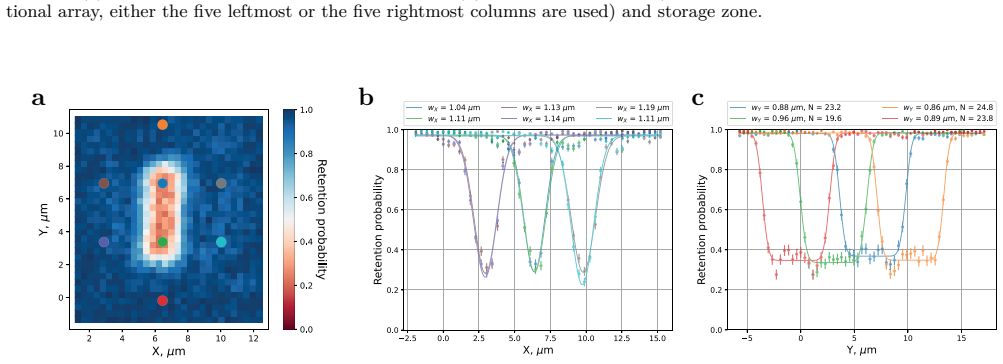
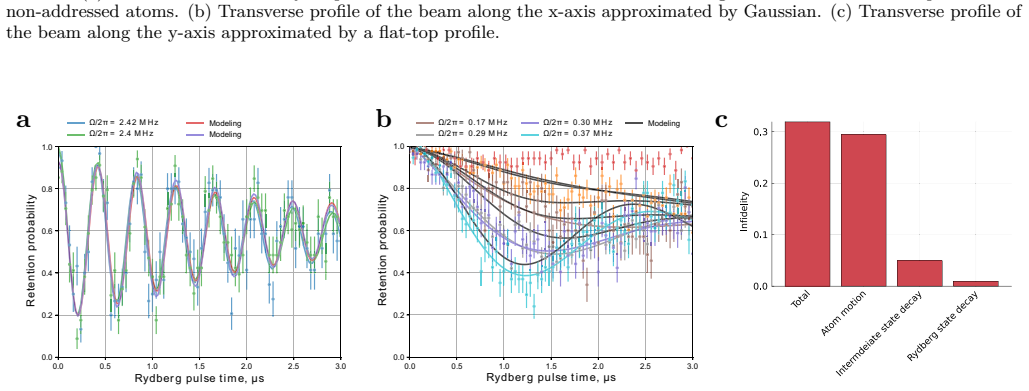
We present a method for generating a laser beam with flat intensity and phase profiles in the focal region where the beam interacts with neutral $^{87}$Rb atoms in an array of optical dipole traps. We synthesize the beam as a superposition of Hermite--Gaussian or Laguerre--Gaussian modes. Then we give analytical expressions for the coefficients of such a superposition, an analysis of beam propagation along the $z$ axis in the vicinity of the waist, and several other related theoretical issues. Rydberg two-qubit dynamics driven by this flat-top profile are analyzed through numerical solutions of the Lindblad master equation using our in-house Julia package. Beam preparation is demonstrated on a neutral-atom experimental platform. Measurements reveal a difference in the visibility of Rabi oscillations for addressed atoms compared with neighboring ones, confirming the effective spatial selectivity provided by the flat-top beam profile.
Editorial analysis
A structured set of objections, weighed in public.
Referee Report
Summary. The paper claims to introduce a method for generating a flat-top laser beam with uniform intensity and phase in the focal plane by superposing Hermite-Gaussian or Laguerre-Gaussian modes. It derives analytical expressions for the mode coefficients, analyzes the beam propagation along the z-axis near the waist, simulates Rydberg two-qubit dynamics using Lindblad master equation solutions via a Julia package, and experimentally demonstrates the approach on a neutral-atom platform with 87Rb atoms, where measurements show a difference in Rabi oscillation visibility for addressed atoms versus neighbors, thereby confirming effective spatial selectivity for Rydberg excitation.
Significance. If the experimental selectivity is quantitatively attributable to the flat-top profile, this technique could advance neutral-atom quantum information processing by enabling precise Rydberg addressing with reduced crosstalk. The analytical expressions for superposition coefficients and the propagation analysis supply a parameter-free theoretical foundation, while the in-house Julia package for Lindblad simulations supports reproducibility of the numerical Rydberg dynamics.
major comments (1)
- Experimental demonstration: The visibility difference in Rabi oscillations is presented as confirmation of the flat-top beam's spatial selectivity, but the text provides no quantitative comparison of the observed visibility ratio to the value computed by integrating the theoretical intensity/phase profile (from the HG/LG mode superposition and its z-propagation) over the atomic density distribution (~1 μm extent). This link is load-bearing for the central claim, as residual curvature, diffraction, or alignment offsets could produce a similar contrast without validating the flat-top design specifically.
minor comments (2)
- The experimental results lack reported error bars on the visibility measurements and details on the Rabi fitting procedure or raw data availability.
- The abstract mentions 'several other related theoretical issues' that are not explicitly enumerated or cross-referenced in the main text sections on the mode superposition.
Simulated Author's Rebuttal
We thank the referee for their careful reading of the manuscript and for highlighting the need for a stronger quantitative link between the experimental observations and the theoretical flat-top profile. We address the major comment below and will revise the manuscript accordingly.
read point-by-point responses
-
Referee: Experimental demonstration: The visibility difference in Rabi oscillations is presented as confirmation of the flat-top beam's spatial selectivity, but the text provides no quantitative comparison of the observed visibility ratio to the value computed by integrating the theoretical intensity/phase profile (from the HG/LG mode superposition and its z-propagation) over the atomic density distribution (~1 μm extent). This link is load-bearing for the central claim, as residual curvature, diffraction, or alignment offsets could produce a similar contrast without validating the flat-top design specifically.
Authors: We agree that the current manuscript presents the visibility difference primarily as qualitative evidence and lacks an explicit quantitative comparison to the integrated theoretical profile. This is a valid point that strengthens the central claim. In the revised version we will add a dedicated section (or subsection) that computes the expected Rabi visibility ratio by integrating the analytically derived intensity and phase profiles—obtained from the Hermite-Gaussian or Laguerre-Gaussian mode superposition and the z-propagation analysis—over the measured atomic density distribution (accounting for the ~1 μm extent). The resulting theoretical contrast will be directly compared to the experimental visibility ratio, including error bars from alignment uncertainty and residual wavefront curvature. We have already performed this calculation using the existing theoretical framework and Lindblad simulations; the observed experimental ratio falls within the predicted range, indicating that the flat-top design is the dominant source of selectivity. The new analysis and associated figure will be included in the revision. revision: yes
Circularity Check
No circularity: standard mode expansion and direct measurement
full rationale
The paper derives analytical coefficients for HG/LG mode superpositions from standard orthogonal decomposition mathematics, performs z-propagation analysis with known diffraction formulas, solves Lindblad dynamics numerically, and reports an experimental visibility contrast in Rabi oscillations as confirmation. None of these steps reduce the selectivity claim to a fitted parameter defined by the same data, a self-citation chain, or a self-definitional ansatz. The derivation chain remains independent of the final experimental outcome and rests on external optics theory plus direct observation.
Axiom & Free-Parameter Ledger
axioms (2)
- standard math Hermite-Gaussian and Laguerre-Gaussian modes form a complete orthogonal basis for paraxial beams
- domain assumption The focal-plane intensity remains flat over the atom size for the chosen superposition coefficients
Reference graph
Works this paper leans on
-
[1]
and horizontal coma (Z1
-
[2]
according to the equations given in [27] by using a linear combina- tion of holograms (a2Z2 2 +a 3Z1
-
[3]
To find the coefficientsa2 anda 3, we diverted a small frac- tion of the radiation using an amplitude beam splitter to a laser beam profiler positioned after a focusing lens
as described in [28]. To find the coefficientsa2 anda 3, we diverted a small frac- tion of the radiation using an amplitude beam splitter to a laser beam profiler positioned after a focusing lens. This allowed us to observe the far-field intensity distribu- tion. The coefficients were then optimized to maximize the uniformity of the flat-top profile while...
2021
-
[4]
This implies thatcn = 0for odd nandd kE(0)/dxk = 0for oddk
Direct analytical solution for the Hermite–Gaussian expansion coefficients It is natural to require the profileE(x)to be symmet- ric, i.e.,E(x) =E(−x). This implies thatcn = 0for odd nandd kE(0)/dxk = 0for oddk. Accordingly, it suffices to consider only even values ofNandKin what follows. From (8) we obtainc0 = 1. Substituting (10) into (7), we obtain: N/...
-
[5]
Consequently, the system is consistent only whenK≤N, with the maximum valueK=N
is triangular. Consequently, the system is consistent only whenK≤N, with the maximum valueK=N. In this case, (7–8) reduces to the equivalent system: c0 = 1,(A4) k∑ n=0 c2n(−1)k−n(2k)! (k−n)!= 0, k= 1,...,N/2.(A5) The solution is given byc2n = 1/n!andc 2n+1 = 0. This follows from the identity below, obtained using the bino- mial theorem: 0≡(2k)! k! (1−1)k ...
-
[6]
Using The- orems 1.1 and 1.2 of Ref
Asymptotics Formula (A10) is more convenient than (A7) for ana- lyzing the asymptotic behavior asN→∞. Using The- orems 1.1 and 1.2 of Ref. [37], we find that, to leading order,E(x)converges to the complementary error func- tionerfc: E(x) = 1 2 erfc (√ 2|x|− √ N+ 4/3 ) +O(1/ √ N),(A12) In practice, the approximation is accurate already for N≳10. For exampl...
-
[7]
[18]), the required input is not the de- sired field profileE(x)itself but its Fourier transform[39] F[E(x)](t) = 1√ 2π ∫∞ −∞E(x) exp(ixt)dx
Fourier transform For certain hologram-computation algorithms (e.g., the method of Ref. [18]), the required input is not the de- sired field profileE(x)itself but its Fourier transform[39] F[E(x)](t) = 1√ 2π ∫∞ −∞E(x) exp(ixt)dx. Since the Fouriertransformislinear, computingF[E(x)]from(A7) reduces to evaluatingF[x 2ne−x2 ]. For any sufficiently fast-decay...
-
[8]
For some applications, a radially symmetric flat-top beam may be required
Beam profile in a polar coordinate system Above, weconsideredtheprofileofaflat-topbeamcon- structed from low-order Hermite–Gaussian modes and therefore having the shape of a smoothed rectangle. For some applications, a radially symmetric flat-top beam may be required. To determine its profile, it is conve- nient to switch to a polar coordinate system. In ...
-
[9]
Pause, L
L. Pause, L. Sturm, M. Mittenbühler, S. Amann, D. Schäffner, M. Schlosser, and G. Birkl, Supercharged two-dimensional tweezer array with more than 1000 atomic qubits, Optica11, 222 (2024)
2024
- [10]
-
[11]
N.-C. Chiu, E. Trapp, J. Guo, M. Abobeih, L. Stew- art, S. Hollerith, P. Stroganov, M. Kalinowski, A. Geim, S. Evered, S. Li, X. Lyu, L. Peters, D. Bluvstein, T. Wang, M. Greiner, and M. Lukin, Continuous opera- tion of a coherent 3,000-qubit system, Nature646, 1075 (2025)
2025
-
[12]
Levine, A
H. Levine, A. Keesling, G. Semeghini, A. Omran, T. T. Wang, S. Ebadi, H. Bernien, M. Greiner, V. Vuletić, H. Pichler, and M. D. Lukin, Parallel implementation of high-fidelity multiqubit gates with neutral atoms, Phys. Rev. Lett.123, 170503 (2019)
2019
-
[13]
Bluvstein, et al., Logical quantum processor based on reconfigurable atom arrays
D. Bluvstein, S. J. Evered, A. A. Geim, S. H. Li, H. Zhou, T. Manovitz, S. Ebadi, M. Cain, M. Kalinowski, D. Hangleiter,et al., Logical quantum processor based on reconfigurable atom arrays, Nature626, 58 (2024), arXiv:2312.03982 [quant-ph]
-
[14]
Evered, M
S. Evered, M. Kalinowski, A. Geim, T. Manovitz, D. Blu- vstein, S. Li, N. Maskara, H. Zhou, S. Ebadi, M. Xu, J. Campo, M. Cain, S. Ostermann, S. Yelin, S. Sachdev, M. Greiner, and M. Lukin, Probing the kitaev honey- comb model on a neutral-atom quantum computer, Na- ture645, 341 (2025)
2025
- [15]
-
[16]
Z. Fu, P. Xu, Y. Sun, Y.-Y. Liu, X.-D. He, X. Li, M. Liu, R.-B. Li, J. Wang, L. Liu, and M.-S. Zhan, High-fidelity entanglement of neutral atoms via a rydberg-mediated single-modulated-pulse controlled-phase gate, Phys. Rev. A105, 042430 (2022)
2022
-
[17]
P. L. Ocola, I. Dimitrova, B. Grinkemeyer, E. Guardado- Sanchez, T. Ðorđević, P. Samutpraphoot, V. Vuletić, and M. D. Lukin, Control and entanglement of individual ry- dberg atoms near a nanoscale device, Phys. Rev. Lett. 132, 113601 (2024)
2024
-
[18]
T. M. Graham, M. Kwon, B. Grinkemeyer, Z. Marra, X. Jiang, M. T. Lichtman, Y. Sun, M. Ebert, and M. Saffman, Rydberg-mediated entanglement in a two- dimensional neutral atom qubit array, Phys. Rev. Lett. 123, 230501 (2019)
2019
-
[19]
Radnaev, W
A. Radnaev, W. Chung, D. Cole, D. Mason, T. Bal- lance, M. Bedalov, D. Belknap, M. Berman, M. Blakely, I. Bloomfield, P. Buttler, C. Campbell, A. Chopinaud, E. Copenhaver, M. Dawes, S. Eubanks, A. Friss, D. Gar- cia, J. Gilbert, M. Gillette, P. Goiporia, P. Gokhale, J. Goldwin, D. Goodwin, T. Graham, C. Guttormsson, G. Hickman, L. Hurtley, M. Iliev, E. Jo...
2025
-
[20]
Bornet, G
G. Bornet, G. Emperauger, C. Chen, F. Machado, S. Chern, L. Leclerc, B. Gély, Y. T. Chew, D. Barredo, T. Lahaye, N. Y. Yao, and A. Browaeys, Enhancing a many-body dipolar rydberg tweezer array with arbitrary local controls, Phys. Rev. Lett.132, 263601 (2024)
2024
-
[21]
Li, J.-Y
X. Li, J.-Y. Hou, J.-C. Wang, G.-W. Wang, X.-D. He, F. Zhou, Y.-B. Wang, M. Liu, J. Wang, P. Xu, and M.- S. Zhan, A fiber array architecture for atom quantum computing, Nature Communications16, 9728 (2025)
2025
-
[22]
Mielec, M
N. Mielec, M. Altorio, S. Ranjita Chanu, D. Horville, D. Holleville, L. Sidorenkov, A. Landragin, and R.Geiger,Atominterferometrywithtop-hatlaserbeams, Applied Physics Letters113, 161108 (2018)
2018
-
[23]
Pause,A New Setup for Scaling Up Microlens- Based Individual-Atom Quantum Processors, Ph.D
L. Pause,A New Setup for Scaling Up Microlens- Based Individual-Atom Quantum Processors, Ph.D. the- sis, Technical University of Dortmund (2023)
2023
-
[24]
Ebadi, T
S. Ebadi, T. T. Wang, H. Levine, A. Keesling, G. Se- meghini, A. Omran, D. Bluvstein, R. Samajdar, H. Pich- ler, W. W. Ho, S. Choi, S. Sachdev, M. Greiner, V. Vuletic, and M. D. Lukin, Quantum phases of matter ona256-atomprogrammablequantumsimulator,Nature 595, 227–232 (2021)
2021
-
[25]
Davis, D
J. Davis, D. Cottrell, J. Campos, M. Yzuel, and I. Moreno, Encoding amplitude information onto phase- only filters, Applied Optics38, 5004 (1999)
1999
-
[26]
Bolduc, N
E. Bolduc, N. Bent, E. Santamato, E. Karimi, and R. Boyd, Exact solution to simultaneous intensity and phase encryption with a single phase-only hologram, Op- tics Letters38, 3546 (2013)
2013
- [27]
-
[28]
L.A.RomeroandF.M.Dickey,Losslesslaserbeamshap- ing, J. Opt. Soc. Am. A13, 751 (1996)
1996
-
[29]
Zhang, C
L. Zhang, C. Li, Z. Haizhe, C. Xu, D. Lei, Y. Li, and D. Fan, Propagation dynamics of super-gaussian beams in fractional schrödinger equation: from linear to nonlin- ear regimes, Optics Express24, 14406 (2016)
2016
-
[30]
Parent, M
A. Parent, M. Morin, and P. Lavigne, Propagation of super-gaussian field distributions, Optical and Quantum Electronics24, S1071 (1992)
1992
-
[31]
Jabczynski, M
J. Jabczynski, M. Kaskow, L. Gorajek, K. Kopczyński, and W. Zendzian, Modeling of the laser beam shape for high-power applications, Optical Engineering57, 1 (2018)
2018
-
[32]
S. A. Suresh, S. Vyas, J. A. Yeh, and Y. Luo, Character- ization of super-gaussian beams generated through vol- ume holography, Optics & Laser Technology190, 113237 (2025)
2025
-
[33]
L. Wu, S. Cheng, and S. Tao, Simultaneous shaping of amplitude and phase of light in the entire output plane with a phase-only hologram, Sci. Rep.5, 1 (2015)
2015
-
[34]
Bowman, T
D. Bowman, T. L. Harte, V. Chardonnet, C. D. Groot, S. J. Denny, G. L. Goc, M. Anderson, P. Ireland, D. Cas- settari, and G. D. Bruce, High-fidelity phase and ampli- 16 tudecontrolofphase-onlycomputergeneratedholograms using conjugate gradient minimisation, Opt. Express25, 11692 (2017)
2017
-
[35]
Born and E
M. Born and E. Wolf,Principles of Optics: Electromag- netic Theory of Propagation, Interference and Diffraction of Light, 6th ed. (Pergamon Press, Oxford, 1980)
1980
-
[36]
Sorimoto, K
K. Sorimoto, K. Kintaka, H. Kawashima, M. Mori, T. Hasama, H. Ishikawa, H. Tsuda, and H. Uetsuka, Fast aberration-correcting algorithm for an slm-based optical switch, IEICE Electron. Express7, 1728 (2010)
2010
-
[37]
Goloshchapov and A
M. Goloshchapov and A. Gordeev, Neutralatoms.jl: Simulation tools for neutral-atom quantum computing, https://github.com/mgoloshchapov/NeutralAtoms.jl (2025), gitHub repository
2025
-
[38]
Jiang, J
X. Jiang, J. Scott, M. Friesen, and M. Saffman, Sensitiv- ity of quantum gate fidelity to laser phase and intensity noise, Physical Review A107, 042611 (2023)
2023
-
[39]
de Léséleuc, D
S. de Léséleuc, D. Barredo, V. Lienhard, A. Browaeys, and T. Lahaye, Analysis of imperfections in the coher- ent optical excitation of single atoms to rydberg states, Physical Review A97, 053803 (2018)
2018
-
[40]
Šibalić, J
N. Šibalić, J. Pritchard, C. Adams, and K. Weatherill, Arc: An open-source library for calculating properties of alkali rydberg atoms, Computer Physics Communica- tions220, 319 (2017)
2017
-
[41]
Krämer, D
S. Krämer, D. Plankensteiner, L. Ostermann, and H. Ritsch, Quantumoptics. jl: A julia framework for sim- ulating open quantum systems, Computer Physics Com- munications227, 109 (2018)
2018
-
[42]
Mølmer, Y
K. Mølmer, Y. Castin, and J. Dalibard, Monte carlo wave-function method in quantum optics, J. Opt. Soc. Am. B10, 524 (1993)
1993
-
[43]
NIST digital library of mathematical functions (2024)
2024
-
[44]
Abramowitz and I
M. Abramowitz and I. A. Stegun, eds.,Handbook of Mathematical Functions with Formulas, Graphs, and Mathematical Tables, National Bureau of Standards Ap- plied Mathematics Series, Vol. 55 (U.S. Government Printing Office, Washington, DC, 1964)
1964
-
[45]
Nemes and A
G. Nemes and A. B. O. Daalhuis, Asymptotic expansions for the incomplete gamma function in the transition re- gions, Math. Comp.88, 1805 (2019)
2019
-
[46]
Note that it is proportional to the Hermite–Gaussian mode waistw 0, sincexis measured in units ofw 0
-
[47]
In what follows, we omit the argument of the Fourier transform, assuming it is denoted by the same symbolx instead oft
discussion (0)
Sign in with ORCID, Apple, or X to comment. Anyone can read and Pith papers without signing in.