Recognition: unknown
Effect of reaction temperature on nascent carbonaceous particles from toluene shock-tube pyrolysis: Insights from FTIR and Raman spectroscopy
Pith reviewed 2026-05-07 12:45 UTC · model grok-4.3
The pith
Toluene pyrolysis produces solid carbonaceous particles starting at 1570 K, shown by the sudden appearance of Raman D and G bands and loss of amorphous TEM structures.
A machine-rendered reading of the paper's core claim, the machinery that carries it, and where it could break.
Core claim
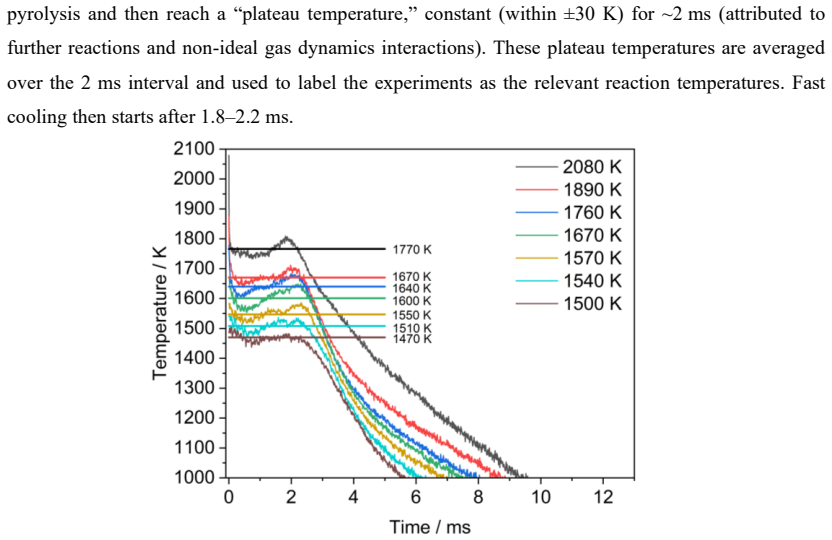
In 2% toluene-argon mixtures pyrolyzed at 2 bar for 2 ms, in situ laser extinction places the onset of particle formation at 1570 K. At this exact temperature, Raman spectra show emerging D and G bands while TEM reveals the disappearance of poorly defined structures, establishing 1570 K as the phase-transition temperature. Rapid loss of sp-hybridized triple bonds occurs just below it. At 1670 K, primary particle diameter reaches a maximum and Raman-inferred disorder decreases, defining the ordering threshold. Deconvoluted FTIR spectra separate in-ring double bonds from side-chain modes and show a change from radical-rich ring-edge sites (bay regions, five-membered defects) below the phase-1.
What carries the argument
Shock-tube pyrolysis with in situ laser extinction, followed by ex situ FTIR and Raman spectroscopy plus TEM imaging of sampled products across 1450-1800 K.
Load-bearing premise
Measurements made after the products are cooled and sampled still faithfully represent the structures and chemistry that existed inside the hot reaction zone.
What would settle it
If in situ high-temperature Raman spectra taken at 1570 K showed no D or G bands or if TEM of particles captured without cooling still showed only poorly defined shapes, the claimed phase-transition temperature would be incorrect.
Figures
read the original abstract
The transition from gaseous precursors to nascent solid particles and their subsequent structural maturation were investigated in single-pulse shock-tube experiments using ex situ Fourier-transform infrared (FTIR) and Raman spectroscopy of sampled products. A mixture of 2% toluene in argon was pyrolyzed at around 2.0 bar with temperature plateau times of 2.0 ms over the 1450-1800 K reaction temperature range. In situ laser extinction measurements indicate the onset of particle formation at 1570 K. At this temperature, Raman spectra exhibit emerging D and G bands, and transmission electron microscopy (TEM) reveals the disappearance of poorly defined structures, identifying 1570 K as the phase-transition reaction temperature. Approaching this reaction temperature, Raman spectra show a rapid disappearance of sp hybridized triple carbon bonds. At 1670 K reaction temperature, a maximum in primary particle diameter and a decrease in structural disorder inferred from Raman spectroscopy are observed, defining the ordering threshold. Deconvolution of the FTIR spectra enables separation of in ring double carbon bond stretching vibrations from isolated and ring-conjugated side-chain double carbon bond modes. The in-ring double carbon band is used to normalize aliphatic and aromatic C-H vibrations. FTIR analysis reveals ring-edge structures associated with electron-localization sites, including bay regions, five-membered ring defects, and benzylic positions, indicating a radical-rich environment below the phase-transition temperature. Between the phase-transition and ordering-threshold temperatures, K-regions and armchair structures associated with electron delocalization and thermal stability increase. The emergence of these electronic and structural characteristics highlights the critical role of radicals in soot inception and early structural ordering.
Editorial analysis
A structured set of objections, weighed in public.
Referee Report
Summary. The manuscript investigates the transition from gaseous precursors to nascent solid particles during toluene pyrolysis in single-pulse shock-tube experiments at ~2 bar with 2 ms reaction times over 1450-1800 K. In situ laser extinction detects particle onset at 1570 K; ex situ FTIR, Raman spectroscopy, and TEM of sampled products are used to identify 1570 K as the phase-transition temperature (emergence of D and G bands, loss of poorly defined structures) and 1670 K as the ordering threshold (maximum primary particle diameter, reduced disorder). Deconvoluted FTIR spectra separate in-ring and side-chain C=C modes to track ring-edge (bay, five-membered defects) vs. K-region/armchair structures, emphasizing radical-rich environments below the transition and increasing thermal stability above it.
Significance. If the ex situ structural assignments accurately reflect the high-temperature state, the work supplies temperature-calibrated experimental markers for soot inception and early maturation, including specific thresholds and the role of localized vs. delocalized electronic sites. The multi-technique approach (extinction + FTIR/Raman/TEM) offers concrete observables that can benchmark kinetic models of PAH growth and particle ordering.
major comments (1)
- [Results/Discussion (1570 K transition)] § on results at 1570 K (phase-transition claim): The assignment of exactly 1570 K as the phase-transition temperature equates the in situ extinction onset with the first appearance of D/G bands in ex situ Raman spectra and the loss of amorphous TEM structures. However, after the 2 ms plateau the gas undergoes finite-rate cooling and sampling; nascent particles at these temperatures contain high radical densities and labile sp/sp2 sites that can undergo additional cyclization, dehydrogenation, or ordering during quench. No quench-rate variation, radical-scavenger controls, or in situ structural diagnostics are reported to bound the magnitude of such post-reaction changes. This directly affects the temperature calibration of all subsequent claims about ring-edge vs. K-region evolution.
minor comments (2)
- [Experimental section] The pressure is given as 'around 2.0 bar'; reporting the measured pressure range and any temperature-pressure covariance across the data set would strengthen reproducibility.
- [FTIR analysis] FTIR deconvolution details (number of components, baseline treatment, uncertainty estimates on integrated intensities) are needed to evaluate the separation of in-ring vs. side-chain C=C bands.
Simulated Author's Rebuttal
We thank the referee for their constructive comments and for acknowledging the significance of our multi-technique investigation into soot inception thresholds. We address the major comment point by point below.
read point-by-point responses
-
Referee: [Results/Discussion (1570 K transition)] § on results at 1570 K (phase-transition claim): The assignment of exactly 1570 K as the phase-transition temperature equates the in situ extinction onset with the first appearance of D/G bands in ex situ Raman spectra and the loss of amorphous TEM structures. However, after the 2 ms plateau the gas undergoes finite-rate cooling and sampling; nascent particles at these temperatures contain high radical densities and labile sp/sp2 sites that can undergo additional cyclization, dehydrogenation, or ordering during quench. No quench-rate variation, radical-scavenger controls, or in situ structural diagnostics are reported to bound the magnitude of such post-reaction changes. This directly affects the temperature calibration of all subsequent claims about ring-edge vs. K-region evolution.
Authors: The referee correctly notes a potential limitation: post-reaction structural evolution during cooling and sampling cannot be fully excluded given the high radical content of nascent particles. Our single-pulse shock-tube protocol relies on rapid expansion cooling (typically >10^5 K/s) following the 2 ms reaction plateau to quench chemistry. The sharp coincidence between the in situ laser extinction onset at 1570 K and the simultaneous emergence of D/G bands, loss of amorphous TEM structures, and disappearance of sp triple bonds in the ex situ spectra provides supporting evidence that the observed transition reflects the high-temperature state. Nevertheless, we did not perform quench-rate variations, radical-scavenger experiments, or in situ structural diagnostics, so the magnitude of any quench-induced changes remains unquantified. In the revised manuscript we will add an explicit discussion paragraph in the Results/Discussion section acknowledging this limitation, its possible effect on the precise temperature calibration, and a more cautious interpretation of the ring-edge versus K-region structural evolution between 1570 K and 1670 K. revision: partial
Circularity Check
No circularity: purely observational experimental study with no derivations or fitted predictions
full rationale
The paper reports direct shock-tube experiments with in situ laser extinction to detect particle onset at 1570 K, followed by ex situ FTIR, Raman, and TEM analysis of sampled products at various temperatures. All claims (phase-transition identification, ordering threshold, structural evolution) are correlations between measured observables at stated reaction temperatures; no equations, models, parameters, or predictions are derived from prior results or self-citations. No load-bearing self-citation chains, ansatzes, or renamings of known results appear in the provided text. The derivation chain is empty by construction, as the work consists of empirical measurements rather than theoretical reduction.
Axiom & Free-Parameter Ledger
axioms (3)
- domain assumption Raman D and G bands indicate carbon structure and disorder in nascent particles
- domain assumption FTIR deconvolution accurately separates in-ring and side-chain double bond vibrations
- domain assumption Ex situ measurements represent in situ conditions at the reaction temperature
Reference graph
Works this paper leans on
-
[1]
2026, https://docs.scipy.org/doc/scipy-1.13.1/index.html
SciPy-community, SciPy, Version 1.13.1, SciPy Project, Accessed 9 Jan. 2026, https://docs.scipy.org/doc/scipy-1.13.1/index.html
2026
-
[2]
A. Sadezky, H. Muckenhuber, H. Grothe, R. Niessner, U. Pöschl, Raman microspectroscopy of soot and related carbonaceous materials: Spectral analysis and structural information, Carbon, 43 (2005) 1731-1742, https://doi.org/10.1016/j.carbon.2005.02.018
-
[3]
H.J. Seong, A.L. Boehman, Evaluation of Raman Parameters Using Visible Raman Microscopy for Soot Oxidative Reactivity, Energ. Fuel, 27 (2013) 1613 -1624, https://doi.org/10.1021/ef301520y
-
[4]
K.C. Le, C. Lefumeux, T. Pino, Watching soot inception via online Raman spectroscopy, Combust. Flame, 236 (2022) 111817, https://doi.org/10.1016/j.combustflame.2021.111817
discussion (0)
Sign in with ORCID, Apple, or X to comment. Anyone can read and Pith papers without signing in.