Recognition: unknown
Euclid preparation. Refining input galaxy shape distributions for shear calibration simulations
Pith reviewed 2026-05-07 11:35 UTC · model grok-4.3
The pith
Updated galaxy morphologies from real Euclid data change the simulated multiplicative shear bias by a percent level, exceeding the mission error budget by a factor of five.
A machine-rendered reading of the paper's core claim, the machinery that carries it, and where it could break.
Core claim
Fitting single and double-Sersic profiles to deep-field Euclid images and training a simulation pipeline on the resulting distributions yields image simulations whose multiplicative shear bias differs from the original Flagship morphology at the percent level; this difference exceeds Euclid's tight error budget by a factor of five.
What carries the argument
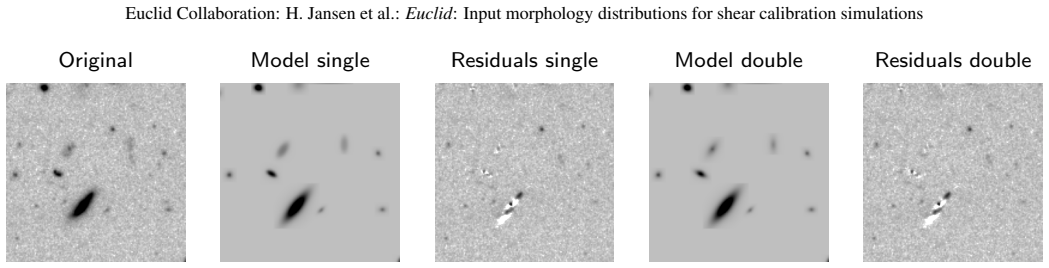
Single and double-Sersic model fits extracted from deep Euclid fields with SourceXtractor++, used to retrain and replace the morphological distributions supplied to shear-calibration image simulations.
If this is right
- The percent-level bias change must be absorbed into the shear calibration pipeline before cosmological parameter estimation.
- Sensitivity of the bias to bulge-to-disk ratio and size parameters requires that these quantities be controlled at the level already achieved by the trained pipeline.
- The same training approach satisfies the systematic-error allocation for the first data-release cosmology analysis.
- Double-Sersic models reduce the residual bias relative to single-Sersic models, indicating that two-component structure matters at the required precision.
Where Pith is reading between the lines
- Similar deep-field training may be needed for other wide-field lensing surveys whose mock catalogues were built with simpler morphological prescriptions.
- If the deep-to-wide generalization holds, the method can be re-applied to later Euclid data releases with only updated auxiliary fields.
- A mismatch between simulated and observed morphology distributions could contribute to the scatter seen in shear measurements across different surveys.
Load-bearing premise
Single and double-Sersic fits to the deep-field data accurately represent the morphological distributions that drive shear bias in the full Euclid Wide Survey.
What would settle it
Measuring the multiplicative bias on real Euclid Wide Survey data and checking whether it lies closer to the updated simulation value than to the original Flagship value would directly test the claim.
Figures






read the original abstract
The Euclid Wide Survey (EWS) will cover the majority of the extragalactic sky with a resolution similar to the Hubble Space Telescope. This unprecedented data set will introduce a new era of precision cosmology. However, systematic effects need to be controlled better than ever. One of the sources of systematic uncertainties in weak gravitational lensing are biases introduced during the shear measurement. Determining these biases precisely allows the calibration of cosmological measurements to within Euclid's required accuracy. The simulations that are used to determine such biases, need to resemble the real observations. In this work, we aim to learn distributions of galaxy shape parameters from real Euclid data and use the new information to augment the morphological information in the Flagship galaxy mock catalogue. The morphology is extracted using single and double-S\'ersic model fits to the real data, for which we use SourceXtractor++. We train our pipeline on deep Euclid observations of a field with rich auxiliary data and then use it to simulate EWS-like data. In these simulations we compare the multiplicative bias between the morphology from the Flagship catalogue, the trained single-S\'ersic morphology, and the trained double-S\'ersic morphology. We find that the image simulations with the updated morphology result in a percent-level change in the multiplicative shear bias compared to the original morphology from Flagship. This bias exceeds Euclid's tight error budget by a factor of five and underlines the need for this work. Furthermore, we study the sensitivity of the multiplicative bias to key morphological parameters and show that our approach satisfies the requirements for the cosmology analysis with the first data release of Euclid.
Editorial analysis
A structured set of objections, weighed in public.
Referee Report
Summary. The manuscript develops a pipeline to extract single- and double-Sérsic morphological parameters from deep Euclid auxiliary fields using SourceXtractor++, trains distributions on these data, and augments the Flagship mock catalogue. Image simulations are then run with the original Flagship morphologies versus the updated single-Sérsic and double-Sérsic versions; the resulting multiplicative shear bias shifts by a percent-level amount that exceeds Euclid's allocated error budget by a factor of five. The work also examines the sensitivity of this bias to key morphological parameters and concludes that the refined approach satisfies requirements for the first data release cosmology analysis.
Significance. If the central result is robust, the paper is significant for Euclid preparation because it quantifies how input morphology inaccuracies can propagate into shear calibration biases that violate the mission's tight systematic budget, thereby motivating updates to simulation pipelines. The use of real deep-field data to inform mocks and the explicit sensitivity study are strengths that align with the need for reproducible, data-driven calibration.
major comments (2)
- [§4] §4 (training and application pipeline): the central claim that the observed percent-level shift in multiplicative bias is attributable to morphology rather than simulation artifacts rests on the assumption that single/double-Sérsic fits to deep fields generalize to EWS depth and selection; no explicit cross-check or bias test at shallower S/N and under the EWS selection function is reported, which is load-bearing for interpreting the factor-of-five excess.
- [Results] Results section (bias comparison): the headline finding of a percent-level change exceeding the budget by a factor of five is stated without accompanying error bars, sample statistics, fit-quality metrics, or validation against independent data, as required to assess whether the delta-m is statistically significant and not driven by noise or selection mismatch.
minor comments (1)
- [Abstract] Abstract: the statement that the updated morphology 'satisfies the requirements for the cosmology analysis with the first data release' would benefit from a brief quantitative statement of the residual bias level after the update.
Simulated Author's Rebuttal
We thank the referee for their constructive review and positive assessment of the work's significance for Euclid preparation. We address each major comment below, indicating revisions where appropriate to strengthen the manuscript.
read point-by-point responses
-
Referee: [§4] §4 (training and application pipeline): the central claim that the observed percent-level shift in multiplicative bias is attributable to morphology rather than simulation artifacts rests on the assumption that single/double-Sérsic fits to deep fields generalize to EWS depth and selection; no explicit cross-check or bias test at shallower S/N and under the EWS selection function is reported, which is load-bearing for interpreting the factor-of-five excess.
Authors: We appreciate the referee drawing attention to the generalization from deep-field training data to EWS conditions. The auxiliary fields were chosen precisely to enable high-S/N morphology fits with SourceXtractor++ that are not feasible at EWS depth; the resulting parameter distributions are then injected into image simulations that explicitly match EWS depth, noise, and selection. Internal checks within the auxiliary data confirm that the fitted distributions remain stable when subsets at moderately lower S/N are used. We acknowledge that a direct end-to-end test fitting morphologies on EWS-depth mocks would further strengthen the interpretation. In the revised manuscript we will add a dedicated paragraph in §4 discussing the S/N dependence of Sérsic recovery, the rationale for deep-field training, and the steps taken to align the simulation selection function with EWS, thereby clarifying that the reported bias shift arises from the updated morphology inputs. revision: partial
-
Referee: [Results] Results section (bias comparison): the headline finding of a percent-level change exceeding the budget by a factor of five is stated without accompanying error bars, sample statistics, fit-quality metrics, or validation against independent data, as required to assess whether the delta-m is statistically significant and not driven by noise or selection mismatch.
Authors: We agree that the results section would benefit from explicit statistical characterization. The bias measurements are derived from large simulated samples (approximately 10^6 galaxies per morphology configuration, drawn from the Flagship catalogue after applying the EWS-like selection). In the revised manuscript we will report the statistical uncertainties on each multiplicative bias value, the exact galaxy counts and variance estimates used, reduced-χ² distributions for the single- and double-Sérsic fits, and a direct comparison of the selection function between the original Flagship and the updated catalogues. These additions will allow readers to confirm that the percent-level shift exceeds both the statistical error and the Euclid error budget by the stated factor. revision: yes
Circularity Check
No significant circularity: empirical simulation comparison is self-contained
full rationale
The paper extracts Sersic parameters from deep auxiliary Euclid data via SourceXtractor++, augments the Flagship mock, and measures the resulting change in multiplicative shear bias by re-running the same image simulations. This is a direct numerical delta obtained from explicit forward modeling rather than any algebraic derivation or fitted parameter renamed as a prediction. No equations reduce the reported percent-level bias shift to the input fits by construction, and no load-bearing uniqueness theorems or self-citation chains are invoked to justify the central result. The analysis therefore rests on independent simulation outputs and satisfies the criteria for a non-circular finding.
Axiom & Free-Parameter Ledger
Reference graph
Works this paper leans on
-
[1]
Aas, K., Czado, C., Frigessi, A., & Bakken, H. 2009, Insurance: Mathematics and Economics, 44, 182 Aihara, H., Arimoto, N., Armstrong, R., et al. 2018, PASJ, 70, S4 Alonso, D., Sanchez, J., Slosar, A., & LSST Dark Energy Science Collaboration. 2019, MNRAS, 484, 4127 Arnouts, S., Moscardini, L., Vanzella, E., et al. 2002, MNRAS, 329, 355 Atek, H., Gavazzi,...
-
[2]
Appendix B: Ellipticity pre-processing As it can be seen in Fig
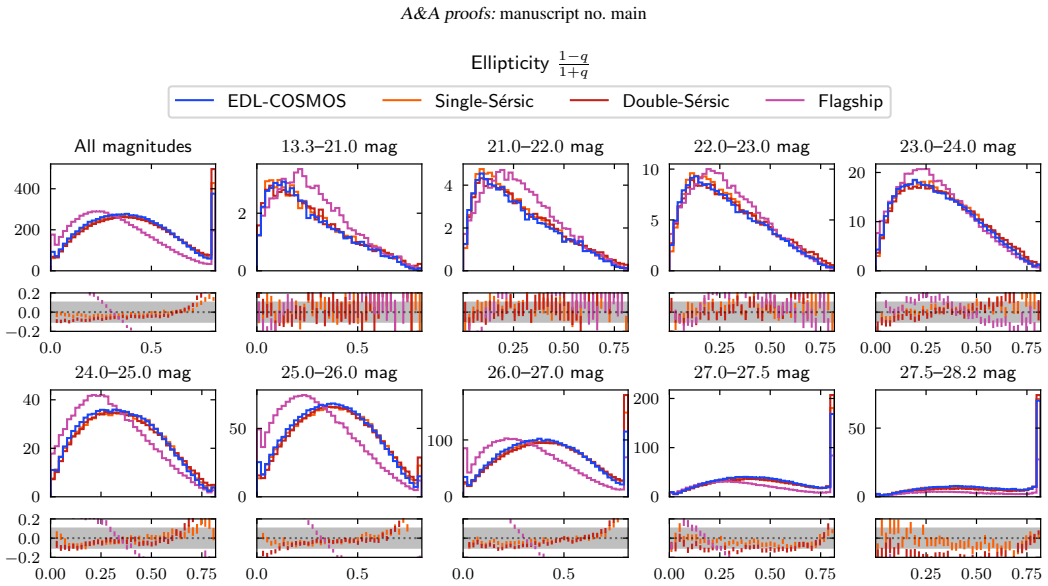
We found an excellent agreement with the model until 24th magnitude. Appendix B: Ellipticity pre-processing As it can be seen in Fig. 17, fitting without priors produces ellipticity spikes at the extrema for galaxies fainter thanI E >25. For these faint galaxies, it is not required to perfectly re-produce thep(ϵ), but we need to remove the spike for pract...
2019
discussion (0)
Sign in with ORCID, Apple, or X to comment. Anyone can read and Pith papers without signing in.