Recognition: unknown
On-the-fly LTLf Synthesis under Partial Observability
Pith reviewed 2026-05-07 11:13 UTC · model grok-4.3
The pith
Progressing LTLf formulas only on observable variables yields the correct belief states for synthesis under partial observability.
A machine-rendered reading of the paper's core claim, the machinery that carries it, and where it could break.
Core claim
The authors claim that observable progression—advancing the LTLf formula with respect to observable variables only while universally quantifying unobservable variables on the fly—constructs exactly the belief states required for synthesis under partial observability. This construction can therefore be performed incrementally during game solving instead of as a separate upfront subset-construction step, and the resulting framework remains correct.
What carries the argument
Observable progression of an LTLf formula, which advances the formula using only visible variables and quantifies hidden variables universally at each step to build belief states incrementally.
If this is right
- Belief-state construction and game solving can be performed together without generating unreachable states in advance.
- Compact representations such as Multi-Terminal Binary Decision Diagrams can represent the incrementally built DFA throughout the process.
- The integrated framework produces a fully on-the-fly synthesis procedure for LTLf specifications under partial observability.
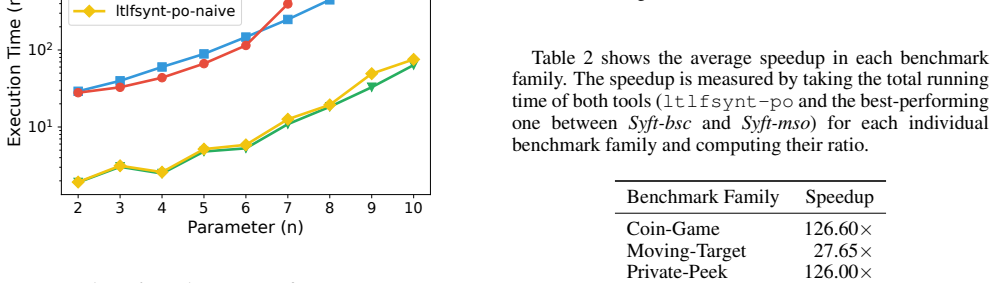
- Experimental comparisons show the method significantly outperforms approaches that separate DFA construction from game solving.
Where Pith is reading between the lines
- The same incremental construction may reduce peak memory use in tools that currently build the full belief automaton before solving the game.
- Similar on-the-fly progression techniques could be applied to other temporal logics that rely on belief-state automata for partial-information synthesis.
- The combination with symbolic diagram representations suggests that the efficiency gains observed for fully observable cases can transfer to the partial-observability setting.
Load-bearing premise
Advancing the LTLf formula only on observable variables while universally quantifying the unobservable ones at each step produces exactly the same set of reachable belief states as the standard upfront subset construction.
What would settle it
A concrete LTLf formula together with a partition of variables into observable and unobservable sets where the belief states reached by observable progression differ from those reached by the standard subset construction applied to the full automaton.
Figures




read the original abstract
LTLf synthesis under partial observability requires reasoning about unobservable environment variables, which is typically handled by constructing a belief-state DFA via subset construction that universally quantifies these variables. Existing approaches perform this construction as a separate step prior to game solving, often generating belief states that are unnecessary in practice. We propose an on-the-fly approach to LTLf synthesis under partial observability based on observable progression. Our method incrementally builds the belief-state DFA by progressing the specification with respect to observable variables only, universally quantifying unobservable variables on the fly. We prove the correctness of the construction and show that it naturally enables on-the-fly game solving, leading to a fully on-the-fly synthesis framework. Our implementation leverages DFAs represented using Multi-Terminal Binary Decision Diagrams: a compact representation that has proven highly effective for LTLf synthesis under full observability. Experimental results demonstrate that our approach significantly outperforms existing methods and further highlight the practical benefits of integrating on-the-fly game solving with belief-state construction.
Editorial analysis
A structured set of objections, weighed in public.
Referee Report
Summary. The paper proposes an on-the-fly approach to LTLf synthesis under partial observability. It incrementally builds the belief-state DFA by progressing the LTLf formula only with respect to observable variables while universally quantifying unobservable variables on the fly, proves correctness of the construction, integrates it with on-the-fly game solving, represents DFAs via MTBDDs, and reports experimental outperformance over methods that perform upfront subset construction.
Significance. If the claimed equivalence to the standard subset construction holds, the work offers a practical improvement in scalability for partial-observability LTLf synthesis by avoiding unnecessary belief states. The explicit correctness proof, the natural enabling of on-the-fly game solving, and the reuse of MTBDD representations (previously effective for full observability) are strengths that could make the framework more efficient in practice.
minor comments (3)
- The definition and inductive argument for observable progression (introduced in the construction) would benefit from an early, self-contained formal statement before the proof, to make the equivalence claim easier to follow without backtracking to the standard subset construction.
- In the experimental evaluation, include a breakdown (e.g., a table or plot) separating the time spent on incremental belief-state construction from game solving; this would directly quantify the benefit of the on-the-fly integration claimed in the abstract.
- Notation for the universal quantification over unobservable variables during progression should be made consistent between the textual description and any pseudocode or formal rules, to avoid ambiguity for readers implementing the method.
Simulated Author's Rebuttal
We thank the referee for the positive summary of our paper and the recommendation for minor revision. The referee accurately captures the key elements of our on-the-fly approach to LTLf synthesis under partial observability, including the use of observable progression, the correctness proof, integration with game solving, MTBDD representation, and experimental results. No specific major comments were raised in the report.
Circularity Check
No significant circularity detected in derivation chain
full rationale
The paper's central contribution is an on-the-fly belief-state construction for LTLf synthesis under partial observability, obtained by progressing the formula only over observable variables while universally quantifying unobservables at each step. This is presented as a direct algorithmic procedure whose correctness is proved by showing equivalence to the standard upfront subset construction; the resulting structure then supports on-the-fly game solving. No step reduces by definition to its own output, renames a fitted parameter as a prediction, or relies on a load-bearing self-citation whose justification is internal to the present work. The construction is a straightforward lifting of established LTLf progression semantics and MTBDD representations, remaining self-contained against external automata-theoretic benchmarks.
Axiom & Free-Parameter Ledger
axioms (2)
- standard math Standard conversion from LTLf formulas to DFAs and the semantics of progression on finite traces
- domain assumption Correctness of subset construction for tracking belief states under partial observability
Reference graph
Works this paper leans on
-
[1]
De Giacomo, G., and Favorito, M
Weak, strong, and strong cyclic planning via symbolic model checking.Artificial Intelligence147(1–2):35–84. De Giacomo, G., and Favorito, M. 2021. Compositional approach to translate LTL f /LDLf into deterministic finite automata. InICAPS, 122–130. De Giacomo, G., and Rubin, S. 2018. Automata-theoretic foundations of FOND planning for LTL f /LDLf goals. I...
2021
-
[2]
Esparza, J.; K ˇret´ınsk´y, J.; and Sickert, S
Supervisory control and reactive synthesis: a com- parative introduction.Discrete Event Dynamic Systems 27(2):209–260. Esparza, J.; K ˇret´ınsk´y, J.; and Sickert, S. 2018. One the- orem to rule them all: A unified translation of LTL intoω- automata. InLICS, 384–393. Favorito, M. 2023. Forward LTLf synthesis: DPLL at work. InIPS-RCRA-SPIRIT@AI*IA. Finkbei...
2018
-
[3]
InIJCAI, 1362–1369
Symbolic LTLf synthesis. InIJCAI, 1362–1369. 11 A Supplementary Evaluation A.1 Full Benchmark Results We provide detailed results of our experiments. We first discuss theTV-Benchmarks, in which the partial observ- ability is originated in the specification. Then we discuss theSYNTCOMP-fin Benchmarks, in which the unobservable variables were randomly selec...
-
[5]
Run MONA to generate a DFA file: mona -u -xw bm.mona > bm.dfa
-
[6]
Run Syft on the resulting DFA, with the system as the starting player (0) and partial observability (implemented via symbolic belief-states construction): Syft bm.dfa bm.part 0 partial dfa Syft-msoTo runSyft-msoon a benchmarkbmcomposed ofLTL f filebm.ltlfand variable partition filebm.part, follow these steps:
-
[7]
Runltlf2folto convert theLTL f file into a MONA input filebm.mona: ltlf2fol NNF bm.ltlf > bm.mona
-
[8]
Quantify the unobservable variables universally in the MONA file (see the script in https://github.com/lucasmt/ ltlf-po-benchmarks/blob/master/quantify.py for an exam- ple), producing a new filebm.mona.quant
-
[9]
Remove the unobservable variables from the variable par- tition file, producing a new filebm.part.quant
-
[10]
Run MONA to generate a DFA file from the universally- quantified MSO formula: mona -u -xw bm.mona.quant > bm.dfa.quant
-
[11]
com/lucasmt/ltlf-po-benchmarks, the.mona,.part, .mona.quantand.part.quantfiles have already been generated, and therefore only the last two steps are necessary in each case
Run Syft on the resulting DFA, with the system as the starting player (0) and full observability (since partial ob- servability has already been handled by universal quan- tification): Syft bm.dfa.quant bm.part.quant 0 full dfa Note that for the benchmarks in https://github. com/lucasmt/ltlf-po-benchmarks, the.mona,.part, .mona.quantand.part.quantfiles ha...
discussion (0)
Sign in with ORCID, Apple, or X to comment. Anyone can read and Pith papers without signing in.