Recognition: unknown
An Effective Orchestral Approach to Satisfiability Modulo Prime Fields
Pith reviewed 2026-05-07 11:38 UTC · model grok-4.3
The pith
A DPLL(T) theory solver that orchestrates multiple modules with varying completeness-efficiency trade-offs decides satisfiability for polynomial equations over prime fields more effectively than prior tools.
A machine-rendered reading of the paper's core claim, the machinery that carries it, and where it could break.
Core claim
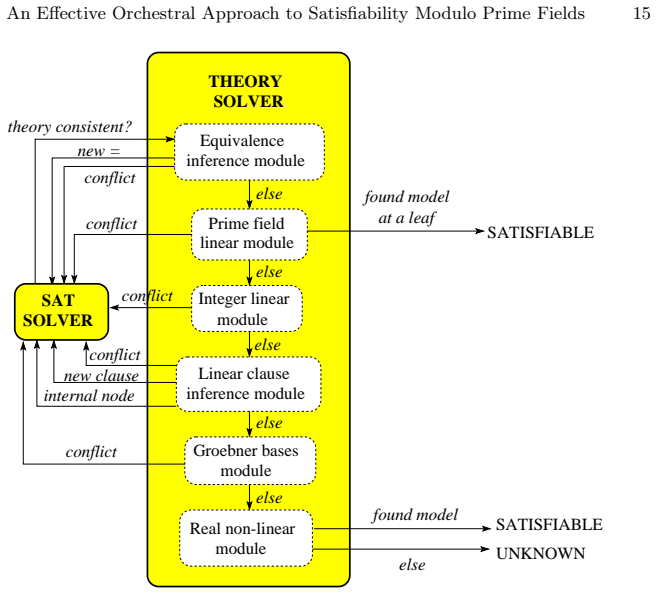
The central claim is that an orchestral theory solver, which dynamically coordinates several modules offering distinct completeness-efficiency trade-offs, can decide the satisfiability of existentially quantified first-order formulas over polynomial equations in a prime field while preserving soundness and completeness and delivering measurable performance gains over existing state-of-the-art solvers on ZKP-related benchmarks.
What carries the argument
The orchestral theory solver, which coordinates multiple modules that trade off completeness against efficiency when handling polynomial constraints modulo a prime.
If this is right
- The approach yields better run times than existing SMT solvers on benchmarks from ZKP compiler correctness checking.
- It also improves performance on newly generated benchmarks arising from arithmetic-circuit verification for zero-knowledge proofs.
- Soundness and completeness of the overall procedure are maintained by the orchestration design.
- The method directly supports more scalable formal verification of privacy-preserving blockchain protocols.
Where Pith is reading between the lines
- The same orchestration pattern could be ported to other SMT theories that involve large finite domains, such as modular arithmetic in cryptography.
- Adding further lightweight modules might extend the technique to still larger prime fields without redesigning the core loop.
- The technique suggests a general template for composing incomplete but fast procedures with complete but slower ones inside any DPLL(T) framework.
Load-bearing premise
The modules can be combined under a single theory solver without introducing unsound decisions or losing completeness on the target class of formulas.
What would settle it
A concrete polynomial system over a prime field, drawn from a ZKP circuit verification task, on which the prototype either returns an incorrect satisfiability verdict or fails to terminate faster than the best competing solver.
Figures
read the original abstract
Zero-knowledge proofs (ZKPs) are an emerging technology that has become the solution to efficiently provide security and privacy along with the transparency requirement of blockchains. ZKPs are usually expressed by means of arithmetic circuits and, more generally, systems of polynomial equations in a large prime field (commonly ranging from 64-bit to 256-bit values). An increasing interest to apply formal verification techniques to ensure soundness and completeness properties of ZKP protocols has shown the need of developing powerful SMT solvers able to handle such constraint systems. In this paper we consider the problem of deciding the satisfiability of existentially quantified first-order formulas defined over polynomial equations on a prime field. We present a new DPLL($T$)-based approach in which the theory solver orchestrates several modules with different trade-offs between completeness and efficiency. We have implemented the proposed techniques in a prototype that already shows better results than existing state-of-the-art tools on both benchmarks from the domain of ZKP compiler correctness and new benchmarks coming from the verification of arithmetic circuits for ZKPs. \keywords{SMT \and Finite field \and Polynomials \and Zero-Knowledge Proofs.
Editorial analysis
A structured set of objections, weighed in public.
Referee Report
Summary. The paper proposes a DPLL(T)-based SMT solver for satisfiability of existentially quantified first-order formulas consisting of polynomial equations over prime fields. The central contribution is an 'orchestral' theory solver that coordinates multiple modules with differing completeness-efficiency trade-offs. A prototype implementation is reported to outperform existing state-of-the-art tools on benchmarks drawn from ZKP compiler correctness checking and arithmetic-circuit verification for zero-knowledge proofs.
Significance. If the orchestration protocol can be shown to preserve soundness and completeness, the work would offer a practical advance in SMT solving for finite fields, directly supporting formal verification of ZKP systems. The domain-specific benchmarks and reported performance gains are relevant strengths; however, the absence of a detailed conflict-resolution mechanism makes it impossible to assess whether the empirical improvements rest on a sound foundation.
major comments (1)
- The description of the DPLL(T) theory solver (abstract and §3): the claim that orchestrating modules with different completeness levels preserves overall soundness and completeness is load-bearing for the central result, yet no account is given of how conflicts between an incomplete module's lemma/decision and a complete module's result are resolved, how explanations are combined, or how backtracking is performed. Without this protocol the reported speedups on ZKP benchmarks cannot be verified to be sound.
Simulated Author's Rebuttal
We thank the referee for the careful review and constructive feedback. We address the major comment on the orchestration protocol below and will revise the manuscript to strengthen the presentation of soundness and completeness.
read point-by-point responses
-
Referee: The description of the DPLL(T) theory solver (abstract and §3): the claim that orchestrating modules with different completeness levels preserves overall soundness and completeness is load-bearing for the central result, yet no account is given of how conflicts between an incomplete module's lemma/decision and a complete module's result are resolved, how explanations are combined, or how backtracking is performed. Without this protocol the reported speedups on ZKP benchmarks cannot be verified to be sound.
Authors: We agree that a detailed account of the conflict-resolution protocol is necessary to substantiate the central claim. The current manuscript provides only a high-level overview in Section 3. In the revised version we will expand this section with a precise description of the orchestration protocol, including: priority rules that ensure complete modules override incomplete ones on conflicts; a lemma-combination procedure that merges explanations while preserving consistency; and an integrated backtracking mechanism within the DPLL(T) framework that propagates conflicts without violating overall soundness or completeness. This addition will make the empirical results on ZKP benchmarks verifiable on a sound foundation. revision: yes
Circularity Check
No significant circularity; derivation builds on standard DPLL(T) without reduction to inputs
full rationale
The paper introduces an orchestration of theory solver modules within a DPLL(T) framework for satisfiability over prime fields, targeting ZKP circuit verification. No load-bearing step reduces by construction to a fitted parameter, self-definition, or self-citation chain; the approach extends established SMT techniques with new module coordination for completeness/efficiency trade-offs, and performance claims rest on prototype implementation and benchmark comparisons rather than renaming or ansatz smuggling. The central soundness claim for the overall solver is presented as following from the DPLL(T) architecture, with no evidence that it collapses to the paper's own inputs or prior self-referential results.
Axiom & Free-Parameter Ledger
axioms (2)
- standard math DPLL(T) framework correctly combines propositional reasoning with theory-specific solvers for decidable fragments.
- domain assumption Polynomial equations over prime fields admit effective decision procedures when combined with appropriate theory solvers.
Reference graph
Works this paper leans on
-
[1]
Ábrahám, E., Davenport, J.H., England, M., Kremer, G.: De ciding the consistency of non-linear real arithmetic constraints wit h a conflict driven search using cylindrical algebraic coverings. J. Log. Alge braic Methods Program. 119, 100633 (2021). https://doi.org/10.1016/J.JLAMP.2020. 100633, https://doi.org/10.1016/j.jlamp.2020.100633
-
[3]
IEEE Transactions on Dependable and Secure Computing 20(6), 4733–4751 (2023)
Bellés-Muñoz, M., Isabel, M., Muñoz-Tapia, J.L., Rubio, A., Baylina, J.: Circom: A circuit description language for building zero-knowledg e applications. IEEE Transactions on Dependable and Secure Computing 20(6), 4733–4751 (2023). https://doi.org/10.1109/TDSC.2022.3232813
-
[4]
Bigatti, A.M., Robbiano, L.: Cocoa: a system for computat ions in com- mutative algebra. In: Trager, B.M. (ed.) Symbolic and Algeb raic Com- putation, International Symposium, ISSAC 2006, Genoa, Ita ly, July 9-12, 2006, Proceedings. p. 6. ACM (2006). https://doi.org/10.1 145/1145768.1145774, https://doi.org/10.1145/1145768.1145774
-
[5]
Bjørner, N.S., Nachmanson, L.: Arithmetic solving in Z3. In: Gurfinkel, A., Ganesh, V. (eds.) Computer Aided Verification - 36th Interna tional Confer- ence, CA V 2024, Montreal, QC, Canada, July 24-27, 2024, Proc eedings, Part I. Lecture Notes in Computer Science, vol. 14681, pp. 26–41. Springer (2024). https://doi.org/10.1007/978-3-031-65627-9\_2, https: ...
-
[7]
Borralleras, C., Larraz, D., Rodríguez-Carbonell, E., O liveras, A., Rubio, A.: In- complete SMT techniques for solving non-linear formulas ov er the integers. ACM Trans. Comput. Log. 20(4), 25:1–25:36 (2019). https://doi.org/10.1145/334092 3, https://doi.org/10.1145/3340923
-
[8]
Brezhniev, O., Baylina, J., Gurkan, K., Rubio, A., Cube, A ., Ben-Reuven, E., Milenkovic, M., Pertsev, A., Bellés-Muñoz, M., Miller, P., Semenov, R.: Circomlib, https://github.com/iden3/circomlib
-
[9]
ACM Transactions on Computational Logic19(3), 1–52 (Jul 2018).https://doi.org/10.1145/3230639
Cimatti, A., Griggio, A., Irfan, A., Roveri, M., Sebastia ni, R.: Incremental lin- earization for satisfiability and verification modulo nonli near arithmetic and transcendental functions. ACM Trans. Comput. Log. 19(3), 19:1–19:52 (2018). https://doi.org/10.1145/3230639, https://doi.org/10.1145/3230639 An Effective Orchestral Approach to Satisfiability Modulo...
-
[10]
McGraw-Hill Higher Education, 2nd edn
Cormen, T.H., Stein, C., Rivest, R.L., Leiserson, C.E.: Introduction to Algorithms. McGraw-Hill Higher Education, 2nd edn. (2001)
2001
-
[11]
Springer (1991)
Cox, D., Little, J., O’Shea, D.: Ideals, Varieties and Al gorithms: An Introduction to Computational Algebraic Geometry and Commutative Algeb ra. Springer (1991)
1991
-
[12]
Dutertre, B., de Moura, L.M.: A fast linear-arithmetic s olver for DPLL(T). In: Ball, T., Jones, R.B. (eds.) Computer Aided Verification , 18th Interna- tional Conference, CA V 2006, Seattle, W A, USA, August 17-20 , 2006, Proceed- ings. Lecture Notes in Computer Science, vol. 4144, pp. 81–9 4. Springer (2006). https://doi.org/10.1007/11817963\_11, https:/...
-
[13]
In: Proceedings of the 2002 Internatio nal Symposium on Sym- bolic and Algebraic Computation
Faugère, J.C.: A new efficient algorithm for computing grö bner bases without re- duction to zero (f5). In: Proceedings of the 2002 Internatio nal Symposium on Sym- bolic and Algebraic Computation. p. 75–83. ISSAC ’02, Assoc iation for Computing Machinery, New York, NY, USA (2002). https://doi.org/10.1 145/780506.780516, https://doi.org/10.1145/780506.780516
-
[14]
Journal of Pure and Applied Algebra 139(1), 61–88 (1999)
Faugère, J.C.: A new efficient algorithm for computing grö bner bases (f4). Journal of Pure and Applied Algebra 139(1), 61–88 (1999). https://doi.org/https://doi.org/10.1016/S002 2-4049(99)00005-5, https://www.sciencedirect.com/science/article/pii/S0022404999000055
-
[15]
Fränzle, M., Herde, C., Teige, T., Ratschan, S., Schuber t, T.: Efficient solving of large non-linear arithmetic constraint systems with complex boolean structure. J. Satisf. Boolean Model. Comput. 1(3-4), 209–236 (2007). https://doi.org/10.3233/SAT190012, https://doi.org/10.3233/sat190012
-
[16]
A vailable at http://www2.macaulay2.com
Grayson, D.R., Stillman, M.E.: Macaulay2, a software sy stem for research in alge- braic geometry. A vailable at http://www2.macaulay2.com
-
[17]
Griggio, A.: A practical approach to satisability modul o linear inte- ger arithmetic. J. Satisf. Boolean Model. Comput. 8(1/2), 1–27 (2012). https://doi.org/10.3233/SAT190086, https://doi.org/10.3233/sat190086
-
[18]
D iploma thesis, Technische Universität Wien (2022)
Hader, T.: Non-linear SMT-reasoning over finite fields. D iploma thesis, Technische Universität Wien (2022). https://doi.org/https://doi.org/10.34726/hss.2022.89445
-
[20]
Hader, T., Kaufmann, D., Kovács, L.: SMT solving over fini te field arithmetic. In: Piskac, R., Voronkov, A. (eds.) LPAR 2023: Proceedings of 24 th International Con- ference on Logic for Programming, Artificial Intelligence a nd Reasoning, Manizales, Colombia, 4-9th June 2023. EPiC Series in Computing, vol. 94 , pp. 238–256. Easy- Chair (2023). https://doi....
-
[21]
In: Déharbe, D., Hyvärinen, A.E.J
Hader, T., Kovács, L.: An SMT approach for solving polyno mials over finite fields. In: Déharbe, D., Hyvärinen, A.E.J. (eds.) Proceedings of th e 20th Internal Work- shop on Satisfiability Modulo Theories co-located with the 1 1th International Joint Conference on Automated Reasoning (IJCAR 2022) part of the 8 th Federated Logic Conference (FLoC 2022), Haifa...
2022
-
[22]
Inc., W.R.: Mathematica, Version 14.3, https://www.wo lfram.com/mathematica, champaign, IL, 2025 22 Authors Suppressed Due to Excessive Length
2025
-
[23]
In: IEEE Symposium on Security a nd Pri- vacy, SP 2024, San Francisco, CA, USA, May 19-23, 2024
Isabel, M., Rodríguez-Núñez, C., Rubio, A.: Scalable ve rification of zero-knowledge protocols. In: IEEE Symposium on Security a nd Pri- vacy, SP 2024, San Francisco, CA, USA, May 19-23, 2024. pp. 1794–1812. IEEE (2024). https://doi.org/10.1109/SP5426 3.2024.00133, https://doi.org/10.1109/SP54263.2024.00133
-
[24]
Jovanovic, D., de Moura, L.: Solving non-linear arithme tic. ACM Commun. Com- put. Algebra 46(3/4), 104–105 (2012). https://doi.org/10.1145/2429135 .2429155, https://doi.org/10.1145/2429135.2429155
-
[25]
Jovanovic, D., de Moura, L.M.: Cutting to the chase - solv ing linear integer arith- metic. J. Autom. Reason. 51(1), 79–108 (2013). https://doi.org/10.1007/S10817- 013-9281-X, https://doi.org/10.1007/s10817-013-9281-x
-
[26]
In: Blanchette, J., Kovács, L., Pattinson, D
Kremer, G., Reynolds, A., Barrett, C.W., Tinelli, C.: Co operating techniques for solving nonlinear real arithmetic in the cvc5 SMT solver (system de- scription). In: Blanchette, J., Kovács, L., Pattinson, D. ( eds.) Automated Reasoning - 11th International Joint Conference, IJCAR 202 2, Haifa, Israel, August 8-10, 2022, Proceedings. Lecture Notes in Comp...
-
[27]
Maplesoft, a division of Waterloo Maple Inc..: Maple, ht tps://hadoop.apache.org
-
[28]
Springer Science & Business Media (2012)
Monagan, M.B., Geddes, K.O., Heal, K.M., Labahn, G., Vor koetter, S.M., Devitt, J., Hansen, M., Redfern, D., Rickard, K., et al.: Maple V Prog ramming Guide: For Release 5. Springer Science & Business Media (2012)
2012
-
[29]
In: Ramakrishnan, C.R., Rehof, J
de Moura, L.M., Bjørner, N.S.: Z3: an efficient SMT solver. In: Ramakrishnan, C.R., Rehof, J. (eds.) Tools and Algorithms for the Construc tion and Analysis of Systems, 14th International Conference, TACAS 2008, Held as Part of the Joint Eu- ropean Conferences on Theory and Practice of Software, ETAP S 2008, Budapest, Hungary, March 29-April 6, 2008. Procee...
-
[30]
In: Giacobazzi, R., Berdine, J., Mastroeni, I
de Moura, L.M., Jovanovic, D.: A model-constructing sat isfiability calculus. In: Giacobazzi, R., Berdine, J., Mastroeni, I. (eds.) Verificat ion, Model Checking, and Abstract Interpretation, 14th International Conferen ce, VMCAI 2013, Rome, Italy, January 20-22, 2013. Proceedings. Lecture Notes in C omputer Science, vol. 7737, pp. 1–12. Springer (2013). ht...
-
[31]
Nieuwenhuis, R., Oliveras, A.: Congruence closure with integer offsets. In: Vardi, M.Y., Voronkov, A. (eds.) Logic for Programming, Art ificial Intelli- gence, and Reasoning, 10th International Conference, LPAR 2003, Almaty, Kaza- khstan, September 22-26, 2003, Proceedings. pp. 78–90. Lec ture Notes in Com- puter Science, Springer (2003). https://doi.org/10...
-
[32]
In: Etessami, K., Rajam ani, S.K
Nieuwenhuis, R., Oliveras, A.: DPLL(T) with exhaustive theory propagation and its application to difference logic. In: Etessami, K., Rajam ani, S.K. (eds.) Com- puter Aided Verification, 17th International Conference, C A V 2005, Edinburgh, Scotland, UK, July 6-10, 2005, Proceedings. Lecture Notes i n Computer Science, vol. 3576, pp. 321–334. Springer (2005...
-
[33]
Microsoft coco: Common objects in contex t
Ozdemir, A., Kremer, G., Tinelli, C., Barrett, C.W.: Sat isfiability mod- ulo finite fields. In: Enea, C., Lal, A. (eds.) Computer Aided V erifica- tion - 35th International Conference, CA V 2023, Paris, Fran ce, July 17-22, An Effective Orchestral Approach to Satisfiability Modulo Pr ime Fields 23 2023, Proceedings, Part II. Lecture Notes in Computer Scien ce,...
work page doi:10.1007/9 2023
-
[34]
Fast semi-iterative finite ele- ment Poisson solvers for tensor core GPUs based on prehandling
Ozdemir, A., Pailoor, S., Bassa, A., Ferles, K., Barrett , C.W., Dillig, I.: Split gröb- ner bases for satisfiability modulo finite fields. In: Gurfinke l, A., Ganesh, V. (eds.) Computer Aided Verification - 36th International Conferenc e, CA V 2024, Montreal, QC, Canada, July 24-27, 2024, Proceedings, Part I. Lecture N otes in Computer Science, vol. 14681, pp...
-
[35]
Pailoor, S., Chen, Y., Wang, F., Rodríguez, C., Van Geffen , J., Morton, J., Chu, M., Gu, B., Feng, Y., Dillig, I.: Automated detection of Unde r-Constrained circuits in Zero-Knowledge proofs. Proc. ACM Program. Lang. 7(PLDI) (Jun 2023)
2023
-
[36]
Mathematische An- nalen 102(1), 520–520 (Dec 1930)
Rabinowitsch, J.L.: Zum hilbertschen nullstellensatz . Mathematische An- nalen 102(1), 520–520 (Dec 1930). https://doi.org/10.1007/BF0178 2361, https://doi.org/10.1007/BF01782361
-
[37]
John Wiley and Sons (1998)
Schrijver, A.: Theory of Linear and Integer Programming . John Wiley and Sons (1998)
1998
-
[38]
In: Proc eedings of the Second Man- itoba Conference on Numerical Mathematics
Shanks, D.: Five number-theoretic algorithms. In: Proc eedings of the Second Man- itoba Conference on Numerical Mathematics. Congressus Num erantium, vol. VII, pp. 51–70. Utilitas Mathematica, Winnipeg, MB, Canada (197 3)
discussion (0)
Sign in with ORCID, Apple, or X to comment. Anyone can read and Pith papers without signing in.