Recognition: no theorem link
Finite-Window Centered Organization of Neighboring Poles
Pith reviewed 2026-05-13 07:30 UTC · model grok-4.3
The pith
Near-degenerate quasinormal modes in finite windows are equivalent to a shared carrier plus a linear time correction term.
A machine-rendered reading of the paper's core claim, the machinery that carries it, and where it could break.
Core claim
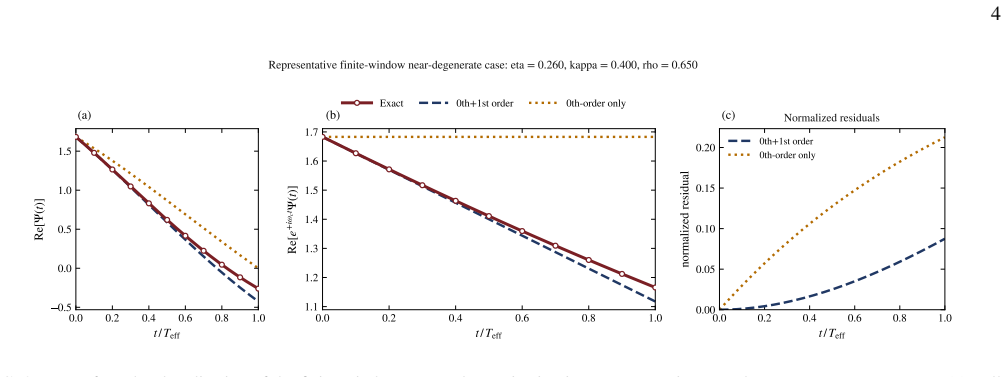
The local two-pole singular block of the Green-function integrand is rewritten exactly about a shared carrier omega_c and half-splitting sigma; for absolute value of sigma t much less than one inside the finite window, the time-domain projection is a carrier plus a first-jet piece proportional to t exp(-i omega_c t) without any literal double pole or exceptional-point merger. The centered first-jet basis then possesses O(1) Gram conditioning, while the resolved-mode basis satisfies cond(G_res) approximately 12 eta to the minus two as eta approaches zero on the transparent real-splitting slice. The same contrast is illustrated for a specific adjacent-overtone pair in Kerr spacetime scanned at
What carries the argument
The centered first-jet basis obtained by rewriting the two-pole Green-function block about a shared carrier frequency omega_c and half-splitting sigma.
If this is right
- The resolved-mode representation becomes unusable once eta falls below roughly 0.3 because its condition number exceeds 100.
- Retaining the first-jet correction reduces the residual error to order eta squared inside the window.
- The diagnostics kappa and eta squared give an analyst an immediate test for whether the jet term is required for a given signal segment.
- The same reorganization applies directly to any chosen adjacent-overtone pair in Kerr ringdown catalogs.
Where Pith is reading between the lines
- Parameter estimation pipelines that fit ringdown data over sliding windows could adopt the jet basis to avoid artificial degeneracies between neighboring overtones.
- Higher-order jet corrections could be derived for sectors containing three or more closely spaced poles.
- The same finite-window centering may improve modal expansions in other open-wave problems where resonances approach one another inside a detector bandwidth.
Load-bearing premise
The local two-pole rewriting and first-jet truncation remain accurate only when the product of half-splitting sigma and time t stays much smaller than one throughout the effective observation window.
What would settle it
Compute the Gram-matrix condition numbers for both the resolved two-mode basis and the centered first-jet basis while driving the dimensionless splitting eta to zero; the claim is settled if the jet basis stays O(1) while the resolved basis grows as twelve over eta squared.
Figures



read the original abstract
Near-degenerate resonance poles arise widely in open-wave systems. For gravitational-wave ringdowns, inference is performed on finite time windows where neighboring quasinormal modes can be spectrally close; the waveform is then dominated by a common carrier with a slowly varying interference envelope, while representing the signal as a sum of two independently resolved damped exponentials $e^{-\ii\omega_\pm t}$ becomes numerically ill-conditioned when the dimensionless splitting $\eta=|\sigma|T_{\mathrm{eff}}$ is small. We give a finite-window organizing principle for such neighboring-pole sectors: the local two-pole singular block of the Green-function integrand is rewritten exactly about a shared carrier $\omega_c$ and half-splitting $\sigma$, and for $|\sigma t|\ll 1$ the time-domain projection is systematically a carrier plus a first-jet piece $\propto t\,e^{-\ii\omega_c t}$, without requiring a literal double pole or exceptional-point merger in parameter space. The centered first-jet basis has $O(1)$ Gram conditioning, whereas the resolved-mode basis satisfies $\mathrm{cond}(G_{\mathrm{res}})\sim 12\,\eta^{-2}$ as $\eta\to 0$ (transparent real-splitting slice). We supply finite-window diagnostics in which $\kappa$ marks when the jet correction must be retained and $\eta^2$ sets the residual error scale once it is retained. Minimal two-pole numerics verify the scaling. For Kerr black holes we fix one adjacent-overtone mode pair (catalog label \texttt{pair45}; shared $(l,m)$ and consecutive overtones in our indexed tabulation), scan spin $a\in[0.8770,0.8810]$, and adopt the spectral window proxy $T_{\mathrm{spec}}=\beta/|\Im\omega_c|$ with $\beta=2.0$ to illustrate the same conditioning contrast in a near-degenerate sector.
Editorial analysis
A structured set of objections, weighed in public.
Referee Report
Summary. The manuscript proposes a finite-window organizing principle for near-degenerate resonance poles in open-wave systems such as gravitational-wave ringdowns. It rewrites the local two-pole singular block of the Green-function integrand exactly about a shared carrier frequency ω_c and half-splitting σ; for |σ t| ≪ 1 inside the effective window T_eff the time-domain projection becomes a carrier plus a first-jet term ∝ t e^{-i ω_c t} without requiring an actual double pole or exceptional-point merger. The centered first-jet basis is shown to have O(1) Gram-matrix conditioning while the resolved-mode basis satisfies cond(G_res) ∼ 12 η^{-2} as η = |σ| T_eff → 0 on the real-splitting slice. Finite-window diagnostics are introduced with κ marking retention of the jet correction and η² setting the residual error; the scalings are verified in a minimal two-pole model and illustrated via a Kerr spin scan (a ∈ [0.8770, 0.8810]) on the adjacent-overtone pair labeled pair45 with spectral-window proxy T_spec = β / |Im ω_c| at β = 2.0.
Significance. If the algebraic centering and controlled small-σt expansion hold, the work supplies a practical, numerically stable basis for fitting neighboring quasinormal modes on finite data segments, directly addressing ill-conditioning that arises in standard resolved-mode analyses of ringdown signals. The explicit conditioning contrast, the κ and η² diagnostics, and the Kerr-pair demonstration are concrete strengths that could be adopted by GW data-analysis pipelines. The approach is parameter-light (only β appears as a free choice) and avoids invoking unphysical coalescence, which increases its utility for realistic near-degenerate sectors.
major comments (2)
- [§3] §3 (derivation of the jet expansion): the Taylor expansion of the oscillatory factors about the centered carrier is stated to yield the first-jet term, but the remainder after the linear term is not bounded explicitly; an O((σ t)^2) error estimate inside the window T_eff is needed to confirm that the residual scales precisely as η² once the jet correction is retained.
- [Kerr scan] Kerr scan paragraph and Table (pair45 results): the factor 12 in cond(G_res) ∼ 12 η^{-2} is quoted for the transparent real-splitting slice, yet the numerical scan at a ∈ [0.8770, 0.8810] reports only qualitative agreement; the manuscript should tabulate the measured condition numbers versus η for at least three spin values so that the prefactor 12 can be verified independently.
minor comments (3)
- [Abstract] Abstract: the label 'pair45' is introduced without a preceding definition or reference to the indexed tabulation; a brief parenthetical or footnote should indicate that it denotes consecutive overtones sharing (l,m).
- [Notation] Notation section: the effective window T_eff is used interchangeably with the proxy T_spec = β / |Im ω_c|; a single sentence clarifying their relation (or the precise definition of T_eff) would remove ambiguity for readers implementing the diagnostics.
- [Figures] Figure captions (minimal two-pole model): the plotted Gram-matrix condition numbers should include the analytic η^{-2} reference curve so that the numerical points can be compared directly to the claimed scaling.
Simulated Author's Rebuttal
We thank the referee for the positive assessment and the detailed comments. We address each major comment below and will revise the manuscript accordingly to incorporate the suggested improvements.
read point-by-point responses
-
Referee: [§3] §3 (derivation of the jet expansion): the Taylor expansion of the oscillatory factors about the centered carrier is stated to yield the first-jet term, but the remainder after the linear term is not bounded explicitly; an O((σ t)^2) error estimate inside the window T_eff is needed to confirm that the residual scales precisely as η² once the jet correction is retained.
Authors: We agree that providing an explicit bound on the remainder term would make the derivation more rigorous. In the revised manuscript, we will apply the Lagrange form of the Taylor remainder to the oscillatory factors e^{-i σ t} and e^{i σ t}, bounding the quadratic term by (σ t)^2 / 2. When integrated against the window function over |t| < T_eff with |σ| T_eff = η, this yields an O(η²) residual error, precisely as stated in the diagnostics. We will add this estimate to §3. revision: yes
-
Referee: [Kerr scan] Kerr scan paragraph and Table (pair45 results): the factor 12 in cond(G_res) ∼ 12 η^{-2} is quoted for the transparent real-splitting slice, yet the numerical scan at a ∈ [0.8770, 0.8810] reports only qualitative agreement; the manuscript should tabulate the measured condition numbers versus η for at least three spin values so that the prefactor 12 can be verified independently.
Authors: We thank the referee for this suggestion to strengthen the numerical verification. In the revised version, we will include a new table (or extended table) reporting the measured cond(G_res) for at least three values of a in the interval [0.8770, 0.8810], together with the corresponding η computed from the spectral window. This will allow direct comparison to the analytic prefactor 12 on the real-splitting slice and confirm the scaling. revision: yes
Circularity Check
No significant circularity detected
full rationale
The central derivation is an exact algebraic re-centering of the two-pole Green-function integrand about a shared carrier ω_c and half-splitting σ, followed by the standard Taylor expansion of the resulting factors for |σ t| ≪ 1 inside the window. This produces the carrier-plus-first-jet form by direct expansion without any parameter fitting, self-definition, or invocation of prior results by the same authors. The Gram conditioning scalings (O(1) for the jet basis versus ∼ η^{-2} for the resolved basis) are immediate algebraic consequences of the basis change on the real-splitting slice and are confirmed by direct numerical evaluation in the minimal two-pole model and the Kerr pair45 scan. No load-bearing step reduces to a fitted input, a self-citation chain, or a renamed known result; the construction is self-contained against external benchmarks.
Axiom & Free-Parameter Ledger
free parameters (1)
- beta
axioms (1)
- domain assumption The local two-pole singular block of the Green-function integrand can be rewritten exactly about a shared carrier ω_c and half-splitting σ
Reference graph
Works this paper leans on
-
[1]
S. K. Özdemir, S. Rotter, F. Nori, and L. Yang, Nat. Mater.18, 783 (2019)
work page 2019
-
[2]
R. El-Ganainy, K. G. Makris, M. Khajavikhan, Z. H. Mussli- mani, S. Rotter, and D. N. Christodoulides, Nat. Phys.14, 11 (2018)
work page 2018
- [3]
-
[4]
W. D. Heiss, Journal of Physics A: Mathematical and Theoreti- cal45, 444016 (2012)
work page 2012
- [5]
-
[6]
E. J. Bergholtz, J. C. Budich, and F. K. Kunst, Rev. Mod. Phys. 93, 015005 (2021)
work page 2021
- [7]
- [8]
-
[9]
K. Ding, C. Fang, and G. Ma, Nat. Rev. Phys.4, 745 (2022)
work page 2022
-
[10]
J. L. Jaramillo, R. P. Macedo, and L. A. Sheikh, Physical Re- view X11, 031003 (2021)
work page 2021
-
[11]
S. Bhagwat, M. Okounkova, S. W. Ballmer, D. A. Brown, M. Giesler, M. A. Scheel, and S. A. Teukolsky, Physical Re- view D97, 104065 (2018)
work page 2018
-
[12]
H. Yang, F. Zhang, A. Zimmerman, D. A. Nichols, E. Berti, and Y . Chen, Physical Review D87, 041502 (2013)
work page 2013
-
[13]
H. Yang, A. Zimmerman, A. Zengino ˘glu, F. Zhang, E. Berti, and Y . Chen, Physical Review D88, 044047 (2013)
work page 2013
-
[14]
J. P. Cavalcante, M. Richartz, and B. C. da Cunha, Physical Review Letters133, 261401 (2024)
work page 2024
-
[15]
J. P. Cavalcante, M. Richartz, and B. C. da Cunha, Physical Review D110, 124064 (2024)
work page 2024
-
[16]
Pair-Dependent Drift of Kerr Neighboring-Overtone Gap Minima
Y . Wu and H.-B. Jin, arXiv e-printsarXiv:2604.24584(2026), arXiv:2604.24584 [gr-qc]
work page internal anchor Pith review Pith/arXiv arXiv 2026
-
[17]
Motohashi, Physical Review Letters134, 141401 (2025)
H. Motohashi, Physical Review Letters134, 141401 (2025)
work page 2025
-
[18]
R. K. L. Lo, L. Sabani, and V . Cardoso, Physical Review D111, 124002 (2025)
work page 2025
-
[19]
Y . Yang, E. Berti, and N. Franchini, Physical Review Letters 135, 201401 (2025)
work page 2025
- [20]
- [21]
-
[22]
S.˜Chandrasekhar,The Mathematical Theory of Black Holes (Oxford University Press, New York, 1985)
work page 1985
-
[23]
E. W. Leaver, Proceedings of the Royal Society of London. A. Mathematical and Physical Sciences402, 285 (1985)
work page 1985
- [24]
- [25]
-
[26]
T. A. Clarke, M. Isi, P. D. Lasky, E. Thrane, M. Boyle, N. Deppe, L. E. Kidder, K. Mitman, J. Moxon, K. C. Nelli, W. Throwe, and N. L. Vu, Phys. Rev. D109, 124030 (2024)
work page 2024
discussion (0)
Sign in with ORCID, Apple, or X to comment. Anyone can read and Pith papers without signing in.