Recognition: unknown
Conditional diffusion denoising probabilistic model for super-resolution of atmospheric boundary layer large eddy simulation
Pith reviewed 2026-05-07 11:37 UTC · model grok-4.3
The pith
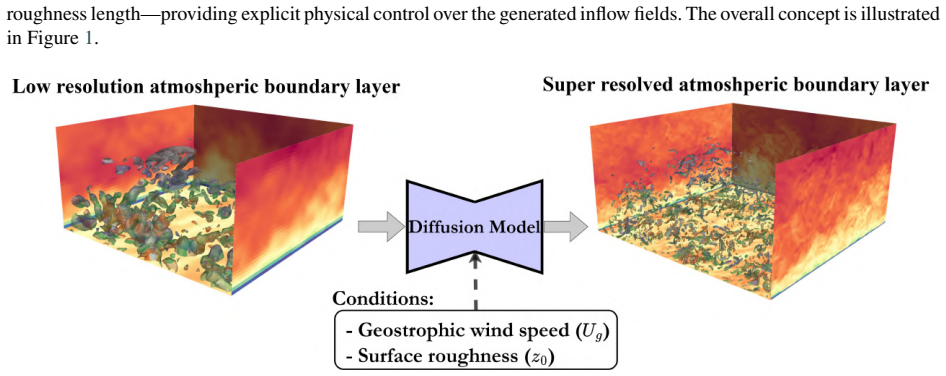
A conditional diffusion model reconstructs fine-scale turbulence and stresses from coarse atmospheric boundary layer simulations inside its training range.
A machine-rendered reading of the paper's core claim, the machinery that carries it, and where it could break.
Core claim
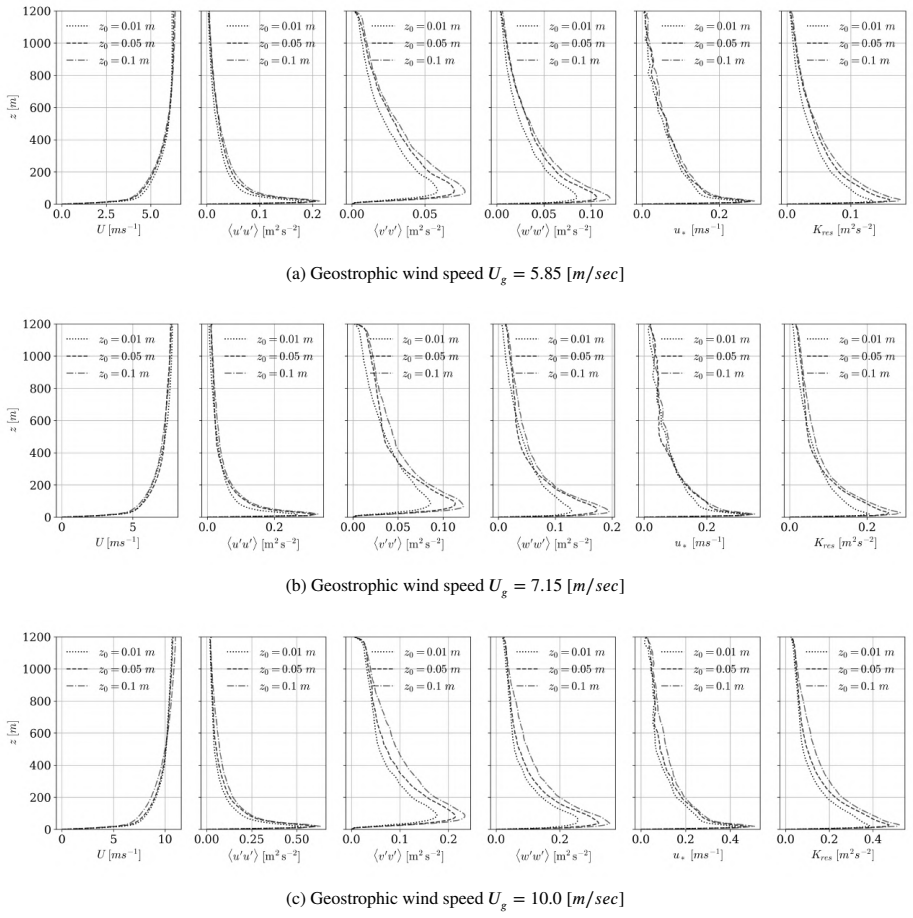
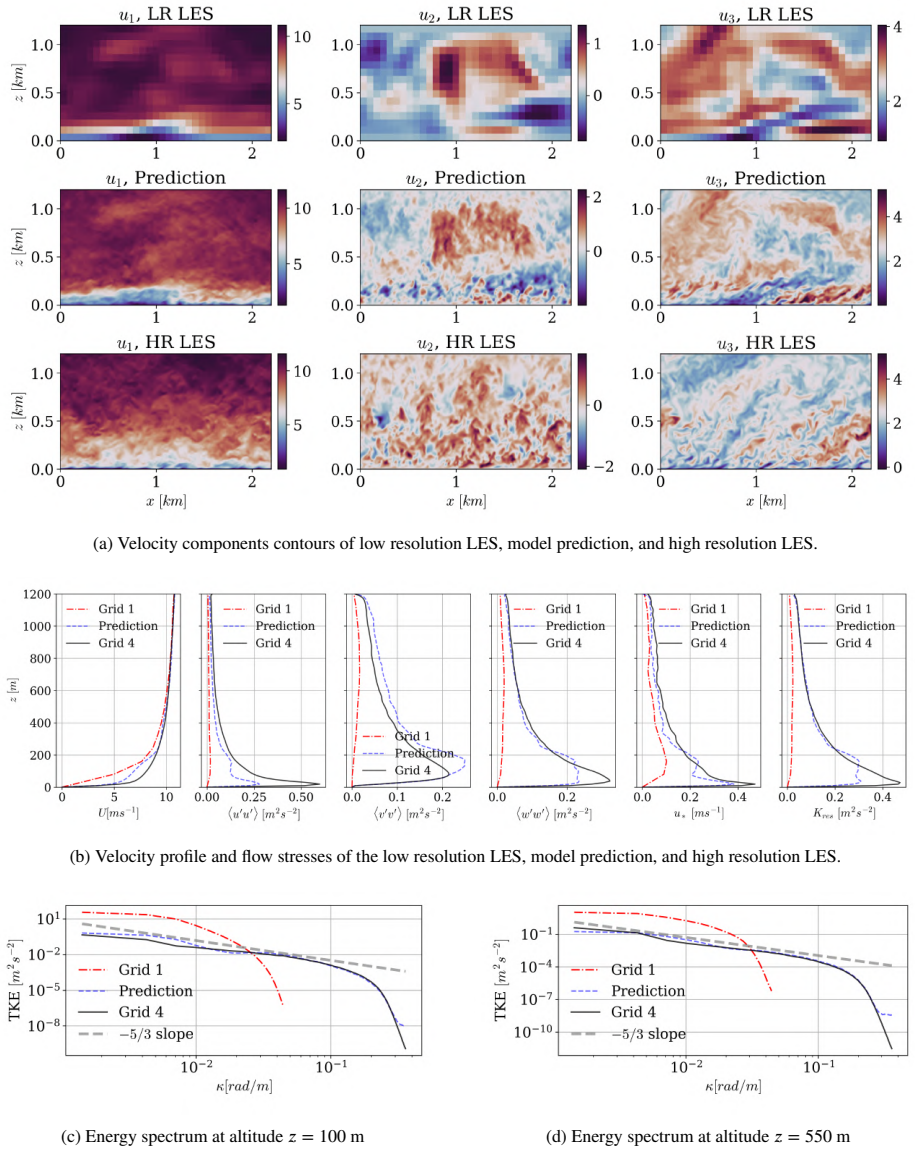
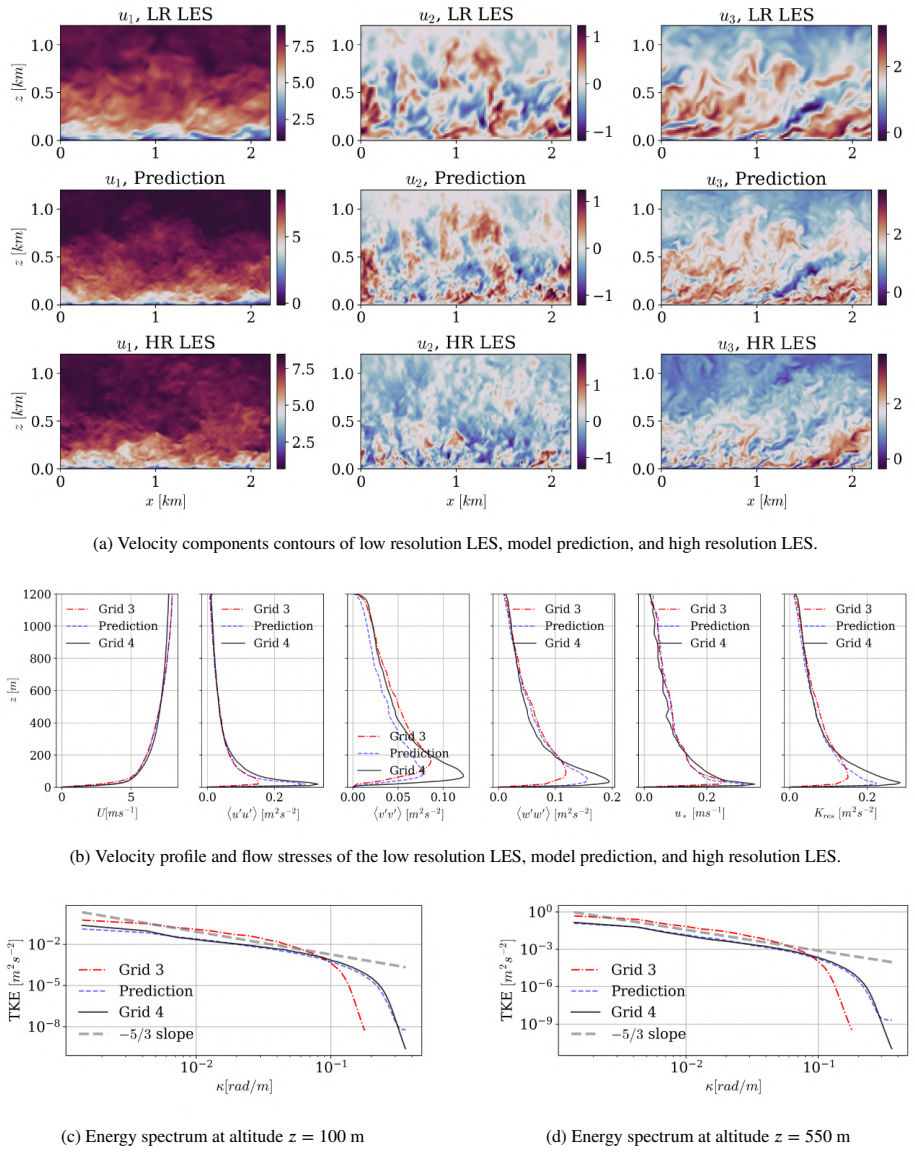
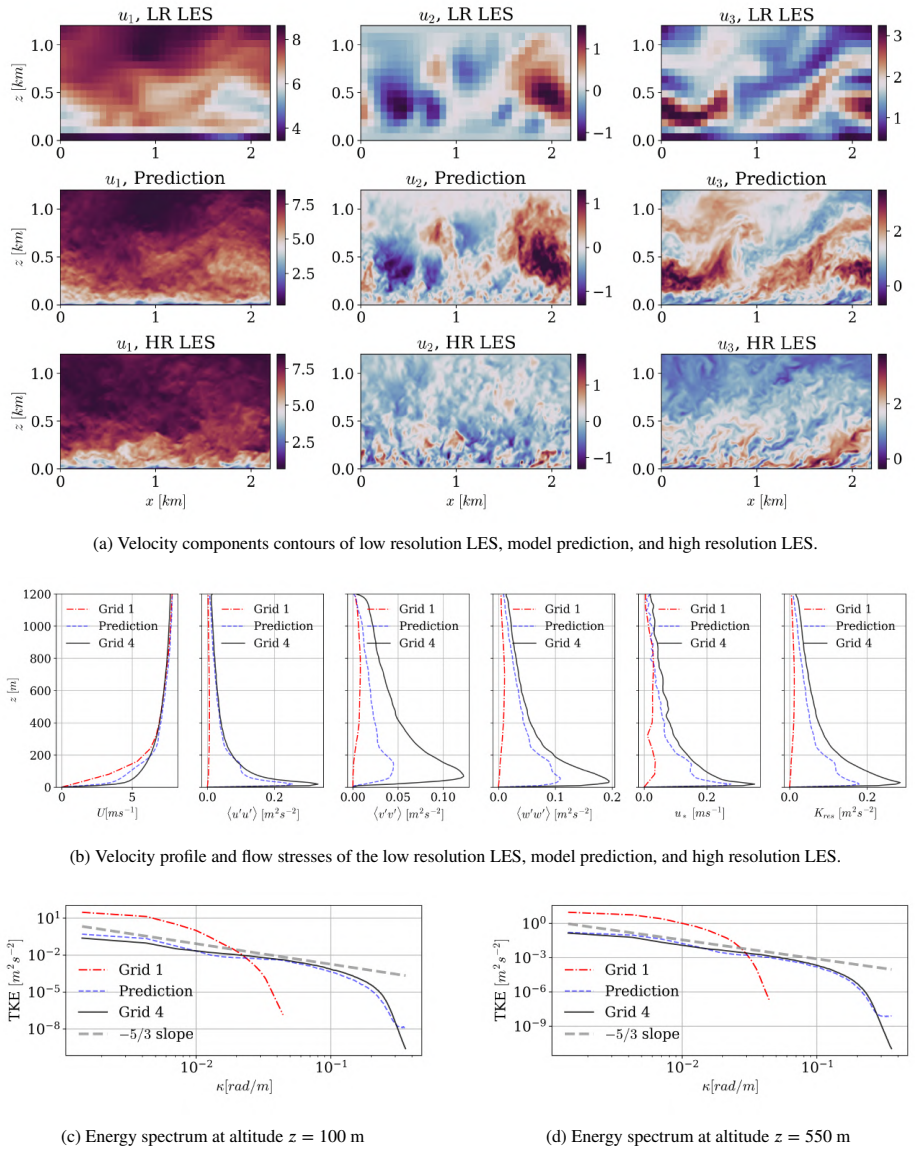
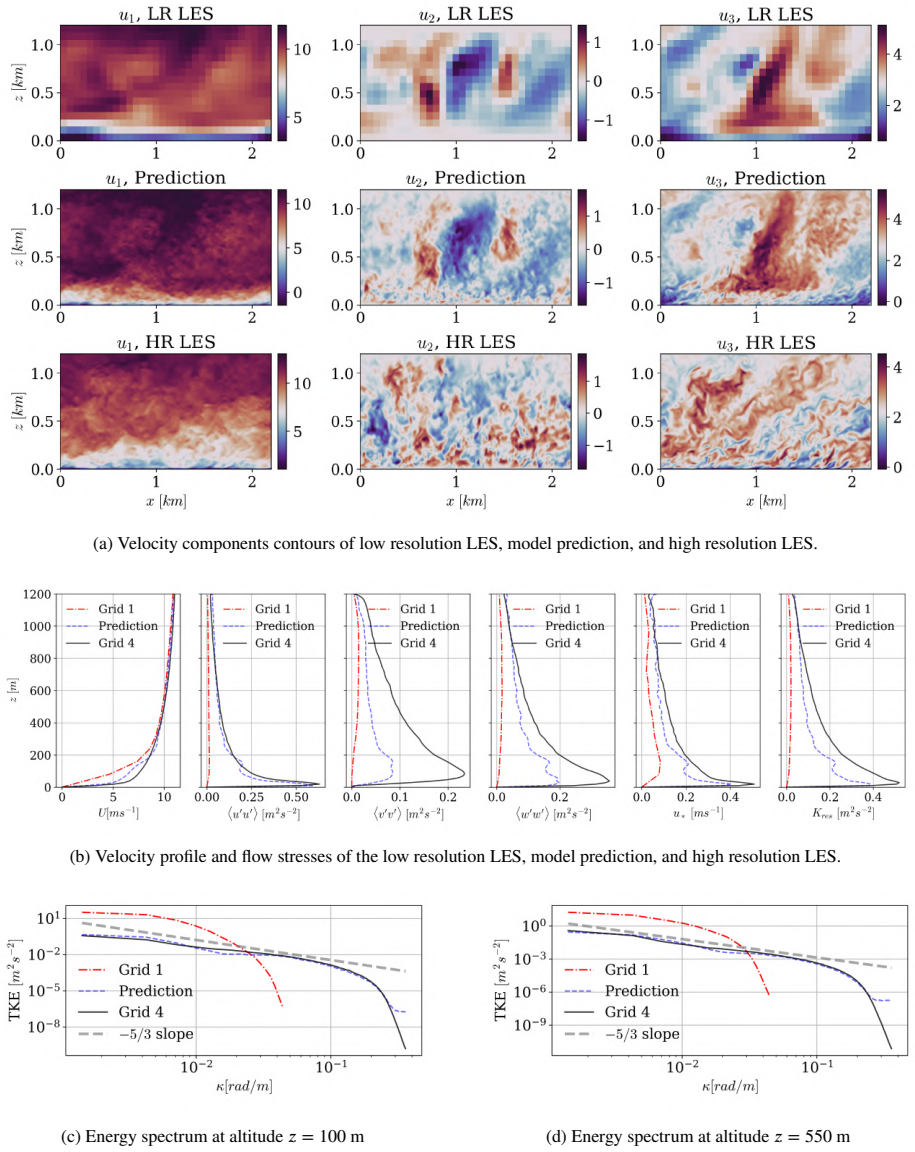
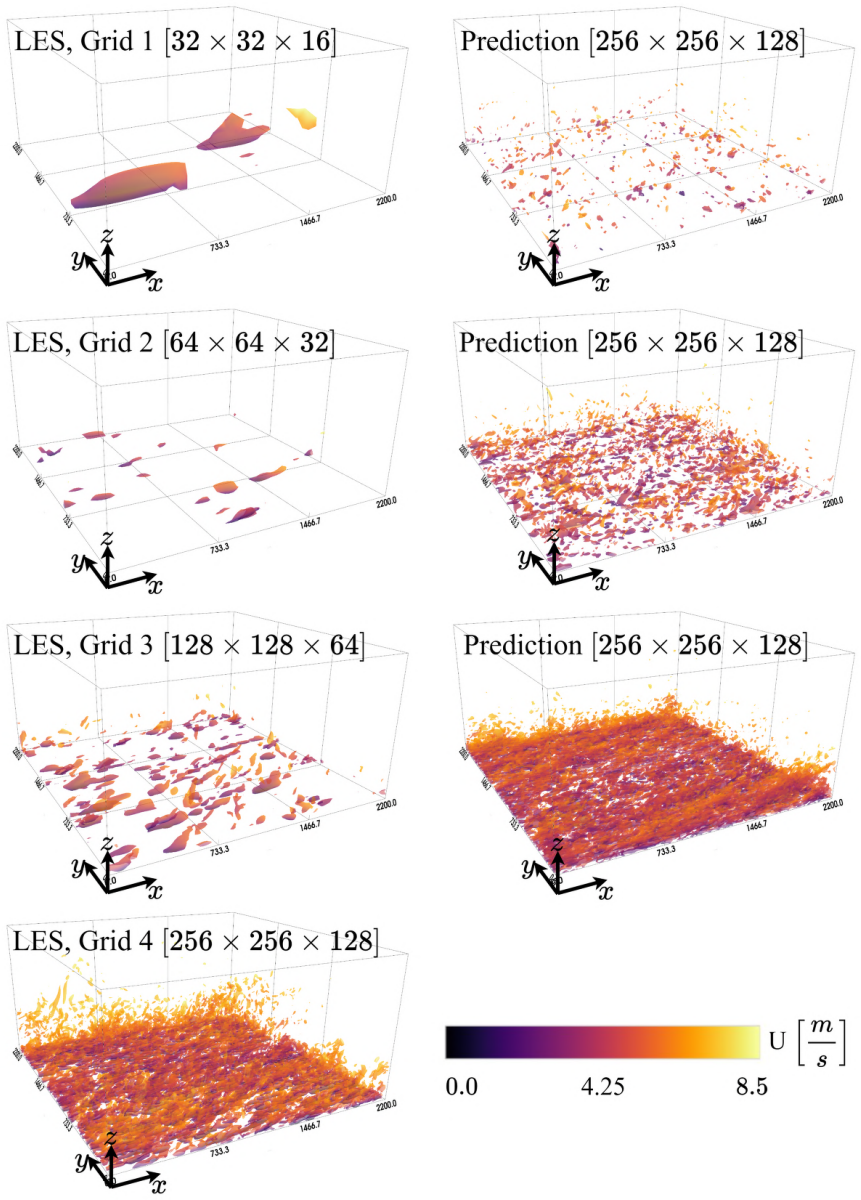
A conditional denoising diffusion probabilistic model is trained on high-fidelity LES datasets generated across varying geostrophic wind speeds and surface roughnesses aligned with IEC wind classes. In interpolation cases the model reconstructs fine-scale turbulent structures and maintains statistical consistency including Reynolds stresses. Extrapolation to higher wind speeds produces increased noise and overprediction of turbulent stresses.
What carries the argument
Conditional denoising diffusion probabilistic model conditioned on coarse-resolution LES fields to generate high-resolution atmospheric boundary layer turbulence.
If this is right
- Reduces the computational cost of generating turbulent inflow conditions for wind-energy load and power predictions.
- Preserves physical consistency in fine-scale structures and Reynolds stresses within the training domain.
- Supports super-resolution at multiple scale factors while staying inside the trained atmospheric conditions.
- Highlights the need for training data that covers the full range of expected wind speeds and roughnesses to avoid noise and stress overprediction.
Where Pith is reading between the lines
- Retraining on a wider set of wind speeds and roughnesses could extend reliable use to more variable atmospheric regimes.
- The same conditioning approach could be tested on super-resolution tasks in other turbulent flows such as channel or ocean simulations.
- Coupling the model with existing LES solvers might enable faster ensemble runs for uncertainty estimates in wind-farm planning.
Load-bearing premise
The distribution of coarse inputs created from the chosen geostrophic wind speeds and surface roughnesses is representative enough for the model to generalize.
What would settle it
Generate an independent high-resolution LES at a geostrophic wind speed outside the training range, downsample it to coarse resolution, pass it through the trained diffusion model, and check whether the output turbulence statistics and structures match the original high-resolution field.
Figures









read the original abstract
Climate change necessitates rapid expansion of renewable energy, with wind energy offering a scalable and low-impact solution. However, accurate prediction of wind loads and power generation remains challenging due to uncertainties in wind shear and turbulence stresses under atmospheric boundary layer (ABL) conditions. High-fidelity Large Eddy Simulations (LES) are typically used to reduce these uncertainties but are computationally expensive and impractical for large-scale or real-time applications. This work addresses this limitation using generative AI, specifically Conditional Denoising Diffusion Probabilistic Models, to reconstruct high-resolution turbulent flow fields from coarse inputs. A high-fidelity dataset is generated using a parallel high-order finite-difference solver across varying geostrophic wind speeds, surface roughness conditions aligned with IEC wind classes, and multiple grid resolutions. The diffusion model is trained for super-resolution across different scale factors and evaluated under interpolation and extrapolation scenarios. Results show accurate recovery of fine-scale turbulent structures, Reynolds stresses, and statistical properties in interpolation cases, indicating strong physical consistency within the training domain. However, extrapolation to higher wind speeds leads to increased noise and overprediction of turbulent stresses, highlighting limitations in generalization. Overall, the study demonstrates that physics-informed generative models can significantly reduce computational cost while maintaining acceptable accuracy, enabling faster and more reliable turbulent inflow characterization for wind energy applications.
Editorial analysis
A structured set of objections, weighed in public.
Referee Report
Summary. The manuscript proposes using conditional denoising diffusion probabilistic models (DDPMs) for super-resolving coarse-resolution large-eddy simulations (LES) of atmospheric boundary layer (ABL) turbulence to high-fidelity fields. It generates training data via a parallel high-order finite-difference solver across multiple geostrophic wind speeds, IEC-aligned surface roughnesses, and grid resolutions. The model is trained for various super-resolution scale factors and assessed in interpolation (within training parameter space) and extrapolation (to higher wind speeds) settings. Key results include accurate reconstruction of fine-scale turbulent structures, Reynolds stresses, and flow statistics for interpolation cases, demonstrating physical consistency, contrasted with degraded performance involving noise and stress overprediction in extrapolation. The work concludes that such AI models can substantially lower computational costs for turbulent inflow characterization in wind energy applications.
Significance. Should the reported physical consistency in interpolation scenarios be confirmed with rigorous quantitative validation, this approach could meaningfully advance renewable energy modeling by providing a computationally efficient alternative to full high-resolution LES for generating realistic turbulent inflows. The application of conditional diffusion models to ABL flows represents a timely integration of generative AI with fluid dynamics, potentially scalable to real-time predictions. The explicit acknowledgment of extrapolation limitations is a strength, though it underscores the importance of expanding the training distribution for broader utility.
major comments (2)
- [Abstract] Abstract (final paragraph): The claim of 'accurate recovery of fine-scale turbulent structures, Reynolds stresses, and statistical properties in interpolation cases' indicating 'strong physical consistency' lacks any reported quantitative metrics such as error norms on velocity fields or stresses, spectral comparisons, or baseline method results; without these, and given the documented degradation under extrapolation to higher wind speeds, it is unclear if the interpolation performance reflects robust recovery or simply close overlap with the limited training parameter combinations.
- [Abstract] Dataset generation (described in abstract): The high-fidelity dataset is generated 'across varying geostrophic wind speeds, surface roughness conditions aligned with IEC wind classes, and multiple grid resolutions' but no explicit ranges, discrete values, number of cases, or sampling strategy are provided; this detail is load-bearing for the interpolation claim because the abstract already shows sensitivity to shifts in wind speed, raising the possibility that reported success depends on dense coverage of the chosen conditions rather than generalization within the domain.
minor comments (1)
- [Abstract] The abstract would be clearer if it included at least one concrete quantitative indicator (e.g., a typical relative error on Reynolds stresses) alongside the qualitative statements of accuracy.
Simulated Author's Rebuttal
We thank the referee for the constructive comments on our manuscript. We address each major comment point by point below and have revised the abstract to improve clarity and support for the claims, as detailed in the responses.
read point-by-point responses
-
Referee: [Abstract] Abstract (final paragraph): The claim of 'accurate recovery of fine-scale turbulent structures, Reynolds stresses, and statistical properties in interpolation cases' indicating 'strong physical consistency' lacks any reported quantitative metrics such as error norms on velocity fields or stresses, spectral comparisons, or baseline method results; without these, and given the documented degradation under extrapolation to higher wind speeds, it is unclear if the interpolation performance reflects robust recovery or simply close overlap with the limited training parameter combinations.
Authors: We agree that the abstract, as a concise summary, would benefit from explicit reference to quantitative support for the interpolation results. The full manuscript reports these metrics (L2 norms on velocity and stress fields, spectral comparisons, and baseline comparisons) in the results section. We have revised the abstract to include a brief statement referencing the key quantitative findings for interpolation cases, such as low error norms and spectral agreement, to better substantiate the physical consistency claim while retaining the contrast with extrapolation performance. revision: yes
-
Referee: [Abstract] Dataset generation (described in abstract): The high-fidelity dataset is generated 'across varying geostrophic wind speeds, surface roughness conditions aligned with IEC wind classes, and multiple grid resolutions' but no explicit ranges, discrete values, number of cases, or sampling strategy are provided; this detail is load-bearing for the interpolation claim because the abstract already shows sensitivity to shifts in wind speed, raising the possibility that reported success depends on dense coverage of the chosen conditions rather than generalization within the domain.
Authors: We acknowledge that the abstract omits specific parameter details, which are provided in the methods section of the full manuscript. To address the concern about transparency for the interpolation claim, we have revised the abstract to include a concise summary of the ranges, discrete values, and number of cases used in dataset generation. This clarifies the sampling within the training domain without altering the manuscript's core findings. revision: yes
Circularity Check
No significant circularity; derivation chain is self-contained
full rationale
The paper generates LES datasets from chosen geostrophic winds and IEC-aligned roughnesses, trains a conditional diffusion model for super-resolution, and reports empirical metrics on held-out interpolation/extrapolation cases. No equations reduce performance metrics (turbulent structures, Reynolds stresses) to quantities defined by the same fitted parameters; training and test splits are described as separate. No self-citations serve as load-bearing uniqueness theorems, no ansatzes are smuggled, and no predictions are statistically forced by construction. The central claims rest on independent evaluation rather than definitional equivalence.
Axiom & Free-Parameter Ledger
free parameters (1)
- diffusion model architecture and training hyperparameters
axioms (1)
- domain assumption Coarse-grid fields contain sufficient statistical information to reconstruct fine-scale turbulence statistics
Reference graph
Works this paper leans on
-
[1]
Energy Information Administration, Where greenhouse gases come from, accessed: 2025-02-21 (n.d.)
U.S. Energy Information Administration, Where greenhouse gases come from, accessed: 2025-02-21 (n.d.). URL https://www.eia.gov/energyexplained/energy-and-the-environment/ where-greenhouse-gases-come-from.php
2025
-
[2]
URL https://www.nrel.gov/wind/offshore-supply-chain-road-map.html
National Renewable Energy Laboratory, A supply chain road map for offshore wind energy in the united states, accessed: 2025-02-21 (January 2023). URL https://www.nrel.gov/wind/offshore-supply-chain-road-map.html
2025
-
[3]
URL https://cleanpower.org/facts/wind-power/
American Clean Power Association, Wind power facts and statistics, accessed: 2025-02-21 (n.d.). URL https://cleanpower.org/facts/wind-power/
2025
-
[4]
A. N. Robertson, K. Shaler, L. Sethuraman, J. Jonkman, Sensitivity analysis of the effect of wind characteristics and turbine properties on wind turbine loads, Wind Energy Science 4 (3) (2019) 479–513
2019
-
[5]
Jonkman, Definition of a 5-mw reference wind turbine for offshore system development, National Renewable Energy Laboratory (2009)
J. Jonkman, Definition of a 5-mw reference wind turbine for offshore system development, National Renewable Energy Laboratory (2009)
2009
-
[6]
B. J. Stanislawski, R. Thedin, A. Sharma, E. Branlard, G. Vijayakumar, M. A. Sprague, Effect of the integral length scales of turbulent inflows on wind turbine loads, Renewable Energy 217 (2023) 119218
2023
-
[7]
35, 2021, pp
T.Yu,Y.Yang,D.Li,T.Hospedales,T.Xiang,Simpleandeffectivestochasticneuralnetworks,in:Proceedings of the AAAI Conference on Artificial Intelligence, Vol. 35, 2021, pp. 3252–3260
2021
-
[8]
G. E. Karniadakis, I. G. Kevrekidis, L. Lu, P. Perdikaris, S. Wang, L. Yang, Physics-informed machine learning, Nature Reviews Physics 3 (6) (2021) 422–440
2021
-
[9]
Cuomo, V
S. Cuomo, V. S. Di Cola, F. Giampaolo, G. Rozza, M. Raissi, F. Piccialli, Scientific machine learning through physics–informedneuralnetworks:Whereweareandwhat’snext,JournalofScientificComputing92(3)(2022) 88
2022
-
[10]
J. Ho, A. Jain, P. Abbeel, Denoising diffusion probabilistic models, Advances in neural information processing systems 33 (2020) 6840–6851
2020
-
[11]
L. Yang, Z. Zhang, Y. Song, S. Hong, R. Xu, Y. Zhao, W. Zhang, B. Cui, M.-H. Yang, Diffusion models: A comprehensive survey of methods and applications, ACM Computing Surveys 56 (4) (2023) 1–39
2023
- [12]
-
[13]
Stoll, J
R. Stoll, J. A. Gibbs, S. T. Salesky, W. Anderson, M. Calaf, Large-eddy simulation of the atmospheric boundary layer, Boundary-Layer Meteorology 177 (2020) 541–581
2020
-
[14]
Smagorinsky, General circulation experiments with the primitive equations: I
J. Smagorinsky, General circulation experiments with the primitive equations: I. the basic experiment, Monthly weather review 91 (3) (1963) 99–164
1963
-
[15]
D.K.Lilly,Therepresentationofsmall-scaleturbulenceinnumericalsimulationexperiments,in:Proc.IBMsci. comput. symp. on environmental science, 1967, pp. 195–210
1967
-
[16]
Kosović, Subgrid-scale modelling for the large-eddy simulation of high-reynolds-number boundary layers, Journal of Fluid Mechanics 336 (1997) 151–182
B. Kosović, Subgrid-scale modelling for the large-eddy simulation of high-reynolds-number boundary layers, Journal of Fluid Mechanics 336 (1997) 151–182
1997
-
[17]
F. K. Chow, R. L. Street, M. Xue, J. H. Ferziger, Explicit filtering and reconstruction turbulence modeling for large-eddy simulation of neutral boundary layer flow, Journal of the atmospheric sciences 62 (7) (2005) 2058– 2077
2005
-
[18]
Wurps, G
H. Wurps, G. Steinfeld, S. Heinz, Grid-resolution requirements for large-eddy simulations of the atmospheric boundary layer, Boundary-Layer Meteorology 175 (2) (2020) 179–201. Omar Sallam et al.:Preprint submitted to Elsevier Page 36 of 38
2020
-
[19]
Ennis, C
J.D.Mirocha,M.J.Churchfield,D.Muñoz-Esparza,R.K.Rai,Y.Feng,B.Kosović,S.E.Haupt,B.Brown,B.L. Ennis, C. Draxl, et al., Large-eddy simulation sensitivities to variations of configuration and forcing parameters in canonical boundary-layer flows for wind energy applications, Wind Energy Science 3 (2) (2018) 589–613
2018
-
[20]
Watanabe, Large-eddy simulation of coherent turbulence structures associated with scalar ramps over plant canopies, Boundary-Layer Meteorology 112 (2004) 307–341
T. Watanabe, Large-eddy simulation of coherent turbulence structures associated with scalar ramps over plant canopies, Boundary-Layer Meteorology 112 (2004) 307–341
2004
-
[21]
Bohrer, G
G. Bohrer, G. G. Katul, R. L. Walko, R. Avissar, Exploring the effects of microscale structural heterogeneity of forest canopies using large-eddy simulations, Boundary-layer meteorology 132 (2009) 351–382
2009
-
[22]
W. C. Skamarock, J. B. Klemp, J. Dudhia, D. O. Gill, D. M. Barker, M. G. Duda, X.-Y. Huang, W. Wang, J. G. Powers, et al., A description of the advanced research wrf version 3, NCAR technical note 475 (125) (2008) 10–5065
2008
-
[23]
Churchfield, S
M. Churchfield, S. Lee, P. Moriarty, Overview of the simulator for wind farm application (sowfa), National Renewable Energy Laboratory 375 (2012)
2012
-
[24]
J. A. Sauer, D. Muñoz-Esparza, J. M. Canfield, K. R. Costigan, R. R. Linn, Y.-J. Kim, A large-eddy simulation study of atmospheric boundary layer influence on stratified flows over terrain, Journal of the Atmospheric Sciences 73 (7) (2016) 2615–2632
2016
-
[25]
P. P. Sullivan, E. G. Patton, The effect of mesh resolution on convective boundary layer statistics and structures generated by large-eddy simulation, Journal of the Atmospheric Sciences 68 (10) (2011) 2395–2415
2011
-
[26]
Sallam, M
O. Sallam, M. Fürth, Dual scale residual-network for turbulent flow sub grid scale resolving: A prior analysis, Computers & Fluids (2025) 106592
2025
-
[27]
Fukami, K
K. Fukami, K. Fukagata, K. Taira, Super-resolution reconstruction of turbulent flows with machine learning, Journal of Fluid Mechanics 870 (2019) 106–120
2019
-
[28]
Fukami, K
K. Fukami, K. Fukagata, K. Taira, Machine-learning-based spatio-temporal super resolution reconstruction of turbulent flows, Journal of Fluid Mechanics 909 (2021) A9
2021
-
[29]
Fukami, K
K. Fukami, K. Taira, Single-snapshot machine learning for super-resolution of turbulence, Journal of Fluid Mechanics 1001 (2024) A32
2024
-
[30]
H. Kim, J. Kim, S. Won, C. Lee, Unsupervised deep learning for super-resolution reconstruction of turbulence, Journal of Fluid Mechanics 910 (2021) A29
2021
-
[31]
Sanderson, W
G.A.Meehl,W.M.Washington,J.M.Arblaster,A.Hu,H.Teng,J.E.Kay,A.Gettelman,D.M.Lawrence,B.M. Sanderson, W. G. Strand, Climate change projections in cesm1 (cam5) compared to ccsm4, Journal of Climate 26 (17) (2013) 6287–6308
2013
-
[32]
Hersbach, B
H. Hersbach, B. Bell, P. Berrisford, S. Hirahara, A. Horányi, J. Muñoz-Sabater, J. Nicolas, C. Peubey, R. Radu, D. Schepers, et al., The era5 global reanalysis, Quarterly journal of the royal meteorological society 146 (730) (2020) 1999–2049
2020
-
[33]
Draxl, A
C. Draxl, A. Clifton, B.-M. Hodge, J. McCaa, The wind integration national dataset (wind) toolkit, Applied Energy 151 (2015) 355–366
2015
-
[34]
Baldauf, A
M. Baldauf, A. Seifert, J. Förstner, D. Majewski, M. Raschendorfer, T. Reinhardt, Operational convective-scale numerical weather prediction with the cosmo model: Description and sensitivities, Monthly Weather Review 139 (12) (2011) 3887–3905
2011
-
[35]
Stengel, A
K. Stengel, A. Glaws, D. Hettinger, R. N. King, Adversarial super-resolution of climatological wind and solar data, Proceedings of the National Academy of Sciences 117 (29) (2020) 16805–16815
2020
-
[36]
Buster, B
G. Buster, B. N. Benton, A. Glaws, R. N. King, High-resolution meteorology with climate change impacts from global climate model data using generative machine learning, Nature Energy 9 (7) (2024) 894–906. Omar Sallam et al.:Preprint submitted to Elsevier Page 37 of 38
2024
-
[37]
O.Miralles,D.Steinfeld,O.Martius,A.C.Davison,Downscalingofhistoricalwindfieldsoverswitzerlandusing generative adversarial networks, Artificial Intelligence for the Earth Systems 1 (4) (2022) e220018
2022
-
[38]
H. Lin, J. Tang, S. Wang, S. Wang, G. Dong, Deep learning downscaled high-resolution daily near surface meteorological datasets over east asia, Scientific Data 10 (1) (2023) 890
2023
-
[39]
Ronneberger, P
O. Ronneberger, P. Fischer, T. Brox, U-net: Convolutional networks for biomedical image segmentation, in: Medical image computing and computer-assisted intervention–MICCAI 2015: 18th international conference, Munich, Germany, October 5-9, 2015, proceedings, part III 18, Springer, 2015, pp. 234–241
2015
-
[40]
Sallam, A
O. Sallam, A. Glaws, M. Sanchez-Gomez, G. Deskos, A. Cortiella, R. King, M. Fürth, Tropical cyclone super resolution using conditional diffusion denoising probabilistic model from mesoscale simulation to les, Environmental Research Communications 7 (12) (2025) 125025
2025
-
[41]
Rybchuk, M
A. Rybchuk, M. Hassanaly, N. Hamilton, P. Doubrawa, M. J. Fulton, L. A. Martínez-Tossas, Ensemble flow reconstruction in the atmospheric boundary layer from spatially limited measurements through latent diffusion models, Physics of Fluids 35 (12) (2023)
2023
-
[42]
Y.Cheng,M.G.Giometto,P.Kauffmann,L.Lin,C.Cao,C.Zupnick,H.Li,Q.Li,Y.Huang,R.Abernathey,etal., Deep learning for subgrid-scale turbulence modeling in large-eddy simulations of the convective atmospheric boundary layer, Journal of Advances in Modeling Earth Systems 14 (5) (2022) e2021MS002847
2022
-
[43]
Bartholomew, G
P. Bartholomew, G. Deskos, R. A. Frantz, F. N. Schuch, E. Lamballais, S. Laizet, Xcompact3d: An open-source framework for solving turbulence problems on a cartesian mesh, SoftwareX 12 (2020) 100550
2020
-
[44]
Laizet, E
S. Laizet, E. Lamballais, High-order compact schemes for incompressible flows: A simple and efficient method with quasi-spectral accuracy, Journal of Computational Physics 228 (16) (2009) 5989–6015
2009
-
[45]
International Electrotechnical Commission (IEC), Wind turbines - part 1: Design requirements, available at: https://www.iec.ch/(2019)
2019
-
[46]
InternationalElectrotechnicalCommission(IEC),Windturbines-part3:Designrequirementsforoffshorewind turbines, available at:https://www.iec.ch/(2019)
2019
-
[47]
Zheng, Y
X. Zheng, Y. Yao, Z. Hu, Z. Yu, S. Hu, Influence of turbulence intensity on the aerodynamic performance of wind turbines based on the fluid-structure coupling method, Applied Sciences 13 (1) (2022) 250
2022
-
[48]
M.J.Churchfield,S.Lee,J.Michalakes,P.J.Moriarty,Anumericalstudyoftheeffectsofatmosphericandwake turbulence on wind turbine dynamics, Journal of turbulence (13) (2012) N14
2012
-
[49]
Y. Kang, S. Lee, Wake effect on floating offshore wind turbine fatigue load, Physics of Fluids 36 (12) (2024)
2024
-
[50]
J. Berg, J. Bryant, B. LeBlanc, D. C. Maniaci, B. Naughton, J. A. Paquette, B. R. Resor, J. White, D. Kroeker, Scaled wind farm technology facility overview, in: 32nd ASME Wind Energy Symposium, 2014, p. 1088
2014
-
[51]
S. B. Pope, Turbulent flows, CambridgeUniversityPress (2000) 558–638
2000
-
[52]
S. B. Pope, Ten questions concerning the large-eddy simulation of turbulent flows, New journal of Physics 6 (1) (2004) 35
2004
-
[53]
2256–2265
J.Sohl-Dickstein,E.Weiss,N.Maheswaranathan,S.Ganguli,Deepunsupervisedlearningusingnonequilibrium thermodynamics, in: International conference on machine learning, pmlr, 2015, pp. 2256–2265
2015
-
[54]
Dhariwal, A
P. Dhariwal, A. Nichol, Diffusion models beat gans on image synthesis, Advances in neural information processing systems 34 (2021) 8780–8794
2021
-
[55]
K. He, X. Zhang, S. Ren, J. Sun, Deep residual learning for image recognition, in: Proceedings of the IEEE conference on computer vision and pattern recognition, 2016, pp. 770–778. Omar Sallam et al.:Preprint submitted to Elsevier Page 38 of 38
2016
-
[56]
7354–7363
H.Zhang,I.Goodfellow,D.Metaxas,A.Odena,Self-attentiongenerativeadversarialnetworks,in:International conference on machine learning, PMLR, 2019, pp. 7354–7363
2019
-
[57]
D. P. Kingma, J. Ba, Adam: A method for stochastic optimization, arXiv preprint arXiv:1412.6980 (2014). Omar Sallam et al.:Preprint submitted to Elsevier Page 39 of 38
work page internal anchor Pith review arXiv 2014
discussion (0)
Sign in with ORCID, Apple, or X to comment. Anyone can read and Pith papers without signing in.