Recognition: 2 theorem links
· Lean TheoremFirst evidence of the decay B^+toπ^+ e^+ e^-
Pith reviewed 2026-05-11 00:56 UTC · model grok-4.3
The pith
LHCb reports the first evidence for the rare decay of a charged B meson into a pion plus an electron-positron pair at 3.2 sigma significance.
A machine-rendered reading of the paper's core claim, the machinery that carries it, and where it could break.
Core claim
The central discovery is the first evidence for B+ to pi+ e+ e- decay, observed as a signal excess with 3.2 sigma significance in the full LHCb dataset. The measured branching fraction is (2.4 +0.9-0.8 +0.4-0.2) x 10^{-8}, where the uncertainties are statistical and systematic respectively, and this value matches the expected range from the Standard Model.
What carries the argument
Reconstruction and selection of the three-body decay topology in the LHCb detector, combined with multivariate background suppression and efficiency corrections derived from simulation and control samples, to isolate the rare signal from dominant combinatorial and misidentification backgrounds.
If this is right
- This measurement supplies an independent test of the Standard Model prediction for the b to d ell+ ell- transition rate.
- The result can be compared directly with other rare B decays to constrain possible contributions from physics beyond the Standard Model.
- Improved precision on this branching fraction becomes feasible with additional LHCb data taking.
- The analysis techniques developed here can be applied to similar rare decays involving electrons.
Where Pith is reading between the lines
- More data could allow separation of this decay from potential new-physics effects that might appear in related b to s transitions.
- This evidence sets a baseline for future searches for lepton-flavor violation or other extensions in the same final state.
- Consistency with the Standard Model here strengthens the case for using these channels in global fits of flavor parameters.
Load-bearing premise
The observed excess must be produced by the true B+ to pi+ e+ e- decay rather than by any unmodeled background process or particle misidentification.
What would settle it
A future analysis with significantly larger data samples that finds either zero signal or a branching fraction outside the reported uncertainty range would falsify the claim of evidence for this decay.
Figures

read the original abstract
The first evidence for the decay $B^+\to\pi^+ e^+ e^-$ is reported using proton-proton collision data recorded by the LHCb experiment at centre-of-mass energies of 7, 8 and 13 TeV, corresponding to an integrated luminosity of 9 fb$^{-1}$. A signal excess with a significance of 3.2$\sigma$ is observed and the branching fraction is measured to be $\cal{BR}(B^+\to\pi^+ e^+ e^-) = (2.4\,{}^{+0.9}_{-0.8} \,{}^{+0.4}_{-0.2}) \times 10^{-8}$, where the first set of uncertainties is statistical and the second is systematic. The result is consistent with the Standard Model expectation.
Editorial analysis
A structured set of objections, weighed in public.
Referee Report
Summary. The paper reports the first evidence for the rare decay B⁺ → π⁺ e⁺ e⁻ using 9 fb⁻¹ of LHCb proton-proton collision data at 7, 8, and 13 TeV. A 3.2σ excess is observed in the data, yielding a branching fraction measurement of (2.4^{+0.9}_{-0.8} ^{+0.4}_{-0.2}) × 10^{-8} that is stated to be consistent with Standard Model expectations.
Significance. If the central result holds, this constitutes the first evidence for a b → d transition decay with electrons and provides a new test of the Standard Model in the electroweak penguin sector. The data-driven extraction of the branching fraction from collision events, without reliance on external branching-fraction inputs beyond standard calibrations, is a positive feature of the analysis.
major comments (1)
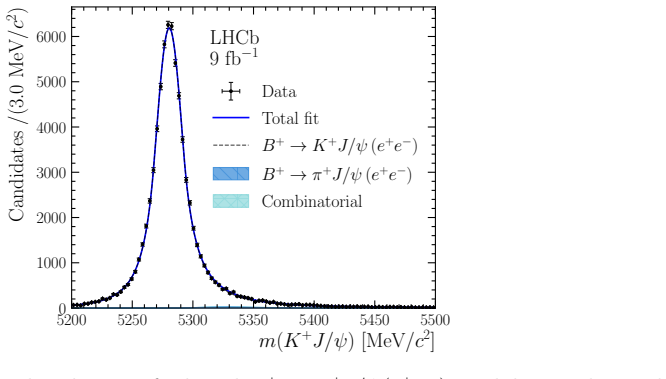
- The 3.2σ significance and branching-fraction central value are extracted from a fit to the B-candidate (π⁺e⁺e⁻) invariant-mass distribution. The manuscript must demonstrate that the background model (combinatorial component plus any peaking contributions from misidentified B → Kℓℓ or B → πππ decays and residual charmonium feed-down) has been validated with control samples and that alternative shape choices do not shift the signal yield outside the quoted uncertainties; underestimation of background in the signal window would directly inflate both the significance and the measured branching fraction.
minor comments (1)
- The abstract uses the notation cal{BR}; this should be aligned with the notation adopted in the body of the paper for consistency.
Simulated Author's Rebuttal
We thank the referee for their careful reading of the manuscript and for the constructive comment on background validation. We address the point in detail below and are prepared to enhance the presentation in a revised version while maintaining that the existing analysis already incorporates the necessary checks.
read point-by-point responses
-
Referee: The 3.2σ significance and branching-fraction central value are extracted from a fit to the B-candidate (π⁺e⁺e⁻) invariant-mass distribution. The manuscript must demonstrate that the background model (combinatorial component plus any peaking contributions from misidentified B → Kℓℓ or B → πππ decays and residual charmonium feed-down) has been validated with control samples and that alternative shape choices do not shift the signal yield outside the quoted uncertainties; underestimation of background in the signal window would directly inflate both the significance and the measured branching fraction.
Authors: We agree that explicit validation of the background model is critical. Section 4 of the manuscript describes the fit to the π⁺e⁺e⁻ invariant-mass distribution, where the combinatorial background is parametrized by an exponential function whose slope is left free in the fit. Peaking contributions from misidentified B → K e⁺ e⁻ decays are estimated from a dedicated control sample of B → K μ⁺ μ⁻ events, with the misidentification probability determined directly from data using the PID calibration samples. The B → π⁺ π⁺ π⁻ contribution is modeled from simulation normalized to the known branching fraction and the measured three-pion yield in the same dataset. Residual charmonium feed-down is subtracted using the observed yield in the J/ψ mass window scaled by the known branching fractions and efficiencies. Validation is performed by fitting the same background model to the mass sidebands and to independent control samples (e.g., the B → K e⁺ e⁻ and B → π⁺ π⁺ π⁻ selections), with the agreement shown in the supplementary material. Alternative background shapes (linear and second-order polynomial) were tested; the resulting changes in signal yield are smaller than the statistical uncertainty and are incorporated into the systematic uncertainty. To make this validation more prominent, we will add an explicit subsection with control-sample fit plots and a table of alternative-shape results in the revised manuscript. revision: partial
Circularity Check
No significant circularity: direct data-driven measurement
full rationale
The paper reports an experimental observation of a rare decay using LHCb pp collision data. The 3.2σ significance and branching fraction are obtained from an unbinned maximum-likelihood fit to the B-candidate invariant mass distribution in the selected sample, with signal shape from simulation and background components constrained from data sidebands and control samples. No equation or result is defined in terms of itself, no fitted parameter is relabeled as a prediction, and no load-bearing premise reduces to a self-citation chain; the central claim rests on the observed excess after standard efficiency corrections and background modeling that are independently validated.
Axiom & Free-Parameter Ledger
Lean theorems connected to this paper
-
IndisputableMonolith/Cost/FunctionalEquation.leanwashburn_uniqueness_aczel unclearThe branching fraction is extracted from an extended simultaneous maximum-likelihood fit to the invariant-mass spectra... combinatorial background is modelled by an exponential function... yields of residual physical backgrounds are constrained to expectation values from simulation.
-
IndisputableMonolith/Foundation/RealityFromDistinction.leanreality_from_one_distinction unclearThe result is consistent with the Standard Model expectation [17] (lattice QCD form factors).
Reference graph
Works this paper leans on
-
[1]
LHCb collaboration, R. Aaijet al.,Measurement of the local and nonlocal amplitudes inB + →K +µ+µ− decays,arXiv:2603.12477, Submitted to JHEP
-
[2]
LHCb collaboration, R. Aaijet al.,Branching fraction measurements of the rare B0 s →ϕµ +µ− and B0 s →f ′ 2(1525)µ+µ− decays, Phys. Rev. Lett.127(2021) 151801, arXiv:2105.14007
-
[3]
LHCb collaboration, R. Aaijet al.,Differential branching fractions and isospin asymmetries ofB→K (∗)µ+µ− decays, JHEP06(2014) 133,arXiv:1403.8044
-
[4]
Aaijet al.,A comprehensive analysis of the B0 →K ∗0µ+µ− decay,arXiv:2512.18053, Submitted to Phys
LHCb collaboration, R. Aaijet al.,A comprehensive analysis of the B0 →K ∗0µ+µ− decay,arXiv:2512.18053, Submitted to Phys. Rev. Lett
-
[5]
CMS collaboration, A. Hayrapetyanet al.,Angular analysis of the B0 →K ∗(892)0µ+µ− decay in proton-proton collisions at √s = 13 TeV, Phys. Lett. B864(2025) 139406,arXiv:2411.11820
-
[6]
LHCb collaboration, R. Aaijet al.,Comprehensive analysis of local and nonlocal amplitudes in the B0 →K ∗0µ+µ− decay, JHEP09(2024) 026, Erratum ibid.05 (2025) 208,arXiv:2405.17347. 7
-
[7]
Aaijet al.,Amplitude analysis of the B0 →K ∗0µ+µ− decay, Phys
LHCb collaboration, R. Aaijet al.,Amplitude analysis of the B0 →K ∗0µ+µ− decay, Phys. Rev. Lett.132(2024) 131801,arXiv:2312.09115
-
[8]
Aaijet al.,Determination of short- and long-distance contribu- tions in B0 →K ∗0µ+µ− decays, Phys
LHCb collaboration, R. Aaijet al.,Determination of short- and long-distance contribu- tions in B0 →K ∗0µ+µ− decays, Phys. Rev.D109(2024) 052009, arXiv:2312.09102
-
[9]
Aaijet al.,Angular analysis of the rare decay B0 s →ϕµ +µ−, JHEP11(2021) 043,arXiv:2107.13428
LHCb collaboration, R. Aaijet al.,Angular analysis of the rare decay B0 s →ϕµ +µ−, JHEP11(2021) 043,arXiv:2107.13428
-
[10]
Aaijet al.,Angular analysis of the B+ →K ∗+µ+µ− decay, Phys
LHCb collaboration, R. Aaijet al.,Angular analysis of the B+ →K ∗+µ+µ− decay, Phys. Rev. Lett.126(2021) 161802,arXiv:2012.13241
-
[11]
ATLAS collaboration, M. Aaboudet al.,Angular analysis of B0 d →K ∗µ+µ− decays in pp collisions at √s = 8TeV with the ATLAS detector, JHEP10(2018) 047, arXiv:1805.04000
-
[12]
Wehleet al.,Lepton-Flavor-Dependent Angular Analysis of B→K ∗ℓ+ℓ−, Phys
Belle collaboration, S. Wehleet al.,Lepton-Flavor-Dependent Angular Analysis of B→K ∗ℓ+ℓ−, Phys. Rev. Lett.118(2017) 111801,arXiv:1612.05014
-
[13]
Aaijet al.,Test of lepton universality in b→sℓ +ℓ− decays, Phys
LHCb collaboration, R. Aaijet al.,Test of lepton universality in b→sℓ +ℓ− decays, Phys. Rev. Lett.131(2023) 051803,arXiv:2212.09152
-
[14]
LHCb collaboration, R. Aaijet al.,Measurement of the branching fraction ratio RK at large dilepton invariant mass, JHEP07(2025) 198,arXiv:2505.03483
-
[15]
Aaijet al.,Test of lepton flavour universality with B0 s → ϕℓ+ℓ− decays, Phys
LHCb collaboration, R. Aaijet al.,Test of lepton flavour universality with B0 s → ϕℓ+ℓ− decays, Phys. Rev. Lett.134(2025) 121803,arXiv:2410.13748
-
[16]
C. Hambrock, A. Khodjamirian, and A. Rusov,Hadronic effects and observables in B→πℓ +ℓ− decay at large recoil, Phys. Rev.D92(2015) 074020, arXiv:1506.07760
- [17]
-
[18]
M. Bordone, C. Cornella, G. Isidori, and M. K¨ onig,The LFU ratioRπ in the Standard Model and beyond, Eur. Phys. J. C81(2021) 850,arXiv:2101.11626
-
[19]
Aaijet al.,First observation of the decay B+ →π +µ+µ−, JHEP12(2012) 125,arXiv:1210.2645
LHCb collaboration, R. Aaijet al.,First observation of the decay B+ →π +µ+µ−, JHEP12(2012) 125,arXiv:1210.2645
-
[20]
LHCb collaboration, R. Aaijet al.,First measurement of the differential branching fraction and C P asymmetry of the B+ →π +µ+µ− decay, JHEP10(2015) 034, arXiv:1509.00414
-
[21]
Aaijet al.,Evidence for the decay B0 s → K ∗0µ+µ−, JHEP07 (2018) 020,arXiv:1804.07167
LHCb collaboration, R. Aaijet al.,Evidence for the decay B0 s → K ∗0µ+µ−, JHEP07 (2018) 020,arXiv:1804.07167
-
[22]
Aaijet al.,Observation of the suppressed decay Λ0 b →pπ −µ+µ−, JHEP04(2017) 029,arXiv:1701.08705
LHCb collaboration, R. Aaijet al.,Observation of the suppressed decay Λ0 b →pπ −µ+µ−, JHEP04(2017) 029,arXiv:1701.08705
-
[23]
Aaijet al.,Study of the rare B0 s and B0 decays into the π+π−µ+µ− final state, Phys
LHCb collaboration, R. Aaijet al.,Study of the rare B0 s and B0 decays into the π+π−µ+µ− final state, Phys. Lett.B743(2015) 46,arXiv:1412.6433. 8
-
[24]
Adachiet al.,Search for rare b→dℓ +ℓ− transitions at Belle, Phys
Belle Belle II collaborations, I. Adachiet al.,Search for rare b→dℓ +ℓ− transitions at Belle, Phys. Rev. Lett.133(2024) 101804,arXiv:2404.08133
-
[25]
LHCb collaboration, A. A. Alves Jr.et al.,The LHCb detector at the LHC, JINST3 (2008) S08005
2008
-
[26]
Aaijet al.,LHCb detector performance, Int
LHCb collaboration, R. Aaijet al.,LHCb detector performance, Int. J. Mod. Phys. A30(2015) 1530022,arXiv:1412.6352
- [27]
-
[28]
Likhomanenkoet al.,LHCb topological trigger reoptimization, J
T. Likhomanenkoet al.,LHCb topological trigger reoptimization, J. Phys. Conf. Ser. 664(2015) 082025,arXiv:1510.00572
-
[29]
A Brief Introduction to PYTHIA 8.1
T. Sj¨ ostrand, S. Mrenna, and P. Skands,A brief introduction to PYTHIA 8.1, Comput. Phys. Commun.178(2008) 852,arXiv:0710.3820
work page internal anchor Pith review arXiv 2008
-
[30]
Belyaevet al.,Handling of the generation of primary events in Gauss, the LHCb simulation framework, J
I. Belyaevet al.,Handling of the generation of primary events in Gauss, the LHCb simulation framework, J. Phys. Conf. Ser.331(2011) 032047
2011
-
[31]
D. J. Lange,The EvtGen particle decay simulation package, Nucl. Instrum. Meth. A462(2001) 152
2001
-
[32]
N. Davidson, T. Przedzinski, and Z. Was,PHOTOS interface in C++: Technical and physics documentation, Comput. Phys. Commun.199(2016) 86, arXiv:1011.0937
-
[33]
Allisonet al.,Geant4 developments and applications, IEEE Trans
Geant4 collaboration, J. Allisonet al.,Geant4 developments and applications, IEEE Trans. Nucl. Sci.53(2006) 270; Geant4 collaboration, S. Agostinelliet al.,Geant4: A simulation toolkit, Nucl. Instrum. Meth.A506(2003) 250
2006
-
[34]
Clemencicet al.,The LHCb simulation application, Gauss: Design, evolution and experience, J
M. Clemencicet al.,The LHCb simulation application, Gauss: Design, evolution and experience, J. Phys. Conf. Ser.331(2011) 032023
2011
-
[35]
P. Ball and R. Zwicky,New results on B→π, K, η decay form-factors from light-cone sum rules, Phys. Rev.D71(2005) 014015,arXiv:hep-ph/0406232
-
[36]
Navaset al.,Review of particle physics, Phys
Particle Data Group, S. Navaset al.,Review of particle physics, Phys. Rev.D110 (2024) 030001
2024
-
[37]
LHCb collaboration, R. Aaijet al.,Measurement of lepton universality parameters in B+ →K +ℓ+ℓ− and B0 →K ∗0ℓ+ℓ− decays, Phys. Rev.D108(2023) 032002, arXiv:2212.09153
-
[38]
Breiman, J
L. Breiman, J. H. Friedman, R. A. Olshen, and C. J. Stone,Classification and regression trees, Wadsworth international group, Belmont, California, USA, 1984
1984
-
[39]
Freund and R
Y. Freund and R. E. Schapire,A decision-theoretic generalization of on-line learning and an application to boosting, J. Comput. Syst. Sci.55(1997) 119
1997
- [40]
-
[41]
S. Tolk, J. Albrecht, F. Dettori, and A. Pellegrino,Data driven trigger efficiency determination at LHCb, LHCb-PUB-2014-039, CERN-LHCb-PUB-2014-039, 2014
2014
-
[42]
Anderliniet al.,The PIDCalib package, LHCb-PUB-2016-021, 2016
L. Anderliniet al.,The PIDCalib package, LHCb-PUB-2016-021, 2016
2016
-
[43]
R. Aaijet al.,Selection and processing of calibration samples to measure the particle identification performance of the LHCb experiment in Run 2, Eur. Phys. J. Tech. Instr.6(2019) 1,arXiv:1803.00824
-
[44]
Skwarnicki,A study of the radiative cascade transitions between the Upsilon-prime and Upsilon resonances, PhD thesis, Institute of Nuclear Physics, Krakow, 1986, DESY-F31-86-02
T. Skwarnicki,A study of the radiative cascade transitions between the Upsilon-prime and Upsilon resonances, PhD thesis, Institute of Nuclear Physics, Krakow, 1986, DESY-F31-86-02
1986
-
[45]
S. S. Wilks,The large-sample distribution of the likelihood ratio for testing composite hypotheses, Ann. Math. Stat.9(1938) 60
1938
-
[46]
A. L. Read,Presentation of search results: The CL s technique, J. Phys.G28(2002) 2693. 10 LHCb collaboration R. Aaij38 , A.S.W. Abdelmotteleb 58 , C. Abellan Beteta 52 , F. Abudin´ en58 , T. Ackernley62 , A. A. Adefisoye 70 , B. Adeva48 , M. Adinolfi 56 , P. Adlarson86 , C. Agapopoulou 14 , C.A. Aidala 88 , Z. Ajaltouni 11, S. Akar11 , K. Akiba 38 , M. Ak...
2002
discussion (0)
Sign in with ORCID, Apple, or X to comment. Anyone can read and Pith papers without signing in.