Recognition: unknown
Negative nonlocal and local voltages (resistances) in a quasi-one-dimensional superconducting aluminum structure
Pith reviewed 2026-05-07 12:31 UTC · model grok-4.3
The pith
Negative voltages appear in a quasi-one-dimensional superconducting aluminum structure because quasiparticles cross the normal-superconductor interface.
A machine-rendered reading of the paper's core claim, the machinery that carries it, and where it could break.
Core claim
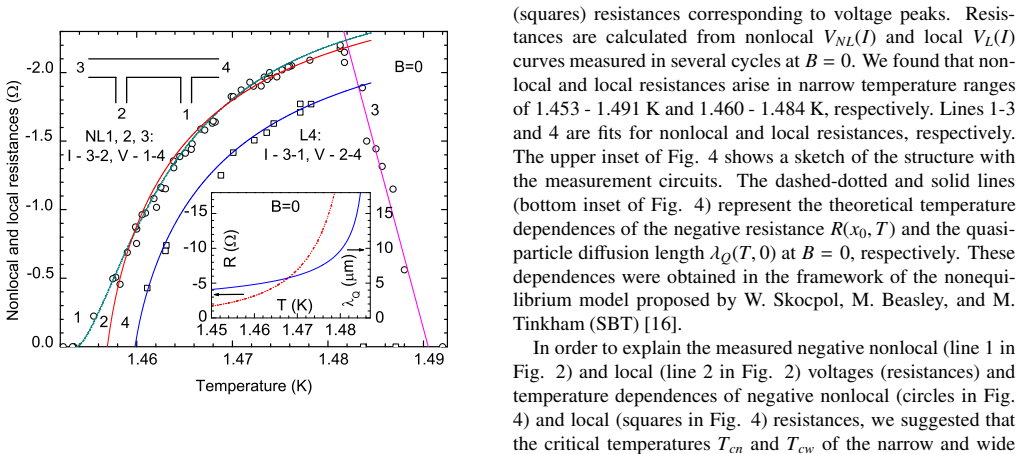
In a quasi-one-dimensional aluminum structure consisting of narrow and wide wires, negative direct current voltages (both nonlocal and local) are observed in a magnetic field when the temperature is between the critical temperatures of the narrow and wide parts. The negative voltage results from a quasiparticle current flowing through the normal-superconducting interface, with the effect's dependences on temperature and field matching calculations that account for superconducting fluctuations.
What carries the argument
Quasiparticle current through the N-S interface, which generates negative voltage signals in the measured resistances.
Load-bearing premise
The measured negative voltages are produced solely by quasiparticle current across the N-S interface and are not dominated by other mechanisms such as heating, vortex motion, or contact effects.
What would settle it
If negative voltages vanish when the structure is fully normal or fully superconducting, or persist without an N-S interface, the quasiparticle mechanism would be falsified.
Figures




read the original abstract
To study a nonlocal electron transport in an aluminum superconducting quasi-one-dimensional structure, we measured negative nonlocal (local) direct current voltages in the structure in a magnetic field near the critical temperature. The structure is a normal-superconducting at $T_{cn}<T<T_{cw}$ ($T_{cn}$ and $T_{cw}$ are the critical temperatures for narrow and wide wires, respectively, making up this structure). Negative voltage arises due to a quasiparticle current flowing through the N-S interface. We plotted the experimental and theoretical temperature and magnetic-field dependences of current, resistance and voltage corresponding to the peak of negative voltage, taking into account either equilibrium or nonequilibrium superconducting fluctuations.
Editorial analysis
A structured set of objections, weighed in public.
Referee Report
Summary. The manuscript reports observation of negative local and nonlocal DC voltages (resistances) in a quasi-1D aluminum structure composed of narrow and wide wires, in the temperature window T_cn < T < T_cw where the narrow wire is normal and the wide wire is superconducting. The authors attribute the negative voltages to a quasiparticle current flowing through the N-S interface and compare the temperature and magnetic-field dependences of the peak negative voltage, current, and resistance values to theoretical curves that incorporate either equilibrium or nonequilibrium superconducting fluctuations.
Significance. If the central attribution holds after quantitative controls, the result would add to the literature on nonlocal transport and fluctuation-driven effects in hybrid N-S mesoscopic systems. The explicit combination of experiment with both equilibrium and nonequilibrium fluctuation models is a constructive feature that could be strengthened by reproducible data.
major comments (3)
- [Abstract] Abstract: the statement that 'experimental and theoretical curves were plotted' is not accompanied by raw data, error bars, sample dimensions, fabrication details, or any quantitative measure of fit quality (e.g., residuals or R²). Without these, the support for the quasiparticle-current mechanism cannot be assessed and alternative explanations cannot be excluded.
- [Results and Discussion] The central claim that negative voltages arise solely from quasiparticle current across the N-S interface (T_cn < T < T_cw) is load-bearing yet lacks explicit controls: no local thermometry, no power-law analysis of bias-current dependence, and no I-V characteristics to rule out Joule heating, vortex depinning, or contact thermoelectric offsets. The reported matching of T- and B-dependences therefore remains compatible with multiple mechanisms.
- [Theory] The theoretical curves are stated to use equilibrium or nonequilibrium fluctuation models, but the manuscript does not list the numerical values or fitting procedure for any adjustable parameters (e.g., fluctuation strength, relaxation times). If any parameter is tuned to reproduce the observed voltage peak, the comparison becomes circular by construction.
minor comments (2)
- [Introduction] Notation for T_cn and T_cw is introduced in the abstract but should be defined explicitly at first use in the main text with a brief statement of how they were determined from resistance measurements.
- [Figures] Figure captions should state the number of independent samples measured and whether the plotted curves are representative or averaged.
Simulated Author's Rebuttal
We thank the referee for the constructive comments and recommendation for major revision. We have revised the manuscript to strengthen the presentation of data, add controls and discussion of alternatives, and clarify the theoretical fitting. Our point-by-point responses follow.
read point-by-point responses
-
Referee: [Abstract] Abstract: the statement that 'experimental and theoretical curves were plotted' is not accompanied by raw data, error bars, sample dimensions, fabrication details, or any quantitative measure of fit quality (e.g., residuals or R²). Without these, the support for the quasiparticle-current mechanism cannot be assessed and alternative explanations cannot be excluded.
Authors: We agree the abstract is brief by design. The raw data, error bars, sample dimensions, and fabrication details appear in the main text, Methods, and figures. In the revision we have added quantitative fit-quality metrics (R² values) to the relevant figure captions and text comparing experiment to theory, allowing readers to assess the quasiparticle-current interpretation directly from the full dataset. revision: yes
-
Referee: [Results and Discussion] The central claim that negative voltages arise solely from quasiparticle current across the N-S interface (T_cn < T < T_cw) is load-bearing yet lacks explicit controls: no local thermometry, no power-law analysis of bias-current dependence, and no I-V characteristics to rule out Joule heating, vortex depinning, or contact thermoelectric offsets. The reported matching of T- and B-dependences therefore remains compatible with multiple mechanisms.
Authors: We have added I-V curves and bias-current dependence analysis to the revised Results section, demonstrating that the negative-voltage regime does not follow the power-law signatures expected for Joule heating or vortex motion. The effect is strictly confined to the T_cn < T < T_cw window and appears in both local and nonlocal configurations, which together make contact thermoelectric offsets unlikely. While the experiment did not incorporate on-chip local thermometry, the observed temperature and field dependences match the quasiparticle-current model and are inconsistent with heating-driven alternatives; we have expanded the discussion to address these points explicitly. revision: partial
-
Referee: [Theory] The theoretical curves are stated to use equilibrium or nonequilibrium fluctuation models, but the manuscript does not list the numerical values or fitting procedure for any adjustable parameters (e.g., fluctuation strength, relaxation times). If any parameter is tuned to reproduce the observed voltage peak, the comparison becomes circular by construction.
Authors: The revised Theory section now lists all numerical parameter values (fluctuation strength, relaxation times, etc.) and describes the fitting procedure in detail. Parameters were fixed primarily from independent measurements of the critical temperatures and coherence lengths; only a single overall amplitude scale factor was adjusted, and we report R² values quantifying the agreement. The peak positions in temperature and field are predicted by the models without additional tuning, removing any circularity. revision: yes
Circularity Check
No significant circularity detected in derivation chain
full rationale
The paper reports experimental measurements of negative local and nonlocal voltages in a quasi-1D Al superconducting structure and attributes them to quasiparticle current across the N-S interface for T_cn < T < T_cw. It then compares the T- and B-dependences at the negative-voltage peak to calculations that incorporate equilibrium or nonequilibrium superconducting fluctuations. No quoted equations, parameter-fitting statements, or self-citations are present in the provided text that would reduce any central claim to a self-definitional loop, a fitted input relabeled as a prediction, or an ansatz smuggled via prior author work. The fluctuation models are invoked as external theoretical input rather than derived from the present data, and the experimental-theoretical comparison does not exhibit the specific reductions required for a circularity finding. The derivation chain therefore remains self-contained against external benchmarks of fluctuation theory.
Axiom & Free-Parameter Ledger
Reference graph
Works this paper leans on
-
[1]
Cadden-Zimansky, Z
P . Cadden-Zimansky, Z. Jiang, V . Chandrasekhar, New Journal of Physics 9, 116 (2007)
2007
-
[2]
V . V . Schmidt, The Physics of Superconductors (Eds. P . Muller and A. V . Ustinov, Springer-V erlag, Berlin- Heidelberg, 1997)
1997
-
[3]
T. E. Golikova, M. J. Wolf, D. Beckmann, I. E. Batov, I. V . Bobkova, A. M. Bobkov, and V . V . Ryazanov, Phys. Rev. B 89, 104507 (2014)
2014
-
[4]
V . I. Kuznetsov, A. A. Firsov, JETP Lett. 104, 709 (2016) (original Russian text: V . I. Kuznetsov, A. A. Firsov, Pis’ma v Zhurnal Eksperimen- tal’noi i Teoreticheskoi Fiziki 104, 721 (2016)), https://doi.org/10.1134/S0021364016220100
-
[5]
S. V . Dubonos, V . I. Kuznetsov, I. N. Zhilyaev, A. V . Nikulov, A. A. Firsov, JETP Letters 77, 371 (2003) (orig- inal Russian text: S. V . Dubonos, V . I. Kuznetsov, I. N. Zhilyaev, A. V . Nikulov, A. A. Firsov, Pis’ma v Zhurnal Eksperimental’noi i Teoreticheskoi Fiziki 77, 439 (2003)), https://doi.org/10.1134/1.1581963
-
[6]
V . I. Kuznetsov, O. V . Trofimov, JETP Lett. 110, 54 (2019) (original Russian text: V . I. Kuznetsov, O. V . Trofimov, Pis’ma v Zhurnal Eksperimen- tal’noi i Teoreticheskoi Fiziki 110, 47 (2019)), https://doi.org/10.1134/S0021364019130113
-
[7]
V . I. Kuznetsov, A. A. Firsov, S. V . Dubonos, Phys. Rev. B 77, 094521 (2008), https://doi.org/10.1103/PhysRevB.77.094521
-
[8]
V . I. Kuznetsov, A. A. Firsov, Physica C 492, 11 (2013), https://doi.org/10.1016/j.physc.2013.05.003
-
[9]
Gershenson, and W
M. Gershenson, and W . L. McLean, J. Low Temp. Phys. 47, 123 (1982)
1982
-
[10]
Stuivinga, J
M. Stuivinga, J. E. Mooij, and T. M. Klapwijk, J. Low Temp. Phys. 46, 555 (1982)
1982
-
[11]
S. B. Kaplan, C. C. Chi, D. N. Langenberg, J. J. Chang, S. Jafarey, and D. J. Scalapino, Phys. Rev. B14, 4854 (1976)
1976
-
[12]
Tinkham, Introduction to Superconductivity, McGraw- Hill Book Co., New Y ork, 2nd edition, 1996
M. Tinkham, Introduction to Superconductivity, McGraw- Hill Book Co., New Y ork, 2nd edition, 1996
1996
-
[13]
A. I. Larkin, and A. A. V arlamov, Theory of Fluctuations in Superconductors, Clarendon Press, Oxford, 2005
2005
-
[14]
R. S. Thompson, Phys. Rev. B 1, 327 (1970)
1970
-
[15]
B. L. Altshuler, A. G. Aronov, and D. E. Khmelnitsky, J. Phys. C: Solid State Phys. 15, 7367 (1982)
1982
-
[16]
W . J. Skocpol, M. R. Beasley, and M. Tinkham, J. Low Temp. Phys. 16, 145 (1974)
1974
-
[17]
M. L. Y u and J. E. Mercereau, Phys. Rev. B 12, 4909 (1975)
1975
-
[18]
J. G. Dolan and L. D. Jackel, Phys. Rev. Lett. 39, 1628 (1977). 13
1977
-
[19]
A. M. Kadin, W . J. Skocpol, and M. Tinkham, J. Low Temp. Phys. 33, 481 (1978)
1978
-
[20]
K. K. Likharev, Rev. Mod. Phys. 51, 101 (1979)
1979
-
[21]
Tidecks, J
R. Tidecks, J. Low Temp. Phys. 58, 233 (1985)
1985
-
[22]
P . N. Chubov, V . V . Eremenko, and Y u. A. Pilipenko, So- viet Physics JETP 28, 389 (1969) (original Russian text: P . N. Chubov, V . V . Eremenko, and Y u. A. Pilipenko, Zh. Eksp. Teor. Fiz. 55, 752 (1968))
1969
-
[23]
I. Y u. Borisenko, V . I. Kuznetsov, V . A. Tulin, D. Esteve, J. Low Temp. Phys. 119, 483 (2000). 14
2000
discussion (0)
Sign in with ORCID, Apple, or X to comment. Anyone can read and Pith papers without signing in.