Recognition: unknown
Bayesian component separation and power spectrum estimation for 21 cm intensity mapping data cubes
Pith reviewed 2026-05-07 11:47 UTC · model grok-4.3
The pith
Bayesian sampling of a joint parametric model separates foregrounds from the 21 cm signal at the map level and recovers the HI power spectrum within statistical uncertainties.
A machine-rendered reading of the paper's core claim, the machinery that carries it, and where it could break.
Core claim
Sampling the posterior distribution with Gibbs sampling for the spectral indices and Gaussian constrained realizations for the map amplitudes allows the model to jointly infer the foreground and 21 cm components while recovering the one-dimensional HI power spectrum to within the reported statistical uncertainties, even in the presence of strong foreground contamination and frequency channel flagging.
What carries the argument
Gibbs sampling combined with Gaussian constrained realizations to draw samples from the posterior of a parametric model containing foregrounds, 21 cm signal, and noise.
If this is right
- Foreground and 21 cm maps are recovered at the pixel level together with uncertainties taken directly from the joint posterior.
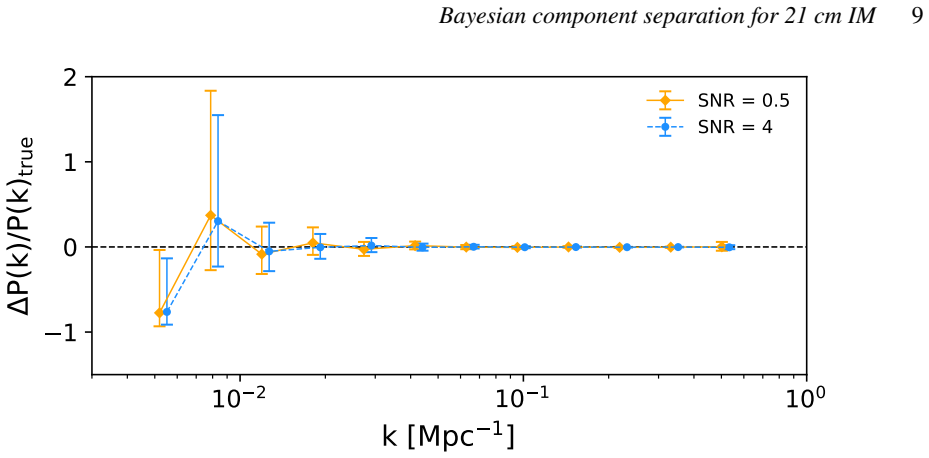
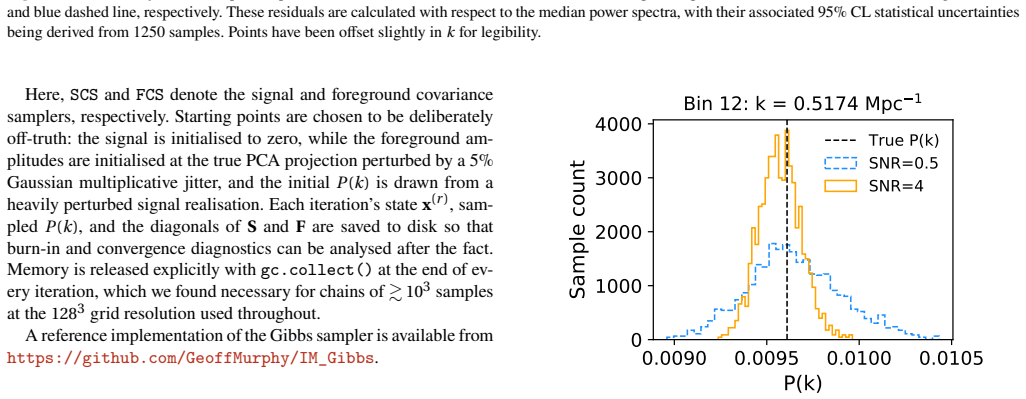
- The one-dimensional HI power spectrum is recovered to within 2 sigma of the true model despite strong foregrounds.
- Missing frequency channels from RFI flagging are in-painted with statistically consistent realizations drawn from the model.
- Full posterior samples provide statistical realizations of both the maps and the power spectrum for downstream use.
Where Pith is reading between the lines
- The availability of the full joint posterior could let uncertainties propagate directly into cosmological parameter constraints without separate transfer-function corrections.
- The same sampling strategy might extend to other high-dimensional component separation tasks in radio data where gaps and bright contaminants coexist.
- Replacing the current parametric foreground model with more flexible forms could test how sensitive the power-spectrum recovery remains to model misspecification.
Load-bearing premise
The parametric forms chosen for foregrounds, the 21 cm signal, and noise accurately describe the statistical properties present in the data.
What would settle it
Apply the sampler to simulated data cubes with a known input HI power spectrum and check whether the recovered estimate and its uncertainty interval contain the true value at the expected frequency.
Figures


read the original abstract
Foreground removal remains an ongoing challenge in radio cosmology, and increasingly sensitive experiments necessitate more robust analysis techniques. In this work, we model simulated data from a single-dish intensity mapping experiment, and use the Gibbs sampling and Gaussian constrained realisation (GCR) techniques to draw samples from the posterior probability distribution of the model parameters. This allows for a separation of the foregrounds and 21 cm signal at the map level, as well as recovery of the 1-dimensional HI power spectrum to within statistical uncertainties. Despite the model consisting of over 2 million free parameters in the example presented here, these methods allow us to sample from the Bayesian posterior at a rate of $<30$ seconds per iteration. This framework is also resilient to frequency channel flagging (e.g. due to RFI excision), with the GCR steps effectively in-painting the missing data with statistically-consistent model realisations. The power spectrum is recovered accurately in the presence of strong foreground contamination and RFI flagging -- the estimate falling within $2\sigma$ of the true model in our example, similar to the commonly-used transfer function correction method. Statistical realisations of foreground and HI maps are also recovered, with associated uncertainties available from the full joint posterior distribution of all parameters.
Editorial analysis
A structured set of objections, weighed in public.
Referee Report
Summary. The manuscript presents a Bayesian component separation framework for 21 cm intensity mapping data cubes that combines Gibbs sampling with Gaussian constrained realizations (GCR) to jointly sample the posterior over foreground maps, 21 cm signal maps, noise, and the 1D HI power spectrum parameters. Demonstrated on simulated single-dish observations containing strong foregrounds, a Gaussian HI field, instrumental noise, and frequency flagging, the method recovers map-level separations with uncertainties and yields a 1D power spectrum estimate lying within 2σ of the input truth, at a sampling cost of <30 s per iteration even with >2 million free parameters.
Significance. If the reported performance holds under more varied conditions, the approach supplies a statistically coherent route to map-level foreground removal and power-spectrum estimation that automatically propagates uncertainties and handles missing channels via GCR in-painting. The computational efficiency for high-dimensional posteriors and the explicit treatment of RFI flagging constitute clear practical strengths for forthcoming intensity-mapping surveys.
major comments (2)
- [numerical results / simulation section] The validation is performed exclusively on data cubes generated from the identical parametric model (foregrounds + Gaussian 21 cm field + noise) that is assumed in the likelihood and prior. Consequently the reported agreement of the recovered power spectrum to within 2σ constitutes a self-consistency check rather than a test of robustness to model misspecification or realistic foreground complexity. This directly limits the strength of the central claim that the framework recovers the HI power spectrum accurately in the presence of strong foreground contamination.
- [results and discussion] The manuscript does not quantify how the recovered posterior widths or bias change when the foreground spectral index or the 21 cm field deviates from the exact parametric assumptions used to generate the test data. Such a controlled misspecification test is required to establish that the 2σ agreement is not an artifact of matched assumptions.
minor comments (2)
- [abstract / introduction] The abstract and introduction would benefit from a concise statement of the precise parametric forms adopted for the foregrounds and the 21 cm covariance; this would clarify the scope of the consistency test.
- [figures] Figure captions should explicitly state the number of Gibbs iterations, burn-in length, and convergence diagnostics used to produce the reported posterior summaries.
Simulated Author's Rebuttal
We thank the referee for their constructive comments on our manuscript. We address each major comment below, agreeing that the current validation is a self-consistency test and that additional misspecification experiments would strengthen the presentation of the results.
read point-by-point responses
-
Referee: [numerical results / simulation section] The validation is performed exclusively on data cubes generated from the identical parametric model (foregrounds + Gaussian 21 cm field + noise) that is assumed in the likelihood and prior. Consequently the reported agreement of the recovered power spectrum to within 2σ constitutes a self-consistency check rather than a test of robustness to model misspecification or realistic foreground complexity. This directly limits the strength of the central claim that the framework recovers the HI power spectrum accurately in the presence of strong foreground contamination.
Authors: We agree that the validation uses data generated from the same parametric model assumed in the likelihood and prior, rendering the 2σ agreement a self-consistency check of the Gibbs sampler and GCR under matched assumptions. The manuscript qualifies the result as applying to our simulated example, which is the appropriate scope for demonstrating that the high-dimensional posterior can be sampled efficiently while recovering the input power spectrum and handling RFI flagging via in-painting. To address the referee's concern about robustness, we will revise the numerical results section to include a discussion of the method's behavior under controlled model variations. revision: yes
-
Referee: [results and discussion] The manuscript does not quantify how the recovered posterior widths or bias change when the foreground spectral index or the 21 cm field deviates from the exact parametric assumptions used to generate the test data. Such a controlled misspecification test is required to establish that the 2σ agreement is not an artifact of matched assumptions.
Authors: We acknowledge that the manuscript does not currently quantify the effects of deviations in foreground spectral index or 21 cm field properties on posterior widths and bias. In the revised manuscript we will add controlled misspecification tests in the results and discussion section. These will consist of additional simulations generated with altered foreground spectral indices and non-Gaussian 21 cm fields, followed by application of the Bayesian framework and reporting of the resulting biases and changes in posterior widths. This will clarify the sensitivity of the recovered power spectrum to the assumed model form. revision: yes
Circularity Check
No significant circularity in derivation chain
full rationale
The manuscript applies Gibbs sampling and Gaussian constrained realizations to sample the joint posterior over a parametric model (foregrounds + 21 cm Gaussian random field + noise) on simulated data cubes generated from the identical model. The headline result—that the recovered 1D HI power spectrum lies within 2σ of the injected truth and that map-level separation is achieved—is a direct consistency check of the sampler under matched assumptions, not a derivation that reduces to its inputs by construction. No self-definitional equations, fitted parameters renamed as predictions, load-bearing self-citations, or uniqueness theorems imported from prior author work appear in the abstract or described framework. The approach is self-contained against external benchmarks (injected truth) and does not smuggle ansatzes or rename known empirical patterns.
Axiom & Free-Parameter Ledger
free parameters (1)
- component amplitude and map parameters
axioms (2)
- domain assumption Observed data is a linear superposition of foreground, 21 cm signal, and noise components
- domain assumption Gaussian statistics apply to the signal and foreground fields for the GCR step
Reference graph
Works this paper leans on
-
[1]
Aguirre J. E., et al., 2022, The Astrophysical Journal, 924, 85 Alonso D., Bull P., Ferreira P. G., Santos M. G., 2015, Monthly Notices of the Royal Astronomical Society, 447, 400 Amiri M., et al., 2023, ApJ, 947, 16 Bobin J., Starck J.-L., Fadili J., Moudden Y., 2007, IEEE Transactions on Image Processing, 16, 2662 Bull P., Ferreira P. G., Patel P., Sant...
discussion (0)
Sign in with ORCID, Apple, or X to comment. Anyone can read and Pith papers without signing in.