Recognition: unknown
The tale of the 3 planets: 3D cloud feedback enhances the spectral diversity of warm Jupiters
Pith reviewed 2026-05-07 11:32 UTC · model grok-4.3
The pith
3D coupling of clouds, circulation, and radiation explains why warm Jupiters show large spectral diversity despite similar parameters.
A machine-rendered reading of the paper's core claim, the machinery that carries it, and where it could break.
Core claim
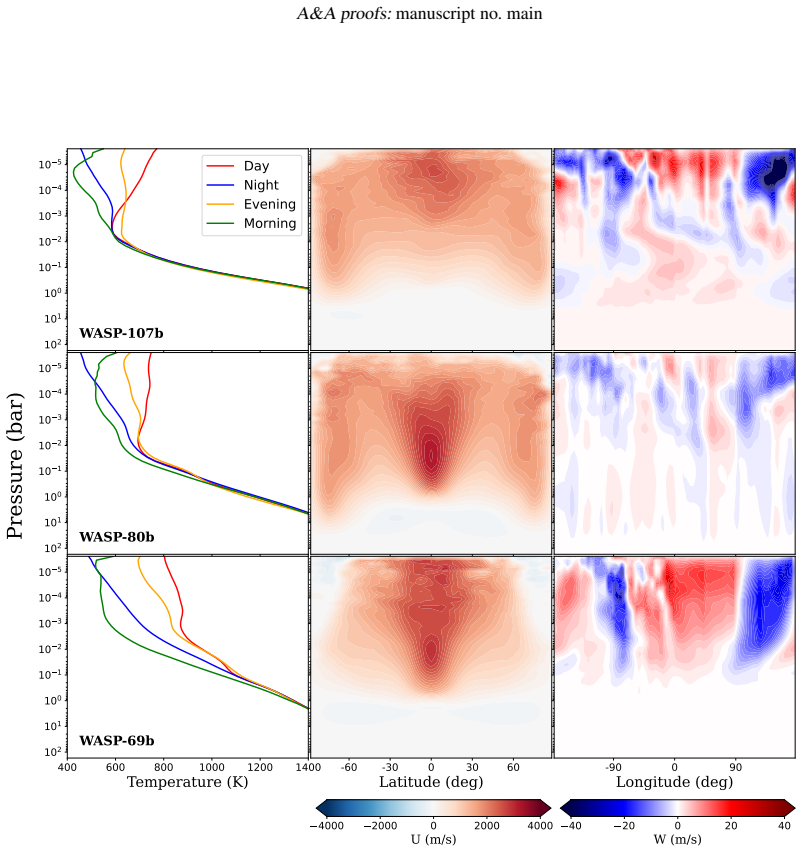
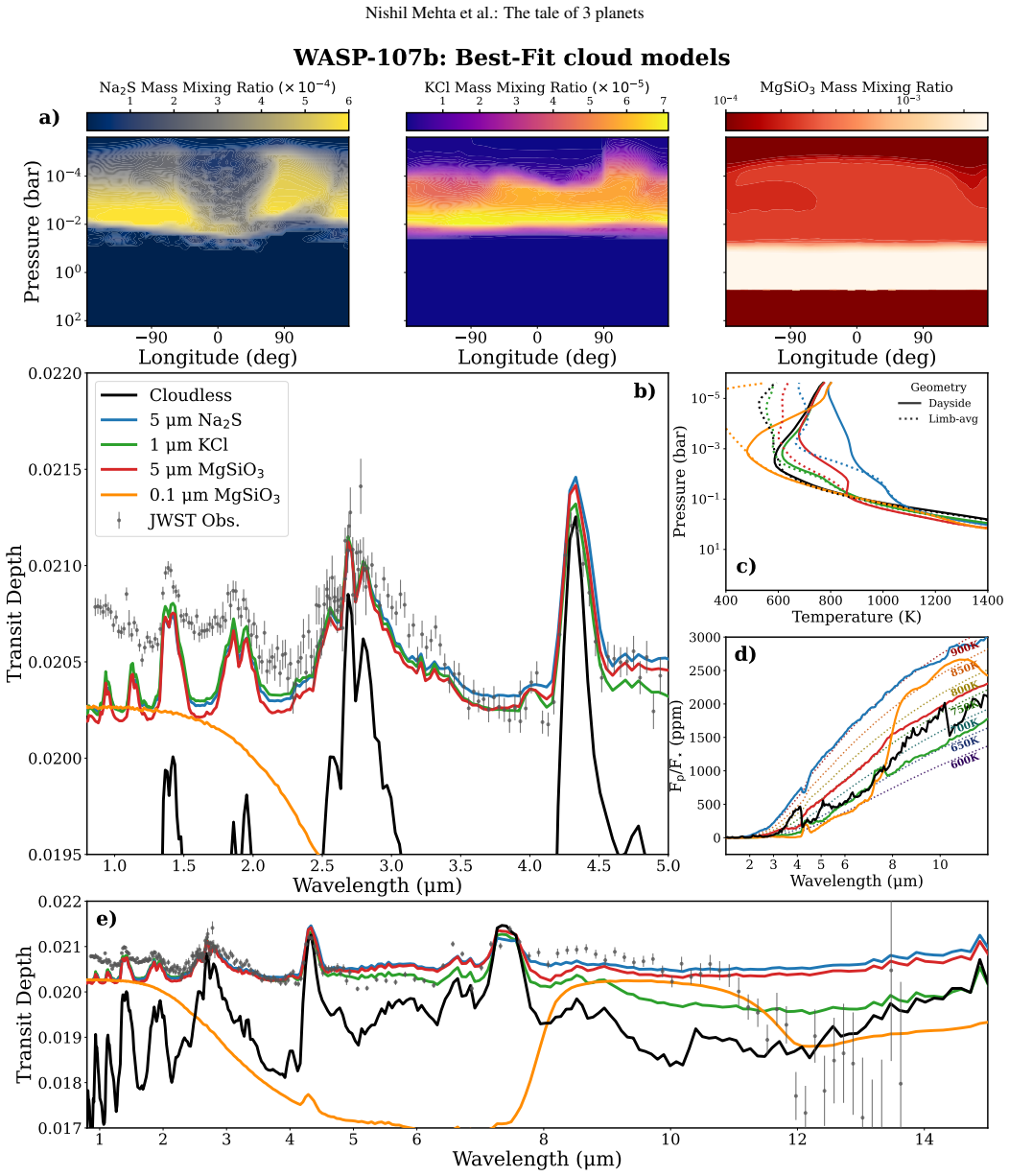
Coupling among 3D circulation, clouds, and radiative transfer can enhance the spectral diversity of warm Jupiter exoplanets, particularly through changes in cloudiness with gravity. Clouds settle deeper in the higher-gravity planet WASP-80b than in WASP-107b, reproducing their spectral difference naturally. For WASP-107b, models with 5 μm Na2S, 1 μm KCl, and 5 μm MgSiO3 fit the NIRCam observations, but cannot match the scattering slope or possible silicate feature, suggesting a multi-modal cloud distribution. The model does not produce a partially cloudy dayside solution for WASP-69b.
What carries the argument
The ADAM 3D model that simultaneously solves cloud transport, radiative transfer, and atmospheric circulation for three condensate species and four discrete particle sizes.
If this is right
- Higher-gravity warm Jupiters will display deeper cloud decks and clearer transmission spectra than lower-gravity counterparts.
- Full wavelength coverage from NIRISS to MIRI requires multi-modal particle size distributions rather than single sizes.
- 3D circulation effects prevent the formation of the partially cloudy daysides inferred from earlier 1D studies for planets like WASP-69b.
- Small silicate particles remain well mixed across limbs and cannot explain observed differences in MIRI limb spectra.
Where Pith is reading between the lines
- The gravity dependence of cloud settling could be tested by comparing transmission spectra of warm Jupiters spanning a wider mass range.
- Discrepancies at short wavelengths and in MIRI may be resolved by adding continuous particle size distributions or additional condensates not included here.
- The framework could be extended to cooler or hotter exoplanets to predict how cloud diversity scales with equilibrium temperature.
- Temperature or composition asymmetries between limbs may be needed to explain spectral differences that the current uniform cloud assumptions leave unresolved.
Load-bearing premise
That three chosen condensate species and four fixed particle sizes capture the dominant cloud effects without continuous size distributions or extra condensates.
What would settle it
High-precision spectra of additional warm Jupiters with measured gravities that show either no systematic clearing with increasing gravity or silicate features inconsistent with the predicted multi-modal particle distribution.
Figures




read the original abstract
JWST has shown a large diversity in warm Jupiter spectra, despite only small variations in the planetary parameters. However, the main driver of this diversity remains unclear. We aim to identify the mechanisms responsible for the spectral difference of three warm Jupiter-size exoplanets observed by JWST: whereas WASP-80b appears mostly cloud-free, both WASP-107b and WASP-69b have spectra dominated by clouds. We model each planet using the same framework, ADAM (formerly SPARC/MITgcm), which solves for the interactions among cloud transport, radiative transfer, and atmospheric circulation in 3D. We investigate the role of three condensate species, Na$_2$S, KCl, and MgSiO$_3$, and four particle sizes (0.1, 1, 5, and 10 $\mu$m). Clouds settle deeper in the atmosphere of the higher-gravity planet WASP-80b than in WASP-107b, reproducing their spectral difference naturally. For WASP-107b, three clouds can reproduce the NIRCam observations: 5 $\mu$m Na$_2$S, 1 $\mu$m KCl, and 5 $\mu$m MgSiO$_3$ models. However, these cannot match the scattering slope observed at shorter wavelengths in NIRISS and the possible silicate feature in the MIRI bandpass, suggesting a multi-modal distribution of clouds. Our model predicts that small silicate particles should be homogeneously distributed and thus cannot account for the difference between the two limb spectra in the MIRI bandpass. Finally, applying the same model to WASP-69b does not yield a partially cloudy dayside solution that fits the emission spectra, as proposed in a previous study. Coupling among 3D circulation, clouds, and radiative transfer can enhance the spectral diversity of warm Jupiter exoplanets, particularly through changes in cloudiness with gravity. The combination of multi-phase, wide-wavelength coverage and models that couple clouds, circulation, and radiative transfer is key to advancing our understanding of these new objects.
Editorial analysis
A structured set of objections, weighed in public.
Referee Report
Summary. The manuscript claims that 3D coupling among atmospheric circulation, cloud transport, and radiative transfer in the ADAM (SPARC/MITgcm) framework can enhance spectral diversity among warm Jupiters observed by JWST. Specifically, higher gravity causes deeper cloud settling in WASP-80b (appearing mostly cloud-free) compared to WASP-107b (cloud-dominated), with single-size models of Na₂S (5 μm), KCl (1 μm), and MgSiO₃ (5 μm) reproducing NIRCam data for WASP-107b. However, these cannot match the NIRISS scattering slope or MIRI silicate feature (suggesting multi-modal clouds), and the same framework yields no partially cloudy dayside solution for WASP-69b that fits emission spectra as previously proposed. The conclusion is that gravity-dependent cloudiness via 3D feedback is a key driver of diversity.
Significance. If the central result holds, the work is significant for demonstrating that self-consistent 3D models can naturally reproduce observed spectral differences among warm Jupiters with only modest changes in gravity and without large variations in other parameters. It highlights the limitations of 1D approximations and provides a concrete example of how circulation-cloud-radiative feedbacks operate, which is valuable for interpreting the growing JWST dataset on exoplanet atmospheres.
major comments (3)
- [Abstract] Abstract: The claim that clouds settle deeper in higher-gravity WASP-80b than WASP-107b, 'reproducing their spectral difference naturally,' is based on forward simulations with only three condensates and four discrete particle sizes. Yet the same models explicitly fail to match the NIRISS scattering slope and possible MIRI silicate feature for WASP-107b, requiring the authors to invoke multi-modal distributions. This restriction on the parameter space (free parameters: particle sizes and condensate species) makes it unclear whether the reported gravity-driven 3D feedback is robust or an artifact of the chosen microphysics.
- [WASP-69b modeling] WASP-69b results: The framework does not produce a partially cloudy dayside solution that fits the emission spectra, in contrast to prior proposals. Because the manuscript positions itself as explaining the diversity across all three planets, this failure for one object is load-bearing and weakens the generality of the conclusion that 3D cloud feedback enhances spectral diversity.
- [Cloud species and sizes] Cloud microphysics assumptions: The choice of only Na₂S, KCl, and MgSiO₃ with fixed sizes (0.1, 1, 5, 10 μm) omits continuous size distributions, nucleation/growth, and other condensates. Given that the models already require multi-modal clouds to approach the WASP-107b data, this limited representation risks making the gravity effect on cloudiness non-generalizable.
minor comments (1)
- [Abstract] The abstract would benefit from a more balanced statement of limitations (e.g., the WASP-69b mismatch and multi-modal requirement) to avoid overstating the success of the single-size models.
Simulated Author's Rebuttal
We thank the referee for their constructive and detailed report. We address each major comment point by point below, clarifying the scope of our results while acknowledging limitations in microphysical assumptions. Revisions have been made to strengthen caveats and discussion.
read point-by-point responses
-
Referee: [Abstract] The claim that clouds settle deeper in higher-gravity WASP-80b than WASP-107b, 'reproducing their spectral difference naturally,' is based on forward simulations with only three condensates and four discrete particle sizes. Yet the same models explicitly fail to match the NIRISS scattering slope and possible MIRI silicate feature for WASP-107b, requiring the authors to invoke multi-modal distributions. This restriction on the parameter space (free parameters: particle sizes and condensate species) makes it unclear whether the reported gravity-driven 3D feedback is robust or an artifact of the chosen microphysics.
Authors: The manuscript already states that the selected models reproduce NIRCam data for WASP-107b but fail to match the NIRISS slope and MIRI feature, explicitly suggesting multi-modal clouds are required. Within the tested discrete sizes and species, the 3D framework produces deeper cloud settling in the higher-gravity WASP-80b, which accounts for its clearer spectrum relative to WASP-107b. This demonstrates the operation of circulation-cloud-radiative feedback rather than claiming it is the only possible mechanism. We have revised the abstract to replace 'reproducing their spectral difference naturally' with 'can enhance spectral diversity through gravity-dependent cloud settling' and added a sentence in the conclusions emphasizing that broader microphysical explorations are needed to test robustness. revision: yes
-
Referee: [WASP-69b modeling] The framework does not produce a partially cloudy dayside solution that fits the emission spectra, in contrast to prior proposals. Because the manuscript positions itself as explaining the diversity across all three planets, this failure for one object is load-bearing and weakens the generality of the conclusion that 3D cloud feedback enhances spectral diversity.
Authors: The abstract and results section already report transparently that the same framework yields no partially cloudy dayside solution matching the emission spectra for WASP-69b. This outcome indicates that additional factors (e.g., different condensate properties, metallicity, or vertical mixing not captured in the current setup) may dominate for this planet, consistent with the overall finding that 3D coupling produces diversity but does not claim to reproduce every prior interpretation. The gravity-dependent effect is robustly shown between WASP-80b and WASP-107b; the WASP-69b case illustrates the limits of the model rather than undermining the mechanism. We have added a paragraph in the discussion section addressing possible reasons for the mismatch and its implications for interpreting JWST data on this object. revision: partial
-
Referee: [Cloud species and sizes] The choice of only Na₂S, KCl, and MgSiO₃ with fixed sizes (0.1, 1, 5, 10 μm) omits continuous size distributions, nucleation/growth, and other condensates. Given that the models already require multi-modal clouds to approach the WASP-107b data, this limited representation risks making the gravity effect on cloudiness non-generalizable.
Authors: These species were selected as the dominant condensates expected at the equilibrium temperatures of the three planets, following standard assumptions in the literature for warm Jupiters. The discrete sizes permit isolation of the gravity-settling effect across the 3D domain. We already note in the text that multi-modal distributions are likely needed to fit the full WASP-107b dataset. While continuous distributions and additional species would provide a more complete picture, the current results show that gravity modulates cloud vertical extent even under these simplified microphysics. We have expanded the methods section with explicit justification for the choices and added a dedicated limitations paragraph in the conclusions recommending future work with more advanced cloud microphysics modules. revision: yes
Circularity Check
Forward 3D simulations with fixed parameters exhibit no circularity
full rationale
The paper runs the ADAM (SPARC/MITgcm) framework as forward simulations with explicitly chosen inputs: three condensate species (Na2S, KCl, MgSiO3) and four discrete particle sizes (0.1, 1, 5, 10 μm). These are applied uniformly to three planets and the resulting spectra are compared to JWST data. The central claim—that gravity-dependent cloud settling produces spectral diversity—follows directly from the simulated physics of transport and radiative transfer, not from any fitted parameter that is then relabeled as a prediction. No equations reduce to their own inputs by construction, no self-citation chain supplies a uniqueness theorem, and no ansatz is imported via prior work. The model is self-contained against external benchmarks (the observations) and reports both successful matches (NIRCam for WASP-107b) and failures (NIRISS slope, MIRI feature, WASP-69b dayside), confirming the derivation does not collapse to tautology.
Axiom & Free-Parameter Ledger
free parameters (2)
- particle sizes =
0.1, 1, 5, 10 μm
- condensate species =
Na₂S, KCl, MgSiO₃
axioms (1)
- domain assumption The ADAM framework accurately captures interactions among cloud transport, radiative transfer, and atmospheric circulation in 3D.
Reference graph
Works this paper leans on
-
[1]
Adcroft, A., Campin, J.-M., Hill, C., & Marshall, J. 2004, Mon. Weather Rev., 132, 2845 Batygin, K. & Stevenson, D. J. 2010, ApJ, 714, L238 Carone, L., Baeyens, R., Mollière, P., et al. 2020, MNRAS, 496, 3582 Collins, W. D., Rasch, P. J., Boville, B. A., et al. 2004, NCAR Tech. Note NCAR/TN-464+STR, 226, 1326 Drummond, B., Hébrard, E., Mayne, N. J., et al...
work page internal anchor Pith review Pith/arXiv arXiv 2004
-
[2]
B.10.K zz profiles for W ASP-107b (left), W ASP-80b (middle), and W ASP-69b (right) for different cloud cases
WASP-69b Cloudless 0.1 m Na2S 1 m Na2S 5 m Na2S 10 m Na2S 0.1 m KCl 1 m KCl 5 m KCl 10 m KCl 0.1 m MgSiO3 1 m MgSiO3 5 m MgSiO3 10 m MgSiO3 Fig. B.10.K zz profiles for W ASP-107b (left), W ASP-80b (middle), and W ASP-69b (right) for different cloud cases. Kzz was calculated as the root mean square of the vertical velocity times the vertical scale height. ...
2000
-
[3]
Article number, page 29 of 30 A&A proofs:manuscript no. main 600 800 1000 1200 1400 1600 1800 2000 Temperature (K) 10 6 10 5 10 4 10 3 10 2 10 1 100 101 102 103 Pressure (bar) Na2S 0.1 m 1 m 5 m 10 m Cloudless GCM Na2S 600 800 1000 1200 1400 1600 1800 2000 Temperature (K) KCl KCl 0.1 m 1 m 5 m 10 m Cloudless GCM KCl 600 800 1000 1200 1400 1600 1800 2000 T...
2000
discussion (0)
Sign in with ORCID, Apple, or X to comment. Anyone can read and Pith papers without signing in.