Recognition: unknown
The effect of spectral resolution on biosignature detection via reflected light observations of the Earth through time
Pith reviewed 2026-05-07 10:14 UTC · model grok-4.3
The pith
Nominal resolutions of 140 in the visible and 70 in the near-infrared suffice to detect key biosignatures like oxygen across atmospheres from Archean to modern Earth.
A machine-rendered reading of the paper's core claim, the machinery that carries it, and where it could break.
Core claim
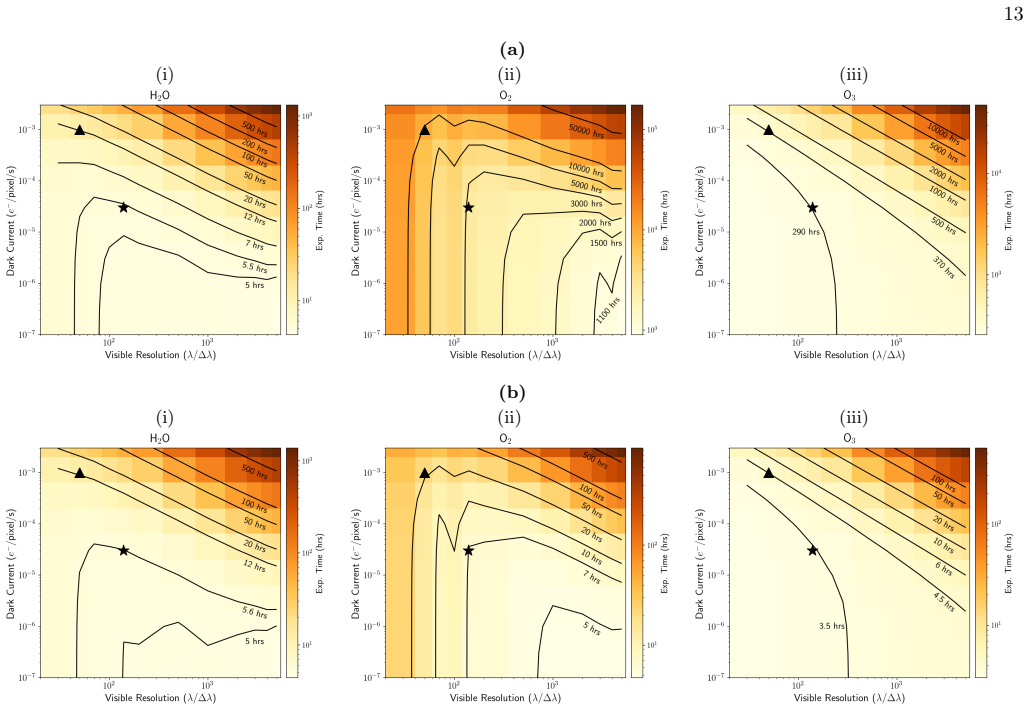
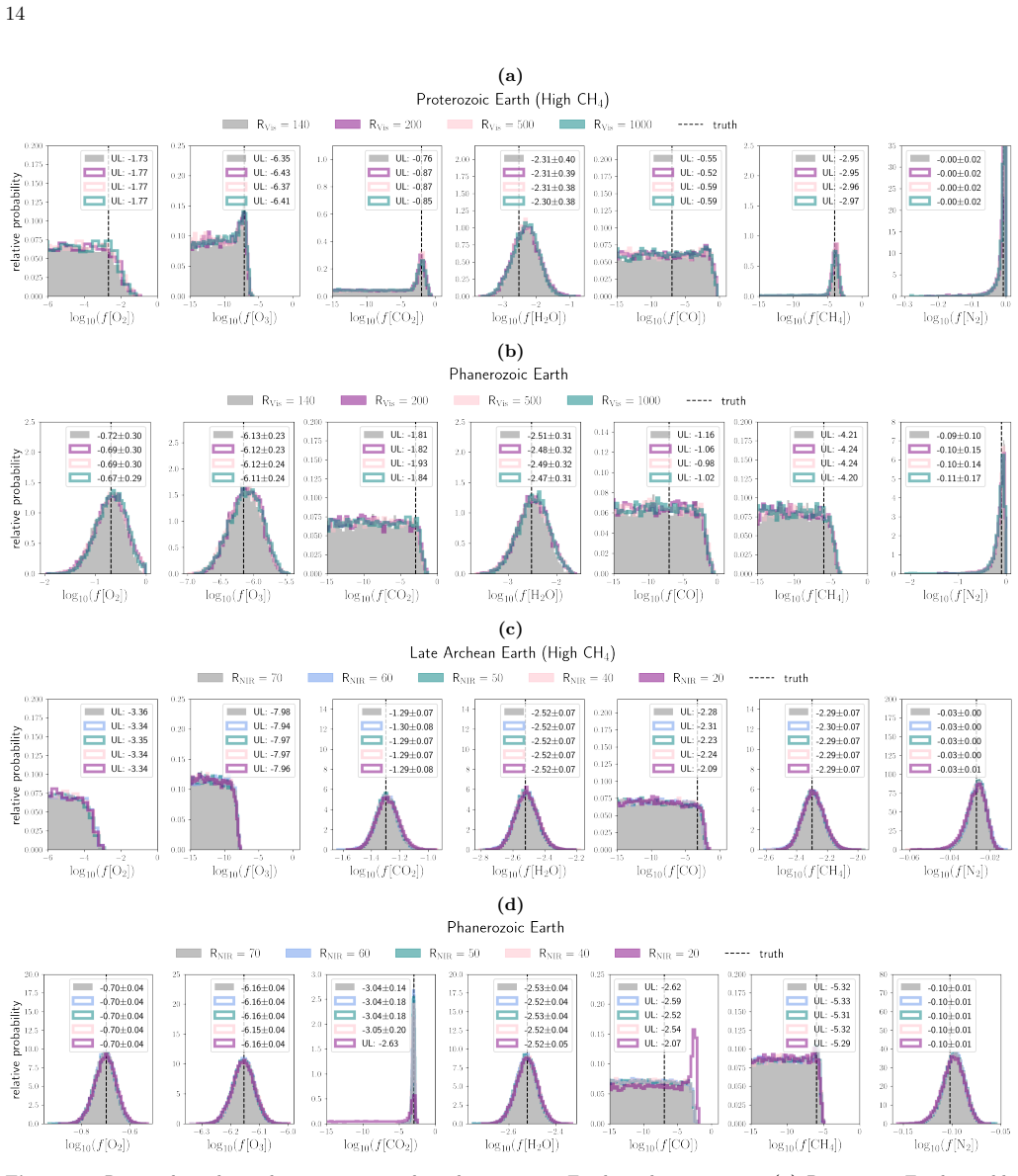
A resolving power of 140 in the visible band detects O2 in Phanerozoic-like atmospheres, while 70 in the near-infrared characterizes all Earth-through-time cases including avoidance of a CO-CO2 degeneracy that could produce false positives for abundant CO. Higher visible resolutions can shorten exposure times for low-O2 Proterozoic cases only if dark current drops by more than a factor of ten, yet they roughly double the time needed to detect H2O. Indirect inference of low-O2 atmospheres via O3 at R_UV around 7 offers a more efficient alternative. These outcomes support the observatory's current baseline resolution choices.
What carries the argument
Analytical detectability calculations across R from 20 to 5000 combined with rfast radiative transfer retrievals and pyEDITH wavelength-dependent noise modeling.
If this is right
- O3 Hartley-Huggins bands allow indirect detection of low-O2 atmospheres at very low UV resolution around 7.
- R_NIR of at least 40 is required to break the CO-CO2 degeneracy and prevent false positive CO detections.
- The nominal settings balance biosignature detectability against exposure time and detector noise constraints for all historical Earth cases.
- Increasing visible resolution beyond 140 offers limited gains for low-O2 cases while increasing H2O detection times.
Where Pith is reading between the lines
- Instrument teams could prioritize reductions in detector dark current over further increases in spectral resolution for visible observations.
- The modeling approach could be applied to other proposed exoplanet missions or to ground-based high-contrast imaging to guide their resolution choices.
- Validation against actual reflected-light spectra of solar system bodies observed at comparable resolutions would test the noise and retrieval assumptions directly.
- Emphasizing UV coverage for ozone alongside visible oxygen searches could strengthen overall biosignature strategies for future telescopes.
Load-bearing premise
The assumed atmospheric compositions for Archean, Proterozoic, and Phanerozoic epochs plus the pyEDITH noise model accurately represent real exoplanet observations and instrument performance without unmodeled systematics.
What would settle it
Retrieve atmospheric properties from synthetic spectra of a known Earth-like planet generated at R_Vis=140 and R_NIR=70 and check whether O2, O3, H2O, CH4, CO2 and CO are recovered at the predicted confidence levels without the expected exposure-time penalties or degeneracies.
Figures




read the original abstract
NASA's Habitable Worlds Observatory (HWO) will search for biosignatures on Earth-like exoplanets using reflected light spectroscopy. A critical instrument design parameter is resolving power, which must balance biosignature detectability against exposure time and detector noise constraints. We assess the resolving power needed to detect and characterize key biosignature gases and habitability indicators including O$_2$, O$_3$, H$_2$O, CH$_4$, CO$_2$ and CO across atmospheres representing the Archean, Proterozoic, and Phanerozoic Earth. We combine analytical detectability calculations spanning spectral resolutions ($\lambda/\Delta{\lambda}$) $R=20$-$5000$ with atmospheric retrievals using the rfast radiative transfer model and pyEDITH exposure time calculator for realistic wavelength-dependent noise modeling. In the visible ($0.4$-$1.0$ $\mu$m), the nominal resolution $R_{Vis}=140$ is sufficient for detecting O$_2$ in Phanerozoic-like atmospheres. Higher resolutions could theoretically reduce exposure times for low-O$_2$ Proterozoic atmospheres, but require $>10\times$ reductions in dark current and could increase H$_2$O detection exposure times by $\sim 2\times$, penalizing the foundational habitability constraint that anchors downstream biosignature searches. The most efficient path for low-O$_2$ atmospheres may instead be indirect inference via O$_3$, whose Hartley-Huggins bands are detectable at $R_{UV}\sim 7$. In the near-IR ($1.0$-$1.7$ $\mu$m), $R_{NIR}\geq40$ is necessary to avoid a degeneracy between CO$_2$ and CO that could produce false positive detections of abundant CO. The nominal $R_{NIR}=70$ is sufficient for characterizing all Earth-through-time cases. These results support HWO's current baseline resolution choices and provide actionable guidance for finalizing spectrometer requirements while maintaining technological feasibility for the search for life on exoplanets.
Editorial analysis
A structured set of objections, weighed in public.
Referee Report
Summary. The manuscript assesses the spectral resolving power required to detect and characterize biosignatures (O2, O3, H2O, CH4, CO2, CO) and habitability indicators in reflected-light spectra of Earth through time (Archean, Proterozoic, Phanerozoic epochs). It combines analytical detectability calculations over R=20–5000 with rfast retrievals and pyEDITH wavelength-dependent noise modeling, concluding that nominal R_Vis=140 suffices for O2 detection in Phanerozoic-like atmospheres, R_NIR=70 suffices for all cases, and higher R offers limited benefit for low-O2 atmospheres without major dark-current improvements; indirect O3 detection at low R_UV is suggested as an alternative.
Significance. If the noise model and atmospheric assumptions hold, the work supplies concrete, actionable guidance for finalizing spectrometer requirements on the Habitable Worlds Observatory by quantifying resolution–exposure-time–dark-current trade-offs across geological epochs. The dual use of analytical SNR calculations and full retrievals, plus explicit discussion of model limitations, strengthens the support for current HWO baseline choices.
major comments (2)
- [Noise modeling / pyEDITH description] Noise modeling section: pyEDITH supplies wavelength-dependent noise but omits a full end-to-end treatment of stellar variability, pointing jitter, and detector persistence. If these systematics contribute at the 10–20 % level, the effective SNR at the O2 A-band drops and the resolution needed to maintain 5-sigma detection in Phanerozoic cases may exceed the nominal R_Vis=140.
- [Results (low-O2 atmospheres)] Results on low-O2 Proterozoic cases: the statement that higher R could reduce exposure times only if dark current falls >10× is presented as a model-dependent trade-off; the manuscript should quantify how sensitive the exposure-time curves and detection thresholds are to plausible variations in the dark-current assumption.
minor comments (2)
- [Abstract] Abstract: the claim that R_NIR ≥40 avoids the CO2–CO degeneracy is stated separately from the nominal R_NIR=70; clarify whether 40 is the strict minimum or if 70 is adopted for additional characterization reasons.
- [Figures] Figure captions and legends: ensure all panels explicitly label the three epochs and the exact R values tested so readers can directly map results to the text without ambiguity.
Simulated Author's Rebuttal
We thank the referee for their constructive and detailed comments on our manuscript. We address each major comment point by point below, providing honest responses based on the scope of our analysis. We have incorporated revisions where they strengthen the work without altering its core conclusions.
read point-by-point responses
-
Referee: Noise modeling section: pyEDITH supplies wavelength-dependent noise but omits a full end-to-end treatment of stellar variability, pointing jitter, and detector persistence. If these systematics contribute at the 10–20 % level, the effective SNR at the O2 A-band drops and the resolution needed to maintain 5-sigma detection in Phanerozoic cases may exceed the nominal R_Vis=140.
Authors: We appreciate the referee's observation regarding the scope of our noise model. pyEDITH, as used in Section 2.3, incorporates wavelength-dependent photon noise, read noise, and dark current for the specified detector parameters, enabling the analytical SNR calculations and rfast retrievals presented. We agree that it does not include a full end-to-end treatment of additional systematics such as stellar variability, pointing jitter, or detector persistence. In the revised manuscript, we will add explicit language in the methods and limitations sections acknowledging that if these effects contribute at the 10-20% level, the effective SNR at the O2 A-band could decrease, potentially increasing the resolution or exposure time needed for 5-sigma detections in Phanerozoic cases. Our conclusions are framed within the assumptions of the current noise model, which we believe still provides actionable guidance for HWO requirements. revision: partial
-
Referee: Results on low-O2 Proterozoic cases: the statement that higher R could reduce exposure times only if dark current falls >10× is presented as a model-dependent trade-off; the manuscript should quantify how sensitive the exposure-time curves and detection thresholds are to plausible variations in the dark-current assumption.
Authors: We agree that further quantification of the sensitivity to dark current assumptions would improve the clarity of the trade-off discussion for low-O2 Proterozoic atmospheres. The manuscript already notes the >10× dark current reduction requirement as a model-dependent result. In the revised version, we will add a sensitivity analysis, including updated exposure-time curves and detection threshold plots for dark current reduction factors of 1×, 5×, 10×, and 20×. This will explicitly show how the required resolutions and exposure times respond to variations in this parameter, allowing readers to better evaluate the robustness of the conclusions. revision: yes
Circularity Check
No circularity: results from external forward models and retrievals
full rationale
The paper derives resolution requirements via analytical detectability calculations and rfast retrievals fed by the pyEDITH noise model applied to fixed atmospheric compositions for Archean/Proterozoic/Phanerozoic epochs. No equations reduce outputs to inputs by construction, no parameters are fitted to the target claims, and no load-bearing self-citations or ansatzes are invoked. The nominal R_Vis=140 and R_NIR=70 conclusions follow directly from the stated simulations rather than presupposing them.
Axiom & Free-Parameter Ledger
free parameters (1)
- Tested spectral resolution range
axioms (2)
- domain assumption Atmospheric compositions for Archean, Proterozoic, and Phanerozoic epochs match prior geological models
- domain assumption pyEDITH provides accurate wavelength-dependent noise for HWO-like instruments
Reference graph
Works this paper leans on
-
[1]
, " * write output.state after.block = add.period write newline
ENTRY address archivePrefix author booktitle chapter doi edition editor eprint howpublished institution journal key month number organization pages publisher school series title misctitle type volume year version url label extra.label sort.label short.list INTEGERS output.state before.all mid.sentence after.sentence after.block FUNCTION init.state.consts ...
-
[2]
write newline
" write newline "" before.all 'output.state := FUNCTION format.url url empty "" new.block "" url * "" * if FUNCTION format.eprint eprint empty "" archivePrefix empty "" archivePrefix "arXiv" = new.block " " eprint * " " * new.block " " eprint * " " * if if if FUNCTION format.doi doi empty "" " " doi * " " * if FUNCTION format.pid doi empty eprint empty ur...
-
[3]
thebibliography [1] 20pt to REFERENCES 6pt =0pt -12pt 10pt plus 3pt =0pt =0pt =1pt plus 1pt =0pt =0pt -12pt =13pt plus 1pt =20pt =13pt plus 1pt \@M =10000 =-1.0em =0pt =0pt 0pt =0pt =1.0em @enumiv\@empty 10000 10000 `\.\@m \@noitemerr \@latex@warning Empty `thebibliography' environment \@ifnextchar \@reference \@latexerr Missing key on reference command E...
-
[4]
Alei, E., & Currie, M. H. 2025, pyEDITH : a Python -based coronagraphic exposure time calculator for the Habitable Worlds Observatory (HWO) , Software documentation. https://pyedith.readthedocs.io/en/latest/
2025
-
[5]
Alei , E., Mandell , A. M., Currie , M. H., et al. 2025, arXiv e-prints, arXiv:2512.05279, 10.48550/arXiv.2512.05279
-
[6]
2025, Claude S onnet 4.6 [Large language model], Accessed 2025
Anthropic. 2025, Claude S onnet 4.6 [Large language model], Accessed 2025. https://claude.ai
2025
-
[7]
J., Hood, A
Bellefroid, E. J., Hood, A. v. S., Hoffman, P. F., et al. 2018, Proceedings of the National Academy of Sciences, 115, 8104
2018
-
[8]
2012, The Astrophysical Journal, 753, 100
Benneke, B., & Seager, S. 2012, The Astrophysical Journal, 753, 100
2012
-
[9]
R., Jones, G
Borges, S. R., Jones, G. G., & Robinson, T. D. 2024, Astrobiology, 24, 283
2024
-
[10]
D., & Spiegel, D
Brandt, T. D., & Spiegel, D. S. 2014, Proceedings of the National Academy of Sciences, 111, 13278
2014
-
[11]
2024, Nature Astronomy, 8, 1008
Carter, A., May, E., Espinoza, N., et al. 2024, Nature Astronomy, 8, 1008
2024
-
[12]
C., Kiang Nancy, Y., Robinson Tyler, D., Rushby Andrew, J., et al
Catling, D. C., Kiang Nancy, Y., Robinson Tyler, D., Rushby Andrew, J., et al. 2018, Astrobiology
2018
-
[13]
C., Zahnle, K
Catling, D. C., Zahnle, K. J., & McKay, C. P. 2001, Science, 293, 839
2001
-
[14]
2021, The Astronomical Journal, 162, 200
Damiano, M., & Hu, R. 2021, The Astronomical Journal, 162, 200
2021
-
[15]
2022, The Astronomical Journal, 163, 299
---. 2022, The Astronomical Journal, 163, 299
2022
-
[16]
2023, The Astronomical Journal, 166, 157
Damiano, M., Hu, R., & Mennesson, B. 2023, The Astronomical Journal, 166, 157
2023
-
[17]
J., Harwit, M
Des Marais, D. J., Harwit, M. O., Jucks, K. W., et al. 2002, Astrobiology, 2, 153
2002
-
[18]
D., Segura, A., Claire, M
Domagal-Goldman, S. D., Segura, A., Claire, M. W., Robinson, T. D., & Meadows, V. S. 2014, The Astrophysical Journal, 792, 90
2014
-
[19]
Ebadirad, S., Lyons, T. W., & Fournier, G. P. 2025, arXiv preprint arXiv:2503.21919
-
[20]
Feinberg, L. D., Sitarski, B. N., McElwain, M. W., et al. 2026, arXiv preprint arXiv:2601.11803
-
[21]
K., Robinson, T
Feng, Y. K., Robinson, T. D., Fortney, J. J., et al. 2018, The Astronomical Journal, 155, 200
2018
-
[22]
W., Lang, D., & Goodman, J
Foreman-Mackey, D., Hogg, D. W., Lang, D., & Goodman, J. 2013, Publications of the Astronomical Society of the Pacific, 125, 306
2013
-
[23]
D., Li, C., & Yung, Y
Gao, P., Hu, R., Robinson, T. D., Li, C., & Yung, Y. L. 2015, The Astrophysical Journal, 806, 249
2015
-
[24]
S., Seager, S., Mennesson, B., et al
Gaudi, B. S., Seager, S., Mennesson, B., et al. 2020, arXiv preprint arXiv:2001.06683
-
[25]
S., & Lustig-Yaeger, J
Gilbert-Janizek, S., Meadows, V. S., & Lustig-Yaeger, J. 2024, The Planetary Science Journal, 5, 148
2024
-
[26]
J., Lewis, N
Gomez Barrientos, J., MacDonald, R. J., Lewis, N. K., & Kaltenegger, L. 2023, The Astrophysical Journal, 946, 96
2023
-
[27]
E., Rothman, L
Gordon, I. E., Rothman, L. S., Hargreaves, e. R., et al. 2022, Journal of quantitative spectroscopy and radiative transfer, 277, 107949
2022
-
[28]
M., et al
Hagee , C., Latouf , N., Mandell , A. M., et al. 2026
2026
-
[29]
Hall, S., Krissansen-Totton, J., Robinson, T., Salvador, A., & Fortney, J. J. 2023, The Astronomical Journal, 166, 254
2023
-
[30]
G., Kent, R., Kaltenegger, L., & Rothschild, L
Hegde, S., Paulino-Lima, I. G., Kent, R., Kaltenegger, L., & Rothschild, L. 2015, Proceedings of the National Academy of Sciences, 112, 3886
2015
-
[31]
Hu, R., Peterson, L., & Wolf, E. T. 2020, The Astrophysical Journal, 888, 122
2020
-
[32]
Kasting, J. F. 2005, Precambrian Research, 137, 119
2005
-
[33]
J., Nimmo, F., & Wogan, N
Krissansen-Totton, J., Fortney, J. J., Nimmo, F., & Wogan, N. 2021, AGU Advances, 2, e2020AV000294
2021
-
[34]
L., & Fortney, J
Krissansen-Totton, J., Thompson, M., Galloway, M. L., & Fortney, J. J. 2022, Nature Astronomy, 6, 189
2022
-
[35]
Krissansen-Totton, J., Ulses, A. G., Frissell, M., et al. 2025, arXiv preprint arXiv:2507.14771
-
[36]
Kump, L. R. 2008, Nature, 451, 277
2008
-
[37]
D., Mandell, A
Latouf, N., Himes, M. D., Mandell, A. M., et al. 2025, The Astronomical Journal, 169, 50
2025
-
[38]
M., Villanueva, G
Latouf, N., Mandell, A. M., Villanueva, G. L., et al. 2023 a , The Astronomical Journal, 166, 129
2023
-
[39]
2023 b , The Astronomical Journal, 167, 27
---. 2023 b , The Astronomical Journal, 167, 27
2023
-
[40]
2019, arXiv preprint arXiv:1912.06219
LUVOIR Team and others . 2019, arXiv preprint arXiv:1912.06219
-
[41]
W., Reinhard, C
Lyons, T. W., Reinhard, C. T., & Planavsky, N. J. 2014, Nature, 506, 307
2014
-
[42]
2014, Educause Review
McCartney, G., Hacker, T., & Yang, B. 2014, Educause Review. https://tinyurl.com/2fd6b934
2014
-
[43]
S., & Crisp, D
Meadows, V. S., & Crisp, D. 1996, Journal of Geophysical Research: Planets, 101, 4595
1996
-
[44]
S., Reinhard, C
Meadows, V. S., Reinhard, C. T., Arney, G. N., et al. 2018, Astrobiology, 18, 630
2018
-
[45]
2021, Pathways to Discovery in Astronomy and Astrophysics for the 2020s (The National Academies Press)
National Academies of Sciences, Engineering, and Medicine . 2021, Pathways to Discovery in Astronomy and Astrophysics for the 2020s (The National Academies Press)
2021
-
[46]
J., Reinhard, C
Planavsky, N. J., Reinhard, C. T., Wang, X., et al. 2014, science, 346, 635
2014
-
[47]
Ragsdale, S. W. 2004, Critical reviews in biochemistry and molecular biology, 39, 165
2004
-
[48]
W., Leung, M., Harman, C
Ranjan, S., Schwieterman, E. W., Leung, M., Harman, C. E., & Hu, R. 2023, The Astrophysical Journal Letters, 958, L15
2023
-
[49]
D., & Salvador, A
Robinson, T. D., & Salvador, A. 2023, The Planetary Science Journal, 4, 10
2023
-
[50]
Characterizing Earth analogs may require a moderate or high-resolution spectrograph
Ruffio, J.-B., Steiger, S., Spohn, C., et al. 2026, arXiv preprint arXiv:2604.17554
work page internal anchor Pith review Pith/arXiv arXiv 2026
-
[51]
2018 a , arXiv preprint arXiv:1801.02744
Schwieterman, E., Reinhard, C., Olson, S., & Lyons, T. 2018 a , arXiv preprint arXiv:1801.02744
-
[52]
W., & Leung, M
Schwieterman, E. W., & Leung, M. 2024, Reviews in Mineralogy and Geochemistry, 90, 465
2024
-
[53]
W., Reinhard, C
Schwieterman, E. W., Reinhard, C. T., Olson, S. L., et al. 2019, The Astrophysical Journal, 874, 9
2019
-
[54]
W., Kiang, N
Schwieterman, E. W., Kiang, N. Y., Parenteau, M. N., et al. 2018 b , Astrobiology, 18, 663
2018
-
[55]
L., Schafer, J., & Ford, E
Seager, S., Turner, E. L., Schafer, J., & Ford, E. B. 2005, Astrobiology, 5, 372
2005
-
[56]
C., Roberge, A., Mandell, A., & Robinson, T
Stark , C. C., Roberge , A., Mandell , A., & Robinson , T. D. 2014, , 795, 122, 10.1088/0004-637X/795/2/122
-
[57]
C., Steiger, S., Tokadjian, A., et al
Stark, C. C., Steiger, S., Tokadjian, A., et al. 2025, arXiv preprint arXiv:2502.18556
-
[58]
2026, Journal of Astronomical Telescopes, Instruments, and Systems, 12, 041005
Steiger, S., Chen, P., & Pueyo, L. 2026, Journal of Astronomical Telescopes, Instruments, and Systems, 12, 041005
2026
-
[59]
A., Krissansen-Totton, J., Wogan, N., Telus, M., & Fortney, J
Thompson, M. A., Krissansen-Totton, J., Wogan, N., Telus, M., & Fortney, J. J. 2022, Proceedings of the National Academy of Sciences, 119, e2117933119
2022
-
[60]
2024, The Astronomical Journal, 168, 292
Tokadjian, A., Hu, R., & Damiano, M. 2024, The Astronomical Journal, 168, 292
2024
-
[61]
G., Krissansen-Totton, J., Robinson, T
Ulses, A. G., Krissansen-Totton, J., Robinson, T. D., et al. 2025, The Astrophysical Journal, 990, 48
2025
-
[62]
2016, Icarus, 266, 15
Wang, Y., Tian, F., Li, T., & Hu, Y. 2016, Icarus, 266, 15
2016
-
[63]
C., Gao , P., Wogan , N., Saxena , P., & Wilkins , J
Washington III , R. C., Gao , P., Wogan , N., Saxena , P., & Wilkins , J. 2026
2026
-
[64]
F., & Catling, D
Wogan, N. F., & Catling, D. C. 2020, The Astrophysical Journal, 892, 127
2020
-
[65]
D., et al
Young , A., Arney , G., Robinson , T. D., et al. 2026
2026
-
[66]
V., Crouse, J., Arney, G., et al
Young, A. V., Crouse, J., Arney, G., et al. 2024, The Planetary Science Journal, 5, 7
2024
-
[67]
V., Robinson, T
Young, A. V., Robinson, T. D., Krissansen-Totton, J., et al. 2025, The Astrophysical Journal, 986, 206
2025
-
[68]
S., & Catling, D
Zahnle, K., Freedman, R. S., & Catling, D. C. 2011, Icarus, 212, 493
2011
-
[69]
M., Catling, D
Zahnle, K., Haberle, R. M., Catling, D. C., & Kasting, J. F. 2008, Journal of Geophysical Research: Planets, 113
2008
discussion (0)
Sign in with ORCID, Apple, or X to comment. Anyone can read and Pith papers without signing in.