Recognition: unknown
Improved results on Higgs boson pair production in the 4b final state
Pith reviewed 2026-05-07 08:06 UTC · model grok-4.3
The pith
CMS sets an upper limit of 4.4 times the Standard Model expectation on Higgs boson pair production in the 4b final state using combined resolved and merged analyses.
A machine-rendered reading of the paper's core claim, the machinery that carries it, and where it could break.
Core claim
The combination of resolved and merged topologies in the HH to 4b channel with 62 fb^{-1} at 13.6 TeV produces an observed (expected) 95% CL upper limit on the HH signal strength μ_HH of 4.4 (4.4). The resolved topology analysis updated with 138 fb^{-1} at 13 TeV gives 10.0 (5.9), an improvement of about 25% in the expected limit over prior results with the same data. Combining the 13 TeV and 13.6 TeV datasets yields an observed (expected) limit of 4.7 (2.8), with corresponding allowed ranges reported for the Higgs trilinear self-coupling and the quartic coupling between two Higgs bosons and two vector bosons.
What carries the argument
The combination of resolved topology using pairs of small-radius jets and merged topology using single large-radius jets, together with updated trigger selection, event selection, and signal extraction methods, to set limits on the HH signal strength.
If this is right
- The limit of 4.4 on μ_HH directly restricts the parameter space allowed for the Higgs trilinear self-coupling.
- The merged topology contributes improved sensitivity compared with previous published LHC results in the same final state.
- The updated 13 TeV resolved analysis demonstrates a 25% gain in expected sensitivity through refinements in selection and extraction.
- Combining data from 13 TeV and 13.6 TeV produces a joint limit of 4.7 observed and 2.8 expected on μ_HH.
- The extracted ranges constrain the quartic coupling between two Higgs bosons and two vector bosons.
Where Pith is reading between the lines
- If the current background modeling holds with larger data sets, the same resolved-plus-merged strategy could approach Standard Model sensitivity in future LHC runs.
- The 4b channel limits provide a cross-check for results in other HH decay modes such as bbγγ or bbττ.
- Stronger bounds on the self-coupling help narrow the range of possible beyond-Standard-Model scenarios that predict enhanced HH production rates.
- The factor-of-two improvement in the resolved topology suggests that further gains in jet tagging and background rejection could accelerate sensitivity growth with additional luminosity.
Load-bearing premise
Background processes are assumed to be accurately modeled by simulation and data-driven methods, with jet reconstruction efficiencies and systematic uncertainties correctly estimated without significant unaccounted biases in the 4b final state.
What would settle it
Observation of a significant excess of 4b events in the signal region relative to the predicted background, or a persistent mismatch between data and simulation in control regions that exceeds the assigned uncertainties, would invalidate the reported upper limit.
Figures









read the original abstract
Measurements of Higgs boson pair (HH) production in the four bottom quark (4b) final state are presented using proton-proton (pp) collision data at $\sqrt{s}$ = 13.6 TeV collected by the CMS experiment at the CERN LHC, corresponding to an integrated luminosity of 62 fb$^{-1}$. Events in which the Higgs boson decays, H$\mathrm{t\bar{t}}$, are separately reconstructed as pairs of small-radius jets (resolved), as well as those where they are reconstructed as single large-radius jets (merged), are studied exclusively. Benefiting from new methods in trigger selection, event selection, and signal extraction, the combination of analyses in the resolved and merged topologies gives an observed (expected) upper limit on the HH signal strength, $\mu_\mathrm{HH}$, of 4.4 (4.4) at 95% confidence level (CL). Compared to previously published LHC results in the 4b final state, the expected limit with an equivalent integrated luminosity is improved by more than a factor of two in the resolved topology and is better in the merged topology as well. An updated analysis of the resolved topology using 138 fb$^{-1}$ of 13 TeV pp collision data yields an observed (expected) 95% CL upper limit on $\mu_\mathrm{HH}$ of 10.0 (5.9), an improvement of about 25% in the expected limit compared to the published results using the same data. Results in the 4b final state with 13 and 13.6 TeV are combined, resulting in an observed (expected) 95% CL upper limit on $\mu_\mathrm{HH}$ of 4.7 (2.8). The allowed ranges for the Higgs boson trilinear self-coupling and quartic coupling between two Higgs bosons and two vector bosons are also reported. These are the most stringent constraints achieved in the 4b final state to date.
Editorial analysis
A structured set of objections, weighed in public.
Referee Report
Summary. The manuscript reports improved measurements of non-resonant Higgs boson pair (HH) production in the four-bottom-quark final state with the CMS detector. Using 62 fb^{-1} of 13.6 TeV pp collision data, separate analyses reconstruct the HH system in resolved (two small-radius jets per Higgs candidate) and merged (one large-radius jet per Higgs candidate) topologies. New trigger, event selection, and signal-extraction techniques are introduced. The combined resolved+merged analysis yields an observed (expected) 95% CL upper limit on the HH signal strength μ_HH of 4.4 (4.4). An updated resolved analysis of 138 fb^{-1} at 13 TeV gives 10.0 (5.9), and the 13+13.6 TeV combination gives 4.7 (2.8). Constraints on the Higgs trilinear self-coupling and the quartic HHVV coupling are also extracted. The work claims the most stringent limits to date in the 4b channel.
Significance. If the background modeling and systematic uncertainties are validated at the claimed precision, the results constitute a substantial advance in the experimental reach for HH production. The factor-of-two improvement in expected sensitivity for the resolved topology, achieved with only 62 fb^{-1} at 13.6 TeV, demonstrates the impact of the new methods. The combined limits tighten the allowed ranges for the Higgs self-interactions, directly addressing a key LHC physics goal. The provision of both resolved and merged results plus the cross-energy combination adds robustness.
major comments (2)
- [§5.2] §5.2 (QCD multijet background estimation, resolved topology): The ABCD extrapolation assumes that b-tagging and jet-mass variables factorize between control and signal regions. The manuscript shows closure in simulation but does not report quantitative data-driven closure tests (e.g., in orthogonal sidebands with varied b-tagging working points or p_T bins) that would bound any residual correlation bias on the fitted μ_HH. Because the quoted 4.4 limit is extracted from a fit whose dominant background is this extrapolation, an unaccounted bias at the few-percent level would shift the central value and the observed/expected agreement.
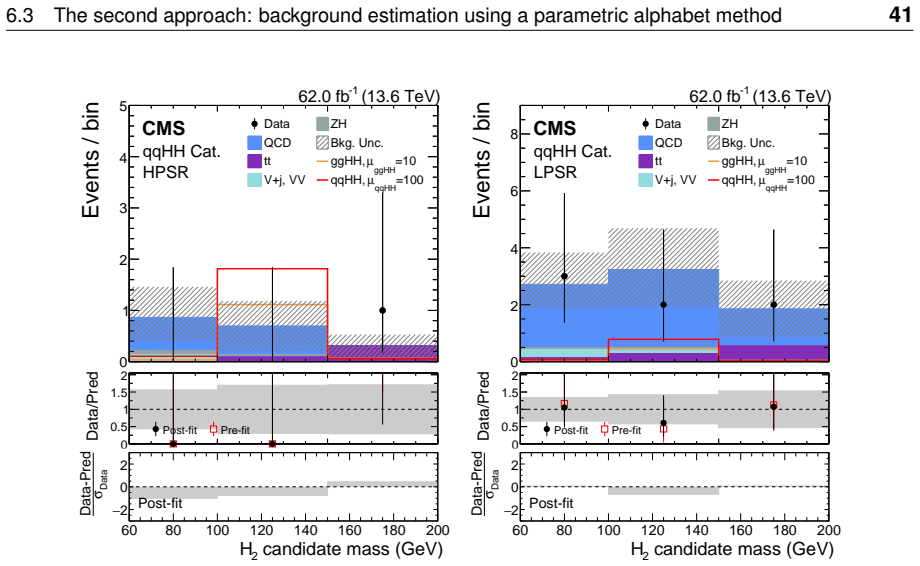
- [§6.3] §6.3 (Combined fit and systematic correlations): The simultaneous fit to resolved and merged categories incorporates jet-energy-scale and b-tagging uncertainties, yet the degree of correlation between the two topologies (particularly for large-R jet grooming variables in the merged case) is not tabulated. If these correlations are underestimated, the combined limit of 4.4 could be overly optimistic; the paper should provide the full covariance matrix or explicit correlation coefficients used in the fit.
minor comments (3)
- [Abstract] Abstract: the phrase 'Higgs boson decays, H t t-bar' is evidently a LaTeX placeholder error and should be replaced by the correct decay mode (H → b b-bar).
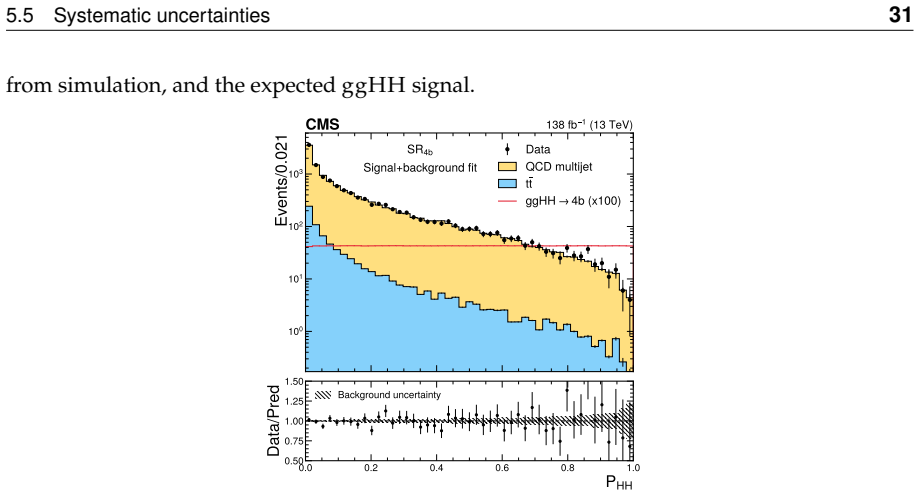
- [Figure 8] Figure 8 (post-fit distributions): the y-axis labels and legend entries are too small for print; enlarging them would improve readability without changing content.
- [§7] §7 (coupling constraints): the translation from the μ_HH limit to the allowed ranges for λ_HHH and λ_HHVV should include a brief statement of the assumed functional form (e.g., the effective Lagrangian parametrization) for completeness.
Simulated Author's Rebuttal
We thank the referee for the careful and constructive review of our manuscript. We appreciate the positive evaluation of the significance of the results and the recognition of the improvements in the resolved and merged topologies. We address the two major comments below and will revise the manuscript accordingly to strengthen the presentation of the background validation and systematic correlations.
read point-by-point responses
-
Referee: [§5.2] §5.2 (QCD multijet background estimation, resolved topology): The ABCD extrapolation assumes that b-tagging and jet-mass variables factorize between control and signal regions. The manuscript shows closure in simulation but does not report quantitative data-driven closure tests (e.g., in orthogonal sidebands with varied b-tagging working points or p_T bins) that would bound any residual correlation bias on the fitted μ_HH. Because the quoted 4.4 limit is extracted from a fit whose dominant background is this extrapolation, an unaccounted bias at the few-percent level would shift the central value and the observed/expected agreement.
Authors: We thank the referee for highlighting the importance of robust validation for the ABCD method. The manuscript demonstrates closure of the extrapolation in simulation, which supports the factorization assumption for the chosen variables. We agree that quantitative data-driven tests provide valuable additional assurance. In the revised manuscript we will add explicit closure tests performed in data using orthogonal sidebands with varied b-tagging working points and across different jet p_T ranges. These tests will be used to quantify any residual non-factorization and to confirm that potential biases on the extracted μ_HH remain well within the assigned systematic uncertainties. This addition will directly address the concern about the reliability of the background estimate underlying the 4.4 limit. revision: yes
-
Referee: [§6.3] §6.3 (Combined fit and systematic correlations): The simultaneous fit to resolved and merged categories incorporates jet-energy-scale and b-tagging uncertainties, yet the degree of correlation between the two topologies (particularly for large-R jet grooming variables in the merged case) is not tabulated. If these correlations are underestimated, the combined limit of 4.4 could be overly optimistic; the paper should provide the full covariance matrix or explicit correlation coefficients used in the fit.
Authors: We agree that explicit documentation of the correlations between the resolved and merged topologies is necessary for full transparency. In the revised manuscript we will include a table of correlation coefficients for the principal systematic uncertainties, with specific attention to jet-energy-scale effects, b-tagging, and the grooming variables used for large-radius jets in the merged topology. The simultaneous fit treats uncertainties that are common to both topologies as fully correlated and topology-specific effects as uncorrelated, consistent with their physical origin. We will also make the full covariance matrix available as supplementary material. These additions will allow readers to verify that the combined observed limit of 4.4 is not overly optimistic. revision: yes
Circularity Check
No circularity: limit extracted from data fit, independent of inputs
full rationale
The paper reports an experimental measurement of HH production in the 4b final state using 62 fb⁻¹ of 13.6 TeV data (plus combinations with prior 13 TeV data). The central result—an observed/expected 95% CL upper limit of 4.4 on the signal strength μ_HH—is obtained by performing a statistical fit to the observed collision data in resolved and merged topologies, with μ_HH as a free parameter in the likelihood. Background yields and shapes are estimated from simulation plus data-driven methods (e.g., sideband extrapolations) that are validated in control regions; these estimates are inputs to the fit rather than outputs derived from the quoted limit. No equation or procedure in the analysis defines the final limit in terms of itself, renames a fitted quantity as a prediction, or relies on a load-bearing self-citation whose validity is assumed without external verification. The result is directly falsifiable against new data and does not reduce to its own inputs by construction.
Axiom & Free-Parameter Ledger
free parameters (1)
- signal strength μ_HH
axioms (2)
- domain assumption Background processes in the 4b final state are accurately modeled by Monte Carlo simulation supplemented by data-driven techniques.
- domain assumption Jet reconstruction efficiencies and energy scales are correctly calibrated and their uncertainties are properly propagated.
Reference graph
Works this paper leans on
-
[1]
Broken symmetry and the mass of gauge vector mesons
F. Englert and R. Brout, “Broken symmetry and the mass of gauge vector mesons”, Phys. Rev. Lett.13(1964) 321,doi:10.1103/PhysRevLett.13.321
-
[2]
Broken symmetries, massless particles and gauge fields
P . W. Higgs, “Broken symmetries, massless particles and gauge fields”,Phys. Lett.12 (1964) 132,doi:10.1016/0031-9163(64)91136-9. 56
-
[3]
Broken symmetries and the masses of gauge bosons
P . W. Higgs, “Broken symmetries and the masses of gauge bosons”,Phys. Rev. Lett.13 (1964) 508,doi:10.1103/PhysRevLett.13.508
-
[4]
Global conservation laws and massless particles
G. S. Guralnik, C. R. Hagen, and T. W. B. Kibble, “Global conservation laws and massless particles”,Phys. Rev. Lett.13(1964) 585,doi:10.1103/PhysRevLett.13.585
-
[5]
Spontaneous Symmetry Breakdown without Massless Bosons
P . W. Higgs, “Spontaneous symmetry breakdown without massless bosons”,Phys. Rev. 145(1966) 1156,doi:10.1103/PhysRev.145.1156
-
[6]
Symmetry breaking in non-abelian gauge theories
T. W. B. Kibble, “Symmetry breaking in non-abelian gauge theories”,Phys. Rev.155 (1967) 1554,doi:10.1103/PhysRev.155.1554
-
[7]
ATLAS Collaboration, “Observation of a new particle in the search for the Standard Model Higgs boson with the ATLAS detector at the LHC”,Phys. Lett. B716(2012) 1, doi:10.1016/j.physletb.2012.08.020,arXiv:1207.7214
work page internal anchor Pith review doi:10.1016/j.physletb.2012.08.020 2012
-
[8]
CMS Collaboration, “Observation of a New Boson at a Mass of 125 GeV with the CMS Experiment at the LHC”,Phys. Lett. B716(2012) 30, doi:10.1016/j.physletb.2012.08.021,arXiv:1207.7235
-
[9]
A portrait of the Higgs boson by the CMS experiment ten years after the discovery
CMS Collaboration, “A portrait of the Higgs boson by the CMS experiment ten years after the discovery.”,Nature607(2022) 60,doi:10.1038/s41586-022-04892-x, arXiv:2207.00043. [Corrigendum:doi:10.1038/s41586-023-06164-8]
-
[10]
A detailed map of Higgs boson interactions by the ATLAS experiment ten years after the discovery
ATLAS Collaboration, “A detailed map of Higgs boson interactions by the ATLAS experiment ten years after the discovery”,Nature607(2022) 52, doi:10.1038/s41586-022-04893-w,arXiv:2207.00092. [Erratum: doi:10.1038/s41586-023-06248-5]
-
[11]
CMS Collaboration, “Measurement of the Higgs boson mass and width using the four-lepton final state in proton-proton collisions at √s=13 TeV”,Phys. Rev. D111 (2025) 092014,doi:10.1103/PhysRevD.111.092014,arXiv:2409.13663
-
[12]
ATLAS Collaboration, “Combined Measurement of the Higgs Boson Mass from the H→γγand H→ZZ ∗ →4ℓDecay Channels with the ATLAS Detector Using √s=7, 8, and 13 TeV pp Collision Data”,Phys. Rev. Lett.131(2023) 251802, doi:10.1103/PhysRevLett.131.251802,arXiv:2308.04775
-
[13]
Higgs boson potential at colliders: Status and perspectives
J. Alison et al., “Higgs boson potential at colliders: Status and perspectives”,Rev. Phys. 5(2020) 100045,doi:10.1016/j.revip.2020.100045,arXiv:1910.00012
-
[14]
Higgs pair production in vector-boson fusion at the LHC and beyond
F. Bishara, R. Contino, and J. Rojo, “Higgs pair production in vector-boson fusion at the LHC and beyond”,Eur. Phys. J. C77(2017) 481, doi:10.1140/epjc/s10052-017-5037-9,arXiv:1611.03860
-
[15]
Search for associated production of a Higgs boson and of two vector bosons via vector boson scattering
CMS Collaboration, “Search for associated production of a Higgs boson and of two vector bosons via vector boson scattering”, technical report, CERN, Geneva, 2025
2025
-
[16]
ATLAS Collaboration, “Combination of Searches for Higgs Boson Pair Production in pp Collisions at √s=13 TeV with the ATLAS Detector”,Phys. Rev. Lett.133(2024) 101801, doi:10.1103/PhysRevLett.133.101801,arXiv:2406.09971
-
[17]
CMS Collaboration, “Combination of searches for nonresonant Higgs boson pair production in proton-proton collisions at √s=13 TeV”, 2025.arXiv:2510.07527. Submitted toJ. Phys. G. References 57
-
[18]
ATLAS Collaboration, “Studies of new Higgs boson interactions through nonresonant HH production in the bbγγfinal state in pp collisions at √s=13 TeV with the ATLAS detector”,JHEP01(2024) 066,doi:10.1007/JHEP01(2024)066, arXiv:2310.12301
-
[19]
ATLAS Collaboration, “Search for nonresonant pair production of Higgs bosons in the bbb b final state in pp collisions at √s=13 TeV with the ATLAS detector”,Phys. Rev. D 108(2023) 052003,doi:10.1103/PhysRevD.108.052003,arXiv:2301.03212
-
[20]
ATLAS Collaboration, “Search for the nonresonant production of Higgs boson pairs via gluon fusion and vector-boson fusion in the bbτ +τ− final state in proton-proton collisions at √s=13 TeV with the ATLAS detector”,Phys. Rev. D110(2024) 032012, doi:10.1103/PhysRevD.110.032012,arXiv:2404.12660
-
[21]
ATLAS Collaboration, “Search for non-resonant Higgs boson pair production in final states with leptons, taus, and photons in pp collisions at √s=13 TeV with the ATLAS detector”,JHEP08(2024) 164,doi:10.1007/JHEP08(2024)164, arXiv:2405.20040
-
[22]
ATLAS Collaboration, “Search for non-resonant Higgs boson pair production in the 2b+2ℓ+E miss T final state in pp collisions at √s=13 TeV with the ATLAS detector”, JHEP02(2024) 037,doi:10.1007/JHEP02(2024)037,arXiv:2310.11286
-
[23]
CMS Collaboration, “Search for nonresonant Higgs boson pair production in final state with two bottom quarks and two tau leptons in proton-proton collisions at√s=13 TeV”,Phys. Lett. B842(2023) 137531, doi:10.1016/j.physletb.2022.137531,arXiv:2206.09401
-
[24]
CMS Collaboration, “Search for Higgs boson pair production with one associated vector boson in proton-proton collisions at √s=13 TeV”,JHEP10(2024) 061, doi:10.1007/JHEP10(2024)061,arXiv:2404.08462
-
[25]
CMS Collaboration, “Search for Higgs boson pairs decaying to WW*WW*, WW*ττ, and ττττin proton-proton collisions at √s=13 TeV”,JHEP07(2023) 095, doi:10.1007/JHEP07(2023)095,arXiv:2206.10268
-
[26]
CMS Collaboration, “Search for Higgs boson pair production in the b bW +W− decay mode in proton-proton collisions at √s=13 TeV”,JHEP07(2024) 293, doi:10.1007/JHEP07(2024)293,arXiv:2403.09430
-
[27]
ATLAS Collaboration, “Study of Higgs boson pair production in the HH→b bγγfinal state with 308 fb−1 of data collected at √s=13 TeV and 13.6 TeV by the ATLAS experiment”, technical report, 2025.arXiv:2507.03495
work page internal anchor Pith review Pith/arXiv arXiv 2025
-
[28]
CMS Collaboration, “Search for Higgs Boson Pair Production in the Four b Quark Final State in Proton-Proton Collisions at √s=13 TeV”,Phys. Rev. Lett.129(2022) 081802, doi:10.1103/PhysRevLett.129.081802,arXiv:2202.09617
-
[29]
ATLAS Collaboration, “Search for pair production of boosted Higgs bosons via vector-boson fusion in the bbbb final state using pp collisions at √s=13 TeV with the ATLAS detector”,Phys. Lett. B858(2024) 139007, doi:10.1016/j.physletb.2024.139007,arXiv:2404.17193. 58
-
[30]
Search for nonresonant pair production of highly energetic Higgs bosons decaying to bottom quarks
CMS Collaboration, “Search for Nonresonant Pair Production of Highly Energetic Higgs Bosons Decaying to Bottom Quarks”,Phys. Rev. Lett.131(2023) 041803, doi:10.1103/PhysRevLett.131.041803,arXiv:2205.06667
-
[31]
CMS Collaboration, “Search for production of Higgs boson pairs in the four b quark final state using large-area jets in proton-proton collisions at √s=13 TeV”,JHEP01 (2019) 040,doi:10.1007/JHEP01(2019)040,arXiv:1808.01473
-
[32]
Search for ZZ and ZH Production in the b bbb Final State using Proton-Proton Collisions at √s=13 TeV
CMS Collaboration, “Search for ZZ and ZH Production in the b bbb Final State using Proton-Proton Collisions at √s=13 TeV”,Eur. Phys. J. C84(2024) 712, doi:10.1140/epjc/s10052-024-13021-z,arXiv:2403.20241
-
[33]
HEPData record for this analysis
“HEPData record for this analysis”, 2026.doi:10.17182/hepdata.171917
-
[34]
The CMS experiment at the CERN LHC
CMS Collaboration, “The CMS Experiment at the CERN LHC”,JINST3(2008) S08004, doi:10.1088/1748-0221/3/08/S08004
-
[35]
Development of the CMS detector for the CERN LHC Run 3
CMS Collaboration, “Development of the CMS detector for the CERN LHC Run 3”, JINST19(2024) P05064,doi:10.1088/1748-0221/19/05/P05064, arXiv:2309.05466
-
[36]
Performance of the CMS Level-1 trigger in proton-proton collisions at √s=13 TeV
CMS Collaboration, “Performance of the CMS Level-1 trigger in proton-proton collisions at √s=13 TeV”,JINST15(2020) P10017, doi:10.1088/1748-0221/15/10/P10017,arXiv:2006.10165
-
[37]
CMS Collaboration, “The CMS trigger system”,JINST12(2017) P01020, doi:10.1088/1748-0221/12/01/P01020,arXiv:1609.02366
-
[38]
Performance of the CMS high-level trigger during LHC Run 2
CMS Collaboration, “Performance of the CMS high-level trigger during LHC Run 2”, JINST19(2024) P11021,doi:10.1088/1748-0221/19/11/P11021, arXiv:2410.17038
-
[39]
Electron and photon reconstruction and identification with the CMS experiment at the CERN LHC
CMS Collaboration, “Electron and photon reconstruction and identification with the CMS experiment at the CERN LHC”,JINST16(2021) P05014, doi:10.1088/1748-0221/16/05/P05014,arXiv:2012.06888
-
[40]
CMS Collaboration, “Performance of the CMS muon detector and muon reconstruction with proton-proton collisions at √s=13 TeV”,JINST13(2018) P06015, doi:10.1088/1748-0221/13/06/P06015,arXiv:1804.04528
work page internal anchor Pith review doi:10.1088/1748-0221/13/06/p06015 2018
-
[41]
Description and performance of track and primary-vertex reconstruction with the CMS tracker
CMS Collaboration, “Description and performance of track and primary-vertex reconstruction with the CMS tracker”,JINST9(2014) P10009, doi:10.1088/1748-0221/9/10/P10009,arXiv:1405.6569
-
[42]
A New Method for Combining NLO QCD with Shower Monte Carlo Algorithms
P . Nason, “A new method for combining NLO QCD with shower Monte Carlo algorithms”,JHEP11(2004) 040,doi:10.1088/1126-6708/2004/11/040, arXiv:hep-ph/0409146
work page internal anchor Pith review doi:10.1088/1126-6708/2004/11/040 2004
-
[43]
Matching NLO QCD computations with Parton Shower simulations: the POWHEG method
S. Frixione, P . Nason, and C. Oleari, “Matching NLO QCD computations with parton shower simulations: the POWHEG method”,JHEP11(2007) 070, doi:10.1088/1126-6708/2007/11/070,arXiv:0709.2092
work page internal anchor Pith review doi:10.1088/1126-6708/2007/11/070 2007
-
[44]
A general framework for implementing NLO calculations in shower Monte Carlo programs: the POWHEG BOX
S. Alioli, P . Nason, C. Oleari, and E. Re, “A general framework for implementing NLO calculations in shower Monte Carlo programs: the POWHEG BOX”,JHEP06(2010) 043,doi:10.1007/JHEP06(2010)043,arXiv:1002.2581. References 59
work page internal anchor Pith review doi:10.1007/jhep06(2010)043 2010
-
[45]
Higgs production via gluon fusion in thePOWHEGapproach in the SM and in the MSSM
E. Bagnaschi, G. Degrassi, P . Slavich, and A. Vicini, “Higgs production via gluon fusion in thePOWHEGapproach in the SM and in the MSSM”,JHEP02(2012) 088, doi:10.1007/JHEP02(2012)088,arXiv:1111.2854
-
[46]
G. Heinrich et al., “NLO predictions for Higgs boson pair production with full top quark mass dependence matched to parton showers”,JHEP08(2017) 088, doi:10.1007/JHEP08(2017)088,arXiv:1703.09252
-
[47]
Parton shower and NLO-matching uncertainties in Higgs boson pair production
S. Jones and S. Kuttimalai, “Parton shower and NLO-matching uncertainties in Higgs boson pair production”,JHEP02(2018) 176,doi:10.1007/JHEP02(2018)176, arXiv:1711.03319
-
[48]
Higgs boson pair production in non-linear effective field theory with fullm t-dependence at NLO QCD
G. Buchalla et al., “Higgs boson pair production in non-linear effective field theory with fullm t-dependence at NLO QCD”,JHEP09(2018) 057, doi:10.1007/JHEP09(2018)057,arXiv:1806.05162
-
[49]
G. Heinrich et al., “Probing the trilinear Higgs boson coupling in di-Higgs production at NLO QCD including parton shower effects”,JHEP06(2019) 066, doi:10.1007/JHEP06(2019)066,arXiv:1903.08137
-
[50]
A non-linear EFT description of gg→HH at NLO interfaced toPOWHEG
G. Heinrich, S. P . Jones, M. Kerner, and L. Scyboz, “A non-linear EFT description of gg→HH at NLO interfaced toPOWHEG”,JHEP10(2020) 021, doi:10.1007/JHEP10(2020)021,arXiv:2006.16877
-
[51]
Double Higgs boson production at NLO: Combining the exact numerical result and high-energy expansion
J. Davies et al., “Double Higgs boson production at NLO: Combining the exact numerical result and high-energy expansion”,JHEP11(2019) 024, doi:10.1007/JHEP11(2019)024,arXiv:1907.06408
-
[52]
J. Alwall et al., “The automated computation of tree-level and next-to-leading order differential cross sections, and their matching to parton shower simulations”,JHEP07 (2014) 079,doi:10.1007/JHEP07(2014)079,arXiv:1405.0301
-
[53]
Neutral Higgs boson pair production at hadron colliders: QCD corrections
S. Dawson, S. Dittmaier, and M. Spira, “Neutral Higgs boson pair production at hadron colliders: QCD corrections”,Phys. Rev. D58(1998) 115012, doi:10.1103/PhysRevD.58.115012,arXiv:hep-ph/9805244
-
[54]
Threshold resummation effects in Higgs boson pair production at the LHC
D. Y. Shao, C. S. Li, H. T. Li, and J. Wang, “Threshold resummation effects in Higgs boson pair production at the LHC”,JHEP07(2013) 169, doi:10.1007/JHEP07(2013)169,arXiv:1301.1245
-
[55]
Higgs boson pair production at next-to-next-to-leading order in QCD
D. de Florian and J. Mazzitelli, “Higgs Boson Pair Production at Next-to-Next-to-Leading Order in QCD”,Phys. Rev. Lett.111(2013) 201801, doi:10.1103/PhysRevLett.111.201801,arXiv:1309.6594
-
[56]
Higgs pair production at next-to-next-to-leading logarithmic accuracy at the LHC
D. de Florian and J. Mazzitelli, “Higgs pair production at next-to-next-to-leading logarithmic accuracy at the LHC”,JHEP09(2015) 053, doi:10.1007/JHEP09(2015)053,arXiv:1505.07122
-
[57]
S. Borowka et al., “Higgs boson pair production in gluon fusion at next-to-leading order with full top-quark mass dependence”,Phys. Rev. Lett.117(2016) 012001, doi:10.1103/PhysRevLett.117.012001,arXiv:1604.06447
-
[58]
Higgs boson pair production at NNLO with top quark mass effects
M. Grazzini et al., “Higgs boson pair production at NNLO with top quark mass effects”, JHEP05(2018) 059,doi:10.1007/JHEP05(2018)059,arXiv:1803.02463. 60
-
[59]
Gluon fusion into Higgs pairs at NLO QCD and the top mass scheme
J. Baglio et al., “Gluon fusion into Higgs pairs at NLO QCD and the top mass scheme”, Eur. Phys. J. C79(2019) 459,doi:10.1140/epjc/s10052-019-6973-3, arXiv:1811.05692
-
[60]
J. Baglio et al., “gg→HH: Combined uncertainties”,Phys. Rev. D103(2021) 056002, doi:10.1103/PhysRevD.103.056002,arXiv:2008.11626
-
[61]
Vector-boson fusion Higgs pair production at N3LO
F. A. Dreyer and A. Karlberg, “Vector-boson fusion Higgs pair production at N3LO”, Phys. Rev. D98(2018) 114016,doi:10.1103/PhysRevD.98.114016, arXiv:1811.07906
-
[62]
A Positive-Weight Next-to-Leading-Order Monte Carlo for Heavy Flavour Hadroproduction
S. Frixione, P . Nason, and G. Ridolfi, “A positive-weight next-to-leading-order Monte Carlo for heavy flavour hadroproduction”,JHEP09(2007) 126, doi:10.1088/1126-6708/2007/09/126,arXiv:0707.3088
work page Pith review doi:10.1088/1126-6708/2007/09/126 2007
-
[63]
T. Je ˇzo et al., “An NLO+PS generator for t t and Wt production and decay including non-resonant and interference effects”,Eur. Phys. J. C76(2016) 691, doi:10.1140/epjc/s10052-016-4538-2,arXiv:1607.04538
-
[64]
Top++: A Program for the Calculation of the Top-Pair Cross-Section at Hadron Colliders
M. Czakon and A. Mitov, “Top++: A program for the calculation of the top-pair cross-section at hadron colliders”,Comput. Phys. Commun.185(2014) 2930, doi:10.1016/j.cpc.2014.06.021,arXiv:1112.5675
-
[65]
Top-pair production at the LHC through NNLO QCD and NLO EW
M. Czakon et al., “Top-pair production at the LHC through NNLO QCD and NLO EW”,JHEP10(2017) 186,doi:10.1007/JHEP10(2017)186,arXiv:1705.04105
-
[66]
Bierlich, et al., SciPost Phys
C. Bierlich et al., “A comprehensive guide to the physics and usage of PYTHIA 8.3”, SciPost Phys. Codeb.2022(2022) 8,doi:10.21468/SciPostPhysCodeb.8, arXiv:2203.11601
-
[67]
Extraction and validation of a new set of CMS PYTHIA8 tunes from underlying-event measurements
CMS Collaboration, “Extraction and validation of a new set of CMSPYTHIA8 tunes from underlying-event measurements”,Eur. Phys. J. C80(2020) 4, doi:10.1140/epjc/s10052-019-7499-4,arXiv:1903.12179
-
[68]
Ball, et al., JHEP04, 040 (2015)
NNPDF Collaboration, “Parton distributions for the LHC Run II”,JHEP04(2015) 040, doi:10.1007/JHEP04(2015)040,arXiv:1410.8849
-
[69]
Parton distributions from high-precision collider data
NNPDF Collaboration, “Parton distributions from high-precision collider data”,Eur. Phys. J. C77(2017) 663,doi:10.1140/epjc/s10052-017-5199-5, arXiv:1706.00428
work page Pith review doi:10.1140/epjc/s10052-017-5199-5 2017
-
[70]
GEANT4 Collaboration, “GEANT4—a simulation toolkit”,Nucl. Instrum. Meth. A506 (2003) 250,doi:10.1016/S0168-9002(03)01368-8
-
[71]
Particle-flow reconstruction and global event description with the CMS detector
CMS Collaboration, “Particle-flow reconstruction and global event description with the CMS detector”,JINST12(2017) P10003,doi:10.1088/1748-0221/12/10/P10003, arXiv:1706.04965
work page internal anchor Pith review doi:10.1088/1748-0221/12/10/p10003 2017
-
[72]
M. Cacciari, G. P . Salam, and G. Soyez, “The anti-kT jet clustering algorithm”,JHEP04 (2008) 063,doi:10.1088/1126-6708/2008/04/063,arXiv:0802.1189
-
[73]
M. Cacciari, G. P . Salam, and G. Soyez, “FastJet user manual”,Eur. Phys. J. C72(2012) 1896,doi:10.1140/epjc/s10052-012-1896-2,arXiv:1111.6097. References 61
-
[74]
Pileup per particle identification
D. Bertolini, P . Harris, M. Low, and N. Tran, “Pileup per particle identification”,JHEP 10(2014) 059,doi:10.1007/JHEP10(2014)059,arXiv:1407.6013
-
[75]
Pileup mitigation at CMS in 13 TeV data
CMS Collaboration, “Pileup mitigation at CMS in 13 TeV data”,JINST15(2020) P09018,doi:10.1088/1748-0221/15/09/P09018,arXiv:2003.00503
-
[76]
Jet energy scale and resolution in the CMS experiment in pp collisions at 8 TeV
CMS Collaboration, “Jet energy scale and resolution in the CMS experiment in pp collisions at 8 TeV”,JINST12(2017) P02014, doi:10.1088/1748-0221/12/02/P02014,arXiv:1607.03663
-
[77]
CMS Collaboration, “Performance of missing transverse momentum reconstruction in proton-proton collisions at √s=13 TeV using the CMS detector”,JINST14(2019) P07004,doi:10.1088/1748-0221/14/07/P07004,arXiv:1903.06078
-
[78]
Identification of heavy-flavour jets with the CMS detector in pp collisions at 13 TeV
CMS Collaboration, “Identification of heavy-flavour jets with the CMS detector in pp collisions at 13 TeV”,JINST13(2018) P05011, doi:10.1088/1748-0221/13/05/P05011,arXiv:1712.07158
work page Pith review doi:10.1088/1748-0221/13/05/p05011 2018
-
[79]
H. Qu and L. Gouskos, “ParticleNet: Jet Tagging via Particle Clouds”,Phys. Rev. D101 (2020) 056019,doi:10.1103/PhysRevD.101.056019,arXiv:1902.08570
-
[80]
Performance of the ParticleNet tagger on small and large-radius jets at High Level Trigger in Run 3
CMS Collaboration, “Performance of the ParticleNet tagger on small and large-radius jets at High Level Trigger in Run 3”, CMS Detector Performance Note CMS-DP-2023-021, CERN, 2023
2023
discussion (0)
Sign in with ORCID, Apple, or X to comment. Anyone can read and Pith papers without signing in.