Recognition: unknown
Non-Local Magic Resources for Fermionic Gaussian States
Pith reviewed 2026-05-07 09:34 UTC · model grok-4.3
The pith
Fermionic Gaussian states admit a closed-form expression for their non-local stabilizer entropies based on the reduced Majorana covariance matrix.
A machine-rendered reading of the paper's core claim, the machinery that carries it, and where it could break.
Core claim
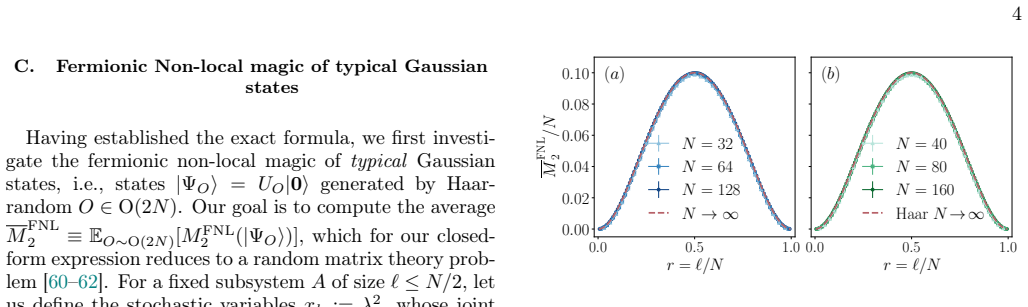
For fermionic Gaussian states, the non-local stabilizer entropy over local Gaussian unitaries admits a closed-form expression that can be evaluated in polynomial time directly from the eigenvalues of the reduced Majorana covariance matrix. This framework is used to characterize non-local magic in typical random states, where it follows an exact Page-like curve, at the quantum critical point of the XY model, where it exhibits logarithmic scaling, and during out-of-equilibrium quenches, where a quasiparticle picture emerges. Because the result depends solely on two-point correlation functions, it also provides a route to experimental estimation in large systems via fermionic shadow tomography.
What carries the argument
A closed-form expression for non-local stabilizer entropies in terms of the eigenvalues of the reduced Majorana covariance matrix, which encodes local two-point correlations and replaces the need for global optimization over unitaries.
If this is right
- An exact Page-like curve describes non-local magic in typical random fermionic Gaussian states.
- Non-local magic shows logarithmic scaling at the quantum critical point of the XY model.
- A quasiparticle picture explains magic generation in out-of-equilibrium quantum quenches.
- The method enables scalable experimental estimation of non-local magic using fermionic shadow tomography on large-scale processors.
Where Pith is reading between the lines
- This reduction suggests that for Gaussian fermionic systems, non-local magic is fully determined by local correlation data.
- Similar closed-form expressions might exist for other restricted classes of states or operations in quantum information.
- Studying non-local magic in this way could help separate the contributions of entanglement and magic in many-body dynamics.
Load-bearing premise
The non-local magic defined by minimization over all unitaries coincides exactly with the minimum restricted to local Gaussian unitaries for these states.
What would settle it
Numerical computation of the stabilizer entropy minimized over arbitrary unitaries for a small fermionic system with 4-6 modes, compared against the proposed eigenvalue-based formula.
Figures


read the original abstract
Entanglement and magic are fundamental resources that capture the complexity of quantum many-body systems. Non-local magic isolates the irreducible nonstabilizerness intrinsically tied to entanglement. However, evaluating this quantity generally requires a prohibitive minimization over the full Hilbert space, making it computationally inaccessible beyond a few qubits. Here, we overcome this bottleneck by suggesting a closed-form expression for the non-local stabilizer entropies of fermionic Gaussian states over local Gaussian unitaries, which can be evaluated in polynomial time directly from the eigenvalues of the reduced Majorana covariance matrix. We apply this framework to characterize fermionic non-local magic across diverse physical regimes: we derive an exact Page-like curve for typical random states, reveal logarithmic scaling at the quantum critical point of the XY model, and establish a quasiparticle picture for magic generation during out-of-equilibrium quantum quenches. Crucially, because our result relies solely on two-point correlation functions, it provides a scalable route for the experimental estimation of fermionic non-local magic in large-scale quantum processors via fermionic shadow tomography.
Editorial analysis
A structured set of objections, weighed in public.
Referee Report
Summary. The manuscript proposes a closed-form expression for the non-local stabilizer entropies of fermionic Gaussian states when minimized over local Gaussian unitaries. This expression is claimed to depend only on the eigenvalues of the reduced Majorana covariance matrix and to be computable in polynomial time. Applications include an exact Page-like curve for typical random states, logarithmic scaling of non-local magic at the quantum critical point of the XY model, and a quasiparticle picture for magic generation in out-of-equilibrium quenches. The result is positioned as enabling experimental estimation of fermionic non-local magic via fermionic shadow tomography since it relies solely on two-point correlation functions.
Significance. If the closed-form reduction holds exactly, the result would be significant for quantum resource theories and many-body physics. It would provide a scalable, polynomial-time route to quantify non-local magic in fermionic Gaussian states, which are central to free-fermion models, topological phases, and quantum simulation platforms. The explicit connection to two-point functions and the applications to random states, criticality, and dynamics would offer concrete, falsifiable predictions that advance the understanding of how entanglement and magic resources interplay in extended systems.
major comments (3)
- [Abstract] The central claim that minimization of the stabilizer entropy over local Gaussian unitaries yields a quantity determined solely by the eigenvalues of the reduced Majorana covariance matrix (with no residual dependence on eigenvectors or higher-order correlations) is load-bearing for all subsequent results. The abstract presents this as a 'suggestion' without derivation steps, error bounds, or verification against exact minimization on small systems; this reduction must be shown explicitly to confirm it computes the intended non-local quantity.
- [Results] The applications in the results section (Page-like curve for random states, logarithmic scaling at the XY critical point, and quasiparticle picture for quenches) all presuppose that the closed-form expression is exact. Any approximation or unaccounted dependence on the specific choice of local Gaussian unitary would undermine the reported scaling behaviors and the quasiparticle interpretation.
- [Discussion] The experimental estimation claim via fermionic shadow tomography assumes that the non-local magic is fully captured by two-point functions after the local unitary optimization. This needs to be justified by showing that the optimal local Gaussian unitary can always be chosen such that the stabilizer entropy depends only on the covariance eigenvalues, without introducing additional sampling overhead or bias.
minor comments (2)
- [Introduction] Clarify the precise definition of 'non-local stabilizer entropy' and its relation to standard stabilizer Rényi entropies early in the manuscript, including any normalization conventions.
- [Methods] The manuscript would benefit from a small-system benchmark (e.g., N=4 or N=6 fermions) comparing the proposed closed-form against brute-force minimization over local Gaussian unitaries to quantify any discrepancy.
Simulated Author's Rebuttal
We thank the referee for their careful reading and constructive comments, which help clarify the presentation of our central result. We address each major comment below and have revised the manuscript to provide additional derivations, verifications, and clarifications.
read point-by-point responses
-
Referee: [Abstract] The central claim that minimization of the stabilizer entropy over local Gaussian unitaries yields a quantity determined solely by the eigenvalues of the reduced Majorana covariance matrix (with no residual dependence on eigenvectors or higher-order correlations) is load-bearing for all subsequent results. The abstract presents this as a 'suggestion' without derivation steps, error bounds, or verification against exact minimization on small systems; this reduction must be shown explicitly to confirm it computes the intended non-local quantity.
Authors: We agree the reduction is central and have revised the abstract to remove 'suggestion' and point explicitly to the derivation. In the updated Section II and new Appendix A, we provide the full analytic steps: local Gaussian unitaries induce orthogonal transformations on the Majorana covariance matrix, and the stabilizer entropy for Gaussian states is invariant under such transformations except for the eigenvalue spectrum after minimization. The minimum is achieved precisely when the matrix is diagonalized, yielding dependence only on eigenvalues with no residual eigenvector or higher-order terms. We added numerical benchmarks for small systems (up to 8 modes) confirming exact numerical agreement between the closed-form and brute-force minimization over local unitaries. The derivation is exact, so no error bounds are required. revision: yes
-
Referee: [Results] The applications in the results section (Page-like curve for random states, logarithmic scaling at the XY critical point, and quasiparticle picture for quenches) all presuppose that the closed-form expression is exact. Any approximation or unaccounted dependence on the specific choice of local Gaussian unitary would undermine the reported scaling behaviors and the quasiparticle interpretation.
Authors: The applications rest on the exact reduction established in the revised Section II. We added a clarifying paragraph in the results section stating that because the minimized entropy depends only on covariance eigenvalues (with the optimal local unitary always existing via orthogonal diagonalization), the Page curve for random states, the logarithmic scaling at the XY critical point, and the quasiparticle interpretation for quenches are all exact consequences rather than approximations. No unaccounted dependence remains. revision: partial
-
Referee: [Discussion] The experimental estimation claim via fermionic shadow tomography assumes that the non-local magic is fully captured by two-point functions after the local unitary optimization. This needs to be justified by showing that the optimal local Gaussian unitary can always be chosen such that the stabilizer entropy depends only on the covariance eigenvalues, without introducing additional sampling overhead or bias.
Authors: The justification follows directly from the derivation: the optimal local Gaussian unitary is the orthogonal transformation that diagonalizes the covariance matrix, so the minimized entropy is a function solely of its eigenvalues. Fermionic shadow tomography estimates the two-point functions (covariance matrix entries) in polynomial time; the eigenvalues are then obtained by standard diagonalization of the estimated matrix. No physical implementation or additional sampling of the unitary is required, introducing neither overhead nor bias. We have expanded the discussion section to include this explicit argument. revision: yes
Circularity Check
No circularity: closed-form expression derived from Gaussian state structure
full rationale
The paper derives a closed-form for non-local stabilizer entropies of fermionic Gaussian states over local Gaussian unitaries, expressed directly in terms of eigenvalues of the reduced Majorana covariance matrix. This reduction follows from the algebraic properties of Gaussian states (two-point correlations fully determining the state) and the parameterization of local unitaries, without any self-definitional loops, fitted parameters renamed as predictions, or load-bearing self-citations. The result is a mathematical simplification that is independently verifiable from the covariance matrix eigenvalues and does not reduce to its inputs by construction.
Axiom & Free-Parameter Ledger
axioms (2)
- domain assumption Fermionic Gaussian states are completely characterized by the covariance matrix of Majorana operators.
- domain assumption Non-local magic is obtained by minimizing stabilizer entropy over local Gaussian unitaries.
Reference graph
Works this paper leans on
-
[1]
Exact results off criticality via corner transfer matrices The reduced density matrix of subsystemAis a fermionic Gaussian state, and can be written as [66] ρA = exp[−Hent] Zent , H ent = i 2 ℓX n=1 εent n ˜γ2n−1˜γ2n ,(21) whereH ent is the entanglement Hamiltonian,Z ent = Tr(exp[−Hent])is the normalization and˜γm are the Ma- jorana operators that diagona...
-
[2]
Only the time-independent part ofpsurvives, p(k,∞) =e −iθk cos(∆θk), whileq(k,∞) = 0
Stationary state via dephasing At long timest→ ∞, the oscillating termscos(2ε kt) andsin(2ε kt)inp(k, t)andq(k, t)average to zero due to dephasing across modes with different group veloci- ties [70]. Only the time-independent part ofpsurvives, p(k,∞) =e −iθk cos(∆θk), whileq(k,∞) = 0. The result- ing stationary covariance matrix is that of a generalized G...
-
[3]
Digital Quantum Matter Ouf- of-Equilibrium
Quasiparticle picture Eq. (33) bears a striking structural similarity to the entanglement entropy of the same quench [70],S= ℓ π R π 0 dkf sin2∆θk , with the binary entropyf(x) := −(1−x) log 2(1−x)−xlog 2(x)replaced bym 2(x2). This parallel extends beyond the stationary state and allows us to derive, from first principles, a quasiparticle picture for the ...
2025
-
[4]
Discussion of the main result We now justify Eq. (6). First, we note that minimizing overM α(|Ψ⟩) = (1−α) −1 log2 ζα(|Ψ⟩)is equivalent to maximizing overζα. We will focus on the latter problem. We consider a generic bipartitionA={i 1, . . . , iℓ} ⊂Λ containingℓ≤N/2qubits andB= Λ\Athe remaining N−ℓones, with Hilbert space dimension respectively dA = 2ℓ and...
-
[5]
2(a), and substantiate our claim that fermionic non-local magic as defined in Eq
Verification via variational optimization We discuss here the numerical methods behind the results in Fig. 2(a), and substantiate our claim that fermionic non-local magic as defined in Eq. (5) coincides with magic of the canonical modewise form of the Gaus- sian state in Eq. (3). We adopt a standard variational optimization ap- proach: given a Gaussian st...
-
[6]
Error analysis for experimental accessibility We provide the error propagation analysis connecting the accuracy onΓ A to the accuracy onM FNL 2 . Since m2(λ2) =−log 2(1−λ 2 +λ 4)is smooth on[0,1], its derivative m′ 2(λ2) = 2λ(1−2λ 2) (1−λ 2 +λ 4) ln 2 (A18) is bounded, som 2 is uniformly Lipschitz on[0,1]with constantL= max λ∈[0,1] |m′ 2(λ2)|=O(1). Combin...
-
[7]
Horodecki, P
R. Horodecki, P. Horodecki, M. Horodecki, and K. Horodecki, Rev. Mod. Phys.81, 865 (2009)
2009
-
[8]
Chitambar and G
E. Chitambar and G. Gour, Rev. Mod. Phys.91, 025001 (2019)
2019
-
[9]
Veitch, S
V. Veitch, S. A. H. Mousavian, D. Gottesman, and J. Emerson, New J. Phys.16, 013009 (2014)
2014
-
[10]
Schollwöck, Ann
U. Schollwöck, Ann. Phys.326, 96–192 (2011)
2011
-
[11]
The Heisenberg Representation of Quantum Computers
D. Gottesman, The heisenberg representation of quan- tum computers (1998), arXiv:quant-ph/9807006 [quant- ph]
work page internal anchor Pith review arXiv 1998
-
[12]
Bravyi, D
S. Bravyi, D. Browne, P. Calpin, E. Campbell, D. Gos- set, and M. Howard, Quantum3, 181 (2019)
2019
-
[13]
Dowling, P
N. Dowling, P. Kos, and X. Turkeshi, Phys. Rev. Lett. 135, 050401 (2025)
2025
- [14]
-
[15]
Laflorencie, Physics Reports646, 1–59 (2016)
N. Laflorencie, Physics Reports646, 1–59 (2016)
2016
-
[16]
Amico, R
L. Amico, R. Fazio, A. Osterloh, and V. Vedral, Rev. Mod. Phys.80, 517 (2008)
2008
-
[17]
Leone, S
L. Leone, S. F. E. Oliviero, and A. Hamma, Phys. Rev. Lett.128, 050402 (2022)
2022
-
[18]
Leone and L
L. Leone and L. Bittel, Phys. Rev. A110, L040403 (2024)
2024
-
[19]
X. Huang, H.-Z. Li, and J.-X. Zhong, A fast and exact 15 approach for stabilizer rényi entropy via the xor-fwht algorithm (2026), arXiv:2512.24685 [quant-ph]
-
[20]
Exponentially Accelerated Sampling of Pauli Strings for Nonstabilizerness
Z. Xiao and S. Ryu, Exponentially accelerated sam- pling of pauli strings for nonstabilizerness (2026), arXiv:2601.00761 [quant-ph]
work page internal anchor Pith review Pith/arXiv arXiv 2026
-
[21]
Computing quantum magic of state vectors
P. Sierant, J. Vallès-Muns, and A. Garcia-Saez, Computing quantum magic of state vectors (2026), arXiv:2601.07824 [quant-ph]
work page internal anchor Pith review Pith/arXiv arXiv 2026
-
[22]
Bittel and L
L. Bittel and L. Leone, Quantum10, 2069 (2026)
2069
-
[23]
Iannotti, L
D. Iannotti, L. Campos Venuti, and A. Hamma, Journal of Physics A: Mathematical and Theoretical59, 075301 (2026)
2026
-
[24]
S. Cusumano, L. C. Venuti, S. Cepollaro, G. Espos- ito, D. Iannotti, B. Jasser, J. O. c, M. Viscardi, and A. Hamma, Non-stabilizerness and violations of chsh inequalities (2025), arXiv:2504.03351 [quant-ph]
-
[25]
Haug and L
T. Haug and L. Piroli, Phys. Rev. B107, 035148 (2023)
2023
-
[26]
P. S. Tarabunga, E. Tirrito, T. Chanda, and M. Dal- monte, PRX Quantum4, 040317 (2023)
2023
-
[27]
Hoshino, M
M. Hoshino, M. Oshikawa, and Y. Ashida, Phys. Rev. X16, 011037 (2026)
2026
-
[28]
M. Hoshino and Y. Ashida, Stabilizer rényi entropy en- codes fusion rules of topological defects and boundaries (2025), arXiv:2507.10656 [quant-ph]
- [29]
-
[30]
Turkeshi, E
X. Turkeshi, E. Tirrito, and P. Sierant, Nat. Commun. 16, 2575 (2025)
2025
-
[31]
Odavić, M
J. Odavić, M. Viscardi, and A. Hamma, Phys. Rev. B 112, 104301 (2025)
2025
-
[32]
Tirrito, X
E. Tirrito, X. Turkeshi, and P. Sierant, Phys. Rev. Lett. 135, 220401 (2025)
2025
-
[33]
P. R. N. Falcão, P. Sierant, J. Zakrzewski, and E. Tir- rito, Phys. Rev. Lett.135, 240404 (2025)
2025
-
[34]
Sierant, M
P. Sierant, M. Schirò, M. Lewenstein, and X. Turkeshi, Phys. Rev. B106, 214316 (2022)
2022
-
[35]
Magni, A
B. Magni, A. Christopoulos, A. De Luca, and X. Turkeshi, Phys. Rev. X15, 031071 (2025)
2025
- [36]
- [37]
-
[38]
M. Viscardi, M. Dalmonte, A. Hamma, and E. Tir- rito, SciPost Physics Core9, 10.21468/scipost- physcore.9.1.012 (2026)
-
[39]
Tirrito, P
E. Tirrito, P. S. Tarabunga, G. Lami, T. Chanda, L. Leone, S. F. E. Oliviero, M. Dalmonte, M. Collura, and A. Hamma, Phys. Rev. A109, L040401 (2024)
2024
-
[40]
Szombathy, A
D. Szombathy, A. Valli, C. Moca, L. Farkas, and G. Zaránd, Phys. Rev. Res.7, 043072 (2025)
2025
-
[41]
Iannotti, G
D. Iannotti, G. Esposito, L. Campos Venuti, and A. Hamma, Quantum9, 1797 (2025)
2025
-
[42]
C. Cao, G. Cheng, A. Hamma, L. Leone, W. Munizzi, and S. F. Oliviero, PRX Quantum6, 040375 (2025)
2025
-
[43]
Qian and J
D. Qian and J. Wang, Phys. Rev. A111, 052443 (2025)
2025
-
[44]
Magic and Non-Clifford Gates in Topological Quantum Field Theory
W. Munizzi and H. J. Schnitzer, Magic and non- clifford gates in topological quantum field theory (2026), arXiv:2604.14271 [hep-th]
work page internal anchor Pith review Pith/arXiv arXiv 2026
-
[45]
Cao, Journal of High Energy Physics2024, 105 (2024)
C. Cao, Journal of High Energy Physics2024, 105 (2024)
2024
-
[46]
Botero and B
A. Botero and B. Reznik, Phys. Lett. A331, 39 (2004)
2004
-
[47]
Bera and M
S. Bera and M. Schirò, SciPost Phys.19, 159 (2025)
2025
-
[48]
M. Collura, J. D. Nardis, V. Alba, and G. Lami, The non-stabilizerness of fermionic gaussian states (2026), arXiv:2412.05367 [quant-ph]
- [49]
-
[50]
Jasser, J
B. Jasser, J. Odavić, and A. Hamma, Phys. Rev. B112, 174204 (2025)
2025
-
[51]
V. Malvimat, M. Sarkis, Y. Suk, and J. Yoon, Multipartite non-local magic and syk model (2026), arXiv:2601.03076 [hep-th]
-
[52]
Russomanno, G
A. Russomanno, G. Passarelli, D. Rossini, and P. Lu- cignano, Phys. Rev. B112, 064312 (2025)
2025
-
[53]
Calabrese and J
P. Calabrese and J. Cardy, J. Phys. A Math. Theor.42, 504005 (2009)
2009
-
[54]
K. Wan, W. J. Huggins, J. Lee, and R. Babbush, Communications inMathematicalPhysics404,629–700 (2023)
2023
-
[55]
G. B. Mbeng, A. Russomanno, and G. E. Santoro, Sci- Post Phys. Lect. Notes , 82 (2024)
2024
-
[56]
Surace and L
J. Surace and L. Tagliacozzo, SciPost Phys. Lect. Notes , 54 (2022)
2022
-
[57]
Sierant, P
P. Sierant, P. Stornati, and X. Turkeshi, PRX Quantum 7, 010302 (2026)
2026
-
[58]
P. Sierant, X. Turkeshi, and P. S. Tarabunga, Theory of the matchgate commutant (2026), arXiv:2603.12392 [quant-ph]
-
[59]
Haug and L
T. Haug and L. Piroli, Quantum7, 1092 (2023)
2023
- [60]
-
[61]
C. Spee, K. Schwaiger, G. Giedke, and B. Kraus, Phys. Rev. A97, 042325 (2018)
2018
-
[62]
Disentangling strategies and entanglement transitions in unitary circuit games with matchgates
R. Morral-Yepes, M. Langer, A. Gammon-Smith, B.Kraus,andF.Pollmann,Disentanglingstrategiesand entanglement transitions in unitary circuit games with matchgates (2025), arXiv:2507.05055 [quant-ph]
work page internal anchor Pith review Pith/arXiv arXiv 2025
- [63]
-
[64]
Dismagicker: Unitary Gate for Non-Stabilizerness Reduction
J. Huang, R. Lv, X. Qian, and M. Qin, Dismagicker: Unitary gate for non-stabilizerness reduction (2026), arXiv:2604.04046 [quant-ph]
work page internal anchor Pith review Pith/arXiv arXiv 2026
- [65]
-
[66]
M. L. Mehta,Random Matrices, 3rd ed. (Academic Press, 2004)
2004
-
[67]
Livan, M
G. Livan, M. Novaes, and P. Vivo,Introduction to Ran- dom Matrices(Springer, 2018)
2018
-
[68]
Vidmar, L
L. Vidmar, L. Hackl, E. Bianchi, and M. Rigol, Phys. Rev. Lett.119, 020601 (2017)
2017
-
[69]
Jin and V
B.-Q. Jin and V. E. Korepin, Journal oxf Statistical Physics116, 79–95 (2004)
2004
-
[70]
A. R. Its, B.-Q. Jin, and V. E. Korepin, J. Phys. A Math. Gen.38, 2975–2990 (2005). 16
2005
-
[71]
Simon,Szego’s Theorem and Its Descendants: Spec- tral Theory for L2 Perturbations of Orthogonal Polyno- mials(Princeton university press, 2010)
B. Simon,Szego’s Theorem and Its Descendants: Spec- tral Theory for L2 Perturbations of Orthogonal Polyno- mials(Princeton university press, 2010)
2010
-
[72]
Peschel, J
I. Peschel, J. Stat. Mech. Theor. Exp.2004, P12005 (2004)
2004
-
[73]
Peschel and V
I. Peschel and V. Eisler, J. Phys. A: Math. Theor.42, 504003 (2009)
2009
-
[74]
Eisler and I
V. Eisler and I. Peschel, J. Phys. A: Math. Theor.50, 284003 (2017)
2017
-
[75]
Calabrese and J
P. Calabrese and J. Cardy, J. Stat. Mech. Theor. Exp. , P06002 (2004)
2004
-
[76]
Calabrese and J
P. Calabrese and J. Cardy, J. Stat. Mech. Theor. Exp. , P04010 (2005)
2005
-
[77]
Fagotti and P
M. Fagotti and P. Calabrese, Phys. Rev. A78, 010306 (2008)
2008
-
[78]
E. Tirrito, L. Lumia, A. Paviglianiti, G. Lami, A. Silva, X. Turkeshi, and M. Collura, Magic phase transitions in monitored gaussian fermions (2025), arXiv:2507.07179 [quant-ph]
- [79]
-
[80]
Swann, D
T. Swann, D. Bernard, and A. Nahum, Phys. Rev. B 112, 064301 (2025)
2025
discussion (0)
Sign in with ORCID, Apple, or X to comment. Anyone can read and Pith papers without signing in.