Recognition: unknown
Searching for GEMS: Three warm Saturns and a super-Jupiter orbiting four early M-dwarfs
Pith reviewed 2026-05-07 10:18 UTC · model grok-4.3
The pith
Four giant planets with masses from 0.5 to 2.1 Jupiter masses orbit early M-dwarfs on periods of 1 to 4 days.
A machine-rendered reading of the paper's core claim, the machinery that carries it, and where it could break.
Core claim
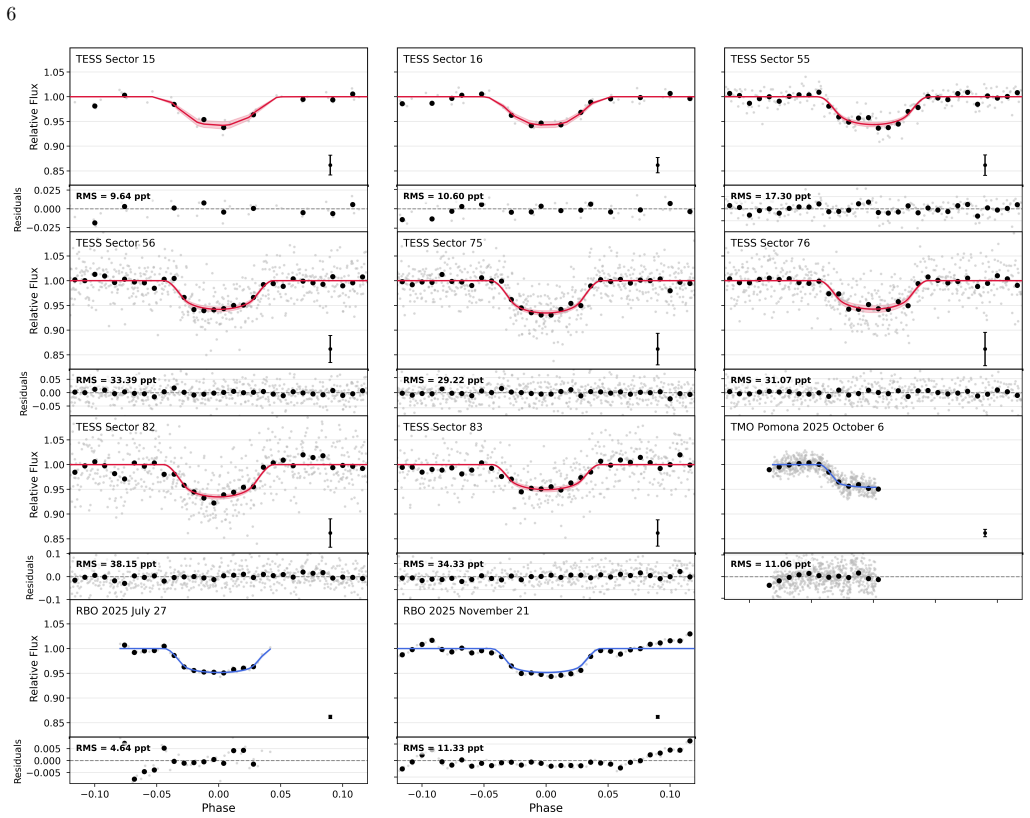
The authors report the confirmation of TOI-7189 b, TOI-7265B b, TOI-7393 b, and TOI-7394B b as four transiting giant planets orbiting early M-dwarfs. Joint modeling of TESS and ground-based light curves with radial velocities from the Habitable-zone Planet Finder and NEID yields self-consistent parameters showing orbital periods of 1.25 to 4.17 days, planetary masses of 0.50 to 2.10 Jupiter masses, and radii near one Jupiter radius. Three planets are Saturn-like in mass and density while the fourth is a dense super-Jupiter on a 1.25-day orbit. The hosts have comparable stellar properties but include one metal-poor star with thin/thick-disk kinematics, revealing substantial diversity in short
What carries the argument
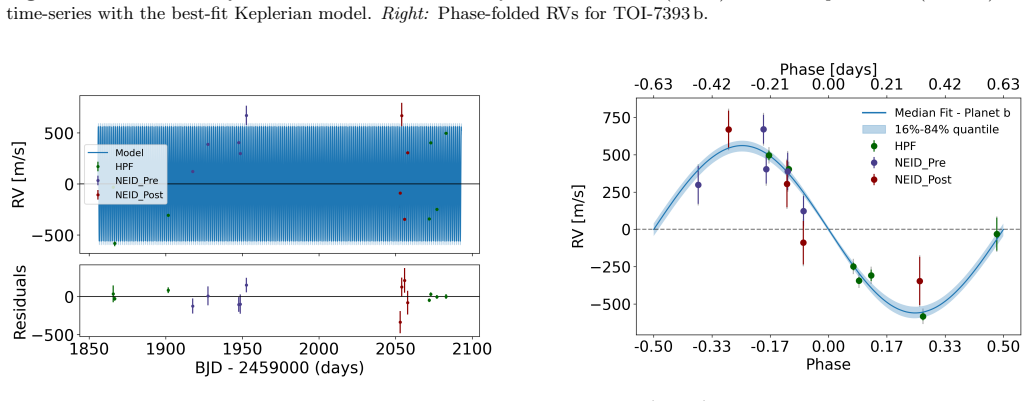
Joint modeling of TESS and ground-based transit photometry with precision radial velocity measurements from HPF and NEID spectrographs to derive consistent orbital and physical parameters.
If this is right
- Giant planets with a wide range of masses and densities can reach short orbits around early M-dwarfs.
- Stellar metallicity influences but does not solely control the mass of these short-period giants.
- The narrow range of host star properties enables controlled comparisons of planetary bulk compositions.
- These systems increase the sample of characterized giant planets around low-mass stars for occurrence rate studies.
Where Pith is reading between the lines
- Different formation pathways such as varying core accretion or disk migration may operate around otherwise similar M-dwarfs.
- Atmospheric follow-up could test whether the higher-density planet has a different heavy-element enrichment than the Saturn analogs.
- The metal-poor host suggests giant planets can assemble in environments previously considered marginal for core accretion.
- Kinematic data on more such systems could link planet properties to stellar age and galactic population.
Load-bearing premise
The observed photometric and radial velocity signals arise purely from planets without significant contamination by stellar activity, spots, or instrumental systematics.
What would settle it
Independent photometric or radial velocity data that fail to recover the reported transit depths and velocity amplitudes at the stated periods, or that show activity signals phased to those periods.
Figures





read the original abstract
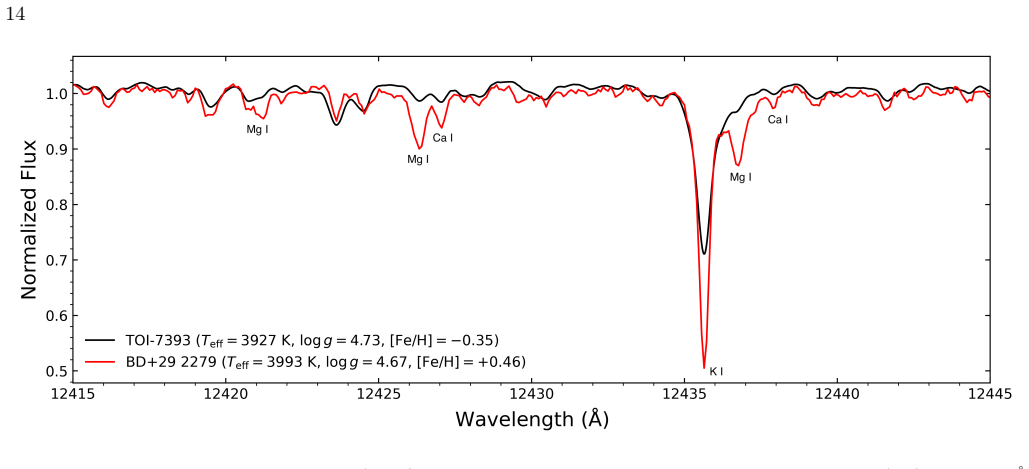
We report the confirmation and characterization of four transiting giant planets orbiting early-M dwarfs discovered by the Searching for Giant Exoplanets around M-dwarf Stars (GEMS) survey: TOI-7189 b, TOI-7265B b, TOI-7393 b, and TOI-7394B b. Joint modeling of TESS and ground-based photometry with precision radial velocities from the Habitable-zone Planet Finder and NEID spectrographs yields self-consistent orbital and physical parameters for all systems. The planets have short orbital periods ($P = 1.25-4.17$ days), masses spanning from $0.5\,M_{\rm J}$ to $2.1\,M_{\rm J}$, and radii comparable to Jupiter ($0.95\,R_{\rm J} < R_p < 1.02\,R_{\rm J}$). TOI-7189 b ($0.50\,M_{\rm J}$), TOI-7265B b ($0.71\,M_{\rm J}$), and TOI-7393 b ($0.61\,M_{\rm J}$) are Saturn-like in mass and density, whereas TOI-7394B b is a dense super-Jupiter ($2.10\,M_{\rm J}$, $\rho_p \approx 2.4$ g cm$^{-3}$) on a 1.25-day orbit. All hosts are early-M dwarfs with a narrow range of stellar properties, enabling a controlled comparison of giant-planet outcomes around low-mass stars. Three systems orbit super-solar metallicity stars, while TOI-7393 ($\mathrm{[Fe/H]} = -0.35 \pm 0.16$) is the most metal-poor GEMS host identified to date, and exhibits kinematics consistent with the thin/thick-disk transition, suggestive of an older stellar population. Together, these systems reveal substantial diversity in the masses and bulk properties of short-period giant planets orbiting early-M dwarfs, demonstrating that markedly different planetary outcomes can arise around stars with otherwise similar fundamental properties.
Editorial analysis
A structured set of objections, weighed in public.
Referee Report
Summary. The manuscript reports the confirmation and characterization of four transiting giant planets (TOI-7189 b, TOI-7265B b, TOI-7393 b, TOI-7394B b) orbiting early M-dwarfs, discovered via the GEMS survey. Joint modeling of TESS and ground-based photometry with precision RVs from HPF and NEID yields orbital periods of 1.25–4.17 days, planet masses of 0.5–2.1 M_J, and radii of ~0.95–1.02 R_J. Three planets are Saturn-like in mass and density while one is a dense super-Jupiter; the sample demonstrates diversity in short-period giant planet properties around hosts with similar stellar parameters, including one metal-poor system.
Significance. If the parameters are robust against activity, the work adds valuable systems to the sparse sample of giant planets around M-dwarfs, enabling a controlled comparison across a narrow range of stellar properties. The inclusion of a metal-poor host and the reported mass/density diversity provide empirical constraints on formation and migration pathways for short-period giants around low-mass stars. The multi-instrument joint fit is a methodological strength when activity is demonstrably controlled.
major comments (2)
- [§3.2 and §4] §3.2 (Radial-velocity modeling) and §4 (Joint photometric-RV fit): The manuscript attributes all periodic RV signals to planetary orbits but provides no description of activity-indicator regression, periodogram analysis of Hα or Ca II, or Gaussian-process marginalization. Early-M dwarfs are known to exhibit spot-induced RV jitter on timescales overlapping the reported 1.25–4.17 d periods; without quantitative tests showing that the fitted semi-amplitudes (corresponding to 0.5–2.1 M_J) are not contaminated, the derived masses and the claimed diversity rest on an unverified assumption. A direct comparison of RV periodograms with activity proxies or a GP kernel test is required to support the central claim.
- [Table 2 and §5] Table 2 (planet parameters) and §5 (Discussion): The reported mass range (0.5–2.1 M_J) and density contrast (Saturn-like vs. ρ_p ≈ 2.4 g cm^{-3}) are load-bearing for the diversity conclusion, yet no error budget or covariance analysis is shown that isolates planetary signals from possible stellar-activity contributions. If activity amplitudes are comparable to the reported K values, the cross-system comparison could be undermined.
minor comments (2)
- [Abstract] Abstract: The phrase 'self-consistent orbital and physical parameters' is used without specifying the number of free parameters or the treatment of limb-darkening and eccentricity; a brief clause would improve clarity for readers.
- [Figure 3] Figure 3 (phase-folded RVs): Residuals and activity-indicator time series should be shown alongside the planetary model to allow visual assessment of any remaining periodic power.
Simulated Author's Rebuttal
We thank the referee for their careful and constructive review. The concerns regarding stellar activity in the RV analysis are well-taken, and we have revised the manuscript to provide the requested quantitative tests and expanded discussion. Our point-by-point responses follow.
read point-by-point responses
-
Referee: [§3.2 and §4] §3.2 (Radial-velocity modeling) and §4 (Joint photometric-RV fit): The manuscript attributes all periodic RV signals to planetary orbits but provides no description of activity-indicator regression, periodogram analysis of Hα or Ca II, or Gaussian-process marginalization. Early-M dwarfs are known to exhibit spot-induced RV jitter on timescales overlapping the reported 1.25–4.17 d periods; without quantitative tests showing that the fitted semi-amplitudes (corresponding to 0.5–2.1 M_J) are not contaminated, the derived masses and the claimed diversity rest on an unverified assumption. A direct comparison of RV periodograms with activity proxies or a GP kernel test is required to support the central claim.
Authors: We agree that explicit activity diagnostics are needed to confirm that the RV semi-amplitudes are not contaminated by stellar jitter. The original manuscript contained only a brief statement that residuals showed no additional periodic signals, without the requested periodogram comparisons or GP tests. In the revised version we add a new subsection to §3.2 that (i) presents GLS periodograms of the Hα and Ca II activity indices together with the RV time series, (ii) demonstrates the lack of significant power at the planetary periods in the activity indicators, and (iii) reports the results of a quasi-periodic GP kernel fit performed jointly with the planetary model. The planetary K values remain unchanged within 1σ after marginalizing over the GP component, supporting the robustness of the reported masses. revision: yes
-
Referee: [Table 2 and §5] Table 2 (planet parameters) and §5 (Discussion): The reported mass range (0.5–2.1 M_J) and density contrast (Saturn-like vs. ρ_p ≈ 2.4 g cm^{-3}) are load-bearing for the diversity conclusion, yet no error budget or covariance analysis is shown that isolates planetary signals from possible stellar-activity contributions. If activity amplitudes are comparable to the reported K values, the cross-system comparison could be undermined.
Authors: We acknowledge that the current manuscript does not present a dedicated covariance or activity-error budget analysis. The uncertainties in Table 2 are the marginal posteriors from the joint MCMC fit. In the revision we expand §5 with (i) a table of Spearman rank correlations between the RV semi-amplitudes and the activity indices, (ii) an upper limit on activity-induced RV amplitude derived from the observed photometric modulation and the measured log R'_HK values, and (iii) a brief discussion of how these tests indicate that activity contributions are smaller than the reported K values for all four systems. These additions directly support the claimed mass and density diversity. revision: yes
Circularity Check
No circularity: purely observational joint modeling of independent datasets
full rationale
The paper performs standard joint photometric and radial-velocity fitting to derive orbital and physical parameters for four planets. No equations, ansatzes, or predictions reduce by construction to other fitted quantities or self-citations. The central results (masses 0.5-2.1 M_J, radii ~1 R_J) are outputs of data modeling against external benchmarks (TESS light curves, HPF/NEID spectra), with no load-bearing self-citation chains, uniqueness theorems, or renaming of known results. This is self-contained observational astronomy with no derivation that loops back to its inputs.
Axiom & Free-Parameter Ledger
free parameters (1)
- planet masses, radii, and orbital elements
axioms (1)
- domain assumption Observed photometric dips and radial-velocity variations are caused by transiting planets on Keplerian orbits with no significant stellar activity contamination
Reference graph
Works this paper leans on
-
[1]
2014, in Protostars and Planets VI, ed
Alexander, R., Pascucci, I., Andrews, S., Armitage, P., & Cieza, L. 2014, in Protostars and Planets VI, ed. H. Beuther, R. S. Klessen, C. P. Dullemond, & T. Henning, 475–496, doi: 10.2458/azu uapress 9780816531240-ch021 Alibert, Y. 2014, A&A, 561, A41, doi: 10.1051/0004-6361/201322293 Alibert, Y., & Benz, W. 2017, A&A, 598, L5, doi: 10.1051/0004-6361/2016...
work page doi:10.2458/azu 2014
-
[2]
0.06 +0.87 −0.06 – – – σPomona,20250722 Pomona (2025 July
2025
-
[3]
9.25 +0.24 −0.23 – – – σRBO,20250727 RBO (2025 July
2025
-
[4]
– 3.28 +0.90 −0.94 – – σRBO,20250818 RBO (2025 August
2025
-
[5]
– – 0.036 +0.42 −0.03 – σPomona,20251006 Pomona (2025 October
2025
-
[6]
– 8.24 +0.39 −0.37 – – σRBO,20251011 RBO (2025 October
2025
-
[7]
15.97 +2.50 −2.08 – – – σKeeble,20251014 Keeble (2025 October
2025
-
[8]
4.28 +0.84 −0.92 – – – σRBO,20251121 RBO (2025 November
2025
-
[9]
– 10.68 +1.08 −0.92 – – σKeeble,20260116 Keeble (2026 January
2026
-
[10]
– – 3.00 +0.55 −0.57 – σKeeble,20260120 Keeble (2026 January
2026
-
[11]
– – – 0.036 +0.38 −0.03 σRBO,20260204 RBO (2026 February
2026
-
[12]
– – 0.042 +0.49 −0.04 – σRBO,20260219 RBO (2026 February
2026
discussion (0)
Sign in with ORCID, Apple, or X to comment. Anyone can read and Pith papers without signing in.