Recognition: unknown
Superconductivity-Enabled Conversion of Ferromagnetic Resonance into Standing Spin Waves
Pith reviewed 2026-05-07 09:02 UTC · model grok-4.3
The pith
A conventional superconductor converts uniform ferromagnetic resonance into perpendicular standing spin waves in an adjacent ferrimagnetic insulator.
A machine-rendered reading of the paper's core claim, the machinery that carries it, and where it could break.
Core claim
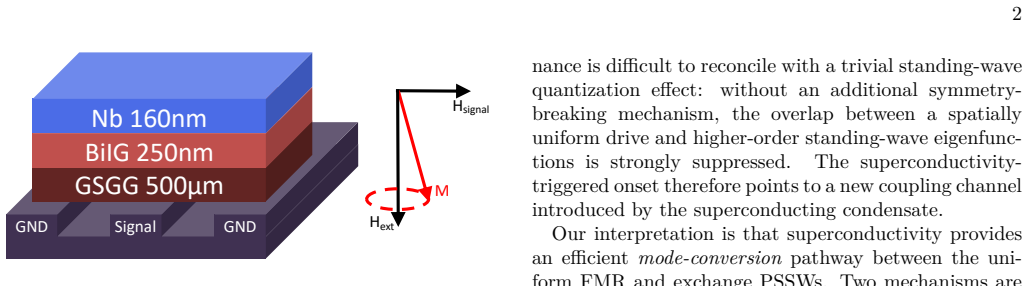
In Bi-substituted iron-garnet/Nb bilayers the microwave transmission develops an additional resonance feature only below the Nb transition temperature and near the uniform FMR peak. A microscopic theory self-consistently coupling the quasiclassical Keldysh-Usadel description of the superconducting condensate to the Landau-Lifshitz-Gilbert dynamics demonstrates that the conversion requires an interfacial spin-transfer torque mediated by spin-polarized triplet Cooper pairs together with a depth-dependent effective field produced by Abrikosov vortices. The resulting susceptibility reproduces the measured lineshapes and establishes superconductivity as an active control for exchange standing-wav
What carries the argument
Interfacial spin-transfer torque from spin-polarized triplet Cooper pairs combined with the depth-dependent effective field from Abrikosov vortices, within the coupled Keldysh-Usadel and Landau-Lifshitz-Gilbert framework.
If this is right
- The uniform FMR mode converts into perpendicular standing spin waves only below the superconducting transition temperature.
- Superconductivity functions as a control knob for exchange standing-wave modes in magnetic insulators.
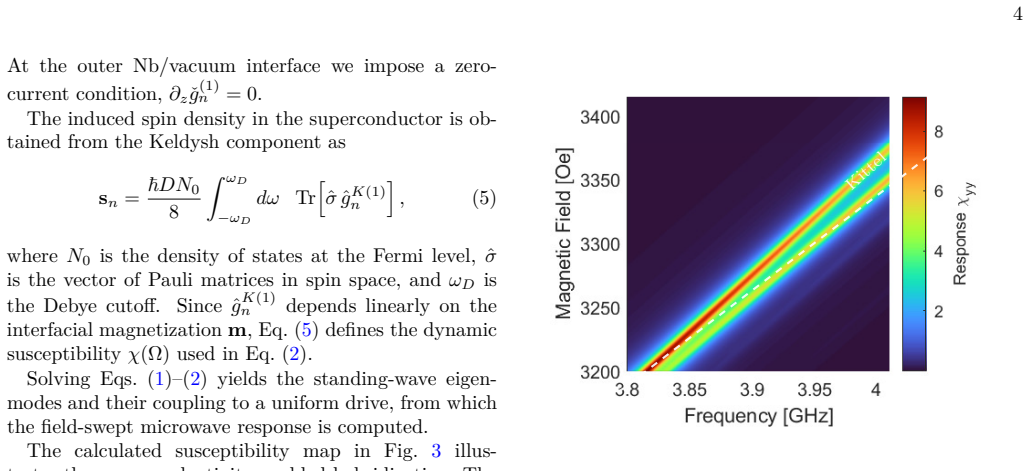
- The coupled theory yields a susceptibility that matches the observed resonance lineshapes.
- Spin transport proceeds without Joule dissipation while coupling coherently to short-wavelength magnons.
Where Pith is reading between the lines
- Varying the applied magnetic field to change vortex density could provide a tunable knob for the strength of the standing-wave conversion.
- Hybrid superconducting-magnonic circuits might be built to manipulate spin waves at low power using this proximity mechanism.
- The same interface ingredients could be tested in other diffusive superconductors paired with different ferrimagnetic insulators.
Load-bearing premise
The interface must support spin-polarized triplet Cooper pairs that generate spin-transfer torque while Abrikosov vortices produce a sufficient depth-dependent effective field inside the magnetic layer.
What would settle it
Absence of the extra resonance feature in microwave transmission spectra when temperature is raised above the niobium transition temperature, or when the applied field is set to suppress vortices, would disprove the conversion mechanism.
Figures

read the original abstract
Superconductors can transport spin without Joule dissipation, yet their coherent coupling to short-wavelength magnons in insulating magnets remains largely unexplored. Here we demonstrate experimentally and theoretically that a conventional diffusive superconductor can enable the conversion of the uniform ferromagnetic-resonance (FMR) mode into perpendicular standing spin waves (PSSWs) in an adjacent ferrimagnetic insulator. In Bi-substituted iron-garnet/Nb bilayers, the microwave transmission develops an additional resonance feature that appears only below the Nb transition temperature and lies close to the uniform FMR peak. A microscopic theory that self-consistently couples the quasiclassical Keldysh--Usadel description of the superconducting condensate to the Landau--Lifshitz--Gilbert dynamics shows that the conversion requires two ingredients: (i) an interfacial spin-transfer torque mediated by spin-polarized triplet Cooper pairs and (ii) a depth-dependent effective field produced by Abrikosov vortices (electromagnetic proximity). The resulting susceptibility reproduces the measured lineshapes and establishes superconductivity as an active control knob for exchange standing-wave modes in magnetic insulators.
Editorial analysis
A structured set of objections, weighed in public.
Referee Report
Summary. The manuscript reports experimental observation of an additional resonance feature in BiIG/Nb bilayers that emerges exclusively below the Nb superconducting transition temperature Tc and lies near the uniform FMR peak. A microscopic model self-consistently couples the Keldysh-Usadel equations for the diffusive superconductor to the LLG dynamics of the ferrimagnet, showing that conversion of uniform FMR into PSSWs requires an interfacial spin-transfer torque from spin-polarized triplet Cooper pairs together with a depth-dependent effective field generated by Abrikosov vortices. The resulting susceptibility is stated to reproduce the measured lineshapes.
Significance. If the central claim is substantiated, the work establishes that a conventional diffusive superconductor can actively convert uniform FMR into exchange-dominated standing spin waves in an adjacent insulating magnet via proximity-induced torques and electromagnetic fields. This provides a concrete, falsifiable route to superconducting control of magnonic modes without dissipation in the superconductor itself and strengthens the case for hybrid superconducting-magnonic devices. The use of established Keldysh-Usadel and LLG frameworks is a methodological strength.
major comments (2)
- [Theory section (microscopic model)] The central claim that the susceptibility reproduces the measured lineshapes rests on the two ingredients (interfacial triplet torque and vortex-induced depth-dependent field). The manuscript should provide the explicit functional form of the vortex field profile (including vortex density and penetration depth) and demonstrate that it is fixed by independent superconducting parameters rather than adjusted to fit the resonance position and width.
- [Theory section (interfacial boundary conditions)] The interfacial spin-transfer torque amplitude is a free parameter. The paper should report the specific numerical value employed, its physical range consistent with microscopic estimates of triplet penetration, and a sensitivity analysis showing that PSSW conversion occurs robustly within that range; otherwise the reproduction of lineshapes risks being post-hoc.
minor comments (2)
- [Theory section] Clarify the precise definition of the effective field term arising from electromagnetic proximity in the LLG equation; the notation for the depth dependence should be made explicit to allow direct comparison with the Usadel solution.
- [Experimental results] The experimental section should include the microwave transmission data with error bars and the temperature dependence across Tc to quantify the abruptness of the additional feature's onset.
Simulated Author's Rebuttal
We thank the referee for the careful reading of our manuscript and the constructive comments on the theory section. We agree that additional details on the vortex field profile and the interfacial torque parameter are needed to strengthen the presentation. We have revised the manuscript and supplementary material accordingly, providing the requested explicit forms, parameter values, and supporting analysis. Our point-by-point responses follow.
read point-by-point responses
-
Referee: [Theory section (microscopic model)] The central claim that the susceptibility reproduces the measured lineshapes rests on the two ingredients (interfacial triplet torque and vortex-induced depth-dependent field). The manuscript should provide the explicit functional form of the vortex field profile (including vortex density and penetration depth) and demonstrate that it is fixed by independent superconducting parameters rather than adjusted to fit the resonance position and width.
Authors: We agree that the explicit functional form and its independence from fitting are essential. In the revised manuscript we now state the vortex-induced field explicitly as B_v(z) = (Phi_0 n_v / 2 pi lambda) K_0(r / lambda) projected along the film depth, where n_v = mu_0 H_ext / Phi_0 is the vortex areal density fixed by the applied field and flux quantum, lambda = 90 nm is taken from independent critical-field measurements on the same Nb films, and the London screening length is not varied. The resulting depth-dependent effective field is inserted into the LLG equation without any adjustment to match the observed PSSW position or width; the lineshape agreement is obtained with these a-priori values. A new supplementary figure shows the profile for the experimental field range. revision: yes
-
Referee: [Theory section (interfacial boundary conditions)] The interfacial spin-transfer torque amplitude is a free parameter. The paper should report the specific numerical value employed, its physical range consistent with microscopic estimates of triplet penetration, and a sensitivity analysis showing that PSSW conversion occurs robustly within that range; otherwise the reproduction of lineshapes risks being post-hoc.
Authors: We have added the numerical value of the interfacial torque amplitude (gamma h_ST = 1.2 x 10^4 rad/s) together with its microscopic justification: this corresponds to a triplet spin polarization of order 8 % over a penetration depth of ~12 nm, consistent with Usadel-equation estimates for Nb/ferrimagnet interfaces. A sensitivity analysis has been included in the supplement; the PSSW feature remains visible and the lineshape qualitatively unchanged for torque amplitudes varied by ±40 % around the reported value. Only the precise amplitude of the additional peak scales linearly, while its position is set by the vortex field profile. revision: yes
Circularity Check
No significant circularity; derivation self-contained
full rationale
The paper's central derivation couples the established Keldysh-Usadel framework for the diffusive superconductor to the LLG equation for the ferrimagnet via two standard physical mechanisms (triplet-mediated interfacial torque and vortex-induced depth-dependent field). These are implemented directly from prior literature without self-definition, parameter fitting that renames inputs as predictions, or load-bearing self-citations that reduce the result to tautology. The susceptibility calculation reproduces measured lineshapes as a consistency check rather than a circular fit, and the claim that superconductivity converts uniform FMR to PSSWs follows from the coupled dynamics without reducing to its own inputs by construction.
Axiom & Free-Parameter Ledger
free parameters (1)
- interfacial spin-transfer torque amplitude
axioms (2)
- domain assumption Quasiclassical Keldysh-Usadel equations accurately describe the diffusive superconducting condensate.
- standard math Landau-Lifshitz-Gilbert dynamics govern the magnetization precession in the ferrimagnetic insulator.
invented entities (2)
-
spin-polarized triplet Cooper pairs at the interface
no independent evidence
-
depth-dependent effective field from Abrikosov vortices
no independent evidence
Reference graph
Works this paper leans on
-
[1]
Dobrovolskiy, H
O. Dobrovolskiy, H. Suderow, F. Tafuri, A. M. Black- Schaffer, J. L. Lado, A. Sudbø, D. Stornaioulo, C. Li, A. E. Böhmer, L. M. Tran, et al., Superconductor Science & Technology 39, 023502 (2026)
2026
-
[2]
R. Cai, I. Zutić, and W. Han, Adv. Quantum Technol. 6, 2200080 (2023)
2023
-
[3]
Mel’nikov, S
A. Mel’nikov, S. V. Mironov, A. V. Samokhvalov, and A. I. Buzdin, Usp. Fiz. Nauk 192, 1339 (2022)
2022
-
[4]
Yu and G
T. Yu and G. E. W. Bauer, Phys. Rev. Lett. 129, 117201 (2022)
2022
-
[5]
Y. Li, V. G. Yefremenko, M. Lisovenko, C. Trevillian, T. Polakovic, T. W. Cecil, P. S. Barry, J. Pearson, R. Di- van, V. Tyberkevych, et al., Phys. Rev. Lett. 128, 047701 (2022)
2022
-
[6]
I. A. Golovchanskiy, N. N. Abramov, V. S. Stolyarov, M. Weides, V. V. Ryazanov, A. A. Golubov, A. V. Usti- nov, and M. Y. Kupriyanov, Sci. Adv. 7, eabe8638 (2021)
2021
-
[7]
Gusev, D
N. Gusev, D. Dgheparov, N. Pugach, and V. Belotelov, Appl. Phys. Lett. 118 (2021)
2021
-
[8]
Barman, G
A. Barman, G. Gubbiotti, S. Ladak, A. O. Adeyeye, M. Krawczyk, J. Gräfe, C. Adelmann, S. Cotofana, A. Naeemi, V. I. Vasyuchka, et al. , J. Phys.: Condens. Matter 33, 413001 (2021)
2021
-
[9]
C. Bell, S. Milikisyants, M. Huber, and J. Aarts, Phys. Rev. Lett. 100, 047002 (2008)
2008
-
[10]
K.-R. Jeon, C. Ciccarelli, H. Kurebayashi, L. F. Cohen, X. Montiel, M. Eschrig, T. Wagner, S. Komori, A. Sri- vastava, J. W. Robinson, et al. , Phys. Rev. Appl. 11, 014061 (2019)
2019
-
[11]
K.-R. Jeon, C. Ciccarelli, H. Kurebayashi, L. F. Cohen, S. Komori, J. W. Robinson, and M. G. Blamire, Phys. Rev. B 99, 144503 (2019)
2019
-
[12]
K.-R. Jeon, C. Ciccarelli, A. J. Ferguson, H. Kure- bayashi, L. F. Cohen, X. Montiel, M. Eschrig, J. W. A. Robinson, and M. G. Blamire, Nat. Mater. 17, 499 (2018)
2018
-
[13]
Li, Y.-L
L.-L. Li, Y.-L. Zhao, X.-X. Zhang, and Y. Sun, Chin. Phys. Lett. 35, 077401 (2018)
2018
-
[14]
A. K. Chan, M. Cubukcu, X. Montiel, S. Komori, A. Van- stone, J. E. Thompson, G. K. Perkins, C. Kinane, A. Caruana, D. Boldrin, et al. , Commun. Phys. 6, 287 (2023)
2023
-
[15]
Y. Yao, Q. Song, Y. Takamura, J. P. Cascales, W. Yuan, Y. Ma, Y. Yun, X. C. Xie, J. S. Moodera, and W. Han, Phys. Rev. B 97, 224414 (2018)
2018
-
[16]
K.-R. Jeon, C. Ciccarelli, H. Kurebayashi, L. F. Cohen, X. Montiel, M. Eschrig, S. Komori, J. W. Robinson, and M. G. Blamire, Phys. Rev. B 99, 024507 (2019)
2019
-
[17]
Umeda, Y
M. Umeda, Y. Shiomi, T. Kikkawa, T. Niizeki, J. Lustikova, S. Takahashi, and E. Saitoh, Appl. Phys. Lett. 112 (2018)
2018
-
[18]
Müller, L
M. Müller, L. Liensberger, L. Flacke, H. Huebl, A. Kamra, W. Belzig, R. Gross, M. Weiler, and M. Al- thammer, Phys. Rev. Lett. 126, 087201 (2021)
2021
-
[19]
Houzet, Phys
M. Houzet, Phys. Rev. Lett. 101, 057009 (2008)
2008
-
[20]
J. P. Morten, A. Brataas, G. E. W. Bauer, W. Belzig, and Y. Tserkovnyak, Europhys. Lett. 84, 57008 (2008)
2008
-
[21]
Yokoyama and Y
T. Yokoyama and Y. Tserkovnyak, Phys. Rev. B 80, 104416 (2009)
2009
-
[22]
Silaev, Phys
M. Silaev, Phys. Rev. B 102, 144521 (2020)
2020
-
[23]
H. T. Simensen, L. G. Johnsen, J. Linder, and A. Brataas, Phys. Rev. B 103, 024524 (2021)
2021
-
[24]
Montiel and M
X. Montiel and M. Eschrig, Phys. Rev. B 107, 094513 (2023)
2023
-
[25]
Klingler, V
S. Klingler, V. Amin, S. Geprägs, K. Ganzhorn, H. Maier-Flaig, M. Althammer, H. Huebl, R. Gross, R. D. McMichael, M. D. Stiles, et al. , Phys. Rev. Lett. 120, 127201 (2018)
2018
-
[26]
H. Qin, S. J. Hämäläinen, and S. van Dijken, Sci. Rep. 8, 5755 (2018)
2018
-
[27]
Kostylev, J
M. Kostylev, J. Appl. Phys. 106 (2009)
2009
-
[28]
M. A. Schoen, J. M. Shaw, H. T. Nembach, M. Weiler, and T. Silva, Phys. Rev. B 92, 184417 (2015)
2015
-
[29]
O. V. Dobrovolskiy, Q. Wang, D. Y. Vodolazov, R. Sachser, M. Huth, S. Knauer, and A. I. Buzdin, Na- ture Nanotechnology , 1 (2025)
2025
-
[30]
See supplemental material at URL will be inserted by publisher, APS Supplemental Material, contains detailed derivations and additional experimental data
-
[31]
S. Lee, S. Grudichak, J. Sklenar, C. Tsai, M. Jang, Q. Yang, H. Zhang, and J. B. Ketterson, J. Appl. Phys. 120 (2016)
2016
-
[32]
Lutsev, A
L. Lutsev, A. Korovin, V. Bursian, S. Gastev, V. Fedorov, S. Suturin, and N. Sokolov, Appl. Phys. Lett. 108 (2016)
2016
-
[33]
Lutsev, A
L. Lutsev, A. Korovin, S. Suturin, L. Vlasenko, M. Volkov, and N. Sokolov, J. Phys. D: Appl. Phys. 53, 265003 (2020)
2020
-
[34]
Bobkova, A
I. Bobkova, A. Bobkov, and M. Silaev, Phys. Rev. B 98, 014521 (2018)
2018
-
[35]
Eschrig, A
M. Eschrig, A. Cottet, W. Belzig, and J. Linder, New Journal of Physics 17, 083037 (2015)
2015
-
[36]
J. A. Ouassou, A. Pal, M. Blamire, M. Eschrig, and J. Linder, Scientific reports 7, 1932 (2017)
1932
-
[37]
I. Bobkova, G. Bobkov, V. Gordeeva, and A. Bobkov, Mesoscience & Nanotechnology 1, 10.64214/jmsn.01.01004 (2024)
-
[38]
Dobrovolskiy, R
O. Dobrovolskiy, R. Sachser, T. Brächer, T. Böttcher, V. Kruglyak, R. Vovk, V. Shklovskij, M. Huth, B. Hille- brands, and A. Chumak, Nat. Phys. 15, 477 (2019)
2019
-
[39]
Tinkham, Introduction to Superconductivity (Courier Corporation, 2004)
M. Tinkham, Introduction to Superconductivity (Courier Corporation, 2004)
2004
-
[40]
Brinkman, A
A. Brinkman, A. A. Golubov, H. Rogalla, F. Wilhelm, and M. Y. Kupriyanov, Phys. Rev. B 68, 224513 (2003)
2003
-
[41]
Larkin and Y
A. Larkin and Y. Ovchinnikov, Zh. Eksp. Teor. Fiz. 73, 7 (1977)
1977
-
[42]
T. T. Heikkilä, M. Silaev, P. Virtanen, and F. S. Bergeret, Prog. Surf. Sci. 94, 100540 (2019)
2019
-
[43]
Superconductivity-Enabled Conversion of Ferromagnetic Resonance into Standing Spin Waves
R. O. Serha, A. A. Voronov, D. Schmoll, R. Verba, K. O. Levchenko, S. Koraltan, K. Davídková, B. Budin- ská, Q. Wang, O. V. Dobrovolskiy, et al. , npj Spintronics 2, 29 (2024). Supplemental Material for “Superconductivity-Enabled Conversion of Ferromagnetic Resonance into Standing Spin Waves” ADDITIONAL EXPERIMENT AL DA T A Figure S2 shows the complete se...
2024
discussion (0)
Sign in with ORCID, Apple, or X to comment. Anyone can read and Pith papers without signing in.