Recognition: unknown
Phase Stability of Superfluid ³He in Anisotropic Aerogel
Pith reviewed 2026-05-07 09:10 UTC · model grok-4.3
The pith
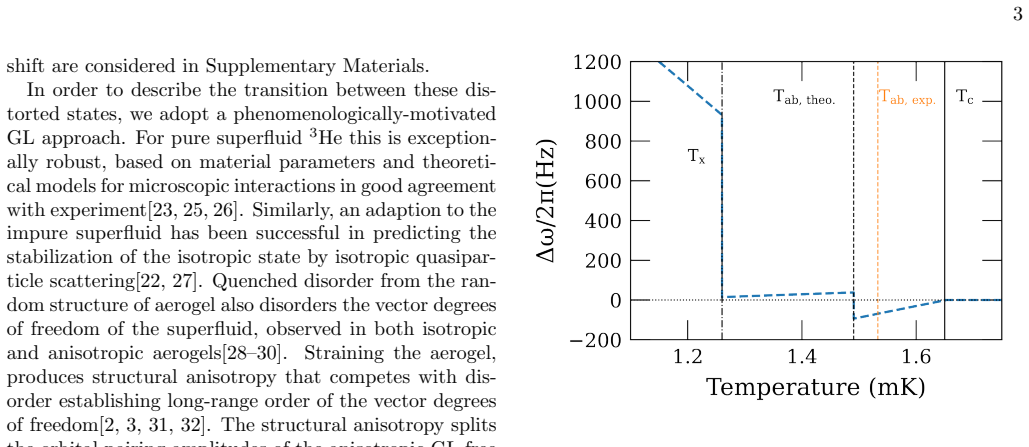
Superfluid 3He in uniformly strained aerogel reorients its vector order parameters at a field-independent temperature Tx.
A machine-rendered reading of the paper's core claim, the machinery that carries it, and where it could break.
Core claim
The vector degrees of freedom in the A and B phases of superfluid 3He spontaneously reorient at a field-independent transition temperature Tx. This reorientation is produced by the anisotropic disorder of uniformly strained silica aerogel and is accounted for by a temperature-dependent anisotropic Ginzburg-Landau model.
What carries the argument
The temperature-dependent anisotropic Ginzburg-Landau free energy that incorporates uniform aerogel strain to determine the equilibrium orientation of the chiral and spin-orbit axes.
If this is right
- The A-B phase boundary shifts because the free-energy minimum changes when the vectors reorient.
- Phase selection becomes independent of magnetic field strength once the temperature-dependent anisotropy dominates.
- NMR or torsional oscillator signatures should exhibit abrupt changes at Tx reflecting the new axis orientation.
- The model predicts that varying the strain magnitude changes the value of Tx while preserving its field independence.
Where Pith is reading between the lines
- The same reorientation mechanism may appear in other superfluids or superconductors placed in controlled anisotropic strain.
- Non-uniform strain distributions could be tested by comparing samples with different aerogel densities to see if the transition broadens.
- The approach offers a route to engineer phase stability in quantum fluids by tuning temperature-dependent anisotropy.
Load-bearing premise
The aerogel strain is uniform and its effects on phase stability can be fully captured by a temperature-dependent extension of the standard Ginzburg-Landau free energy without extra disorder terms.
What would settle it
Measurement of a magnetic-field dependence in the reorientation temperature Tx, or absence of any reorientation in a uniformly strained sample.
Figures



read the original abstract
The A and B phases of superfluid 3 He have vector degrees of freedom that reflect their characteristic broken symmetries, respectively chiral and spin-orbit rotation axes. Anisotropic disorder in the superfluid, imbibed in uniformly strained silica aerogel, orients these degrees of freedom, thereby affecting phase stability. These degrees of freedom have been found to spontaneously reorient at a field-independent transition temperature Tx , that can be accounted for with a temperature dependent anisotropic Ginzburg-Landau model.
Editorial analysis
A structured set of objections, weighed in public.
Referee Report
Summary. The manuscript examines phase stability of superfluid 3He imbibed in uniformly strained silica aerogel. It reports that the chiral and spin-orbit vector degrees of freedom in the A and B phases spontaneously reorient at a field-independent transition temperature Tx, and states that this reorientation is accounted for by extending the standard Ginzburg-Landau free energy with temperature-dependent anisotropy coefficients.
Significance. If the temperature-dependent anisotropy is shown to be predictive rather than fitted and if the uniform-strain approximation is validated against the observed field independence of Tx, the work would strengthen the GL description of anisotropic disorder in 3He and provide a concrete example of how strain-induced terms control phase stability without invoking additional disorder-induced or higher-order corrections.
major comments (2)
- [Abstract] Abstract and model section: the statement that the transition 'can be accounted for' with a temperature-dependent anisotropic GL model does not specify whether the temperature dependence of the anisotropy coefficients is derived from microscopic considerations or introduced to reproduce the observed Tx; without this distinction the central claim risks circularity.
- [Model section] Model derivation: the uniform-strain assumption is load-bearing for the field-independent Tx prediction; if local nanoscale strain variations in the aerogel produce spatially random anisotropy that cannot be averaged into the uniform terms, the model would require additional disorder-induced contributions to remain consistent with experiment.
minor comments (2)
- [Abstract] Abstract: include a short statement of the experimental signature used to identify Tx and its field independence.
- [Model section] Notation: define the anisotropy coefficients explicitly (e.g., their temperature dependence) at first use to avoid ambiguity with standard GL parameters.
Simulated Author's Rebuttal
We thank the referee for their careful reading of the manuscript and for providing constructive comments that help clarify the presentation of our results. We address each major comment below.
read point-by-point responses
-
Referee: [Abstract] Abstract and model section: the statement that the transition 'can be accounted for' with a temperature-dependent anisotropic GL model does not specify whether the temperature dependence of the anisotropy coefficients is derived from microscopic considerations or introduced to reproduce the observed Tx; without this distinction the central claim risks circularity.
Authors: The referee correctly identifies a potential ambiguity in our wording. The temperature dependence is not derived from a full microscopic calculation in this work but is introduced as a phenomenological extension of the GL functional, chosen to reproduce the observed Tx while remaining consistent with the expected form from microscopic theory (e.g., the strain-induced splitting of the transition temperatures). We will revise the abstract and the model section to make this explicit, stating that the model is phenomenological but predictive for the field dependence and other properties. This avoids circularity because the same parameters then account for the field-independent nature of Tx without additional fitting. revision: yes
-
Referee: [Model section] Model derivation: the uniform-strain assumption is load-bearing for the field-independent Tx prediction; if local nanoscale strain variations in the aerogel produce spatially random anisotropy that cannot be averaged into the uniform terms, the model would require additional disorder-induced contributions to remain consistent with experiment.
Authors: We agree that the uniform-strain approximation is central to our prediction of field-independent Tx. The aerogel is described as uniformly strained, and the model averages the anisotropy over this uniform strain. Local nanoscale variations are present but, given the coherence length of the superfluid and the averaging inherent in the macroscopic measurement, they do not introduce significant random components that would affect the reorientation transition in the manner suggested. The field independence itself serves as validation that random disorder terms are not required. We will add a paragraph in the model section discussing the validity of the uniform approximation and why additional disorder-induced terms are not necessary here. revision: partial
Circularity Check
No significant circularity in derivation chain
full rationale
The abstract states that the reorientation transition at Tx can be accounted for with a temperature-dependent anisotropic Ginzburg-Landau model, but no specific equations, parameter-fitting procedure, or self-referential reduction (such as a fitted quantity renamed as a prediction or a self-citation chain) are exhibited in the provided text. The uniform-strain assumption is a modeling choice rather than a load-bearing derivation that collapses to the input data by construction. The central claim remains a phenomenological description without demonstrated circularity.
Axiom & Free-Parameter Ledger
free parameters (1)
- temperature-dependent anisotropy coefficients
axioms (1)
- domain assumption The standard Ginzburg-Landau free-energy functional for superfluid 3He remains valid in the presence of uniform anisotropic strain from aerogel.
Reference graph
Works this paper leans on
-
[1]
Vollhardt and P
D. Vollhardt and P. Wolfle,The superfluid phases of he- lium 3(Courier Corporation, 2013)
2013
-
[2]
Aoyama and R
K. Aoyama and R. Ikeda, Phys. Rev. B73, 060504(R) (2006)
2006
-
[3]
J. A. Sauls, Phys. Rev. B88, 214503 (2013)
2013
-
[4]
A. J. Leggett, Phys. Rev. Lett.31, 352 (1973)
1973
-
[5]
A. M. Zimmerman, J. I. A. Li, M. D. Nguyen, and W. P. Halperin, Phys. Rev. Lett.121, 255303 (2018)
2018
-
[6]
J. W. Scott, M. D. Nguyen, D. Park, and W. P. Halperin, Phys. Rev. Lett.131, 046001 (2023)
2023
-
[7]
M. D. Nguyen, J. Simon, J. W. Scott, A. M. Zimmerman, Y. C. C. Tsai, and W. P. Halperin, Nature communica- 6 tions15, 201 (2024)
2024
-
[8]
Ngampruetikorn and J
V. Ngampruetikorn and J. A. Sauls, Phys. Rev. Lett. 124, 157002 (2020)
2020
-
[9]
Sharma and J
P. Sharma and J. A. Sauls, Journal of Low Temperature Physics , 1 (2022)
2022
-
[10]
D. T. Sprague, T. M. Haard, J. B. Kycia, M. R. Rand, Y. Lee, P. J. Hamot, and W. P. Halperin, Phys. Rev. Lett.77, 4568 (1996)
1996
-
[11]
Collin, S
E. Collin, S. Triqueneaux, Y. M. Bunkov, and H. Godfrin, Phys. Rev. B80, 094422 (2009)
2009
-
[12]
A. M. Zimmerman, M. D. Nguyen, and W. P. Halperin, Journal of Low Temperature Physics195, 358 (2019)
2019
-
[13]
Hasegawa, Progress of Theoretical Physics70, 1141 (1983)
Y. Hasegawa, Progress of Theoretical Physics70, 1141 (1983)
1983
-
[14]
V. V. Dmitriev, A. A. Senin, A. A. Soldatov, E. V. Surovtsev, and A. N. Yudin, Journal of Experimental and Theoretical Physics119, 1088 (2014)
2014
-
[15]
A. J. Leggett, Annals of Physics85, 11 (1974)
1974
-
[16]
Brinkman and H
W. Brinkman and H. Smith, Physics Letters A51, 449 (1975)
1975
-
[17]
Brinkman and H
W. Brinkman and H. Smith, Physics Letters A53, 43 (1975)
1975
-
[18]
W. F. Brinkman, H. Smith, D. D. Osheroff, and E. I. Blount, Phys. Rev. Lett.33, 624 (1974)
1974
-
[19]
D. D. Osheroff, S. Engelsberg, W. F. Brinkman, and L. R. Corruccini, Phys. Rev. Lett.34, 190 (1975)
1975
-
[20]
Ambegaokar, P
V. Ambegaokar, P. G. deGennes, and D. Rainer, Phys. Rev. A9, 2676 (1974)
1974
-
[21]
M. R. Rand, D. T. Sprague, T. M. Haard, J. B. Kycia, H. H. Hensley, Y. Lee, P. J. Hamot, D. M. Marks, W. P. Halperin, T. Mizusaki, and T. Ohmi, Phys. Rev. Lett. 77, 1314 (1996)
1996
-
[22]
E. V. Thuneberg, S. K. Yip, M. Fogelstr¨ om, and J. A. Sauls, Phys. Rev. Lett.80, 2861 (1998)
1998
-
[23]
J. J. Wiman,Quantitative Superfluid Helium-3 from Confinement to Bulk, Ph.D. thesis, Northwestern Uni- versity (2018)
2018
-
[24]
R. C. Regan, J. J. Wiman, and J. A. Sauls, Phys. Rev. B101, 024517 (2020)
2020
-
[25]
N. D. Mermin and C. Stare, Phys. Rev. Lett.30, 1135 (1973)
1973
-
[26]
H. Choi, J. P. Davis, J. Pollanen, T. M. Haard, and W. P. Halperin, Phys. Rev. B75, 174503 (2007)
2007
-
[27]
Gervais, K
G. Gervais, K. Yawata, N. Mulders, and W. P. Halperin, Phys. Rev. B66, 054528 (2002)
2002
-
[28]
J. I. A. Li, J. Pollanen, A. M. Zimmerman, C. A. Collett, W. J. Gannon, and W. P. Halperin, Nature Physics9, 775 (2013)
2013
-
[29]
J. I. A. Li, A. M. Zimmerman, J. Pollanen, C. A. Collett, W. J. Gannon, and W. P. Halperin, Phys. Rev. Lett.112, 115303 (2014)
2014
-
[30]
V. V. Dmitriev, D. A. Krasnikhin, N. Mulders, A. A. Senin, G. E. Volovik, and A. N. Yudin, JETP letters91, 599 (2010)
2010
-
[31]
G. E. Volovik, Journal of Low Temperature Physics150, 453 (2008)
2008
-
[32]
Surovtsev, Journal of Experimental and Theoretical Physics128, 477 (2019)
E. Surovtsev, Journal of Experimental and Theoretical Physics128, 477 (2019)
2019
-
[33]
J. A. Sauls and P. Sharma, Phys. Rev. B68, 224502 (2003)
2003
-
[34]
Sharma and J
P. Sharma and J. A. Sauls, Journal of Low Temperature Physics125, 115 (2001)
2001
-
[35]
V. V. Dmitriev, M. S. Kutuzov, A. A. Soldatov, and A. N. Yudin, Phys. Rev. Lett.127, 265301 (2021)
2021
-
[36]
Fomin, JETP letters88, 59 (2008)
I. Fomin, JETP letters88, 59 (2008)
2008
-
[37]
Thuneberg, Journal of low temperature physics122, 657 (2001)
E. Thuneberg, Journal of low temperature physics122, 657 (2001)
2001
-
[38]
Pollanen, J
J. Pollanen, J. I. A. Li, C. A. Collett, W. J. Gannon, W. P. Halperin, and J. A. Sauls, Nature Physics8, 317 (2012)
2012
-
[39]
Zimmerman,Engineering Order with Disorder: NMR Studies of SuperfluidHe 3 in Silica Aerogel, Ph.D
A. Zimmerman,Engineering Order with Disorder: NMR Studies of SuperfluidHe 3 in Silica Aerogel, Ph.D. thesis, Northwestern University (2019)
2019
-
[40]
W. P. Halperin and E. Varoquaux, inModern Problems in Condensed Matter Sciences, Vol. 26 (Elsevier, 1990) pp. 353–522
1990
-
[41]
V. V. Dmitriev, M. S. Kutuzov, A. Y. Mikheev, V. N. Morozov, A. A. Soldatov, and A. N. Yudin, Phys. Rev. B102, 144507 (2020)
2020
-
[42]
V. V. Dmitriev, A. A. Soldatov, and A. N. Yudin, Journal of Experimental and Theoretical Physics131, 2 (2020)
2020
-
[43]
Li,Transverse pulsed NMR of superfluidHe 3 in aero- gel: engineering superfluid states with disorder, Ph.D
J. Li,Transverse pulsed NMR of superfluidHe 3 in aero- gel: engineering superfluid states with disorder, Ph.D. thesis, Northwestern University (2014)
2014
-
[44]
P. J. Heikkinen, A. Casey, L. V. Levitin, X. Rojas, A. Vorontsov, P. Sharma, N. Zhelev, J. M. Parpia, and J. Saunders, Nature Communications12, 1 (2021)
2021
-
[45]
V. P. Mineev, Phys. Rev. B98, 014501 (2018)
2018
-
[46]
Baramidze and G
G. Baramidze and G. Kharadze, Journal of low temper- ature physics135, 399 (2004)
2004
discussion (0)
Sign in with ORCID, Apple, or X to comment. Anyone can read and Pith papers without signing in.