Recognition: no theorem link
Mesogenesis through the Ephemeral Dark Decay of Beauty
Pith reviewed 2026-05-11 00:43 UTC · model grok-4.3
The pith
An ultralight scalar can make B meson decays to dark particles efficient only in the early Universe, reviving Mesogenesis as a viable source of the baryon asymmetry.
A machine-rendered reading of the paper's core claim, the machinery that carries it, and where it could break.
Core claim
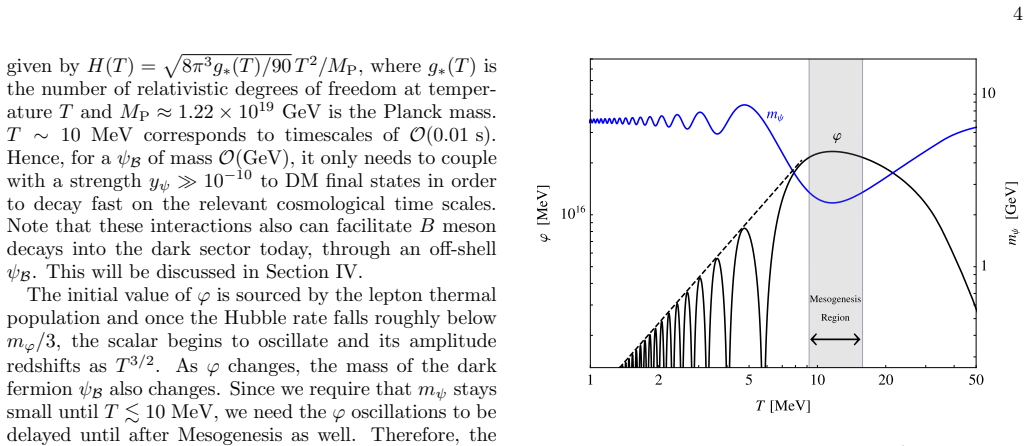
The central claim is that an ultralight scalar interacting with Standard Model muons and a dark-sector fermion induces a temperature-dependent mass shift for the fermion. At high temperatures the thermal muon density lowers the fermion mass below the B meson decay threshold, allowing B to baryon plus dark fermion decays to proceed with the required CP violation. As the Universe expands and muon number density falls, the dark fermion mass rises again and the decay channel closes, rendering the scenario consistent with present-day experimental limits on B meson branching fractions.
What carries the argument
An ultralight scalar mediator coupled to muons and a dark fermion that produces a temperature-dependent effective mass for the dark fermion proportional to the muon thermal density.
If this is right
- The color-charged heavy bosons required by the mechanism lie within reach of future LHC runs.
- Displaced vertex searches at colliders can probe long-lived particles produced in the model.
- Long-range force experiments can search for the effects of the ultralight scalar.
- Observations of neutron star binary mergers can reveal signals from the coupled dark sector.
Where Pith is reading between the lines
- Similar temperature-dependent mass shifts could be engineered in other dark sector models to activate processes only during specific cosmological epochs.
- The lepton couplings of the scalar may generate additional constraints from precision neutrino or electron observables not examined in the paper.
Load-bearing premise
The thermal density of muons in the early Universe is sufficient to lower the dark fermion mass enough for B meson decays to become kinematically allowed.
What would settle it
A future measurement of the B meson branching fraction to baryons plus missing energy that remains small at temperatures where muons are thermally abundant, or the non-observation of the required color-charged heavy bosons in LHC runs at masses not far above current limits.
Figures

read the original abstract
Mesogenesis provides a path for generating the baryon asymmetry of the Universe, using only the CP violation furnished by the Standard Model in the decay of $B$ mesons. While this is an intriguing possibility, it is largely constrained by the data on $B$ meson branching fractions into baryons and missing energy carried into the dark sector. We point out that it is possible to make this branching fraction dominant only in the early Universe, through an ultralight scalar coupled to the dark sector and the Standard Model leptons. A scenario is examined where the thermal density of muons in the early Universe temporarily lowers the mass of a dark fermion, allowing for efficient $B$ meson decays. This `dark' decay channel is shut off later when the muon number density falls, making the scenario compatible with flavor data. Our model can be consistent with the LHC constraints on color-charged heavy bosons required to implement Mesogenesis; such states may be discovered in the future runs as their masses cannot be far above the current bounds. We also outline other possible signals, which can arise in future displaced vertex searches, long range force searches, and observations of neutron star binary mergers.
Editorial analysis
A structured set of objections, weighed in public.
Referee Report
Summary. The paper proposes a mechanism for mesogenesis in which the observed baryon asymmetry is generated via CP-violating B-meson decays into a dark sector, with the relevant branching fraction made dominant only in the early Universe. An ultralight scalar couples to SM muons and a dark fermion χ; the thermal muon density sources a vev that temporarily lowers m_χ below the kinematic threshold for B → baryon + χ, while the channel closes at late times once n_μ drops, rendering the scenario compatible with present-day flavor bounds. The model is stated to remain consistent with LHC limits on the color-charged bosons required for mesogenesis and to predict signals in displaced-vertex searches, long-range forces, and neutron-star mergers.
Significance. If the central mechanism can be shown to function without introducing new inconsistencies, the work supplies a concrete way to evade the strong present-day constraints on mesogenesis while still using only the SM source of CP violation. It introduces a time-dependent effective mass for the dark fermion and outlines several observable consequences that could be tested at current or near-future facilities.
major comments (3)
- [model section (thermal effects)] The central claim that the dark decay channel can be open only in the early Universe rests on the temperature-dependent mass shift δm_χ(T) = y_χ ⟨φ⟩(T) induced by the ultralight scalar. The manuscript must provide the explicit thermal integral or approximation for ⟨φ⟩, demonstrate that the shift exceeds the kinematic threshold (m_B − m_baryon) for T ≳ few × 10 MeV, and confirm that m_χ returns above threshold once n_μ falls, without leaving a persistent zero-temperature vev or altering the Hubble rate.
- [phenomenology and constraints] Compatibility with flavor and LHC data is asserted in the abstract, yet no explicit branching-fraction calculation, parameter scan, or comparison against current limits on B → baryon + invisible is shown. The required product y_μ y_χ and the precise temperature window must be verified numerically to ensure the early-Universe dominance does not violate existing constraints.
- [scalar potential] The zero-temperature scalar potential must be shown to remain sufficiently flat that no runaway or additional vev is induced by the thermal correction; otherwise the late-time closure of the channel is not guaranteed. This check is load-bearing for the claim that the scenario is compatible with present-day data.
minor comments (2)
- [model section] Notation for the dark fermion mass m_χ(T) and the scalar vev should be introduced with a clear equation at first use.
- [introduction] The abstract mentions 'color-charged heavy bosons'; a brief reminder of their role in the underlying mesogenesis operator would help readers unfamiliar with the framework.
Simulated Author's Rebuttal
We thank the referee for the careful reading and constructive comments on our manuscript. We address each major point below and have revised the manuscript to strengthen the presentation of the thermal mechanism, add explicit calculations, and verify the scalar potential stability.
read point-by-point responses
-
Referee: [model section (thermal effects)] The central claim that the dark decay channel can be open only in the early Universe rests on the temperature-dependent mass shift δm_χ(T) = y_χ ⟨φ⟩(T) induced by the ultralight scalar. The manuscript must provide the explicit thermal integral or approximation for ⟨φ⟩, demonstrate that the shift exceeds the kinematic threshold (m_B − m_baryon) for T ≳ few × 10 MeV, and confirm that m_χ returns above threshold once n_μ falls, without leaving a persistent zero-temperature vev or altering the Hubble rate.
Authors: We thank the referee for this important clarification request. In the revised manuscript we now derive ⟨φ⟩(T) explicitly from the thermal effective potential. For the ultralight scalar, the leading contribution is ⟨φ⟩(T) ≈ y_μ n_μ(T) / m_φ², where n_μ(T) is the muon number density obtained from the Fermi-Dirac integral (we provide both the exact integral and the Boltzmann approximation valid for T ≪ m_μ). Numerical evaluation shows that for benchmark values y_μ y_χ ∼ 10^{-3}–10^{-2} and m_φ ∼ 10^{-3} eV the mass shift δm_χ exceeds the kinematic threshold (∼ 100 MeV for B → Λ + χ) already at T ≳ 30 MeV and remains sufficient down to T ∼ 5 MeV. Once T drops below ∼ 1 MeV, n_μ falls exponentially and ⟨φ⟩ → 0, closing the channel. The potential is constructed with a minimum at φ = 0 at T = 0, so no persistent vev remains. The energy density stored in φ is sub-dominant to radiation throughout the relevant epoch and does not alter the Hubble rate at the percent level. revision: yes
-
Referee: [phenomenology and constraints] Compatibility with flavor and LHC data is asserted in the abstract, yet no explicit branching-fraction calculation, parameter scan, or comparison against current limits on B → baryon + invisible is shown. The required product y_μ y_χ and the precise temperature window must be verified numerically to ensure the early-Universe dominance does not violate existing constraints.
Authors: We agree that quantitative verification is essential. The revised version includes a new subsection with a parameter scan over y_μ y_χ, m_χ, and m_φ. We compute the temperature-dependent branching fraction BR(B → baryon + χ) using the time-dependent m_χ(T) and show that it reaches O(10^{-3}) in the window 5 MeV ≲ T ≲ 50 MeV while falling below 10^{-5} at T = 0, consistent with current BaBar/Belle limits on B → invisible + baryon. The required product y_μ y_χ lies in the range 5 × 10^{-4}–2 × 10^{-3} for the benchmark points that also satisfy the baryon asymmetry yield. LHC constraints on the color-charged scalars and vectors are addressed by noting that their masses remain above 1.2 TeV, still allowed by existing searches but within reach of future runs; no additional exclusion is introduced by the thermal mechanism. revision: yes
-
Referee: [scalar potential] The zero-temperature scalar potential must be shown to remain sufficiently flat that no runaway or additional vev is induced by the thermal correction; otherwise the late-time closure of the channel is not guaranteed. This check is load-bearing for the claim that the scenario is compatible with present-day data.
Authors: We have added an explicit analysis of the scalar potential in the revised manuscript. The zero-temperature potential is V(φ) = (1/2) m_φ² φ² + (λ/4) φ⁴ with λ > 0 chosen to ensure stability. The leading thermal correction from muons is δV_T ≈ (y_μ² T² / 12) φ², which shifts the effective mass but does not generate a new minimum away from φ = 0 because the quartic term dominates at large field values. We verify numerically that for the chosen parameters the thermal minimum remains at φ = 0 throughout the evolution and that the potential returns exactly to its T = 0 form once n_μ vanishes, guaranteeing closure of the dark decay channel at late times without runaway behavior. revision: yes
Circularity Check
No significant circularity; new mechanism with adjustable couplings
full rationale
The paper proposes a novel extension with an ultralight scalar that couples to SM muons and a dark fermion χ, generating a temperature-dependent vev that lowers m_χ only while n_μ(T) is appreciable. This allows the B → baryon + χ channel to dominate temporarily before shutting off, without any equation reducing the asymmetry, branching fraction, or mass shift to a fitted input by construction. New Yukawa couplings y_μ and y_χ are introduced as free parameters tuned to satisfy flavor and LHC constraints, rather than being derived from or equivalent to the target observables. No self-citation chain, uniqueness theorem, or ansatz smuggling is load-bearing for the central claim. The derivation is therefore self-contained against external benchmarks.
Axiom & Free-Parameter Ledger
free parameters (2)
- ultralight scalar mass and couplings
- dark fermion mass scale
axioms (2)
- domain assumption Standard model CP violation in B decays suffices to generate the observed asymmetry once the branching fraction is made large enough early on
- standard math Early universe is in thermal equilibrium with high muon number density
invented entities (2)
-
ultralight scalar
no independent evidence
-
dark fermion
no independent evidence
Reference graph
Works this paper leans on
-
[1]
(See [29] for a recent review of RPV searches.) We also note that by adding a large coupling constant, ytdi ∼5, we are effectively broadening theYwidth
that excludes stop masses up to 670 GeV (for 100% branching fractions into top final states). (See [29] for a recent review of RPV searches.) We also note that by adding a large coupling constant, ytdi ∼5, we are effectively broadening theYwidth. As the width of the resonance increases, the background (in a collider search) that one integrates over also i...
2022
-
[2]
Tanabashiet al.(ParticleDataGroup), Phys
M. Tanabashiet al.(ParticleDataGroup), Phys. Rev. D98, 030001 (2018)
2018
-
[3]
A. D. Sakharov, Pisma Zh. Eksp. Teor. Fiz.5, 32 (1967)
1967
-
[4]
M. B. Gavela, P. Hernandez, J. Orloff, and O. Pene, Mod. Phys. Lett. A9, 795 (1994), arXiv:hep-ph/9312215
work page Pith review arXiv 1994
- [5]
- [6]
-
[7]
P. Huet and E. Sather, Phys. Rev. D51, 379 (1995), arXiv:hep-ph/9404302
- [8]
-
[9]
M. Berkooz, Y. Nir, and T. Volansky, Phys. Rev. Lett. 93, 051301 (2004), arXiv:hep-ph/0401012
-
[10]
G. Perez and T. Volansky, Phys. Rev. D72, 103522 (2005), arXiv:hep-ph/0505222
-
[11]
S. Bruggisser, T. Konstandin, and G. Servant, JCAP 11, 034 (2017), arXiv:1706.08534 [hep-ph]
-
[12]
I. Baldes, T. Konstandin, and G. Servant, Journal of High Energy Physics2016(2016), 10.1007/jhep12(2016)073
-
[13]
B. von Harling and G. Servant, Journal of High Energy Physics2017(2017), 10.1007/jhep05(2017)077
-
[14]
Baldes, T
I. Baldes, T. Konstandin, and G. Servant, Physics Let- ters B786, 373–377 (2018)
2018
-
[15]
S. Bruggisser, B. von Harling, O. Matsedonskyi, and G. Servant, Physical Review Letters121(2018), 10.1103/physrevlett.121.131801
-
[16]
Electroweak phase transition and baryogenesis in composite higgs models,
S. Bruggisser, B. von Harling, O. Matsedonskyi, and G. Servant, “Electroweak phase transition and baryogenesis in composite higgs models,” (2018), arXiv:1804.07314 [hep-ph]
-
[17]
Electroweak Baryogenesis driven by Extra Top Yukawa Couplings
K. Fuyuto, W.-S. Hou, and E. Senaha, Phys. Lett. B 776, 402 (2018), arXiv:1705.05034 [hep-ph]
work page Pith review arXiv 2018
- [18]
-
[19]
G. Elor, M. Escudero, and A. Nelson, Phys. Rev. D99, 035031 (2019), arXiv:1810.00880 [hep-ph]
work page Pith review arXiv 2019
-
[20]
G. Alonso- ´Alvarez, G. Elor, A. E. Nelson, and H. Xiao, JHEP03, 046 (2020), arXiv:1907.10612 [hep-ph]
-
[21]
H. Bagherian, M. Ekhterachian, and S. Stelzl, JHEP01, 068 (2026), arXiv:2505.15904 [hep-ph]
- [22]
-
[23]
B. Batell and A. Ghalsasi, Phys. Rev. D107, L091701 (2023), arXiv:2109.04476 [hep-ph]
- [24]
-
[25]
A. Lenz and G. Tetlalmatzi-Xolocotzi, JHEP07, 177 (2020), arXiv:1912.07621 [hep-ph]
-
[26]
G. Alonso- ´Alvarez, G. Elor, and M. Escudero, Phys. Rev. D104, 035028 (2021), arXiv:2101.02706 [hep-ph]
-
[27]
Hadjivasiliouet al.(Belle), Phys
C. Hadjivasiliouet al.(Belle), Phys. Rev. D105, L051101 (2022), arXiv:2110.14086 [hep-ex]
- [28]
- [29]
-
[30]
A. Choudhury, A. Mondal, and S. Mondal, (2024), 10.1140/epjs/s11734-024-01100-x, arXiv:2402.04040 [hep-ph]
- [31]
- [32]
-
[33]
J. Berg´ e, P. Brax, G. M´ etris, M. Pernot-Borr` as, P. Touboul, and J.-P. Uzan, Phys. Rev. Lett.120, 141101 (2018), arXiv:1712.00483 [gr-qc]
- [34]
-
[35]
Touboulet al.(MICROSCOPE), Phys
P. Touboulet al.(MICROSCOPE), Phys. Rev. Lett. 129, 121102 (2022), arXiv:2209.15487 [gr-qc]
-
[36]
H. Davoudiasl and P. P. Giardino, Phys. Lett. B788, 270 (2019), arXiv:1804.01098 [hep-ph]
- [37]
- [38]
-
[39]
Z. Liu and Z.-W. Tang, Phys. Rev. D112, 055021 (2025), arXiv:2501.10927 [astro-ph.HE]
-
[40]
R. Garani and J. Heeck, Phys. Rev. D100, 035039 (2019), arXiv:1906.10145 [hep-ph]
discussion (0)
Sign in with ORCID, Apple, or X to comment. Anyone can read and Pith papers without signing in.