Recognition: unknown
First Observation of Multiple Very-Near-Earth Reconnection Events During a Single Storm Main Phase
Pith reviewed 2026-05-07 10:06 UTC · model grok-4.3
The pith
Three very-near-Earth reconnection events occurred within a single storm main phase for the first time.
A machine-rendered reading of the paper's core claim, the machinery that carries it, and where it could break.
Core claim
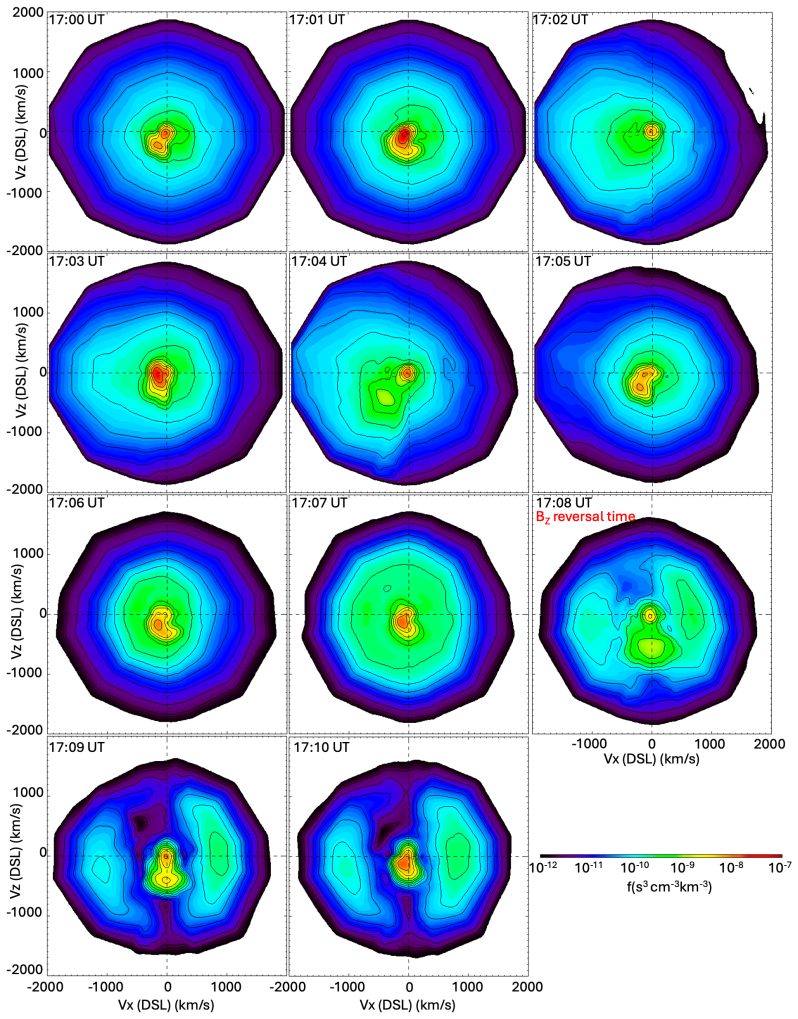
The authors report the first observation of three very-near-Earth reconnection events during the main phase of one storm. These events featured tailward retreating x-lines at radial distances of 12-13 Earth radii and magnetic local times of 23-24, within a current sheet thinner than 1 Earth radius. Concurrent observations showed dispersionless energetic particle injections and magnetic field dipolarizations at lower altitudes, with earthward flow bursts detected below geosynchronous orbit. This indicates that very-near-Earth reconnection can be frequent and plays a key role in driving the injections that power the ring current, though limited to the pre-midnight sector near the neutral sheet
What carries the argument
Very-near-Earth reconnection (VNERX) events identified through tailward plasma flows, thin current sheets under 1 Earth radius thick, energetic particle injections above tens of keV, and magnetic field dipolarizations.
Load-bearing premise
The events are identified as very-near-Earth reconnection based on plasma signatures and radial distance without independent confirmation that the x-lines are truly at 12-13 Earth radii rather than projections from farther distances.
What would settle it
An observation during a comparable storm main phase showing no multiple events or showing the x-lines located beyond 20 Earth radii with similar plasma signatures would challenge the claim.
Figures


read the original abstract
For the first time, this paper presents three very-near-Earth reconnection (VNERX) events observed within the same 12-hour-long storm main phase. The THEMIS inner probes observed the hallmarks of three episodes of tailward retreating x-lines positioned between magnetic local time (MLT) 23-24 and radial distance 12-13 Earth radii (RE). The events occurred within a thin current sheet, < 1 RE thick. Simultaneously, dispersionless energetic particle injections above 10s of keV and magnetic field dipolarizations were observed near and earthward of geosynchronous altitude by the KOMPSAT and Arase satellites. Arase observed earthward flow bursts at or below geosynchronous altitude via ExB enhancements, suggesting VNERX ejecta proceed below geosynchronous orbit. These observations demonstrate that VNERX events, which predominantly occur during the storm main phase, can be frequent and essential for driving injections that can effectively power the ring current. However, they can be observed only at the pre-midnight sector, close to the neutral sheet.
Editorial analysis
A structured set of objections, weighed in public.
Referee Report
Summary. The manuscript reports the first observation of three very-near-Earth reconnection (VNERX) events during a single 12-hour storm main phase. THEMIS inner probes detected hallmarks of tailward-retreating x-lines at MLT 23-24 and 12-13 RE within a thin (<1 RE) current sheet, while KOMPSAT and Arase observed associated dispersionless injections above tens of keV, magnetic dipolarizations, and earthward flow bursts at or below geosynchronous altitude, suggesting VNERX ejecta can reach these regions. The work concludes that such events are frequent in the main phase, essential for ring-current powering, and observable primarily in the pre-midnight sector near the neutral sheet.
Significance. If the radial locations and VNERX identification hold, the result demonstrates that multiple reconnection episodes can occur at very near-Earth distances within one storm main phase and directly drive inner-magnetosphere injections. The multi-point coverage (THEMIS for the tail, KOMPSAT/Arase for geosynchronous and below) supplies a coherent picture of tail-to-inner coupling that is rarely achieved in a single event study. This strengthens the case for VNERX as a key process in storm-time dynamics and supplies concrete observational targets for future missions.
major comments (2)
- [Abstract] Abstract: the claim that the x-lines are positioned at 12-13 RE rests on tailward flows and standard signatures (thin current sheet, injections, dipolarizations) without reported flow-reversal crossings, simultaneous earthward/tailward flow pairs at different radii, or magnetic topology diagnostics that would independently constrain the reconnection site. Tailward flows observed at a fixed spacecraft can arise from an x-line several RE farther out via propagation or mapping, so the 'very-near-Earth' radial assignment is not yet load-bearing for the multiple-event claim.
- [Abstract] Abstract and event-selection description: no quantitative thresholds (e.g., minimum flow speed, exact current-sheet thickness with uncertainty, Bz reversal criteria), error bars on spacecraft positions, or explicit exclusion criteria for alternative interpretations (flapping, projection effects) are supplied. This absence makes independent verification of the three distinct VNERX episodes difficult and weakens the 'first time' assertion.
minor comments (2)
- [Abstract] The abstract would be strengthened by inserting one or two numerical values (e.g., observed flow speeds or current-sheet thickness in RE) to anchor the qualitative description.
- A brief comparison table or timeline figure showing the timing of the three events relative to the storm main-phase Dst profile would improve readability and allow readers to assess simultaneity.
Simulated Author's Rebuttal
We thank the referee for the detailed and constructive review of our manuscript. The comments highlight important aspects of evidence strength and reproducibility that we will address to improve clarity and robustness. We provide point-by-point responses below.
read point-by-point responses
-
Referee: [Abstract] Abstract: the claim that the x-lines are positioned at 12-13 RE rests on tailward flows and standard signatures (thin current sheet, injections, dipolarizations) without reported flow-reversal crossings, simultaneous earthward/tailward flow pairs at different radii, or magnetic topology diagnostics that would independently constrain the reconnection site. Tailward flows observed at a fixed spacecraft can arise from an x-line several RE farther out via propagation or mapping, so the 'very-near-Earth' radial assignment is not yet load-bearing for the multiple-event claim.
Authors: We acknowledge that the absence of direct x-line crossings or simultaneous flow reversals at multiple radii limits the precision of the x-line location. The radial assignment of 12-13 RE is based on the THEMIS inner probes' positions where tailward flows, thin current sheet (<1 RE), and associated Bz signatures were observed, combined with the rapid timing to inner-magnetosphere injections and dipolarizations seen by KOMPSAT and Arase. These coordinated multi-point observations are consistent with VNERX rather than distant reconnection with propagation delays. Prior literature has employed similar multi-signature approaches for VNERX identification. We agree that propagation from farther out remains a possible alternative. In revision we will add an explicit discussion of this limitation, include any available topology indicators from the data, and qualify the radial claim as inferred from the observed flow locations rather than direct crossing. revision: partial
-
Referee: [Abstract] Abstract and event-selection description: no quantitative thresholds (e.g., minimum flow speed, exact current-sheet thickness with uncertainty, Bz reversal criteria), error bars on spacecraft positions, or explicit exclusion criteria for alternative interpretations (flapping, projection effects) are supplied. This absence makes independent verification of the three distinct VNERX episodes difficult and weakens the 'first time' assertion.
Authors: We agree that the lack of explicit quantitative thresholds hinders independent verification. The revised manuscript will incorporate specific event-selection criteria, including minimum tailward flow speeds, current-sheet thickness derived from multi-probe timing with uncertainty estimates, Bz fluctuation or reversal thresholds, and position error bars for THEMIS. We will also add a dedicated paragraph outlining exclusion of alternatives such as flapping (via consistency checks across MLT and radial distances) and projection effects. These additions will strengthen the reproducibility of the three-event identification and support the novelty claim. revision: yes
Circularity Check
Pure observational report with no derivations, fits, or self-referential predictions
full rationale
The paper is an observational report identifying VNERX events from spacecraft data using established plasma signatures (tailward flows, thin current sheets, injections, dipolarizations). No equations, parameter fittings, predictions, or derivation chains are present in the abstract or described structure. No self-citations are invoked to justify uniqueness theorems, ansatzes, or load-bearing premises. The central claim rests on direct data interpretation rather than any reduction to inputs by construction, making the finding self-contained with no circularity.
Axiom & Free-Parameter Ledger
axioms (1)
- domain assumption Observed tailward flows, thin current sheet, dispersionless injections, and dipolarizations are reliable signatures of very-near-Earth reconnection.
Reference graph
Works this paper leans on
-
[1]
doi: 10.1029/JA094iA02p01303 Hones, E. W., Jr. (1985, January). Magnetic reconnection in the earth’s magneto- tail.Australian Journal of Physics,38, 981-997. doi: 10.1071/PH850981 Iyemori, T. (1990, January). Storm-time magnetospheric currents inferred from mid- latitude geomagnetic field variations.Journal of Geomagnetism and Geoelec- tricity,42(11), 124...
-
[2]
doi: 10.1007/s11214-020-0636-4 Sergeev, V. A., Shukhtina, M. A., Rasinkangas, R., Korth, A., Reeves, G. D., Singer, H. J., . . . Vagina, L. I. (1998, May). Event study of deep energetic particle injections during substorm.jgr,103(A5), 9217-9234. doi: 10.1029/97JA03686 Shi, X., Stephens, G. K., Artemyev, A. V., Sitnov, M. I., & Angelopoulos, V. (2024, Octo...
-
[3]
doi: 10.1186/s40623-017-0754-8 –21–
discussion (0)
Sign in with ORCID, Apple, or X to comment. Anyone can read and Pith papers without signing in.