Recognition: unknown
Unmasking Hidden Wigner's Symmetry from First Principles
Pith reviewed 2026-05-07 09:38 UTC · model grok-4.3
The pith
Realistic χEFT internucleon forces exhibit dominant Wigner's supermultiplet symmetry in light nuclei.
A machine-rendered reading of the paper's core claim, the machinery that carries it, and where it could break.
Core claim
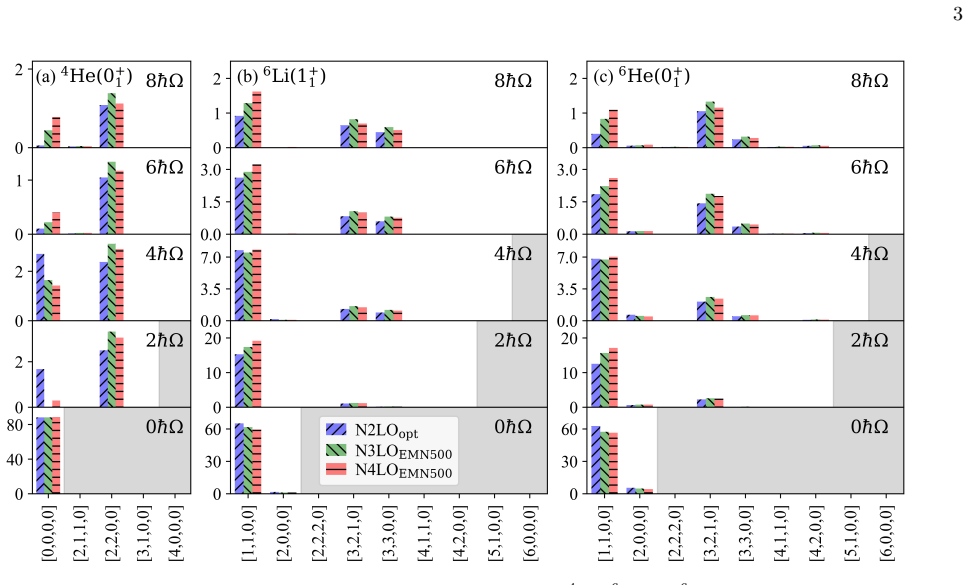
High-quality internucleon forces derived from χEFT exhibit a striking dominance of Wigner's supermultiplet symmetry. A majority of the ^4He, ^6Li, and ^6He wave functions is concentrated in a few U(4) irreducible representations without imposing any a priori constraints on the model space. This emergent feature points to a strategy for reducing explosive many-body bases of the NCSM while retaining physically important configurations needed to compute observables.
What carries the argument
The ab initio Symmetry Adapted Model (SAM) that decomposes nuclear wave functions into U(4) supermultiplet irreducible representations and quantifies their dominance under χEFT interactions.
If this is right
- Many-body bases in the no-core shell model can be reduced by retaining only the dominant U(4) components while keeping observables accurate.
- Spin-isospin polarizability remains suppressed for these nuclei under realistic χEFT forces.
- The symmetry emerges directly from χEFT without invoking large-N_c limits of QCD or assumptions about specific nuclei.
- The same concentration pattern supplies a systematic way to identify and keep physically important configurations in larger calculations.
Where Pith is reading between the lines
- If the pattern persists, similar U(4) dominance could appear in calculations for heavier nuclei using the same interactions.
- Varying the chiral order or cutoff in χEFT potentials would test whether the symmetry strength grows with improved force quality.
- The result invites comparison with other emergent symmetries in quantum many-body systems derived from effective field theories.
Load-bearing premise
The observed concentration arises from the χEFT interactions themselves rather than being selected or amplified by the Symmetry Adapted Model, the chosen light nuclei, or the truncation scheme.
What would settle it
Repeating the SAM decomposition with a different high-quality realistic interaction or in a much larger model space, and finding the wave-function weight spread evenly across many U(4) representations instead of concentrated in a few, would falsify the dominance claim.
Figures




read the original abstract
We present quantitative evidence that high-quality internucleon forces derived from $\chi$EFT exhibit a striking dominance of Wigner's supermultiplet symmetry, without invoking the large-$N_c$ limit of QCD or assumptions about specific nuclei. We trace the manifestation of this symmetry in nuclear structure using the \textit{ab initio} Symmetry Adapted Model (SAM) and identify suppressed spin-isospin polarizability. Our calculations show that a majority of $\rm ^4He$, $\rm ^6Li$, and $\rm ^6He$ wave functions is concentrated in a few $\rm U(4)$ irreducible representations, without imposing any \textit{a priori} constraints on the model space. This emergent feature points to a strategy for reducing explosive many-body bases of the NCSM while retaining physically important configurations needed to compute observables.
Editorial analysis
A structured set of objections, weighed in public.
Referee Report
Summary. The manuscript claims that ab initio calculations with the Symmetry Adapted Model (SAM) using χEFT-derived internucleon forces reveal an emergent dominance of Wigner's U(4) supermultiplet symmetry in the ground-state wave functions of ^4He, ^6Li, and ^6He. A majority of the wave-function norm is concentrated in a few U(4) irreps without a priori constraints on the model space or large-N_c assumptions; the work also reports suppressed spin-isospin polarizability and suggests this symmetry can be exploited to truncate NCSM bases while retaining important configurations.
Significance. If the dominance is shown to be interaction-driven rather than an artifact of the symmetry-adapted basis, the result would be significant: it supplies first-principles, quantitative evidence for hidden Wigner symmetry in realistic nuclear forces and offers a concrete route to reducing the dimensionality of ab initio calculations. The absence of large-N_c or nucleus-specific assumptions is a strength.
major comments (3)
- [§3] §3 (SAM basis construction): the symmetry-adapted SU(3)×U(4) truncation may preferentially weight high-U(4) components by construction. A control calculation in an unconstrained NCSM basis at the same N_max (or equivalent Hilbert-space dimension) is required to isolate whether the reported concentration is emergent from the χEFT interaction or selected by the basis choice.
- [§4] §4 (Results): the abstract and results assert that 'a majority' of the wave functions resides in 'a few' U(4) irreps, yet no numerical fractions, cumulative norms, or thresholds defining 'majority' and 'few' are supplied, nor are convergence plots versus N_max or basis size with error estimates.
- [§4] §4 (polarizability): the claim of suppressed spin-isospin polarizability is stated without a quantitative definition, comparison to a symmetry-unconstrained calculation, or explicit operator whose expectation value is reported.
minor comments (2)
- [§2] The specific χEFT interactions (order, regulator, etc.) used for each nucleus should be stated explicitly in the methods section for reproducibility.
- [Figures/Tables] Table or figure captions should include the precise N_max values and the number of U(4) irreps retained in the dominant subspace.
Simulated Author's Rebuttal
We thank the referee for the thoughtful and constructive report. The comments highlight important points for clarifying our results on the emergent dominance of Wigner's U(4) symmetry in χEFT-based calculations for light nuclei. We address each major comment below and indicate the revisions that will be incorporated.
read point-by-point responses
-
Referee: §3 (SAM basis construction): the symmetry-adapted SU(3)×U(4) truncation may preferentially weight high-U(4) components by construction. A control calculation in an unconstrained NCSM basis at the same N_max (or equivalent Hilbert-space dimension) is required to isolate whether the reported concentration is emergent from the χEFT interaction or selected by the basis choice.
Authors: The SAM basis is constructed as a complete set of states carrying good SU(3) and U(4) quantum numbers up to a given N_max, without any a priori selection or truncation on the U(4) irreps themselves; all U(4) representations compatible with the chosen SU(3) labels are retained, and the Hamiltonian matrix is diagonalized in this space. The concentration of norm in a few U(4) irreps therefore reflects the dynamics generated by the χEFT interaction rather than an imposed bias. Nevertheless, we agree that an explicit comparison with a symmetry-unconstrained NCSM calculation at comparable dimension would be valuable. Such a calculation lies beyond the computational resources of the present study, but we will add a dedicated paragraph in §3 that details the basis construction and explains why the observed U(4) dominance cannot be attributed to the symmetry adaptation alone. revision: partial
-
Referee: §4 (Results): the abstract and results assert that 'a majority' of the wave functions resides in 'a few' U(4) irreps, yet no numerical fractions, cumulative norms, or thresholds defining 'majority' and 'few' are supplied, nor are convergence plots versus N_max or basis size with error estimates.
Authors: We accept that the manuscript would benefit from explicit quantitative support. In the revised version we will insert a table in §4 listing the cumulative norm fractions carried by the leading U(4) irreps for each nucleus, adopt a concrete threshold (e.g., the minimal number of irreps needed to reach at least 70 % of the total norm), and include convergence plots of these fractions versus N_max together with estimated truncation uncertainties. revision: yes
-
Referee: §4 (polarizability): the claim of suppressed spin-isospin polarizability is stated without a quantitative definition, comparison to a symmetry-unconstrained calculation, or explicit operator whose expectation value is reported.
Authors: We will expand the discussion in §4 to define spin-isospin polarizability quantitatively as the squared norm of the wave-function components lying outside the dominant U(4) irreps (equivalently, the expectation value of a spin-isospin mixing operator that projects onto non-dominant representations). Numerical values will be reported for ^4He, ^6Li, and ^6He, and a brief comparison with results obtained in a less symmetry-restricted basis will be added where feasible. revision: yes
Circularity Check
No significant circularity in derivation chain
full rationale
The paper computes wavefunction decompositions for light nuclei using χEFT-derived interactions inside the Symmetry Adapted Model. The central claim—that a majority of the wavefunction weight lies in a few U(4) irreps—is presented as an output of the ab initio calculation rather than an input. The abstract explicitly states that no a priori constraints are imposed on the model space, and the SAM is used as a computational basis that still allows the interaction to determine the mixing. No equations, fitted parameters, or self-citations are shown to reduce the reported dominance to a definitional feature of the basis choice or to a prior result by the same authors. The derivation therefore remains self-contained: χEFT forces are taken as external input, the many-body problem is solved, and the symmetry content is measured afterward.
Axiom & Free-Parameter Ledger
axioms (2)
- domain assumption χEFT-derived internucleon forces are high-quality representations of nuclear interactions
- domain assumption The Symmetry Adapted Model accurately captures nuclear structure without preferentially selecting U(4) components
Reference graph
Works this paper leans on
-
[1]
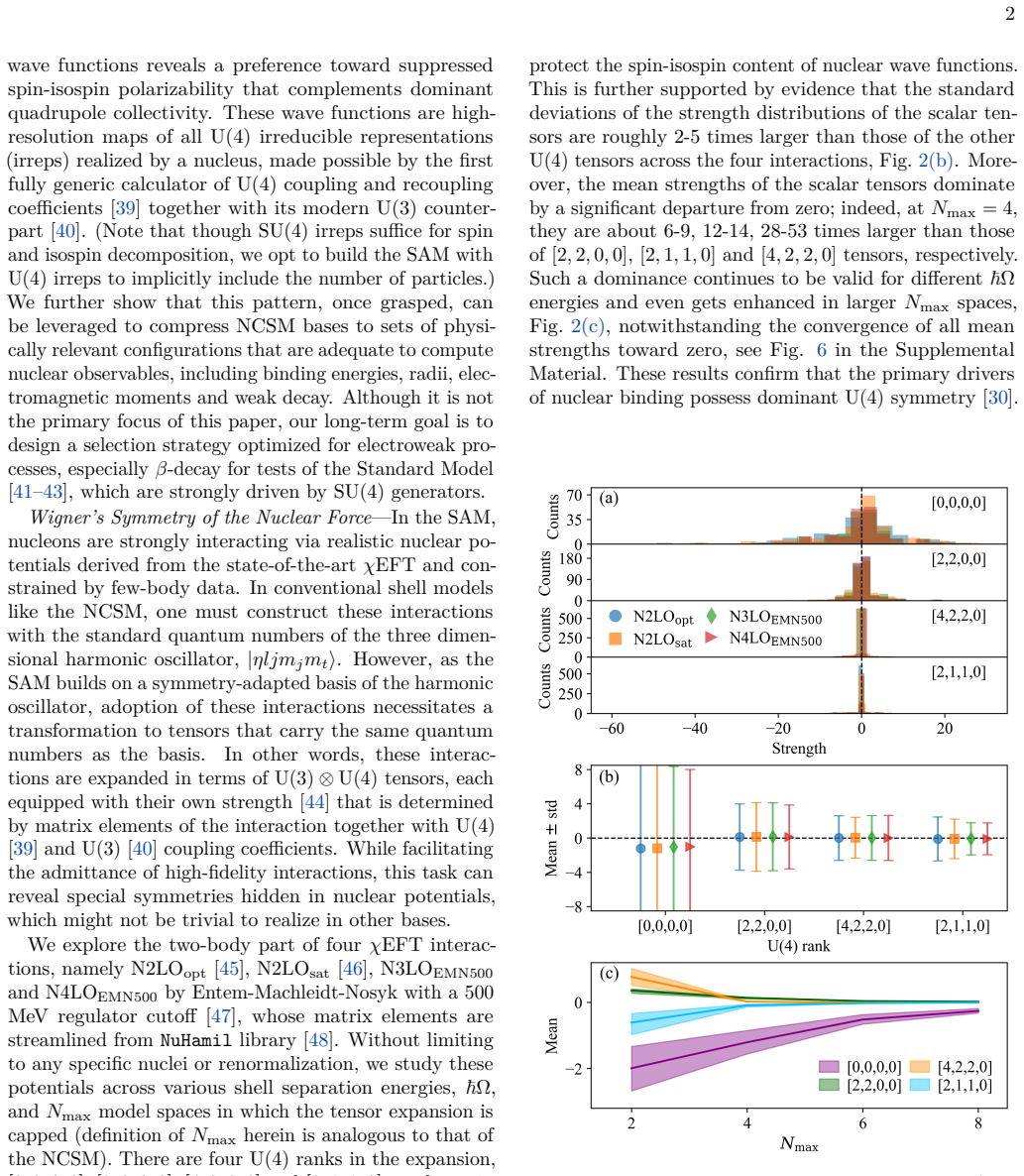
andU(3)[ 40] coupling coefficients. While facilitating the admittance of high-fidelity interactions, this task can reveal special symmetries hidden in nuclear potentials, which might not be trivial to realize in other bases. We explore the two-body part of fourχEFT interac- tions, namelyN2LO opt [45],N2LO sat [46],N3LO EMN500 andN4LO EMN500 by Entem-Machl...
-
[2]
slightly mixed with[2, 2, 0, 0]irrep, whereas the other irreps contribute no more than 0.05%. Similarly, the two A = 6isobars assume virtually the same set of three dom- inant irreps ([1, 1, 0, 0],[3 , 2, 1, 0]and[3 , 3, 0, 0]) in each excited ℏΩsubspace, whereas the others represent less than 0.8%. Such akinU(4)structure paves the way for β-decay to occu...
-
[3]
Dytrych, K
T. Dytrych, K. Sviratcheva, C. Bahri, J. Draayer, and J. Vary, Evidence for Symplectic Symmetry in Ab Initio No-Core Shell Model Results for Light Nuclei, Physical Review Letters98, 162503 (2007)
2007
-
[4]
Dytrych, K
T. Dytrych, K. D. Launey, J. P. Draayer, P. Maris, J. P. Vary, E. Saule, U. Catalyurek, M. Sosonkina, D. Langr, and M. A. Caprio, Collective Modes in Light Nuclei from First Principles, Physical Review Letters111, 252501 (2013)
2013
-
[5]
Dytrych, K
T. Dytrych, K. D. Launey, J. P. Draayer, D. J. Rowe, J. L. Wood, G. Rosensteel, C. Bahri, D. Langr, and R. B. Baker, Physics of Nuclei: Key Role of an Emergent Symmetry, Physical Review Letters124, 042501 (2020)
2020
-
[6]
K. D. Launey, T. Dytrych, and J. P. Draayer, Symmetry- guided large-scale shell-model theory, Progress in Particle and Nuclear Physics89, 101 (2016)
2016
-
[7]
A. E. McCoy, M. A. Caprio, T. Dytrych, and P. J. Fasano, EmergentSp(3, R)Dynamical Symmetry in the Nuclear 6 Many-Body System from an Ab Initio Description, Phys- ical Review Letters125, 102505 (2020)
2020
-
[8]
E. P. Wigner, On the Consequences of the Symmetry of the Nuclear Hamiltonian on the Spectroscopy of Nuclei, Physical Review51, 106 (1937)
1937
-
[9]
J.-W. Chen, D. Lee, and T. Schaefer, Inequalities for Light Nuclei in the Wigner Symmetry Limit, Physical Review Letters93, 242302 (2004)
2004
-
[10]
D. B. Kaplan and M. J. Savage, The spin-flavor depen- dence of nuclear forces from large-N QCD, Physics Letters B365, 244 (1996)
1996
-
[11]
D. Lee, S. Bogner, B. A. Brown, S. Elhatisari, E. Epel- baum, H. Hergert, M. Hjorth-Jensen, H. Krebs, N. Li, B.-N. Lu, and U.-G. Meißner, Hidden Spin-Isospin Ex- change Symmetry, Physical Review Letters127, 062501 (2021)
2021
-
[12]
Franzini and L
P. Franzini and L. Radicati, On the validity of the super- multiplet model, Physics Letters6, 322 (1963)
1963
-
[13]
Cauvin, V
M. Cauvin, V. Gillet, F. Soulmagnon, and M. Danos, Mass formula based on SU(4), Nuclear Physics A361, 192 (1981)
1981
-
[14]
E. P. Wigner, On Coupling Conditions in Light Nuclei and the Lifetimes ofβ-Radioactivities, Physical Review 56, 519 (1939)
1939
-
[15]
Fujita and K
J.-I. Fujita and K. Ikeda, Existence of Isobaric States and Beta Decay of Heavier Nuclei, Nuclear Physics67, 145 (1965)
1965
-
[16]
J. P. Elliott, Isospin in Nuclear Physics (North-Holland Publishing, 1969)
1969
-
[17]
Vogel and M
P. Vogel and M. R. Zirnbauer, Suppression of the Two- NeutrinoDouble-BetaDecaybyNuclear-StructureEffects, Physical Review Letters57, 3148 (1986)
1986
-
[18]
Vogel, M
P. Vogel, M. Ericson, and J. Vergados, Sum rules for two- particle operators and double beta decay, Physics Letters B212, 259 (1988)
1988
-
[19]
Donnelly and G
T. Donnelly and G. Walker, Inelastic electron scattering and supermultiplets in the particle-hole model forC12, O16,Si 28,S 32, andCa40, Annals of Physics60, 209 (1970)
1970
-
[20]
Y. V. Gaponov and Y. S. Lutostansky, Giant Gamow- Teller Resonance in Neutron-Rich Nuclei, Physics of Atomic Nuclei73, 1360 (2010)
2010
-
[21]
D. B. Kaplan and A. V. Manohar, Nucleon-nucleon po- tential in the1/Nc expansion, Physical Review C56, 56 (1997)
1997
-
[22]
A. C. Cordón and E. R. Arriola, Wigner symmetry, large Nc, and renormalized one-boson exchange potentials, Physical Review C78, 054002 (2008)
2008
-
[23]
Mehen, I
T. Mehen, I. W. Stewart, and M. B. Wise, Wigner Sym- metry in the Limit of Large Scattering Lengths, Physical Review Letters83, 931 (1999)
1999
-
[24]
S. R. Beane, E. Chang, S. D. Cohen, W. Detmold, P. Jun- narkar, H. W. Lin, T. C. Luu, K. Orginos, A. Parreño, M. J. Savage, and A. Walker-Loud, Nucleon-nucleon scat- tering parameters in the limit ofSU(3)flavor symmetry, Physical Review C88, 024003 (2013)
2013
-
[25]
S. R. Beane, D. B. Kaplan, N. Klco, and M. J. Savage, Entanglement Suppression and Emergent Symmetries of Strong Interactions, Physical Review Letters122, 102001 (2019)
2019
-
[26]
K. T. Hecht and J. P. Draayer, Spectral distributions and the breaking of isospin and supermultiplet symmetries in nuclei, Nuclear Physics A223, 285 (1974)
1974
-
[27]
R. U. Haq and J. C. Parikh, Space symmetry in light nuclei: (II). SU(4) isospin-spin averages, Nuclear Physics A220, 349 (1974)
1974
-
[28]
Vogel and W
P. Vogel and W. E. Ormand, Spin-isospin SU(4) symmetry in sd- and fp-shell nuclei, Physical Review C47, 623 (1993)
1993
-
[29]
P. V. Isacker, A. Algora, A. Vitéz-Sveiczer, G. G. Kiss, S. E. A. Orrigo, B. Rubio, and P. Aguilera, Gamow–Teller Beta Decay and Pseudo-SU(4) Symmetry, Symmetry15, 2001 (2023)
2001
-
[30]
V. K. B. Kota and R. Sahu, Proxy-SU(4)symmetry in A = 60–90 region, Physica Scripta99, 065306 (2024)
2024
- [31]
-
[32]
B.-N. Lu, N. Li, S. Elhatisari, D. Lee, E. Epelbaum, and U.-G. Meißner, Essential elements for nuclear binding, Physics Letters B797, 134863 (2019)
2019
-
[33]
B.-N. Lu, N. Li, S. Elhatisari, D. Lee, J. E. Drut, T. A. Lähde, E. Epelbaum, and U.-G. Meißner, Ab Initio Nu- clear Thermodynamics, Physical Review Letters125, 192502 (2020)
2020
-
[34]
S. Shen, T. A. Lähde, D. Lee, and U.-G. Meißner, Wigner SU(4) symmetry, clustering, and the spectrum of12C, The European Physical Journal A57, 276 (2021)
2021
-
[35]
Z. Ren, S. Elhatisari, T. A. Lähde, D. Lee, and U.-G. Meißner, Ab initio study of nuclear clustering in hot dilute nuclear matter, Physics Letters B850, 138463 (2024)
2024
-
[36]
Z. Ren, S. Elhatisari, and U.-G. Meißner, Ab Initio Study of the Radii of Oxygen Isotopes, Physical Review Letters 135, 152502 (2025)
2025
-
[37]
Niu and B.-N
Z.-W. Niu and B.-N. Lu, Sign-Problem-Free Nuclear Quantum Monte Carlo Simulation, Physical Review Let- ters135, 222504 (2025)
2025
-
[38]
S. Shen, S. Elhatisari, T. A. Lähde, D. Lee, B.-N. Lu, and U.-G. Meißner, Emergent geometry and duality in the carbon nucleus, Nature Communications14, 2777 (2023)
2023
-
[39]
S. Shen, S. Elhatisari, D. Lee, U.-G. Meißner, and Z. Ren, Ab Initio Study of the Beryllium Isotopes7Be to 12Be, Physical Review Letters134, 162503 (2025)
2025
-
[40]
Draayer, F
J. Draayer, F. Pan, and P. Dang, Reconsideration of Wigner’s Supermultiplet Symmetry, Physica Scripta99, 102002 (2024)
2024
-
[41]
P. Dang, J. P. Draayer, F. Pan, T. Dytrych, D. Langr, D. Kekejian, K. S. Becker, and N. Thompson, Coupling and Recoupling Coefficients for Wigner’sU(4)Supermul- tiplet Symmetry, The European Physical Journal Plus 139, 933 (2024)
2024
-
[42]
P. Dang, J. P. Draayer, F. Pan, and K. S. Becker, New Procedure for Evaluation ofU(3)Coupling and Recou- pling Coefficients, The European Physical Journal Plus 139, 704 (2024)
2024
-
[43]
G. H. Sargsyan, K. D. Launey, M. T. Burkey, A. T. Gal- lant, N. D. Scielzo, G. Savard, A. Mercenne, T. Dytrych, D. Langr, L. Varriano, B. Longfellow, T. Y. Hirsh, and J. P. Draayer, Impact of clustering on the8Liβdecay and recoil form factors, Physical Review Letters128, 202502 (2022)
2022
-
[44]
M. T. Burkey, G. Savard, A. T. Gallant, N. D. Scielzo, J. A. Clark, T. Y. Hirsh, L. Varriano, G. H. Sargsyan, K. D. Launey, M. Brodeur, D. P. Burdette, E. Heckmaier, K. Joerres, J. W. Klimes, K. Kolos, A. Laminack, K. G. Leach, A. F. Levand, B. Longfellow, B. Maaß, S. T. Mar- ley, G. E. Morgan, P. Mueller, R. Orford, S. W. Padgett, A. P. Galván, J. R. Pie...
2022
-
[45]
G. B. King, Gamow-tellerβ-decay in light nuclei, inElec- troweak Structure and Reactions in Light Nuclei with Quantum Monte Carlo Methods(Springer Nature Switzer- land, Cham, 2025) pp. 31–64
2025
-
[46]
Oberhuber, T
T. Oberhuber, T. Dytrych, K. Launey, D. Langr, and J. P. Draayer, Transformation of a nucleon-nucleon potential operator into itsSU(3)tensor form using GPUS, Discrete and Continuous Dynamical Systems – Series S14, 1111 (2021)
2021
-
[47]
Ekström, G
A. Ekström, G. Baardsen, C. Forssén, G. Ha- gen, M. Hjorth-Jensen, G. R. Jansen, R. Machleidt, W. Nazarewicz, T. Papenbrock, J. Sarich, and S. M. Wild, Optimized Chiral Nucleon-Nucleon Interaction at Next- to-Next-to-Leading Order, Physical Review Letters110, 192502 (2013)
2013
-
[48]
Ekström, G
A. Ekström, G. R. Jansen, K. A. Wendt, G. Hagen, T. Pa- penbrock, B. D. Carlsson, C. Forssén, M. Hjorth-Jensen, P. Navrátil, and W. Nazarewicz, Accurate nuclear radii and binding energies from a chiral interaction, Physical Review C91, 051301 (2015)
2015
-
[49]
D. R. Entem, R. Machleidt, and Y. Nosyk, High-quality two-nucleon potentials up to fifth order of the chiral ex- pansion, Physical Review C96, 024004 (2017)
2017
-
[50]
Miyagi, Nuhamil: A numerical code to generate nuclear two- and three-body matrix elements from chiral effective field theory, The European Physical Journal A59, 150 (2023)
T. Miyagi, Nuhamil: A numerical code to generate nuclear two- and three-body matrix elements from chiral effective field theory, The European Physical Journal A59, 150 (2023)
2023
-
[51]
Gloeckner and R
D. Gloeckner and R. Lawson, Spurious center-of-mass motion, Physics Letters B53, 313 (1974)
1974
-
[52]
F. Pan, Y. Wu, A. Li, Y. Zhang, L. Dai, and J. P. Draayer, An algebraic projection procedure for construction of the basis vectors of irreducible representations ofU(4)in the SUS(2) ⊗ SUT(2)basis, The European Physical Journal Plus138, 662 (2023)
2023
-
[53]
A. A. Isayev, Spin-ordered phase transitions in isospin asymmetric nuclear matter, Physical Review C74, 057301 (2006)
2006
-
[54]
Verhaar, A method for the elimination of spurious states in the nuclear harmonic oscillator shell model, Nu- clear Physics21, 508 (1960)
B. Verhaar, A method for the elimination of spurious states in the nuclear harmonic oscillator shell model, Nu- clear Physics21, 508 (1960)
1960
-
[55]
Tilley, C
D. Tilley, C. Cheves, J. Godwin, G. Hale, H. Hofmann, J. Kelley, C. Sheu, and H. Weller, Energy levels of light nuclei A=5, 6, 7, Nuclear Physics A708, 3 (2002)
2002
-
[56]
Bogner, R
S. Bogner, R. Furnstahl, and A. Schwenk, From low- momentum interactions to nuclear structure, Progress in Particle and Nuclear Physics65, 94 (2010)
2010
-
[57]
D. R. Entem and R. Machleidt, Accurate charge- dependent nucleon-nucleon potential at fourth order of chiral perturbation theory, Physical Review C68, 041001 (2003)
2003
-
[58]
E. D. Jurgenson, P. Navrátil, and R. J. Furnstahl, Evo- lution of Nuclear Many-Body Forces with the Similarity Renormalization Group, Physical Review Letters103, 082501 (2009)
2009
-
[59]
Knecht, R
A. Knecht, R. Hong, D. W. Zumwalt, B. G. Delbridge, A. García, P. Müller, H. E. Swanson, I. S. Towner, S. Ut- suno, W. Williams, and C. Wrede, Precision measurement of the 6He half-life and the weak axial current in nuclei, Physical Review C86, 035506 (2012)
2012
-
[60]
Gysbers, G
P. Gysbers, G. Hagen, J. D. Holt, G. R. Jansen, T. D. Mor- ris, P. Navrátil, T. Papenbrock, S. Quaglioni, A. Schwenk, S. R. Stroberg, and K. A. Wendt, Discrepancy between experimental and theoreticalβ-decay rates resolved from first principles, Nature Physics15, 428 (2019)
2019
-
[61]
I. J. Shin, Y. Kim, P. Maris, J. P. Vary, C. Forssén, J. Rotureau, and N. Michel,Ab initiono-core solutions for 6Li, Journal of Physics G: Nuclear and Particle Physics 44, 075103 (2017). 8 SUPPLEMENT AL MA TERIAL T ensor expansion statistics ofN2LO sat,N3LO EMN500 andN4LO EMN500 FIG. 6. Dependence onNmax of the mean strengths for fourU(4)ranks,[0 , 0, 0, ...
2017
-
[62]
long-range
As one expands the model space of tensor expansion with higherNmax, starting to appear are “long-range” tensors that can connect configurations differing in a large number of harmonic oscillator quanta. These tensors, though large in their numbers, possess very small strengths, which in turn bring down the overall mean strengths in the tensor expansion, d...
-
[63]
Specifically, atNmax = 8, the mean strengths of theU(4)-symmetric tensors dominate those of[2, 2, 0, 0],[2, 1, 1, 0] and[4,2,2,0]by a factor of 6-12, 41-59, 52-143, respectively
In spite of the convergence trend, at each value ofNmax, the scalar tensors always eclipse the other tensors. Specifically, atNmax = 8, the mean strengths of theU(4)-symmetric tensors dominate those of[2, 2, 0, 0],[2, 1, 1, 0] and[4,2,2,0]by a factor of 6-12, 41-59, 52-143, respectively
-
[64]
The mean strengths of the[4, 2, 2, 0]tensors approach zero the most quickly. It is seen that atNmax = 2, these tensors seem to be the second dominant contributor to the nuclear force, however, atNmax = 4, they begin to intrude below the[2,2,0,0]tensors with the mean under 0.05, being the smallest among the fourU(4)ranks. Wigner’s symmetry in excited state...
discussion (0)
Sign in with ORCID, Apple, or X to comment. Anyone can read and Pith papers without signing in.