Recognition: unknown
Hindered Prompt-Neutron Evaporation in Surrogate Reactions for ²³⁹Pu(n,f)
Pith reviewed 2026-05-07 09:31 UTC · model grok-4.3
The pith
Surrogate two-proton transfer reactions for plutonium fission reduce prompt neutron multiplicity due to extra angular momentum favoring gamma emission.
A machine-rendered reading of the paper's core claim, the machinery that carries it, and where it could break.
Core claim
The prompt neutron multiplicity derived from isotopic fission-fragment distributions in the surrogate reaction is reduced relative to neutron-capture-induced fission of 239Pu, even though the fragment yield distributions are similar. This discrepancy is due to the additional angular momentum in the multi-nucleon transfer reaction exciting the fissioning system to higher-spin states, thereby increasing gamma emission that competes with neutron evaporation, particularly from the fission barrier to the scission point.
What carries the argument
The angular momentum imparted by the entrance channel in surrogate multi-nucleon transfer reactions, which shifts the competition between neutron evaporation and gamma decay in the pre-scission de-excitation of the compound nucleus.
If this is right
- Fission fragment yield distributions can be reliably measured using surrogate reactions even when neutron multiplicities differ.
- The limitations of surrogate reactions must be considered when using their data for nuclear technology applications.
- Higher initial spin states enhance gamma emission over neutron evaporation in the fission process.
- Properties derived from surrogate reactions may not directly translate to neutron-induced fission observables.
Where Pith is reading between the lines
- Models of fission should include explicit spin-dependent branching ratios to reconcile surrogate and direct reaction data.
- Direct measurement of gamma-ray multiplicities in these reactions could test the proposed mechanism.
- This effect may influence the interpretation of surrogate data for other actinide nuclei in nuclear data libraries.
Load-bearing premise
The reduction in prompt neutron multiplicity is primarily due to differences in angular momentum from the entrance channel and not from other factors like reaction mechanism details, fragment identification, or excitation energy accuracy.
What would settle it
A measurement showing that the spin distribution in the surrogate reaction does not produce enough additional gamma competition to account for the observed drop in neutron multiplicity, or finding identical neutron multiplicities once angular momentum is matched between surrogate and direct reactions.
Figures


read the original abstract
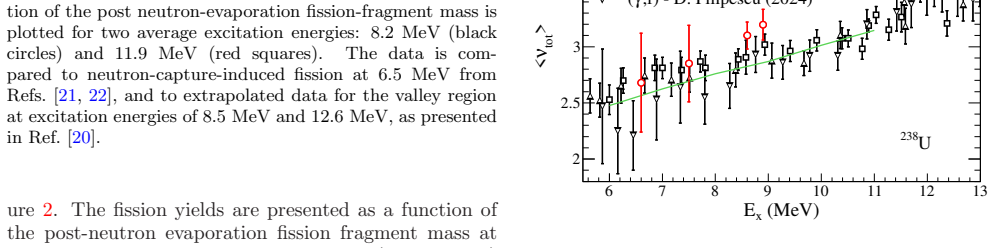
Isotopic fission-fragment distributions of $^{240}$Pu have been measured, for the first time, as a function of the initial excitation energy, and the prompt neutron multiplicity has been derived from these data. The $^{240}$Pu fissioning system was produced through the two-proton transfer reaction between $^{238}$U and $^{12}$C, a surrogate reaction for the neutron-capture-induced fission $^{239}$Pu(n,f). The reaction was measured in inverse kinematics, allowing the fission fragments to be fully identified with the VAMOS Spectrometer. When compared to neutron-capture-induced reactions, the observed prompt neutron multiplicity shows a clear reduction in the surrogate two-proton transfer, revealing an unexpected influence of the entrance channel in the fission output. At the same time, fission-fragment yield distributions obtained in neutron-capture-induced reactions show a relative fission-fragment production in the symmetry region similar to that measured in this work. The discrepancy in neutron multiplicity is attributed to the additional angular momentum induced in the multi-nucleon transfer reactions, which excites the fissioning system to higher-spin states, increasing the probability of gamma emission that competes with neutron evaporation, in particular from the fission barrier to the scission point. This observation underlines the limitations in the utilisation of properties derived from surrogate reactions in nuclear technology and other applications of nuclear fission.
Editorial analysis
A structured set of objections, weighed in public.
Referee Report
Summary. The manuscript reports the first measurement of isotopic fission-fragment distributions for ^{240}Pu produced via the two-proton transfer surrogate reaction ^{238}U + ^{12}C in inverse kinematics, using the VAMOS spectrometer for full fragment identification. Prompt neutron multiplicity is derived from the post-neutron yields as a function of initial excitation energy and compared to literature data for direct ^{239}Pu(n,f) at matched E*. A reduction in neutron multiplicity is observed in the surrogate channel and attributed to higher angular momentum in the multi-nucleon transfer, which increases gamma competition with neutron evaporation between the fission barrier and scission. Fission-fragment yield distributions in the symmetry region are reported to be similar to neutron-induced cases.
Significance. If the reduction and angular-momentum interpretation are confirmed with quantitative controls, the result would be significant for surrogate-reaction applications in nuclear data for technology and stockpile stewardship. It demonstrates that entrance-channel effects beyond E* matching can alter key fission observables such as neutron multiplicity, while the inverse-kinematics VAMOS approach provides high-resolution isotopic yields that strengthen the experimental basis for such comparisons.
major comments (2)
- [Abstract] Abstract: the central claim of a 'clear reduction' in prompt neutron multiplicity is presented without any numerical values, uncertainties, statistical significance, or description of the derivation method from post-neutron isotopic fragment yields. This prevents quantitative evaluation of the effect size and robustness of the comparison to ^{239}Pu(n,f) data.
- [Abstract] Abstract (interpretation paragraph): the attribution to additional angular momentum requires that the reconstructed E* distribution in the surrogate reaction has no systematic offset relative to the neutron-induced case and that VAMOS fragment identification introduces no spin-dependent efficiency differences. No quantitative comparison of E* centroids, no propagated uncertainties on the multiplicity extraction, and no cross-checks (e.g., total gamma multiplicity or fission-fragment kinetic-energy spectra) are provided to bound these alternatives.
minor comments (1)
- [Abstract] The abstract would be strengthened by including the approximate range of excitation energies covered and a brief statement on event statistics or background subtraction to contextualize the 'clear reduction'.
Simulated Author's Rebuttal
We thank the referee for the positive assessment of the significance of our work and for the detailed comments that help improve the clarity of the manuscript. We respond to each major comment below.
read point-by-point responses
-
Referee: Abstract: the central claim of a 'clear reduction' in prompt neutron multiplicity is presented without any numerical values, uncertainties, statistical significance, or description of the derivation method from post-neutron isotopic fragment yields. This prevents quantitative evaluation of the effect size and robustness of the comparison to ^{239}Pu(n,f) data.
Authors: We agree with this observation. The abstract summarizes the key finding but omits specific numbers to keep it concise. The full paper details the derivation of prompt neutron multiplicity from the post-neutron isotopic yields and the comparison to literature values for ^{239}Pu(n,f). In the revised manuscript, we will modify the abstract to include the approximate magnitude of the reduction along with uncertainties and a short note on the method used. revision: yes
-
Referee: Abstract (interpretation paragraph): the attribution to additional angular momentum requires that the reconstructed E* distribution in the surrogate reaction has no systematic offset relative to the neutron-induced case and that VAMOS fragment identification introduces no spin-dependent efficiency differences. No quantitative comparison of E* centroids, no propagated uncertainties on the multiplicity extraction, and no cross-checks (e.g., total gamma multiplicity or fission-fragment kinetic-energy spectra) are provided to bound these alternatives.
Authors: The manuscript does compare the excitation energy ranges between the surrogate and neutron-induced reactions, but we acknowledge the need for more explicit quantitative support. We will add a direct comparison of E* centroids and include propagated uncertainties in the multiplicity extraction in the revised text. Regarding cross-checks, total gamma multiplicity and detailed kinetic-energy spectra were not part of this measurement campaign, limiting our ability to provide them here. We will expand the discussion of possible systematic effects from VAMOS efficiencies and why the angular momentum interpretation remains favored based on the reaction mechanism. revision: partial
- Cross-checks using total gamma multiplicity or fission-fragment kinetic-energy spectra, since these observables were not measured in the experiment.
Circularity Check
No significant circularity; experimental measurement with derivation from yields compared to independent external data.
full rationale
The paper performs a direct experimental measurement of isotopic fission-fragment distributions in the surrogate 238U+12C reaction, derives prompt-neutron multiplicity from the post-neutron yields using standard conversion methods, and compares the result to literature values for 239Pu(n,f) at matched excitation energy. No equations or fits are presented that reduce the claimed multiplicity reduction to parameters defined by the result itself. The attribution to angular momentum is an interpretive statement, not a load-bearing derivation. No self-citations, ansatzes, or uniqueness theorems are invoked to force the central claim. The chain is self-contained against external benchmarks and receives a score of 0.
Axiom & Free-Parameter Ledger
Reference graph
Works this paper leans on
-
[1]
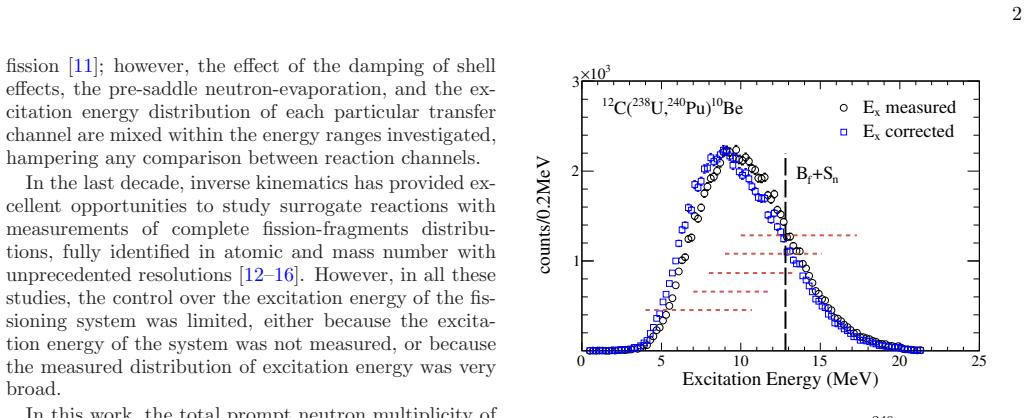
This distribu- tion is corrected for the probability of populating excited states in the target-like recoil, which was measured to be 0 . 14 ± 0. 04 [ 17]. The corrected Ex distribution is presented with blue squares in Fig. 1. A black dashed line in the same figure indicates the threshold excitation energy of the second-chance fission . This is the mini- m...
1980
-
[2]
7653 (2022)
2022 OECD Nuclear Energy Agency Annual Report, Re- port No. 7653 (2022)
2022
-
[3]
Goriely, J
S. Goriely, J. L. Sida, J. F. Lema ˆ ıtre, S. Panebianco, N. Dubray, S. Hilaire, A. Bauswein, and H. T. Janka, Phys. Rev. Lett. 111, 242502 (2013)
2013
-
[4]
J. D. Cramer and H. C. Britt, Phys. Rev. C 2, 2350 (1970)
1970
-
[5]
J. E. Escher and F. S. Dietrich, Phys. Rev. C 74, 054601 (2006)
2006
-
[6]
J. E. Escher, J. T. Burke, F. S. Dietrich, N. D. Scielzo, I. J. Thompson, and W. Younes, Rev. Mod. Phys. 84, 353 (2012)
2012
-
[7]
P´ erez S´ anchez, B
R. P´ erez S´ anchez, B. Jurado, V. M´ eot, O. Roig, M. Dupuis, O. Bouland, D. Denis-Petit, P. Marini, L. Mathieu, I. Tsekhanovich, M. A ¨ ıche, L. Audouin, C. Cannes, S. Czajkowski, S. Delpech, A. G¨ orgen, M. Guttormsen, A. Henriques, G. Kessedjian, K. Nishio, D. Ramos, S. Siem, and F. Zeiser, Phys. Rev. Lett. 125, 122502 (2020)
2020
-
[8]
Nishio, H
K. Nishio, H. Ikezoe, Y. Nagame, S. Mitsuoka, I. Nishi- 6 naka, L. Duan, K. Satou, S. Goto, M. Asai, H. Haba, K. Tsukada, N. Shinohara, S. Ichikawa, and T. Ohsawa, Phys. Rev. C 67, 014604 (2003)
2003
-
[9]
L´ eguillon, K
R. L´ eguillon, K. Nishio, K. Hirose, H. Makii, I. Nishinaka, R. Orlandi, K. Tsukada, J. Smallcombe, S. Chiba, Y. Ar- itomo, T. Ohtsuki, R. Tatsuzawa, N. Takaki, N. Tamura, S. Goto, I. Tsekhanovich, C. Petrache, and A. Andreyev, Physics Letters B 761, 125 (2016)
2016
-
[10]
Ramos, M
D. Ramos, M. Caama˜ no, F. Farget, C. Rodr ´ ıguez-Tajes, L. Audouin, J. Benlliure, E. Casarejos, E. Clement, D. Cortina, O. Delaune, X. Derkx, A. Dijon, D. Dor´ e, B. Fern´ andez-Dom ´ ınguez, G. de France, A. Heinz, B. Jacquot, A. Navin, C. Paradela, M. Rejmund, T. Roger, M.-D. Salsac, and C. Schmitt, Phys. Rev. C 97, 054612 (2018)
2018
-
[11]
D. E. Ward, B. G. Carlsson, T. Døssing, P. M¨ oller, J. Randrup, and S. ˚ Aberg, Phys. Rev. C 95, 024618 (2017)
2017
-
[12]
M. J. Vermeulen, K. Nishio, K. Hirose, K. R. Kean, H. Makii, R. Orlandi, K. Tsukada, I. Tsekhanovich, A. N. Andreyev, S. Ishizaki, M. Okubayashi, S. Tanaka, and Y. Aritomo, Phys. Rev. C 102, 054610 (2020)
2020
-
[13]
Schmidt, S
K.-H. Schmidt, S. Steinh¨ auser, C. B¨ ockstiegel, A. Grewe, A. Heinz, A. Junghans, J. Benlliure, H.-G. Clerc, M. de Jong, J. M¨ uller, M. Pf¨ utzner, and B. Voss, Nucl. Phys. A 665, 221 (2000)
2000
-
[14]
Caama˜ no, O
M. Caama˜ no, O. Delaune, F. Farget, X. Derkx, K.-H. Schmidt, L. Audouin, C.-O. Bacri, G. Barreau, J. Benl- liure, E. Casarejos, A. Chbihi, B. Fern´ andez-Dom ´ ınguez, L. Gaudefroy, C. Golabek, B. Jurado, A. Lemasson, A. Navin, M. Rejmund, T. Roger, A. Shrivastava, and C. Schmitt, Phys. Rev. C 88, 024605 (2013)
2013
-
[15]
Pellereau, J
E. Pellereau, J. Ta ¨ ıeb, A. Chatillon, H. Alvarez- Pol, L. Audouin, Y. Ayyad, G. B´ elier, J. Benlliure, G. Boutoux, M. Caama˜ no, E. Casarejos, D. Cortina-Gil, A. Ebran, F. Farget, B. Fern´ andez-Dom ´ ınguez, T. Gor- binet, L. Grente, A. Heinz, H. Johansson, B. Jurado, A. Keli ´ c Heil, N. Kurz, B. Laurent, J.-F. Martin, C. No- ciforo, C. Paradela, S....
2017
-
[16]
Ramos, M
D. Ramos, M. Caama˜ no, A. Lemasson, M. Rej- mund, L. Audouin, H. ´Alvarez-Pol, J. D. Frankland, B. Fern´ andez-Dom ´ ınguez, E. Galiana-Bald´ o, J. Piot, D. Ackermann, S. Biswas, E. Clement, D. Durand, F. Farget, M. O. Fregeau, D. Galaviz, A. Heinz, A. I. Henriques, B. Jacquot, B. Jurado, Y. H. Kim, P. Mor- fouace, D. Ralet, T. Roger, C. Schmitt, P. Teub...
2019
-
[17]
Chatillon, J
A. Chatillon, J. Ta ¨ ıeb, H. Alvarez-Pol, L. Audouin, Y. Ayyad, G. B´ elier, J. Benlliure, G. Boutoux, M. Caama˜ no, E. Casarejos, D. Cortina-Gil, A. Ebran, F. Farget, B. Fern´ andez-Dom ´ ınguez, T. Gorbinet, L. Grente, A. Heinz, H. T. Johansson, B. Jurado, A. Keli ´ c Heil, N. Kurz, B. Laurent, J.-F. Martin, C. No- ciforo, C. Paradela, E. Pellereau, S....
2020
-
[18]
Rodr ´ ıguez-Tajes, F
C. Rodr ´ ıguez-Tajes, F. Farget, X. Derkx, M. Caama˜ no, O. Delaune, K.-H. Schmidt, E. Cl´ ement, A. Dijon, A. Heinz, T. Roger, L. Audouin, J. Benlliure, E. Casare- jos, D. Cortina, D. Dor´ e, B. Fern´ andez-Dom ´ ınguez, B. Jacquot, B. Jurado, A. Navin, C. Paradela, D. Ramos, P. Romain, M. D. Salsac, and C. Schmitt, Phys. Rev. C 89, 024614 (2014)
2014
-
[19]
Rejmund, B
M. Rejmund, B. Lecornu, A. Navin, C. Schmitt, S. Damoy, O. Delaune, J. M. Enguerrand, G. Fremont, P. Gangnant, L. Gaudefroy, B. Jacquot, J. Pancin, S. Pullanhiotan, and C. Spitaels, Nucl. Instr. Meth. A 646, 184 (2011)
2011
-
[20]
Lemasson and M
A. Lemasson and M. Rejmund, Nuclear Instruments and Methods in Physics Research Section A: Acceler- ators, Spectrometers, Detectors and Associated Equip- ment 1054, 168407 (2023)
2023
-
[21]
J. E. Gindler, L. E. Glendenin, D. J. Henderson, and J. W. Meadows, Phys. Rev. C 27, 2058 (1983)
2058
-
[22]
Schmitt, A
C. Schmitt, A. Guessous, J. Bocquet, H.-G. Clerc, R. Brissot, D. Engelhardt, H. Faust, F. G¨ onnenwein, M. Mutterer, H. Nifenecker, J. Pannicke, C. Ristori, and J. Theobald, Nuclear Physics A 430, 21 (1984)
1984
-
[23]
A. Bail, O. Serot, L. Mathieu, O. Litaize, T. Materna, U. K¨ oster, H. Faust, A. Letourneau, and S. Panebianco, Phys. Rev. C 84, 034605 (2011)
2011
-
[24]
EXOR entry n
J.Frehaut, G.Mosinski, R.Bois, and M.Soleilhac, Mea- surement of the average prompt neutron number nu-p emitted during fission of 240pu and 241pu induced by neutrons with energy between 1.5 and 15 mev (1973), eANDC Topical Conference 154, 67. EXOR entry n. 20488
1973
-
[25]
Marini, J
P. Marini, J. Taieb, D. Neudecker, G. B´ elier, A. Chatil- lon, D. Etasse, B. Laurent, P. Morfouace, B. Moril- lon, M. Devlin, J. Gomez, R. Haight, K. Kelly, and J. O’Donnell, Physics Letters B 835, 137513 (2022)
2022
-
[26]
J. T. Caldwell, E. J. Dowdy, B. L. Berman, R. A. Alvarez, and P. Meyer, Phys. Rev. C 21, 1215 (1980)
1980
-
[27]
H. Naik, G. Kim, R. Schwengner, K. Kim, R. John, R. Massarczyk, A. Junghans, A. Wagner, and A. Goswami, The European Physical Journal A 51, 150 (2015)
2015
-
[28]
Filipescu, I
D. Filipescu, I. Gheorghe, S. Goriely, A. Tudora, K. Nishio, T. Ohtsuki, H. Wang, G. Fan, K. Stopani, F. Suzaki, K. Hirose, M. Inagaki, Y.-W. Lui, T. Ari- izumi, S. Miyamoto, T. Otsuka, and H. Utsunomiya, Phys. Rev. C 109, 044602 (2024)
2024
-
[29]
Schmidt, B
K.-H. Schmidt, B. Jurado, C. Amouroux, and C. Schmitt, Nucl. Data Sheets 131, 107 (2016) , version 2023
2016
-
[30]
Koning, S
A. Koning, S. Hilaire, and S. Goriely, The European Physical Journal A 59, 131 (2023)
2023
-
[31]
Tanaka, K
S. Tanaka, K. Hirose, K. Nishio, K. R. Kean, H. Makii, R. Orlandi, K. Tsukada, and Y. Aritomo, Phys. Rev. C 105, L021602 (2022)
2022
-
[32]
Simpson, F
J. Simpson, F. Azaiez, G. de France, G. Fouan, J. Gerl, R. Julin, W. Korten, P. Nolan, B. Nyako, G. Sletten, and P. Walker, Acta Physica Hungarica New Series-Heavy ion 11, 159 (2000)
2000
-
[33]
Zielinska, L
M. Zielinska, L. P. Gaffney, K. Wrzosek-Lipska, E. Clement, T. Grahn, N. Kesteloot, P. Napiorkowski, J. Pakarinen, P. Van Duppen, and N. Warr, The Euro- pean Physical Journal A 52, 99 (2016)
2016
-
[34]
Litaize, O
O. Litaize, O. Serot, and L. Berge, The European Phys- ical Journal A 51, 177 (2015)
2015
-
[35]
M. A. Kellett, O. Besillon, and R. W. Mills, The JEFF-3.1/-3.1.1 radioactive decay data and fission yields sub-libraries, OECD Nuclear Energy Agency Report No. 6287 (2009)
2009
-
[36]
Wilson, D
J. Wilson, D. Thisse, and M. e. a. Lebois, Nature 590, 7 566 (2021)
2021
-
[37]
Shrivastava, M
A. Shrivastava, M. Caama˜ no, M. Rejmund, A. Navin, F. Rejmund, K. H. Schmidt, A. Lemasson, C. Schmitt, L. Gaudefroy, K. Sieja, L. Audouin, C. O. Bacri, G. Bar- reau, J. Benlliure, E. Casarejos, X. Derkx, B. Fern´ andez- Dom ´ ınguez, C. Golabek, B. Jurado, T. Roger, and J. Taieb, Phys. Rev. C 80, 051305 (2009)
2009
-
[38]
Navin, M
A. Navin, M. Rejmund, C. Schmitt, S. Bhattacharyya, G. Lhersonneau, P. V. Isacker, M. C. no, E. Cl´ ement, O. Delaune, F. Farget, G. de France, and B. Jacquot, Physics Letters B 728, 136 (2014)
2014
-
[39]
Carjan, P
N. Carjan, P. Talou, and O. Serot, Nuclear Physics A 792, 102 (2007)
2007
-
[40]
Capote, N
R. Capote, N. Carjan, and S. Chiba, Phys. Rev. C 93, 024609 (2016)
2016
-
[41]
Abdurrahman, M
I. Abdurrahman, M. Kafker, A. Bulgac, and I. Stetcu, Phys. Rev. Lett. 132, 242501 (2024)
2024
-
[42]
Cannarozzo, S
S. Cannarozzo, S. Pomp, A. Solders, A. Al-Adili, Z. Gao, M. Lantz, H. Penttil¨ a, A. Kankainen, I. Moore, T. Ero- nen, Z. Ge, J. Ruotsalainen, M. Mougeot, V. Virtanen, A. Jaries, M. Stryjczyk, and A. Raggio, Phys. Rev. C 111, L031601 (2025)
2025
-
[43]
Nuclear Reactor Analysis
J. Duderstadt and L. Hamilton, “Nuclear Reactor Analysis”, edited by John Wiley & Sons (1976)
1976
-
[44]
The Physics of Nuclear Reactors
S. Marguet, “The Physics of Nuclear Reactors”, edited by Springer (2017)
2017
-
[45]
Doligez, S
X. Doligez, S. Bouneau, S. David, M. Ernoult, A.-A. Zakari-Issoufou, N. Thiolli` ere, A. Bidaud, O. M´ eplan, A. Nuttin, and N. Capellan, Comptes Rendus. Physique 18, 372 (2017)
2017
discussion (0)
Sign in with ORCID, Apple, or X to comment. Anyone can read and Pith papers without signing in.