Recognition: unknown
Hybrid Fourier Neural Operator-Lattice Boltzmann Method
Pith reviewed 2026-05-07 08:06 UTC · model grok-4.3
The pith
A hybrid neural operator and lattice Boltzmann method speeds up fluid flow simulations with up to 70 percent faster convergence to steady state.
A machine-rendered reading of the paper's core claim, the machinery that carries it, and where it could break.
Core claim
The central claim is that FNO-based initialization accelerates LBM convergence to steady states by up to 70 percent for density and over 40 percent for pressure drop in porous media flows, while hybrid coupling of FNO rollouts as super-time-stepping into LBM advancement stabilizes long-term predictions and reduces errors by 96 to 99.8 percent, enabling small surrogate models to match the accuracy of much larger ones without introducing non-physical artifacts.
What carries the argument
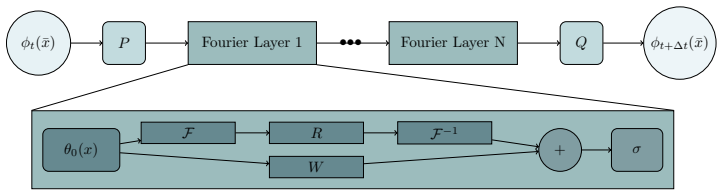
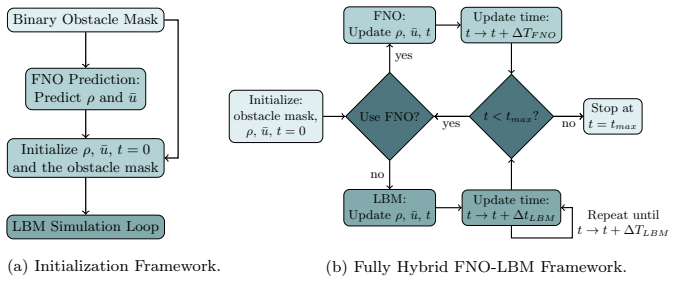
The hybrid coupling strategy that uses FNO predictions either for initialization of steady-state LBM runs or for embedded super-time-stepping rollouts during unsteady LBM evolution.
If this is right
- Porous media flow simulations reach their steady states substantially faster in all macroscopic quantities while ending at the same accurate solution.
- Long-horizon unsteady flow trajectories show markedly lower error accumulation when the hybrid insertion of FNO predictions is used compared with pure LBM or pure FNO.
- A lightweight neural operator achieves nearly the same predictive quality as a much larger operator when operated inside the hybrid scheme.
- The overall computational cost decreases because fewer LBM steps are needed to reach the desired accuracy level.
Where Pith is reading between the lines
- This hybrid idea could be tested with other neural operator architectures or other fluid solvers to see if the stabilization effect is general.
- Applying the method to three-dimensional porous media or flows with higher Reynolds numbers would test how far the training data generalizes.
- If the conservation properties remain intact, the approach might allow faster design iterations in applications such as porous filter optimization.
Load-bearing premise
The Fourier Neural Operator, after training on a limited set of flows, must produce outputs that remain compatible with the lattice Boltzmann update rules without generating non-physical artifacts or breaking long-term stability.
What would settle it
Running the hybrid method on a new unsteady flow trajectory for thousands of time steps and observing a drift in total mass or momentum beyond the level seen in pure lattice Boltzmann would falsify the claim of preserved physical consistency.
Figures



read the original abstract
We propose an accelerated computational fluid dynamics framework based on a hybrid Fourier Neural Operator-Lattice Boltzmann Method (FNO-LBM) for steady and unsteady weakly compressible flows. FNO-based initialization significantly accelerates LBM in reaching steady-states of porous media flows across all macroscopic fields, achieving up to 70% speed-up in convergence of density and more than 40% of pressure-drop while preserving the final steady-state accuracy. Simulations of unsteady flows can be accelerated by hybrid coupling strategies that employ FNO rollouts embedded into LBM time advancement in a way of super-time-stepping. Global and time-resolved error metrics across 100 trajectories for generic 2D flows demonstrate that hybridization consistently improves accuracy and stabilizes long-horizon rollouts. Best efficiency is achieved for a lightweight 2.6M-parameter FNO, which diverges under pure autoregressive rollout but achieves 96-99.8% error reduction under hybrid coupling, matching the predictive capability of a much more expensive 11.2M-parameter model. The hybrid framework enhances predictive fidelity, suppresses error accumulation, and enables small and cheap surrogate models to operate effectively within the same error regime as larger surrogates. These results demonstrate that hybrid neural-operator coupling achieves robust and computationally efficient accelerated LBM while maintaining physically consistent flow evolution.
Editorial analysis
A structured set of objections, weighed in public.
Referee Report
Summary. The manuscript proposes a hybrid Fourier Neural Operator-Lattice Boltzmann Method (FNO-LBM) framework for accelerating steady and unsteady weakly compressible flow simulations. FNO-based initialization is claimed to speed up LBM convergence to steady states in porous media flows, achieving up to 70% speed-up in density convergence and over 40% in pressure-drop while preserving final accuracy. For unsteady flows, FNO rollouts are embedded into LBM time advancement via super-time-stepping, yielding 96-99.8% error reduction on 100 trajectories with a lightweight 2.6M-parameter FNO (which diverges in pure autoregressive rollout) that matches the performance of an 11.2M-parameter model. The hybrid approach is presented as enhancing predictive fidelity, suppressing error accumulation, and enabling physically consistent accelerated evolution.
Significance. If the central claims hold, the work offers a practical route to accelerate LBM-based CFD by leveraging neural operators for initialization and super-time-stepping while retaining the underlying physics solver's stability. The result that a small FNO can match a much larger one under hybrid coupling is noteworthy and could lower barriers to using surrogate models in production simulations of porous media and unsteady flows. Credit is due for the multi-field validation (density, pressure, velocity) and the explicit contrast between pure FNO divergence and hybrid stabilization. The significance would be strengthened by explicit verification that the hybrid operator preserves the conservation structure that defines LBM attractors.
major comments (2)
- [Abstract and hybrid coupling description] Abstract and hybrid coupling section: The abstract reports quantitative speed-ups (70% density convergence, 40% pressure-drop) and 96-99.8% error reduction, yet the description of embedding FNO rollouts as super-time-steps provides no indication of a subsequent correction or projection step that restores the locally conserved moments (mass and momentum) after each FNO prediction. Because LBM collision and streaming steps are constructed to enforce these conservations exactly, the absence of such a step risks secular drift in complex geometries even when pointwise errors appear small; this directly bears on the claim of 'physically consistent flow evolution'.
- [Results section on unsteady flows] Results on unsteady flows (100 trajectories): Global and time-resolved error metrics are shown, but no diagnostics are reported for global conservation residuals (e.g., integrated mass or momentum deviation relative to pure LBM over the full horizon) or for boundary-flux consistency. Such checks are required to confirm that the hybrid trajectory reaches the same physical attractor as pure LBM, particularly on horizons where the 2.6M-parameter FNO alone diverges.
minor comments (2)
- [Methods] Training data details, exact definitions of the reported error norms, and the precise baseline (pure LBM wall-clock time versus hybrid) should be expanded in the methods section to support the quantitative claims.
- [Figures] Figure captions and legends should explicitly distinguish hybrid, pure LBM, and pure FNO curves and state the number of independent runs or trajectories used for each metric.
Simulated Author's Rebuttal
We thank the referee for their thorough review and valuable suggestions, which have helped us improve the clarity and rigor of our manuscript. We address each of the major comments below and have made revisions to incorporate the requested clarifications and additional diagnostics.
read point-by-point responses
-
Referee: [Abstract and hybrid coupling description] Abstract and hybrid coupling section: The abstract reports quantitative speed-ups (70% density convergence, 40% pressure-drop) and 96-99.8% error reduction, yet the description of embedding FNO rollouts as super-time-steps provides no indication of a subsequent correction or projection step that restores the locally conserved moments (mass and momentum) after each FNO prediction. Because LBM collision and streaming steps are constructed to enforce these conservations exactly, the absence of such a step risks secular drift in complex geometries even when pointwise errors appear small; this directly bears on the claim of 'physically consistent flow evolution'.
Authors: We appreciate the referee pointing out the need for explicit description of how conservation is maintained in the hybrid coupling. In the original manuscript, the embedding of FNO rollouts as super-time-steps was described at a high level, but the subsequent correction step to restore the conserved moments was not detailed. This step is indeed present in our implementation: after the FNO predicts the macroscopic fields over the super-time-step, we recompute the distribution functions using the LBM equilibrium based on the corrected moments to ensure exact local conservation of mass and momentum before resuming the standard LBM collision and streaming. We have revised the hybrid coupling section to include this description, along with the relevant equations for the projection. This ensures the hybrid evolution remains consistent with the LBM attractors and mitigates the risk of secular drift. We believe this revision strengthens the claim of physically consistent flow evolution. revision: yes
-
Referee: [Results section on unsteady flows] Results on unsteady flows (100 trajectories): Global and time-resolved error metrics are shown, but no diagnostics are reported for global conservation residuals (e.g., integrated mass or momentum deviation relative to pure LBM over the full horizon) or for boundary-flux consistency. Such checks are required to confirm that the hybrid trajectory reaches the same physical attractor as pure LBM, particularly on horizons where the 2.6M-parameter FNO alone diverges.
Authors: We agree that reporting conservation residuals is essential to substantiate the physical consistency, especially given that the small FNO diverges in pure rollout. In the revised version, we have added new analysis in the unsteady flows results section, including plots of the time evolution of global mass and momentum conservation errors (integrated deviations from the pure LBM reference) for representative trajectories. We also report boundary flux consistency metrics for the porous media simulations. These diagnostics show that the hybrid method maintains conservation residuals at levels comparable to pure LBM (on the order of machine precision for mass and small numerical errors for momentum), confirming that the trajectories converge to the same physical attractor. This addition directly addresses the referee's concern and provides the requested verification. revision: yes
Circularity Check
No circularity: empirical hybrid validation on independent trajectories
full rationale
The paper introduces a hybrid FNO-LBM algorithm for accelerating steady and unsteady flows, reporting speed-ups and error reductions (up to 70% convergence acceleration, 96-99.8% error reduction) measured on 100 held-out trajectories. These are direct empirical outcomes of running the coupled solver versus pure LBM or pure FNO; no derivation chain, equation, or fitted parameter is redefined or renamed to produce the reported metrics by construction. No self-citations are invoked as load-bearing uniqueness theorems or ansatzes. The framework is self-contained against external benchmarks (LBM conservation properties and trajectory accuracy), satisfying the default expectation of non-circularity.
Axiom & Free-Parameter Ledger
free parameters (1)
- FNO parameter count (2.6M vs 11.2M)
axioms (2)
- domain assumption LBM accurately models weakly compressible flows on the chosen lattice
- domain assumption FNO can be trained to produce rollouts that remain compatible with LBM conservation laws when inserted at super-time-step intervals
Reference graph
Works this paper leans on
-
[1]
doi: 10.1007/978-3-319-44649-3
T. Krüger, H. Kusumaatmaja, A. K. O. Shardt, G. Silva, E. M. Viggen, Lattice Boltzmann Method: Principles and Practice, Springer Interna- tional Publishing, 2017. doi:10.1007/978-3-319-44649-3. 20 Table A.5: Porous Media Flow Simulation Parameters Boundary Conditions Physical Parameters LBM Algorithm Inlet: Fixed InflowU ∞ = 0.5 m s Single Precision Sides...
-
[2]
Caron, P
C. Caron, P. Lauret, A. Bastide, Machine learning to speed up compu- tational fluid dynamics engineering simulations for built environments: A review, Building and Environment 267 (2025) 112229
2025
-
[3]
Greenfeld, M
D. Greenfeld, M. Galun, R. Basri, I. Yavneh, R. Kimmel, Learning to optimize multigrid pde solvers, in: International Conference on Machine Learning, PMLR, 2019, pp. 2415–2423
2019
- [4]
-
[5]
M. Raissi, P. Perdikaris, G. Karniadakis, Physics-informed neu- ral networks: A deep learning framework for solving forward and inverse problems involving nonlinear partial differential equa- tions, Journal of Computational Physics 378 (2019) 686–707. doi:https://doi.org/10.1016/j.jcp.2018.10.045
-
[6]
Kochkov, J
D. Kochkov, J. A. Smith, A. Alieva, Q. Wang, M. P. Brenner, S. Hoyer, Machine learning–accelerated computational fluid dynamics, Proceed- ings of the National Academy of Sciences 118 (21) (2021) e2101784118. 23
2021
-
[8]
Z.Li, N.Kovachki, K.Azizzadenesheli, B.Liu, K.Bhattacharya, A.Stu- art, A. Anandkumar, Neural operator: Graph kernel network for partial differential equations (2020). arXiv:2003.03485
-
[9]
Hyperparameter Estimation in Bayesian MAP Estimation: Parameterizations and Consistency
K. Bhattacharya, B. Hosseini, N. B. Kovachki, A. M. Stuart, Model Re- duction And Neural Networks For Parametric PDEs, The SMAI Jour- nal of computational mathematics 7 (2021) 121–157. doi:10.5802/smai- jcm.74
-
[10]
L. Lu, P. Jin, G. Pang, Z. Zhang, G. E. Karniadakis, Learning nonlin- ear operators via deeponet based on the universal approximation the- orem of operators, Nature Machine Intelligence 3 (3) (2021) 218–229. doi:10.1038/s42256-021-00302-5
-
[11]
R. G. Patel, N. A. Trask, M. A. Wood, E. C. Cyr, A physics-informed operator regression framework for extracting data-driven continuum models, Computer Methods in Applied Mechanics and Engineering 373 (2021) 113500. doi:https://doi.org/10.1016/j.cma.2020.113500
- [12]
- [13]
-
[14]
Bonev, T
B. Bonev, T. Kurth, C. Hundt, J. Pathak, M. Baust, K. Kashinath, A. Anandkumar, Spherical Fourier neural operators: Learning stable dynamics on the sphere, in: A. Krause, E. Brunskill, K. Cho, B. En- gelhardt, S. Sabato, J. Scarlett (Eds.), Proceedings of the 40th Inter- national Conference on Machine Learning, Vol. 202 of Proceedings of Machine Learning ...
2023
-
[15]
Z. You, Z. Xu, W. Cai, Mscalefno: Multi-scale fourier neu- ral operator learning for oscillatory functions and wave scatter- ing problems, Journal of Computational Physics 547 (2026) 114530. doi:https://doi.org/10.1016/j.jcp.2025.114530
-
[16]
A. Choubineh, J. Chen, D. A. Wood, F. Coenen, F. Ma, Fourier neural operatorforfluidflowinsmall-shape2dsimulatedporousmediadataset, Algorithms 16 (1) (2023). doi:10.3390/a16010024
-
[17]
F. Lehmann, F. Gatti, D. Clouteau, Multiple-input fourier neural operator (mifno) for source-dependent 3d elastody- namics, Journal of Computational Physics 527 (2025) 113813. doi:https://doi.org/10.1016/j.jcp.2025.113813
-
[18]
Q. Guo, Y. He, M. Liu, Y. Zhao, Y. Liu, J. Luo, Reduced geostatistical approach with a fourier neural operator surrogate model for inverse modeling of hydraulic tomography, Water Resources Research 60 (6) (2024). doi:https://doi.org/10.1029/2023WR034939
-
[19]
N. Margenberg, F. X. Kärtner, M. Bause, Optimal dirichlet boundary control by fourier neural operators applied to nonlin- 25 ear optics, Journal of Computational Physics 499 (2024) 112725. doi:https://doi.org/10.1016/j.jcp.2023.112725
-
[20]
V. Gopakumar, S. Pamela, L. Zanisi, Z. Li, A. Gray, D. Brennand, N.Bhatia, G.Stathopoulos, M.Kusner, M.PeterDeisenroth, A.Anand- kumar, the JOREK Team, M. Team, Plasma surrogate modelling us- ing fourier neural operators, Nuclear Fusion 64 (5) (2024) 056025. doi:10.1088/1741-4326/ad313a
-
[21]
A. Rabbani, M. Babaei, Hybrid pore-network and lattice- boltzmann permeability modelling accelerated by machine learning, Advances in Water Resources 126 (2019) 116–128. doi:https://doi.org/10.1016/j.advwatres.2019.02.012
-
[22]
Nonlinear Var
T.Zhang, H.Xiao, D.Ghosh, Physics-informedfourierneuraloperators: A machine learning method for parametric partial differential equations, J. Nonlinear Var. Anal. 9 (2025) 45–64
2025
-
[23]
P. Fischer, S. Kaltenbach, S. Litvinov, S. Succi, P. Koumoutsakos, Opti- mal lattice boltzmann closures through multi-agent reinforcement learn- ing (2025). arXiv:2504.14422. URLhttps://arxiv.org/abs/2504.14422
- [24]
-
[25]
P. Sousa, C. V. Rodrigues, A. Afonso, Enhancing cfd solver with machine learning techniques, Computer Meth- 26 ods in Applied Mechanics and Engineering 429 (2024) 117133. doi:https://doi.org/10.1016/j.cma.2024.117133
-
[26]
DeepONet based preconditioning strategies for solving parametric linear systems of equations
A. Kopaničáková, G. E. Karniadakis, Deeponet based pre- conditioning strategies for solving parametric linear systems of equations, SIAM Journal on Scientific Computing 47 (1) (2025) C151–C181. arXiv:https://doi.org/10.1137/24M162861X, doi:10.1137/24M162861X. URLhttps://doi.org/10.1137/24M162861X
-
[27]
J. M. Winter, D. Wawrzyniak, S. J. Schmidt, T. Indinger, C. F. Janßen, U. Schramm, N. A. Adams, A fully-differentiable lattice-boltzmann solver for integrated machine-learning simulation workflows, Conference contribution at GTC 24, San José (2024). URLhttps://www.nvidia.com/en-us/on-demand/session/gtc24 -s62237/
2024
-
[28]
S. Chen, G. D. Doolen, Lattice boltzmann method for fluid flows, An- nual Review of Fluid Mechanics 30 (Volume 30, 1998) (1998) 329–364. doi:https://doi.org/10.1146/annurev.fluid.30.1.329
-
[29]
Succi, The Lattice Boltzmann Equation: For Fluid Dynamics and Beyond, Oxford University Press, Oxford, 2001
S. Succi, The Lattice Boltzmann Equation: For Fluid Dynamics and Beyond, Oxford University Press, Oxford, 2001
2001
-
[30]
P. Lallemand, L.-S. Luo, M. Krafczyk, W.-A. Yong, The lattice boltzmann method for nearly incompressible flows, Journal of Computational Physics 431 (2021) 109713. doi:https://doi.org/10.1016/j.jcp.2020.109713
-
[31]
Fourier Neural Operator for Parametric Partial Differential Equations
Z.Li, N.Kovachki, K.Azizzadenesheli, B.Liu, K.Bhattacharya, A.Stu- 27 art, A. Anandkumar, Fourier neural operator for parametric partial dif- ferential equations (2021). arXiv:2010.08895. URLhttps://arxiv.org/abs/2010.08895
work page internal anchor Pith review arXiv 2021
- [32]
-
[33]
Contributors, Nvidia physicsnemo: An open-source framework for physics-based deep learning in science and engineering (2023-02-24)
P. Contributors, Nvidia physicsnemo: An open-source framework for physics-based deep learning in science and engineering (2023-02-24). URLhttps://github.com/NVIDIA/physicsnemo
2023
-
[34]
Espinoza-Andaluz, A
M. Espinoza-Andaluz, A. Moyón, M. Andersson, A comparative study between d2q9 and d2q5 lattice boltzmann scheme for mass transport phenomena in porous media, Computers & Mathematics with Applica- tions 78 (9) (2019) 2886–2896
2019
-
[35]
A. D’Orazio, A. Karimipour, R. Ranjbarzadeh, Lattice boltzmann mod- elling of fluid flow through porous media: A comparison between pore-structure and representative elementary volume methods, Ener- gies 16 (14) (2023). doi:10.3390/en16145354. 28
discussion (0)
Sign in with ORCID, Apple, or X to comment. Anyone can read and Pith papers without signing in.