Recognition: unknown
X-Ray Diagnostics Analysis Verification and Exploration (xDAVE) Code for the Prediction and Interpretation of X-Ray Thomson Scattering Experiments
Pith reviewed 2026-05-07 10:17 UTC · model grok-4.3
The pith
The xDAVE code provides fast Chihara-based modeling of dynamic structure factors to interpret X-ray Thomson scattering spectra from warm dense matter.
A machine-rendered reading of the paper's core claim, the machinery that carries it, and where it could break.
Core claim
The xDAVE code is designed to estimate dynamic structure factors quickly via the Chihara decomposition and to analyze experimental X-ray Thomson scattering spectra by convolving those factors with the source-instrument function. Validation is performed by re-processing an OMEGA experiment on isochorically heated beryllium. The code is also demonstrated in combination with ray-tracing for experiment planning, and the authors show that energy-dependent instrument functions must be accounted for when modeling spectra from highly compressed beryllium at the National Ignition Facility.
What carries the argument
The Chihara decomposition, which splits the dynamic structure factor into separate contributions from bound and free electrons to enable rapid calculations suitable for large-scale parameter fitting.
If this is right
- Experimental teams can obtain plasma density, temperature, and charge-state estimates more rapidly from XRTS data.
- Coupling xDAVE to ray-tracing codes allows quantitative prediction of scattering signals before shots are taken.
- Accounting for energy-dependent spectrometer responses reduces systematic error in the analysis of high-compression data.
- The same workflow can be applied to other light elements and facilities once the underlying decomposition is accepted.
Where Pith is reading between the lines
- If Chihara proves insufficient for heavier elements, xDAVE could serve as a fast front-end to more advanced structure-factor calculations.
- Real-time integration of xDAVE into facility control rooms could enable on-the-fly experiment adjustments during a campaign.
- The code's emphasis on instrument-function energy dependence suggests similar corrections may be needed for other spectroscopy diagnostics in dense plasmas.
Load-bearing premise
The Chihara decomposition supplies a sufficiently accurate model of the dynamic structure factor under the warm dense matter conditions and for the materials tested in the validation experiments.
What would settle it
A new X-ray Thomson scattering measurement on beryllium or a similar material in which the plasma parameters recovered by xDAVE differ substantially from independent density or temperature diagnostics would show the model or code to be inadequate.
Figures

read the original abstract
X-ray Thomson scattering (XRTS) is a common diagnostic used in the warm dense matter (WDM) regime to estimate plasma parameters like density, temperature and charge state. Experimental analysis typically relies on a forward model to obtain estimates for these parameters, as the measured spectrum is a convolution of the dynamic structure factor (DSF) and the source-instrument function. The Chihara decomposition, where the spectrum is separated into contributions from bound and free electrons, is commonly used to estimate DSFs in the WDM regime, as it allows for the fast calculation of DSFs and therefore can easily be applied in a large-scale parameter optimization. Due to the limited availability of XRTS codes, in this work we present the ``\textbf{X}-ray \textbf{D}iagnostics, \textbf{A}nalysis, \textbf{V}erification and \textbf{E}xploration`` (\texttt{xDAVE}) code, designed to quickly estimate DSFs using the Chihara decomposition and analyse experimental spectra. The code is validated by re-analysing an experiment with isochorically heated beryllium at the OMEGA Laser Facility. In addition, we demonstrate the applicability of the code to plan experiments and predict scattering spectra through the coupling to a ray-tracing code. Lastly, the importance of accounting for the energy-dependence of spectrometer instrument functions is demonstrated by comparing ray-tracing simulations to the standard convolution for strongly compressed Beryllium shots at the National Ignition Facility similar to previously published results.
Editorial analysis
A structured set of objections, weighed in public.
Referee Report
Summary. The manuscript introduces the xDAVE code, which implements the Chihara decomposition for rapid calculation of dynamic structure factors (DSFs) to forward-model and interpret X-ray Thomson scattering (XRTS) spectra in warm dense matter. The code is validated by re-analyzing an isochorically heated beryllium experiment at the OMEGA Laser Facility, coupled to a ray-tracing code for predicting spectra in experiment planning, and used to demonstrate the importance of energy-dependent spectrometer instrument functions for NIF-like compressed beryllium shots.
Significance. If the implementation is correct and the Chihara model sufficiently accurate for the targeted conditions, xDAVE would provide a practical, accessible tool for the WDM community to perform parameter optimization and experimental design in XRTS diagnostics. The ray-tracing coupling and explicit treatment of instrument function energy dependence are useful practical contributions that address common analysis pitfalls. The significance is reduced, however, by the validation approach, which relies on re-analysis without independent quantitative checks against data or alternative models.
major comments (2)
- [§4] §4 (Validation against OMEGA Be experiment): the re-analysis is presented without quantitative metrics of agreement, such as residual norms, chi-squared values, or shifts in inferred density/temperature/ionization with uncertainties relative to prior analyses. This is load-bearing for the central validation claim, as agreement could reflect shared model assumptions rather than independent fidelity of the xDAVE implementation.
- [§2] §2 (Chihara decomposition implementation): the paper does not quantify or bound the expected error from known Chihara limitations (e.g., neglect of local-field corrections or non-equilibrium effects) for the reported Be densities and temperatures, which directly affects the reliability of both the OMEGA validation and the NIF-like predictions.
minor comments (2)
- [Introduction] The manuscript would benefit from an explicit statement of code availability (repository link, license) and a brief comparison table to other existing XRTS forward-modeling tools.
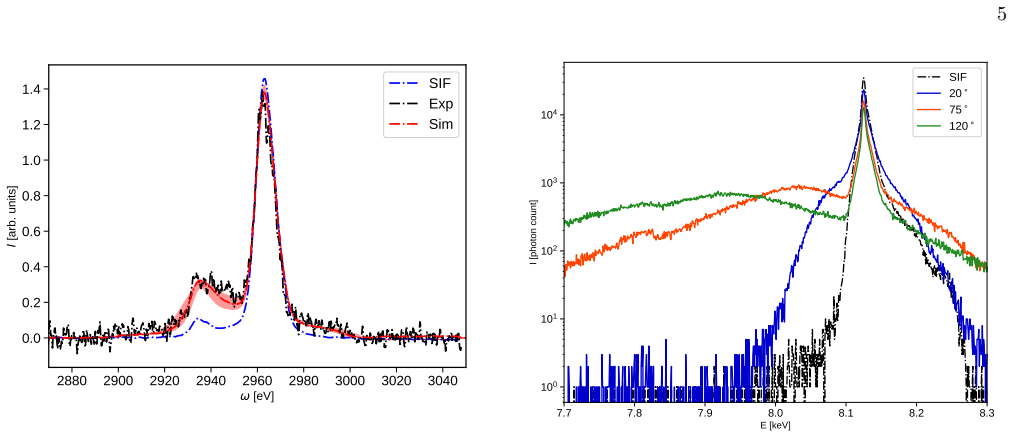
- [Results] Figure captions for the ray-tracing comparisons should include the specific instrument function models and energy ranges used.
Simulated Author's Rebuttal
We thank the referee for their careful and constructive review of our manuscript. The comments have prompted us to strengthen the validation section with quantitative metrics and to expand the discussion of model limitations. We address each major comment below.
read point-by-point responses
-
Referee: [§4] §4 (Validation against OMEGA Be experiment): the re-analysis is presented without quantitative metrics of agreement, such as residual norms, chi-squared values, or shifts in inferred density/temperature/ionization with uncertainties relative to prior analyses. This is load-bearing for the central validation claim, as agreement could reflect shared model assumptions rather than independent fidelity of the xDAVE implementation.
Authors: We agree that quantitative metrics are necessary to demonstrate that the agreement is not solely due to shared model assumptions. In the revised manuscript we have added chi-squared values for the fits to the OMEGA beryllium spectra, together with a table comparing the inferred density, temperature and ionization state (with uncertainties) to the values reported in the original experimental analysis. These additions show that the xDAVE results lie within the previously published uncertainties while also quantifying small differences attributable to implementation details. revision: yes
-
Referee: [§2] §2 (Chihara decomposition implementation): the paper does not quantify or bound the expected error from known Chihara limitations (e.g., neglect of local-field corrections or non-equilibrium effects) for the reported Be densities and temperatures, which directly affects the reliability of both the OMEGA validation and the NIF-like predictions.
Authors: The referee is correct that explicit error bounds would improve the assessment of reliability. We have added a new paragraph in §2 that cites literature comparisons of the Chihara model against more advanced calculations (including local-field corrections) for beryllium at the relevant densities (∼1–5 g cm⁻³) and temperatures (∼10–50 eV). The added text states that the neglected corrections typically alter the DSF by ≲10 % in this regime and discusses the local thermodynamic equilibrium assumption, thereby bounding the impact on both the validation and the NIF-like predictions. revision: yes
Circularity Check
No significant circularity: xDAVE implements established Chihara DSF model with external validation
full rationale
The paper describes a forward-modeling code that applies the pre-existing Chihara decomposition (bound + free electron contributions) to compute dynamic structure factors for XRTS analysis. Validation consists of re-processing a published OMEGA beryllium experiment and comparing to prior results, without introducing new fitted parameters that are then renamed as predictions. No self-definitional equations, load-bearing self-citations, or ansatzes smuggled via prior author work appear in the abstract or described workflow. The derivation chain is therefore self-contained against the standard physical model rather than reducing to its own inputs by construction.
Axiom & Free-Parameter Ledger
axioms (1)
- domain assumption The Chihara decomposition accurately separates bound and free electron contributions to the dynamic structure factor in the WDM regime.
Reference graph
Works this paper leans on
-
[1]
Vorberger, F
J. Vorberger, F. Graziani, D. Riley, A. D. Baczewski, I. Baraffe, M. Bethkenhagen, S. Blouin, M. P. B¨ ohme, M. Bonitz, M. Bussmann, A. Casner, W. Cayzac, P. Cel- liers, G. Chabrier, N. Chamel, D. Chapman, M. Chen, J. Cl´ erouin, G. Collins, F. Coppari, T. D¨ oppner, T. Dorn- heim, L. B. Fletcher, D. O. Gericke, S. Glenzer, A. F. Goncharov, G. Gregori, S....
2025
-
[2]
Militzer, W
B. Militzer, W. B. Hubbard, J. Vorberger, I. Tamblyn, and S. A. Bonev, A massive core in jupiter predicted from first-principles simulations, The Astrophysical Jour- nal688, L45 (2008)
2008
-
[3]
Militzer, F
B. Militzer, F. Soubiran, S. M. Wahl, and W. Hubbard, Understanding jupiter’s interior, Journal of Geophysical Research: Planets121, 1552 (2016)
2016
-
[4]
Kraus, A
D. Kraus, A. Ravasio, M. Gauthier, D. O. Gericke, J. Vor- berger, S. Frydrych, J. Helfrich, L. B. Fletcher, G. Schau- mann, B. Nagler, B. Barbrel, B. Bachmann, E. J. Gam- boa, S. G¨ ode, E. Granados, G. Gregori, H. J. Lee, P. Neu- mayer, W. Schumaker, T. D¨ oppner, R. W. Falcone, S. H. Glenzer, and M. Roth, Nanosecond formation of diamond and lonsdaleite ...
2016
-
[5]
Kraus, J
D. Kraus, J. Vorberger, A. Pak, N. J. Hartley, L. B. Fletcher, S. Frydrych, E. Galtier, E. J. Gamboa, D. O. Gericke, S. H. Glenzer, E. Granados, M. J. MacDonald, A. J. MacKinnon, E. E. McBride, I. Nam, P. Neumayer, M. Roth, A. M. Saunders, A. K. Schuster, P. Sun, T. van Driel, T. D¨ oppner, and R. W. Falcone, Formation of di- amonds in laser-compressed hy...
2017
-
[6]
L. J. Conway, C. J. Pickard, and A. Hermann, Rules of formation of h–c–n–o compounds at high pressure and the fates of planetary ices, Proceedings of the National Academy of Sciences118, 10.1073/pnas.2026360118 (2021)
-
[7]
S. X. Hu, B. Militzer, V. N. Goncharov, and S. Skupsky, First-principles equation-of-state table of deuterium for inertial confinement fusion applications, Phys. Rev. B84, 224109 (2011)
2011
-
[8]
A. L. Kritcher, T. D¨ oppner, C. Fortmann, T. Ma, O. L. Landen, R. Wallace, and S. H. Glenzer, In-flight measure- ments of capsule shell adiabats in laser-driven implosions, Physical Review Letters107, 015002 (2011)
2011
-
[9]
Fletcher, A
L. Fletcher, A. L. Kritcher, A. Pak, T. Ma, T. D¨ oppner, C. Fortmann, L. Divol, O. S. Jones, O. L. Landen, H. A. Scott, J. Vorberger, D. A. Chapman, D. O. Gericke, B. A. Mattern, G. T. Seidler, G. Gregori, R. W. Falcone, and S. H. Glenzer, Observations of continuum depression in warm dense matter with x-ray thomson scattering, Phys- ical Review Letters11...
2014
-
[10]
A. L. Kritcher, C. V. Young, H. F. Robey, C. R. We- ber, A. B. Zylstra, O. A. Hurricane, D. A. Callahan, J. E. Ralph, J. S. Ross, K. L. Baker, D. T. Casey, D. S. Clark, T. D¨ oppner, L. Divol, M. Hohenberger, L. B. Hop- kins, S. L. Pape, N. B. Meezan, A. Pak, P. K. Patel, R. Tommasini, S. J. Ali, P. A. Amendt, L. J. Atherton, B. Bachmann, D. Bailey, L. R....
2022
-
[11]
M. M. Marinak, G. B. Zimmerman, T. Chapman, G. D. Kerbel, M. V. Patel, J. M. Koning, S. M. Sepke, B. Chang, C. R. Schroeder, J. A. Harte, D. S. Bailey, L. A. Taylor, S. H. Langer, M. A. Belyaev, D. S. Clark, J. Gaffney, B. A. Hammel, D. E. Hinkel, A. L. Kritcher, J. L. Milovich, H. F. Robey, and C. R. Weber, How nu- merical simulations helped to achieve b...
2024
-
[12]
S. H. Glenzer and R. Redmer, X-ray thomson scattering in high energy density plasmas, Rev. Mod. Phys81, 1625 (2009). 11
2009
-
[13]
Voigt, M
K. Voigt, M. Zhang, K. Ramakrishna, A. Amouretti, K. Appel, E. Brambrink, V. Cerantola, D. Chekrygina, T. D¨ oppner, R. W. Falcone, K. Falk, L. B. Fletcher, D. O. Gericke, S. G¨ ode, M. Harmand, N. J. Hartley, S. P. Hau-Riege, L. G. Huang, O. S. Humphries, M. Loka- mani, M. Makita, A. Pelka, C. Prescher, A. K. Schuster, M. ˇSm´ ıd, T. Toncian, J. Vorberge...
2021
-
[14]
D. S. Bespalov, U. Zastrau, Z. A. Moldabekov, T. Gawne, T. Dornheim, M. Meshhal, A. Amouretti, M. Andrze- jewski, K. Appel, C. Baehtz, E. Brambrink, K. Buakor, C. Camarda, D. Chin, G. Collins, C. Cr´ epeisson, A. Descamps, J. Eggert, L. Fletcher, A. Forte, G. Gre- gori, M. Harmand, O. S. Humphries, H. H¨ oppner, J. Kuh- lke, W. Lynn, J. L¨ utgert, M. Masr...
work page internal anchor Pith review arXiv 2026
-
[15]
Kraus, B
D. Kraus, B. Bachmann, B. Barbrel, R. W. Falcone, L. B. Fletcher, S. Frydrych, E. J. Gamboa, M. Gauthier, D. O. Gericke, S. H. Glenzer, S. G¨ ode, E. Granados, N. J. Hart- ley, J. Helfrich, H. J. Lee, B. Nagler, A. Ravasio, W. Schu- maker, J. Vorberger, and T. D¨ oppner, Characterizing the ionization potential depression in dense carbon plasmas with high-...
2019
-
[16]
Sperling, E
P. Sperling, E. J. Gamboa, H. J. Lee, H. K. Chung, E. Galtier, Y. Omarbakiyeva, H. Reinholz, G. R¨ opke, U. Zastrau, J. Hastings, L. B. Fletcher, and S. H. Glen- zer, Free-electron x-ray laser measurements of collisional- damped plasmons in isochorically heated warm dense matter, Phys. Rev. Lett.115, 115001 (2015)
2015
-
[17]
W. M. Martin, J. Nilsen, L. B. Fletcher, M. J. MacDon- ald, L. Andersen, A. Arnott, H. Bellenbaum, M. B¨ ohme, N. Boiadjieva, N. Czapla, T. E. Cowan, T. D¨ oppner, G. Dyer, R. N. Ettelbrick, R. Falcone, S. Faubel, E. Galtier, A. Laso Garcia, T. Gawne, L. Hancock, P. Hart, N. J. Hartley, M. L. Herbert, X. Huang, G. Jain, K. D. Kabelitz, D. Khaghani, D. Kra...
-
[18]
A. L. Kritcher, D. C. Swift, T. D¨ oppner, B. Bachmann, L. X. Benedict, G. W. Collins, J. L. DuBois, F. El- sner, G. Fontaine, J. A. Gaffney, S. Hamel, A. Lazicki, W. R. Johnson, N. Kostinski, D. Kraus, M. J. MacDon- ald, B. Maddox, M. E. Martin, P. Neumayer, A. Nikroo, J. Nilsen, B. A. Remington, D. Saumon, P. A. Sterne, W. Sweet, A. A. Correa, H. D. Whi...
2020
-
[19]
D¨ oppner, M
T. D¨ oppner, M. Bethkenhagen, D. Kraus, P. Neumayer, D. A. Chapman, B. Bachmann, R. A. Baggott, M. P. B¨ ohme, L. Divol, R. W. Falcone, L. B. Fletcher, O. L. Landen, M. J. MacDonald, A. M. Saunders, M. Sch¨ orner, P. A. Sterne, J. Vorberger, B. B. L. Witte, A. Yi, R. Red- mer, S. H. Glenzer, and D. O. Gericke, Observing the on- set of pressure-driven k-s...
2023
-
[20]
Boehly, D
T. Boehly, D. Brown, R. Craxton, R. Keck, J. Knauer, J. Kelly, T. Kessler, S. Kumpan, S. Loucks, S. Letzring, F. Marshall, R. McCrory, S. Morse, W. Seka, J. Soures, and C. Verdon, Initial performance results of the omega laser system, Optics Communications133, 495 (1997)
1997
-
[21]
J. S. Ross, D. H. Froula, A. J. Mackinnon, C. Sorce, N. Meezan, S. H. Glenzer, W. Armstrong, R. Bahr, R. Huff, and K. Thorp, Implementation of imaging thom- son scattering on the omega laser, Review of Scientific Instruments77, 10.1063/1.2220077 (2006)
-
[22]
L. B. Fletcher, A. Kritcher, A. Pak, T. Ma, T. D¨ oppner, C. Fortmann, L. Divol, O. L. Landen, J. Vorberger, D. A. Chapman, D. O. Gericke, R. W. Falcone, and S. H. Glenzer, X-ray thomson scattering measurements of tem- perature and density from multi-shocked CH capsules, Physics of Plasmas20, 10.1063/1.4807032 (2013)
-
[23]
Poole, M
H. Poole, M. K. Ginnane, M. Millot, H. M. Bellenbaum, G. W. Collins, S. X. Hu, D. Polsin, R. Saha, J. Topp- Mugglestone, T. G. White, D. A. Chapman, J. R. Rygg, S. P. Regan, and G. Gregori, Multimessenger measure- ments of the static structure of shock-compressed liquid silicon at 100 gpa, Physical Review Research6, 023144 (2024)
2024
-
[24]
Kremp, M
D. Kremp, M. Schlanges, and T. Bornath,Quan- tum Statistics of Nonideal Plasmas, Springer Series on Atomic, Optical, and Plasma Physics (Springer, 2005)
2005
-
[25]
Dornheim, Z
T. Dornheim, Z. A. Moldabekov, K. Ramakrishna, P. To- lias, A. D. Baczewski, D. Kraus, T. R. Preston, D. A. Chapman, M. P. B¨ ohme, T. D¨ oppner, F. Graziani, M. Bonitz, A. Cangi, and J. Vorberger, Electronic den- sity response of warm dense matter, Phys. Plasmas30, 032705 (2023)
2023
-
[26]
L. B. Fletcher, J. Vorberger, W. Schumaker, C. Ruyer, S. Goede, E. Galtier, U. Zastrau, E. P. Alves, S. D. Baal- rud, R. A. Baggott, B. Barbrel, Z. Chen, T. D¨ oppner, M. Gauthier, E. Granados, J. B. Kim, D. Kraus, H. J. Lee, M. J. MacDonald, R. Mishra, A. Pelka, A. Rava- sio, C. Roedel, A. R. Fry, R. Redmer, F. Fiuza, D. O. Gericke, and S. H. Glenzer, El...
-
[27]
T. Gawne, H. Bellenbaum, L. B. Fletcher, K. Appel, C. Baehtz, V. Bouffetier, E. Brambrink, D. Brown, A. Cangi, A. Descamps, S. Goede, N. J. Hartley, M.-L. Herbert, P. Hesselbach, H. H¨ oppner, O. S. Humphries, Z. Konˆ opkov´ a, A. Laso Garcia, B. Lindqvist, J. L¨ utgert, M. J. MacDonald, M. Makita, W. Martin, M. Mishchenko, Z. A. Moldabekov, M. Nakatsutsu...
-
[28]
M. F. Kasim, T. P. Galligan, J. Topp-Mugglestone, G. Gregori, and S. M. Vinko, Inverse problem instabilities in large-scale modeling of matter in extreme conditions, Phys. Plasmas26, 112706 (2019)
2019
-
[29]
Bonitz, T
M. Bonitz, T. Dornheim, Z. A. Moldabekov, S. Zhang, P. Hamann, H. K¨ ahlert, A. Filinov, K. Ramakrishna, and J. Vorberger, Ab initio simulation of warm dense matter, Phys. Plasmas27, 042710 (2020)
2020
-
[30]
Model-free Rayleigh weight from x-ray Thomson scattering measurements
T. Dornheim, H. M. Bellenbaum, M. Bethkenhagen, S. B. Hansen, M. P. B¨ ohme, T. D¨ oppner, L. B. Fletcher, T. Gawne, D. O. Gericke, S. Hamel, D. Kraus, M. J. MacDonald, Z. A. Moldabekov, T. R. Preston, R. Red- mer, M. Sch¨ orner, S. Schwalbe, P. Tolias, and J. Vor- berger, Model-free rayleigh weight from x-ray thom- son scattering measurements, Physics of...
-
[31]
T. Dornheim, T. D¨ oppner, P. Tolias, M. P. B¨ ohme, L. B. Fletcher, T. Gawne, F. R. Graziani, D. Kraus, M. J. Mac- Donald, Z. A. Moldabekov, S. Schwalbe, D. O. Gericke, and J. Vorberger, Unraveling electronic correlations in warm dense quantum plasmas, Nature Communications 16, 10.1038/s41467-025-60278-3 (2025)
-
[32]
A. D. Baczewski, L. Shulenburger, M. P. Desjarlais, S. B. Hansen, and R. J. Magyar, X-ray thomson scattering in warm dense matter without the chihara decomposition, Phys. Rev. Lett116, 115004 (2016)
2016
-
[33]
Sch¨ orner, M
M. Sch¨ orner, M. Bethkenhagen, T. D¨ oppner, D. Kraus, L. B. Fletcher, S. H. Glenzer, and R. Redmer, X-ray thomson scattering spectra from density functional the- ory molecular dynamics simulations based on a modified chihara formula, Phys. Rev. E107, 065207 (2023)
2023
-
[34]
Poole, D
H. Poole, D. Cao, R. Epstein, I. Golovkin, T. Walton, S. X. Hu, M. Kasim, S. M. Vinko, J. R. Rygg, V. N. Goncharov, G. Gregori, and S. P. Regan, A case study of using x-ray thomson scattering to diagnose the in-flight plasma conditions of dt cryogenic implosions, Phys. Plas- mas29, 072703 (2022)
2022
-
[35]
Chihara, Difference in x-ray scattering between metal- lic and non-metallic liquids due to conduction electrons, Journal of Physics F: Metal Physics17, 295 (1987)
J. Chihara, Difference in x-ray scattering between metal- lic and non-metallic liquids due to conduction electrons, Journal of Physics F: Metal Physics17, 295 (1987)
1987
-
[36]
Dornheim, M
T. Dornheim, M. B¨ ohme, D. Kraus, T. D¨ oppner, T. R. Preston, Z. A. Moldabekov, and J. Vorberger, Accurate temperature diagnostics for matter under extreme con- ditions, Nature Communications13, 7911 (2022)
2022
-
[37]
Dornheim, M
T. Dornheim, M. P. B¨ ohme, D. A. Chapman, D. Kraus, T. R. Preston, Z. A. Moldabekov, N. Schl¨ unzen, A. Cangi, T. D¨ oppner, and J. Vorberger, Imaginary- time correlation function thermometry: A new, high- accuracy and model-free temperature analysis technique for x-ray Thomson scattering data, Phys. Plasmas30, 042707 (2023)
2023
-
[38]
H. M. Bellenbaum, M. P. B¨ ohme, M. Bonitz, T. D¨ oppner, L. B. Fletcher, T. Gawne, D. Kraus, Z. A. Moldabekov, S. Schwalbe, J. Vorberger, and T. Dornheim, Estimating ionization states and continuum lowering from ab initio path integral monte carlo simulations for warm dense hy- drogen, Physical Review Research7, 10.1103/9d7r-1xbm (2025)
-
[39]
D¨ oppner, O
T. D¨ oppner, O. Landen, H. Lee, P. Neumayer, S. Regan, and S. Glenzer, Temperature measurement through de- tailed balance in x-ray thomson scattering, High Energy Density Physics5, 182 (2009)
2009
-
[40]
Gawne, A
T. Gawne, A. Kononov, A. Baczewski, H. Bellen- baum, M. P. B¨ ohme, Z. Moldabekov, T. R. Preston, S. Schwalbe, J. Vorberger, and T. Dornheim, Spectral de- convolution without the deconvolution: Extracting tem- perature from x-ray thomson scattering spectra without the source-and-instrument function (2025)
2025
-
[41]
Hansen and I
J. Hansen and I. McDonald,Theory of simple liquids : with applications to soft matter(Academic Press, 2013)
2013
-
[42]
Kubo, The fluctuation-dissipation theorem, Reports on Progress in Physics29, 255 (1966)
R. Kubo, The fluctuation-dissipation theorem, Reports on Progress in Physics29, 255 (1966)
1966
-
[43]
W¨ unsch, P
K. W¨ unsch, P. Hilse, M. Schlanges, and D. O. Gericke, Structure of strongly coupled multicomponent plasmas, Physical Review E77, 056404 (2008)
2008
-
[44]
D. O. Gericke, J. Vorberger, K. W¨ unsch, and G. Gre- gori, Screening of ionic cores in partially ionized plasmas within linear response, Physical Review E81, 065401 (2010)
2010
-
[45]
Pauling and J
L. Pauling and J. Sherman, Screening constants for many-electron atoms. the calculation and interpretation of x-ray term values, and the calculation of atomic scat- tering factors, Zeitschrift f¨ ur Kristallographie - Crys- talline Materials81, 1 (1932)
1932
-
[46]
N. D. Mermin, Lindhard dielectric function in the relaxation-time approximation, Phys. Rev. B1, 2362 (1970)
1970
-
[47]
Bohm and A
D. Bohm and A. D. Pines, Collective description of elec- tron interactions: Ii. collective vs individual particle as- pects of the interactions, Phys. Rev.85, 338 (1952)
1952
-
[48]
Hubbard, Proceedings of the Royal Society of London
J. Hubbard, Proceedings of the Royal Society of London. Series A. Mathematical and Physical Sciences240, 539 (1957)
1957
-
[49]
Fortmann, A
C. Fortmann, A. Wierling, and G. R¨ opke, Influence of local-field corrections on thomson scattering in collision- dominated two-component plasmas, Physical Review E 81, 026405 (2010)
2010
-
[50]
Reinholz, R
H. Reinholz, R. Redmer, G. R¨ opke, and A. Wierling, Long-wavelength limit of the dynamical local-field factor and dynamical conductivity of a two-component plasma, Phys. Rev. E62, 5648 (2000)
2000
-
[51]
Schumacher, F
M. Schumacher, F. Smend, and I. Borchert, Incoherent scattering of gamma rays by inner-shell electrons, Jour- nal of Physics B: Atomic and Molecular Physics8, 1428 (1975), bF-DSF Formulation
1975
-
[52]
M. P. B¨ ohme, L. B. Fletcher, T. D¨ oppner, D. Kraus, A. D. Baczewski, T. R. Preston, M. J. MacDonald, F. R. Graziani, Z. A. Moldabekov, J. Vorberger, and T. Dorn- heim, Evidence of free-bound transitions in warm dense matter and their impact on equation-of-state measure- ments (2023), arXiv:2306.17653 [physics.plasm-ph]
-
[53]
Gregori, S
G. Gregori, S. H. Glenzer, W. Rozmus, R. W. Lee, and O. L. Landen, Theoretical model of x-ray scattering as a dense matter probe, Phys. Rev. E67, 026412 (2003)
2003
-
[54]
Gregori, A
G. Gregori, A. Ravasio, A. H¨ oll, S. Glenzer, and S. Rose, Derivation of the static structure factor in strongly cou- pled non-equilibrium plasmas for x-ray scattering studies, High Energy Density Physics3, 99 (2007)
2007
-
[55]
H. M. Bellenbaum, M. P. B¨ ohme, and T. Gawne, X-ray diagnostics, analysis, verification and exploration code (2026)
2026
-
[56]
C. R. Harris, K. J. Millman, S. J. van der Walt, R. Gom- mers, P. Virtanen, D. Cournapeau, E. Wieser, J. Tay- lor, S. Berg, N. J. Smith, R. Kern, M. Picus, S. Hoyer, M. H. van Kerkwijk, M. Brett, A. Haldane, J. F. del R´ ıo, M. Wiebe, P. Peterson, P. G´ erard-Marchant, K. Shep- 13 pard, T. Reddy, W. Weckesser, H. Abbasi, C. Gohlke, and T. E. Oliphant, Arr...
2020
-
[57]
SciPy Community, Scipy api, version 1.16.2
-
[58]
W¨ unsch,Theory of X-ray Thomson scattering in warm dense matter, phdthesis, University of Warwick (2011)
K. W¨ unsch,Theory of X-ray Thomson scattering in warm dense matter, phdthesis, University of Warwick (2011)
2011
-
[59]
Gawne, S
T. Gawne, S. Schwalbe, T. Chuna, U. H. Acosta, T. R. Preston, and T. Dornheim, Heart: A new x-ray tracing code for mosaic crystal spectrometers, Computer Physics Communications , 109878 (2025)
2025
-
[60]
Newville, R
M. Newville, R. Otten, A. Nelson, T. Stensitzki, A. In- gargiola, D. Allan, A. Fox, F. Carter, and M. Rawlik, Lmfit: Non-linear least-squares minimization and curve- fitting for python (2025)
2025
-
[61]
Foreman-Mackey, D
D. Foreman-Mackey, D. W. Hogg, D. Lang, and J. Good- man, emcee: The mcmc hammer (2012)
2012
-
[62]
Dornheim, Z
T. Dornheim, Z. A. Moldabekov, and P. Tolias, Analyti- cal representation of the local field correction of the uni- form electron gas within the effective static approxima- tion, Phys. Rev. B103, 165102 (2021)
2021
-
[63]
Dornheim, A
T. Dornheim, A. Cangi, K. Ramakrishna, M. B¨ ohme, S. Tanaka, and J. Vorberger, Effective static approxima- tion: A fast and reliable tool for warm-dense matter the- ory, Phys. Rev. Lett.125, 235001 (2020)
2020
-
[64]
Crowley, Continuum lowering – a new perspective, High Energy Density Physics13, 84 (2014)
B. Crowley, Continuum lowering – a new perspective, High Energy Density Physics13, 84 (2014)
2014
-
[65]
D. A. Chapman, J. Vorberger, L. B. Fletcher, R. A. Bag- gott, L. Divol, T. D¨ oppner, R. W. Falcone, S. H. Glen- zer, G. Gregori, T. M. Guymer, A. L. Kritcher, O. L. Landen, T. Ma, A. E. Pak, and D. O. Gericke, Ob- servation of finite-wavelength screening in high-energy- density matter, Nature Communications6, 10.1038/n- comms7839 (2015)
work page doi:10.1038/n- 2015
-
[66]
Kraus, T
D. Kraus, T. D¨ oppner, A. L. Kritcher, A. Yi, K. Boehm, B. Bachmann, L. Divol, L. B. Fletcher, S. H. Glenzer, O. L. Landen, N. Masters, A. M. Saunders, C. Weber, R. W. Falcone, and P. Neumayer, Platform for spectrally resolved x-ray scattering from imploding capsules at the national ignition facility, Journal of Physics: Conference Series717, 012067 (2016)
2016
-
[67]
S. H. Glenzer, O. L. Landen, P. Neumayer, R. W. Lee, K. Widmann, S. W. Pollaine, R. J. Wallace, G. Gre- gori, A. H¨ oll, T. Bornath, R. Thiele, V. Schwarz, W.- D. Kraeft, and R. Redmer, Observations of plasmons in warm dense matter, Phys. Rev. Lett.98, 065002 (2007)
2007
-
[68]
Z. A. Johnson, L. G. Silvestri, G. M. Petrov, L. G. Stanton, and M. S. Murillo, Comparison of trans- port models in dense plasmas, Physics of Plasmas31, 10.1063/5.0204226 (2024)
-
[69]
Zastrau, K
U. Zastrau, K. Appel, C. Baehtz, O. Baehr, L. Batchelor, A. Bergh¨ auser, M. Banjafar, E. Brambrink, V. Cerantola, T. E. Cowan, H. Damker, S. Dietrich, S. Di Dio Cafiso, J. Dreyer, H.-O. Engel, T. Feldmann, S. Findeisen, M. Foese, D. Fulla-Marsa, S. G¨ ode, M. Hassan, J. Hauser, T. Herrmannsd¨ orfer, H. H¨ oppner, J. Kaa, P. Kaever, K. Kn¨ ofel, Z. Konˆ o...
2021
-
[70]
Preston, S
T. Preston, S. G¨ ode, J.-P. Schwinkendorf, K. Appel, E. Brambrink, V. Cerantola, H. H¨ oppner, M. Makita, A. Pelka, C. Prescher, K. Sukharnikov, A. Schmidt, I. Thorpe, T. Toncian, A. Amouretti, D. Chekrygina, R. Falcone, K. Falk, L. Fletcher, E. Galtier, M. Har- mand, N. Hartley, S. Hau-Riege, P. Heimann, L. Huang, O. Humphries, O. Karnbach, D. Kraus, H....
-
[71]
Kraus, T
D. Kraus, T. R. Preston, and U. Zastrau, Warm dense matter studies with x-ray free-electron lasers, Nature Re- views Physics8, 27 (2025)
2025
-
[72]
M. P. B¨ ohme, W. Martin, H. Bellenbaum, M. Berrens, J. Vorberger, S. Schwalbe, Z. Moldabekov, T. Gawne, S. Hamel, B. Aguilar-Solis, A. Sharma, F. Graziani, T. D¨ oppner, S. Glenzer, T. Dornheim, and D. Bishel, Correlation function metrology for warm dense matter: Recent developments and practical guidelines (2025)
2025
-
[73]
Dornheim, T
T. Dornheim, T. D¨ oppner, A. D. Baczewski, P. Tolias, M. P. B¨ ohme, Z. Moldabekov, T. Gawne, D. Ranjan, D. A. Chapman, M. J. MacDonald, T. Preston, D. Kraus, and J. Vorberger, X-ray Thomson scattering absolute in- tensity from the f-sum rule in the imaginary-time domain, Scientific Reports14, 14377 (2024)
2024
-
[74]
D¨ oppner, A
T. D¨ oppner, A. L. Kritcher, P. Neumayer, D. Kraus, B. Bachmann, S. Burns, R. W. Falcone, S. H. Glenzer, J. Hawreliak, A. House, O. L. Landen, S. LePape, T. Ma, A. Pak, and D. Swift, Qualification of a high-efficiency, gated spectrometer for x-ray thomson scattering on the national ignition facilitya), Review of Scientific Instru- ments85, 11D617 (2014)
2014
-
[75]
T. A. Hall, A focusing x-ray crystal spectrograph, Journal of Physics E: Scientific Instruments17, 110 (1984)
1984
-
[76]
Chung, M
H.-K. Chung, M. Chen, W. Morgan, Y. Ralchenko, and R. Lee, Flychk: Generalized population kinetics and spectral model for rapid spectroscopic analysis for all el- ements, High Energy Density Physics1, 3 (2005)
2005
-
[77]
M. J. MacDonald, A. M. Saunders, B. Bachmann, M. Bethkenhagen, L. Divol, M. D. Doyle, L. B. Fletcher, S. H. Glenzer, D. Kraus, O. L. Landen, H. J. LeFevre, S. R. Klein, P. Neumayer, R. Redmer, M. Sch¨ orner, N. Whiting, R. W. Falcone, and T. D¨ oppner, Demonstra- tion of a laser-driven, narrow spectral bandwidth x-ray source for collective x-ray scatterin...
2021
-
[78]
M. W. C. Dharma-wardana and D. D. Klug, Highly com- pressed spin-singlet be at a million kelvin, Physical Re- view E111, 10.1103/m7x8-ds58 (2025)
-
[79]
J. Zeng, A. Deng, C. Gao, Y. Hou, and J. Yuan, Extended chemical picture of ionization balance to extremely dense plasmas, Physical Review E111, 015211 (2025)
2025
-
[80]
L. v. H´ amos, R¨ ontgenspektroskopie und abbildung mit- tels gekr¨ ummter kristallreflektoren, Naturwissenschaften 20, 705 (1932)
1932
discussion (0)
Sign in with ORCID, Apple, or X to comment. Anyone can read and Pith papers without signing in.